Crypto Morning Brief: U.S. July PPI annual rate higher than expected; Futu Securities launches SOL retail trading service
TechFlow Selected TechFlow Selected
Crypto Morning Brief: U.S. July PPI annual rate higher than expected; Futu Securities launches SOL retail trading service
The U.S. SEC confirms acceptance of Invesco Galaxy's spot Solana ETF application.
 Navigating Web3 tides with focused insights
Author: TechFlow
Yesterday's Market Dynamics
U.S. July PPI Year-on-Year Rate at 3.3%, Expected 2.5%, Previous Value Revised from 2.30% to 2.4%
According to Jinshi Data, the U.S. July Producer Price Index (PPI) year-on-year rate was 3.3%, higher than the expected 2.5%. The previous value was revised from 2.30% to 2.4%.
U.S. July PPI Month-on-Month Rate was 0.9%, expected 0.20%, previous 0.00%.
U.S. Weekly Initial Jobless Claims for the Week of August 9: 224,000, Expected 228,000
According to Jinshi Data, initial jobless claims in the U.S. for the week ending August 9 were 224,000, below the expected 228,000. The prior figure was revised from 226,000 to 227,000.
SEC Confirms Acceptance of Invesco Galaxy Spot Solana ETF Application
According to official documents, the U.S. Securities and Exchange Commission (SEC) has confirmed acceptance of the spot Solana ETF application submitted by Invesco Galaxy.
Earlier, Invesco Galaxy filed a listing application for a spot Solana ETF with Cboe.
Citibank Plans to Expand Stablecoin Custody and Payment Services
According to Reuters, Citibank is exploring offering custody and payment services for stablecoins and cryptocurrency exchange-traded funds (ETFs). Biswarup Chatterjee, head of global partnerships and innovation at Citibank, said the bank’s priority is providing custody services for high-quality assets backing stablecoins.
Approximately $250 billion in stablecoins have been issued globally. Citibank plans to develop services including custodial services for stablecoin reserve assets, digital asset custody for crypto ETFs, and payment and settlement services based on stablecoins. The bank has already launched a blockchain-based "tokenized" dollar payment system enabling 24-hour cross-border payments between New York, London, and Hong Kong.
This move follows congressional passage of legislation requiring stablecoin issuers to hold safe assets such as U.S. Treasuries or cash as reserves. Besides Citibank, financial institutions including Bank of America and Fiserv are also considering expanding into stablecoin services.
KULR Releases Q2 Financial Report: Quarterly Revenue Reaches $397 Million, Driven Mainly by Bitcoin Appreciation
KULR Technology Group (NYSE: KULR) released its second-quarter 2025 financial report. The report shows quarterly revenue reached $397 million, a 63% year-on-year increase. Net profit was $814 million, with earnings per share of $0.22, primarily driven by the appreciation in value of its held Bitcoin.
As of June 30, 2025, the company held $24.73 million in cash and accounts receivable, with a gross margin of 18%. Operating loss for the quarter was $9.45 million, mainly due to increased sales, administrative expenses, and R&D investment.
Notably, the company currently holds over 1,035 Bitcoins and has increased its Bitcoin mining hash rate to 750 PH/s, planning to expand to 1.25 EH/s by the end of summer this year. Additionally, the company has secured a $20 million credit facility agreement with Coinbase to support its Bitcoin reserve strategy.
Canaan Releases 2025 Q2 Earnings: Revenue Exceeds $100 Million, Bitcoin Mining Income Hits Record $28.1 Million
Canaan Inc. released its second-quarter 2025 financial results, reporting total revenue of $100.2 million, a 39.5% year-on-year increase. Bitcoin mining revenue reached $28.1 million, up 201.6% year-on-year, setting a new record high.
The financial report indicates the company mined 284 Bitcoins during Q2, with an average revenue of $98,866 per Bitcoin. As of the end of July 2025, the company’s Bitcoin holdings totaled 1,511 coins. Gross profit for the quarter was $9.3 million, turning profitable compared to a loss of $19.1 million in the same period last year.
BTCS Releases Q2 Report: Revenue Hits $2.77 Million, Ethereum Holdings Reach 70,140 ETH
BTCS (Nasdaq: BTCS), a U.S.-listed Ethereum treasury company, disclosed that it achieved a record quarterly revenue of $2.77 million in Q2 2025, up 394% year-on-year and 64% quarter-on-quarter. Its Builder+ block construction business contributed $2.51 million in revenue, a significant increase from $76,000 in the same period last year.
The report shows that as of August 12, 2025, BTCS’s Ethereum holdings reached 70,140 ETH, valued at over $321 million.
Charles Allen, CEO of BTCS, stated the company will continue focusing on deepening its presence in the Ethereum ecosystem and enhancing infrastructure to support long-term growth. Notably, the gross margin for Q2 was negative 2.9%, primarily due to the company prioritizing market share expansion and Ethereum accumulation strategies.
He Yi: Fortune Report on My Holding 10% Stake in Binance Is Inaccurate
Binance co-founder He Yi responded on social media to a Fortune article, saying, “From kerosene lamps to the world’s spotlight, I can do it, and so can you. Some details in the article are inaccurate—such as the equity stake, very Western perspective—but unusually not negative.”
Previously, Fortune reported that Binance co-founder He Yi owns approximately 10% of Binance.
Futu Securities Launches Solana (SOL) Retail Trading Service
According to an official announcement, Futu Securities has launched retail trading services for Solana (SOL). Eligible Hong Kong retail and professional investors can now securely trade SOL via the Futu NiuNiu app. Additionally, SOL simulated trading will soon be available on the platform, helping more beginner crypto investors become familiar with trading procedures and master investment skills.
In addition to SOL spot trading, Futu previously offered various stock-crypto integrated opportunities, including SOL CME futures and SOL ETFs, allowing investors to purchase multiple SOL-related assets through a single platform.
Payment Infrastructure Mesh Secures Investment from PayPal Ventures, Coinbase Ventures; Total Funding Surpasses $130 Million
According to The Block, crypto payment infrastructure firm Mesh has raised investments from PayPal Ventures, Coinbase Ventures, UpholdByBit, and SBI Japan, bringing total funding beyond $130 million. The latest round amount was undisclosed, coming just five months after its $82 million Series B led by Paradigm in March this year.
Mesh provides crypto payment infrastructure for businesses, enabling users to pay with over 100 cryptocurrencies while merchants can instantly settle into stablecoins or fiat. The company plans to use the new capital to expand its products and APIs to serve more payment platforms.
Stablecoin Protocol USD.AI Completes $13 Million Series A Led by Framework Ventures
According to CoinDesk, USD.AI, a GPU-collateralized stablecoin protocol developed by Permian Labs, has completed a $13 million Series A funding round led by Framework Ventures, with participation from Bullish, Dragonfly, Arbitrum, among others.
The protocol offers loans to emerging AI companies using graphics processing units (GPUs) as collateral, reducing approval times by over 90% compared to traditional lenders. The system includes USDai, a dollar-pegged stablecoin, and sUSDai, a yield-bearing token backed by computing asset returns.
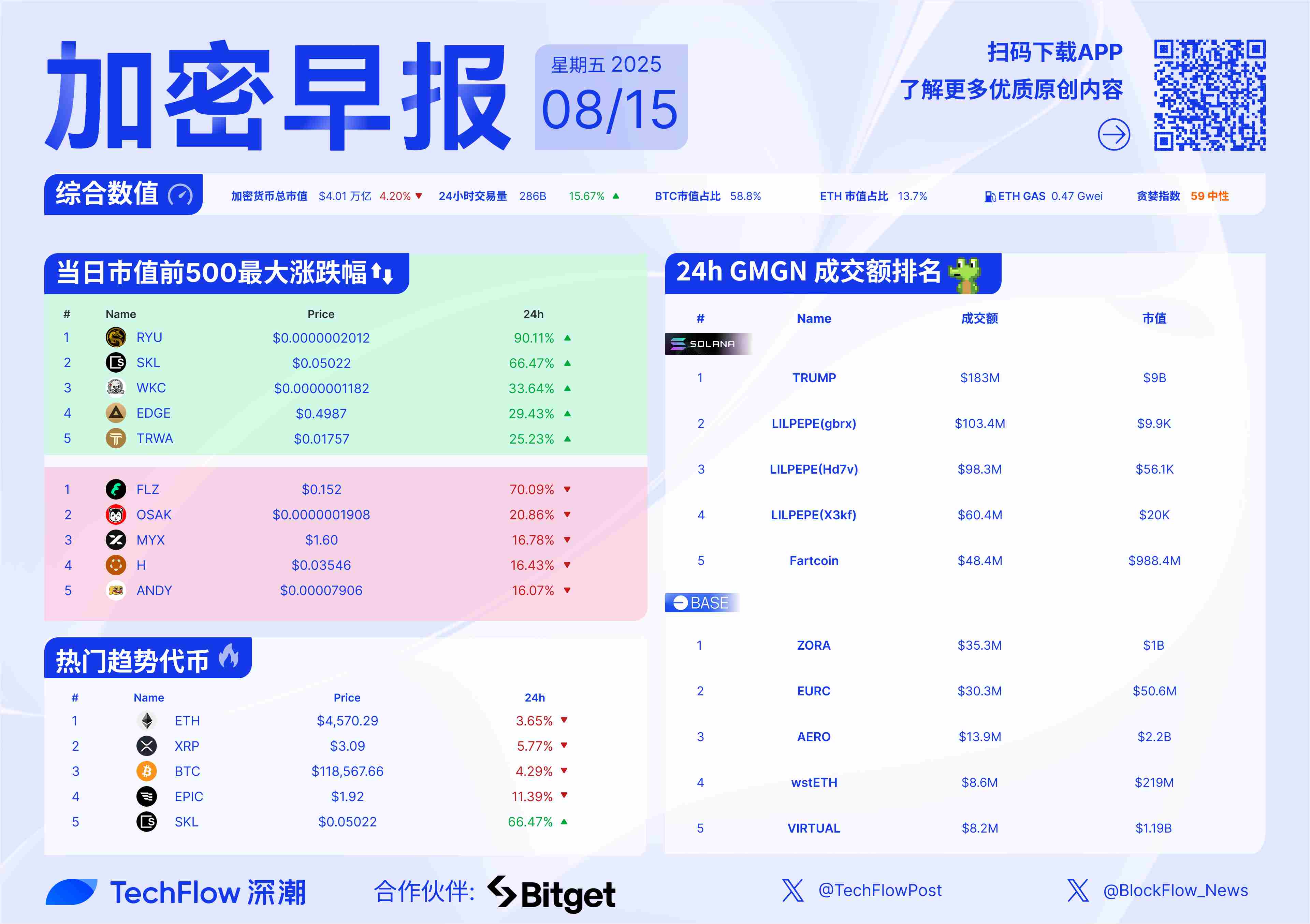
Market Movements
Suggested Reading
When Harvard and Yale Enter: The Crypto Landscape Within Elite Universities
This article explores how top universities are entering the cryptocurrency space through their endowment funds, analyzing their capital, talent, and technological positioning within the crypto industry. It examines early university investments in crypto and their profound impact on industry development, while revealing the "clique culture" formed by alumni networks within the sector.
An SEC Official Stops Pretending
This article recounts how SEC Commissioner Hester Peirce delivered a speech at UC Berkeley openly criticizing the existing financial regulatory framework and advocating for privacy-preserving technologies. Citing the Cypherpunk Manifesto, she emphasized that technology—not law—is better suited to protect privacy, urging governments to respect individual privacy rights. Peirce’s views are more radical than many crypto enthusiasts, showing strong support for decentralized networks and zero-knowledge proofs, while condemning government suppression of privacy-enhancing technologies.
From Printing Money to Building Chains: Circle's 'Central Bank Dream'
This article discusses Circle’s strategic transformation from a stablecoin issuer to a digital central bank role. By launching Arc blockchain—specifically designed for stablecoins—Circle aims to control the entire value chain from currency issuance to financial infrastructure, positioning itself as a leader in the race for digital dollars. The article compares strategic approaches of Circle, PayPal, and Tether in the stablecoin space, analyzing their respective strengths, weaknesses, and future prospects.
Starting with Mystonks: Exposing the 'U.S. Compliance' Marketing Trap of Crypto Platforms
This article discusses the controversy surrounding Mystonks freezing user funds, raising questions about its claimed "compliance." Its actual operations deviate from standard financial institution practices. The platform misleads ordinary investors through information asymmetry, presenting limited private placement registration as full operating licenses. True compliance requires high costs and transparency—vague marketing often masks a lack of real qualifications.
a16z's Latest Insight: Is Traditional E-commerce Dead? AI-Native Platforms Are Redefining 'Shopping'
This article explores how traditional e-commerce models are being replaced by AI-driven intelligent shopping experiences. The rise of AI poses structural challenges to traditional search engines like Google and is reshaping the e-commerce landscape. AI applications across different purchasing behaviors will profoundly change consumer habits and reshape brand marketing logic. In the future, AI-driven business models will accelerate economic digitization, improve market efficiency and price transparency, but may also diminish the joy of shopping.
Join TechFlow official community to stay tuned
Telegram:https://t.me/TechFlowDaily
X (Twitter):https://x.com/TechFlowPost
X (Twitter) EN:https://x.com/BlockFlow_News
 深潮TechFlow