After 10x Surge in Stock Price, Circle's First Financial Report Reveals Highlights and Concerns
TechFlow Selected TechFlow Selected
After 10x Surge in Stock Price, Circle's First Financial Report Reveals Highlights and Concerns
From a single stablecoin issuer to a global digital financial infrastructure provider, this transformation journey is full of uncertainties.
 Navigating Web3 tides with focused insights
By: San, David
Last night, Circle, the issuer of the stablecoin USDC, released its Q2 financial results.
As its first earnings report following its IPO, the data provides the market with crucial insights into assessing the true value of this so-called "first stablecoin stock." By closely analyzing key financial metrics, we can gain a clearer view of Circle's growth momentum and potential challenges.
USDC Expands Strongly, but Revenue Structure Remains Narrow
Based on information disclosed in the earnings report, the following data points deserve close attention.
-
Core Business Metrics: USDC Shows Robust Expansion
First and foremost, the most notable highlight in the report is the dual growth in USDC circulation and market share.
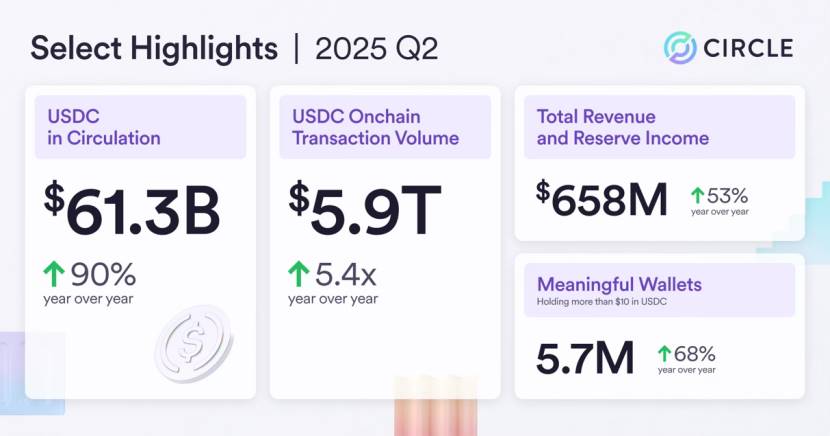
By the end of Q2, USDC’s circulating supply reached $61.3 billion, a 90% year-over-year increase and up 49% since the beginning of the year. As of August 10, this figure had further climbed to $65.2 billion, indicating sustained growth momentum. In terms of stablecoin market share, USDC maintains a solid position at around 28%, reinforcing its status as the second-largest stablecoin.
Secondly, USDC’s on-chain transaction activity has seen explosive growth.
On-chain transaction volume for USDC surged to $5.9 trillion, a staggering 540% year-over-year increase. This explosive growth not only reflects the rapid expansion of USDC’s use cases but also reveals a critical trend: the stablecoin ecosystem is transitioning from mere value storage toward becoming a mainstream payment and settlement tool.
-
Financial Performance: Strong Revenue Growth Amid Structural Imbalance
The report shows total revenue for Q2 reached $658 million, a 53% year-over-year increase, broken down as follows:
-
Reserve interest income: $634 million (96.4% of total), up 50% YoY
-
Subscription and service revenue: $24 million (3.6% of total), up 252% YoY
This revenue structure still highlights Circle’s heavy reliance on reserve interest income. Although subscription and service revenue grew at an impressive 252%, its absolute contribution remains minimal.
Circle’s profitability is highly dependent on high interest rates set by the Federal Reserve. This dependence on a single income stream constitutes its biggest operational risk. Should the Fed enter a rate-cutting cycle, Circle’s profitability would face severe pressure.
Another often overlooked point is that high IPO-related expenses obscured actual operating performance.
At first glance, Circle reported a net loss of $482 million in Q2. While this number appears large, upon adjustment:
Total non-cash IPO-related expenses amounted to $591 million
-
Equity-based compensation: $424 million
-
Convertible note fair value adjustment: $167 million
Adjusted EBITDA (earnings before interest, taxes, depreciation, and amortization) was $126 million, representing a 52% year-over-year increase.
In other words, excluding IPO-related costs, Circle’s underlying operating performance remains solid. The adjusted profit metrics indicate healthy growth in core operations, which explains why the stock price rose rather than fell after the earnings release.
-
Pressure to Cash Out Amid High Valuation
On the same day as the earnings release, Circle also announced a secondary offering of 10 million shares.
Based on the closing price of $163.21, this offering will raise $1.63 billion. Compared to the IPO price of $31, early investors have achieved a return of over 426%, with more than $1 billion cashed out.
Circle CEO Allaire has already sold 357,800 shares but retains 23.9% voting power.
Taken together, the financial data shows that USDC’s network effect is accelerating. However, Circle’s challenges are equally apparent:
Over-reliance on interest rate conditions, rising competition (such as PayPal’s PYUSD), and regulatory uncertainty remain significant hurdles.
The Q2 report offers insight into whether Circle is overvalued, but the final judgment will depend on performance over the coming quarters—particularly how Circle adapts when interest rates change.
Strategic Transformation: Circle’s Path Toward Diversification
The strategic initiatives disclosed in Circle’s Q2 earnings report and subsequent conference call clearly outline its transformation from a stablecoin issuer to a comprehensive financial infrastructure provider.
This may also be a direct response to the issue of narrow revenue streams highlighted in the financial report.
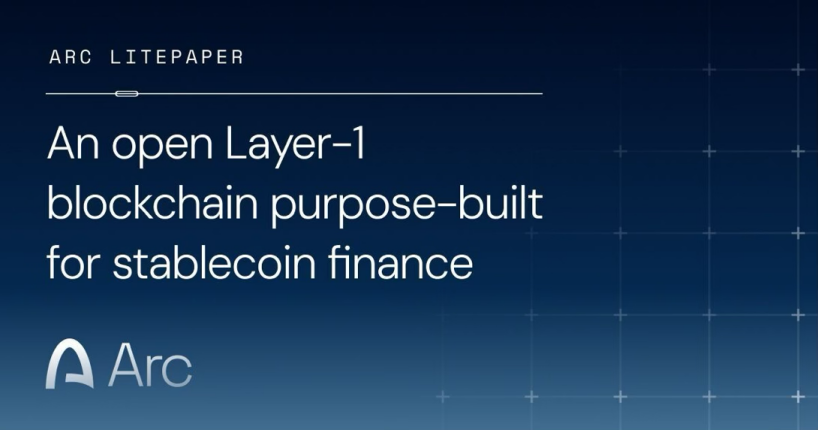
Circle announced it will launch Arc, its proprietary blockchain, in the second half of 2025—a move that quickly became a focal point of market discussion. According to official disclosures, Arc is an open public chain specifically designed for stablecoin finance, with USDC serving as the native gas fee token, targeting applications in payments, foreign exchange, and related areas.
Interestingly, major stablecoin players appear to be converging on the same strategy.
Tether, issuer of USDT, is developing Stable; payment giant Stripe, partnering with top-tier VC Paradigm, has launched Tempo. The race for stablecoin payment chains is now fully underway. Today, OKX announced an upgrade to X Layer, entering this competitive arena as well.
In this race, Circle holds clear advantages: compared to Tether, which faces regulatory scrutiny, Circle enjoys strong compliance advantages, with the Trump administration’s proposed GENIUS Act removing key policy barriers. Compared to Stripe, which has deep payment experience, Circle benefits from USDC’s 24% market share and the resulting network effects, along with the trust of over 1,800 institutional clients.
The deeper business logic behind Arc directly addresses Circle’s greatest weakness—overreliance on interest income.
Currently, 96% of Circle’s revenue comes from U.S. Treasury interest on USDC reserves—a vulnerability that could become fatal in a falling rate environment. By controlling its own blockchain infrastructure, Circle can generate new revenue through on-chain transaction fees and staking services, reduce reliance on third-party blockchains, and cut rising distribution costs.
Besides launching its own public chain Arc, Circle mentioned during the Q2 earnings call plans to deepen partnerships with Binance, FIS, and Corpay.
These include promoting the adoption of Circle’s wallet technology with Binance and using the tokenized money market fund USYC on Binance’s institutional trading products as yield-generating and OTC collateral; integrating Corpay’s global FX platform with USDC to provide 24/7 settlement services for enterprises worldwide; and collaborating with FIS to enable U.S. financial institutions to offer domestic and cross-border USDC payments via FIS’s Money Movement Hub, combining Circle’s blockchain-native infrastructure with FIS’s real-time payment systems to unlock faster, lower-cost, compliant digital dollar transactions.
Beyond these three companies, Circle also referenced cooperation directions with leading exchange OKX and fintech firm Fiserv in the earnings report.
Overall, Circle’s Q2 report paints a picture of a company at a critical juncture of transformation. It is both a leader in the stablecoin space, benefiting from the growth driven by USDC’s network effects, and a fintech firm facing structural challenges, needing to reshape its business model before interest rates decline.
As a standout performer in this year’s stock market, Circle is indeed deserving of its spotlight. Yet beneath the halo of being the “first stablecoin stock,” investors must remain clear-eyed about the challenges ahead. The journey from a single-product stablecoin issuer to a global digital financial infrastructure provider is fraught with uncertainty. Whether Circle can continue the post-IPO miracle of a tenfold stock surge remains to be seen.
Join TechFlow official community to stay tuned
Telegram:https://t.me/TechFlowDaily
X (Twitter):https://x.com/TechFlowPost
X (Twitter) EN:https://x.com/BlockFlow_News
 深潮TechFlow