Ethereum Treasury Company: A "Disruptor" or "Builder" in the On-chain Ecosystem?
TechFlow Selected TechFlow Selected
Ethereum Treasury Company: A "Disruptor" or "Builder" in the On-chain Ecosystem?
Although still in the accumulation phase, higher on-chain participation could increase Ethereum's exposure to corporate funding risks while enhancing its liquidity and security.
 Navigating Web3 tides with focused insights
By: Tanay Ved
Translation: Saoirse, Foresight News
Key Takeaways
-
Digital asset treasuries focused on Ethereum are rapidly expanding, accumulating 2.2 million ETH in just two months—1.8% of total supply—creating supply-demand imbalances.
-
These treasuries pursue active on-chain strategies, planning to stake and deploy capital via DeFi to generate yield while supporting network security and liquidity.
-
While still in the accumulation phase, higher on-chain participation could increase exposure to corporate treasury risks even as it strengthens Ethereum’s liquidity and security.
The Rise of Digital Asset Treasuries
Digital asset treasuries (DATs)—publicly traded companies holding crypto assets like Bitcoin or Ethereum on their balance sheets—have emerged as a new market entry vehicle. The launch of spot ETFs in 2024 unlocked demand from investors previously unable to directly custody BTC and ETH. Similarly, digital asset treasuries offer investors exposure to these assets and their ecosystems through publicly traded equities, with strategic capabilities for fundraising and capital deployment.
We previously analyzed Michael Saylor’s playbook, which raised capital through equity and convertible bond issuances to accumulate over 628,000 bitcoins—2.9% of Bitcoin’s total supply. Companies worldwide have followed suit, from Marathon Digital to Japan’s Metaplanet, offering shareholders amplified or “leveraged” exposure to Bitcoin. Now this model is expanding into other ecosystems, with numerous entities racing to accumulate ETH within corporate treasuries.
While the goal of increasing shareholder exposure to underlying assets remains unchanged, Ethereum treasuries differ fundamentally from Bitcoin treasuries: they can leverage Ethereum’s staking and DeFi ecosystems. This opens opportunities to enhance returns through native yield generation and efficient on-chain capital allocation. In this article, we analyze how Ethereum treasuries impact the dynamic supply of ETH and explore the potential implications of large institutions becoming active participants on-chain.
Supply Dynamics: A Race for 5% of Supply
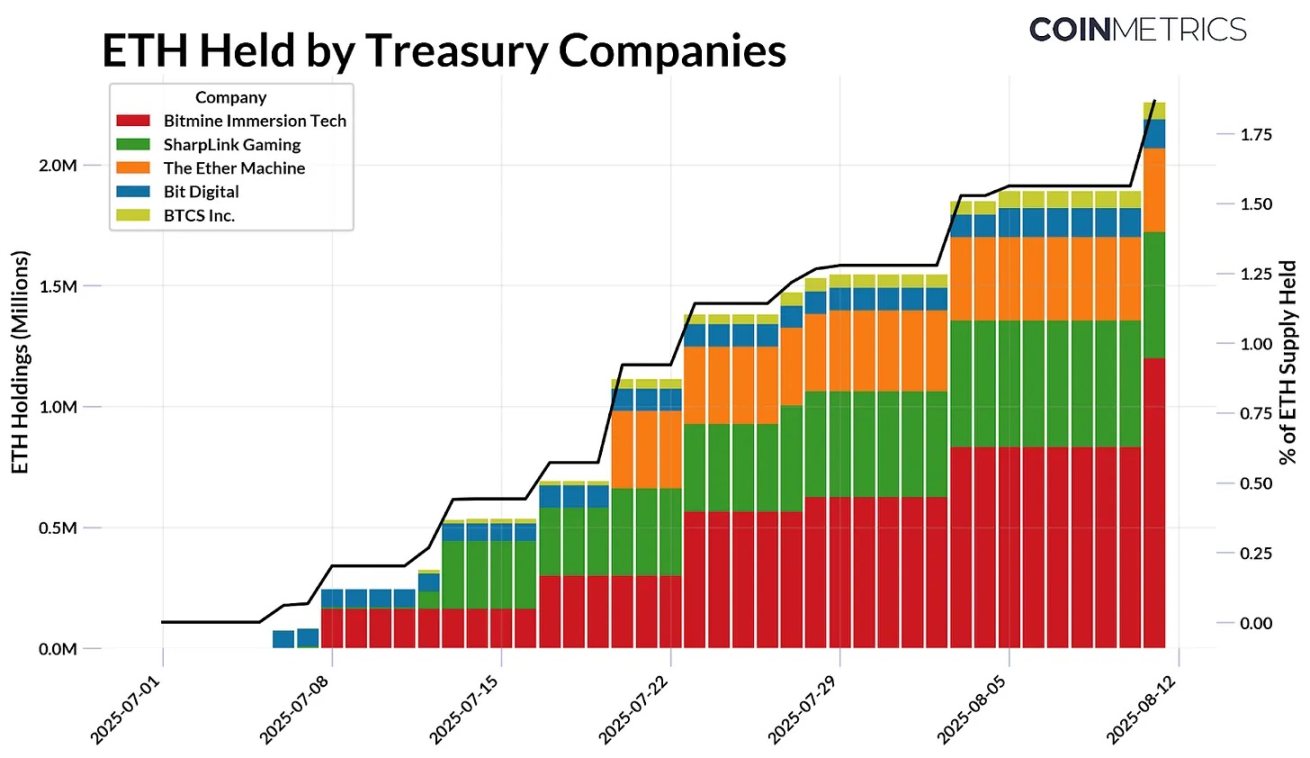
Since July this year, Ethereum-focused digital asset treasuries have collectively accumulated 2.2 million ETH—nearly 1.8% of ETH’s current total supply. There are currently five major players in this space, raising capital through equity financing methods such as public offerings or private investments in public equity (PIPE) to allocate capital and increase holdings. As of August 11, their holdings stand at:
-
Bitmine Immersion Technologies: 1.15 million ETH, worth approximately $4.8 billion
-
SharpLink Gaming: 521,000 ETH, worth approximately $2.2 billion
-
The Ether Machine: 345,000 ETH, worth approximately $1.4 billion
-
Bit Digital: 120,000 ETH, worth approximately $503 million
-
BTCS Inc.: 70,000 ETH, worth approximately $293 million
Bitmine Immersion Technologies is currently the largest corporate holder of ETH, owning 0.95% of total ETH supply, and is rapidly advancing toward its stated goal of accumulating 5% of ETH’s circulating supply. As market conditions shift, these companies are able to build reserves on favorable cost bases, intensifying competition for larger shares of ETH.
Source: Coin Metrics Network Data Pro and public filings (as of August 11, 2025)
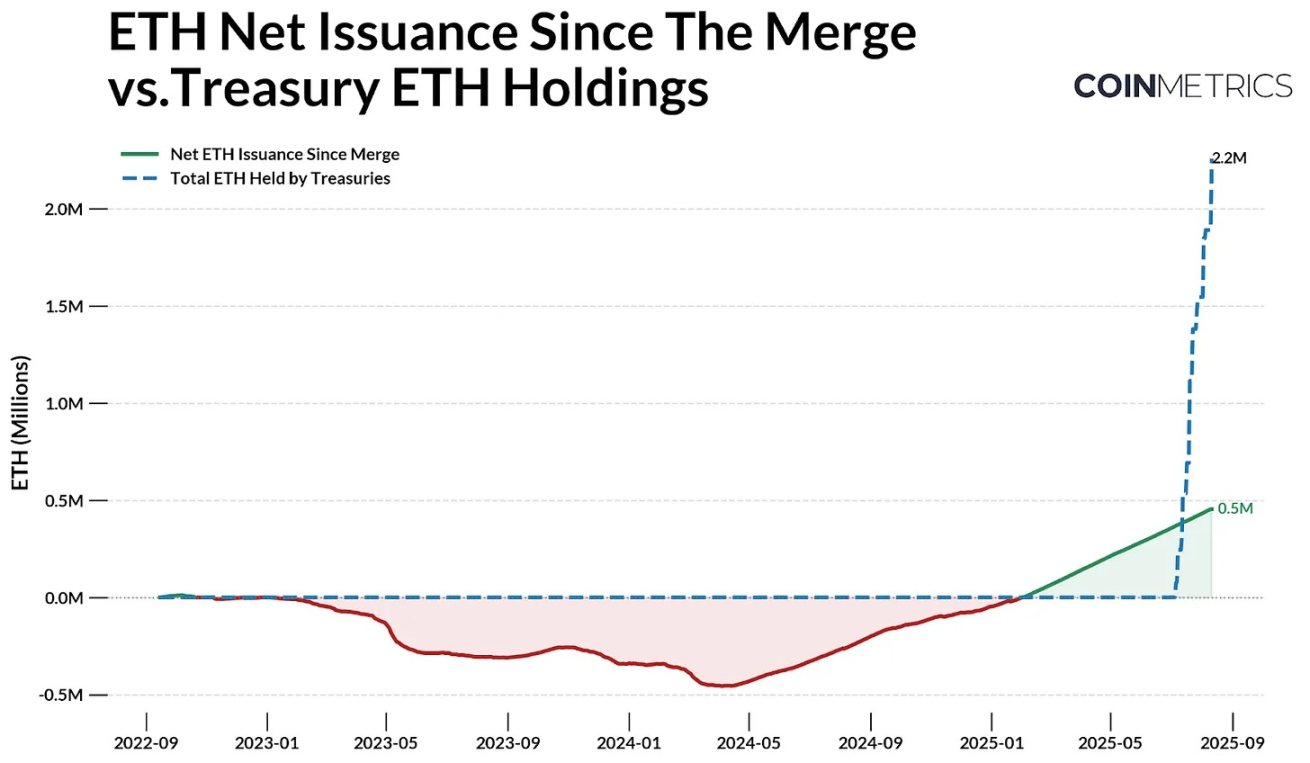
This trend becomes even more significant when viewed alongside Ethereum’s issuance dynamics. Ethereum’s supply is governed by its PoS mechanism: newly issued ETH goes to validators, while some transaction fees are burned, resulting in net issuance that can fluctuate between negative (deflationary) and positive (inflationary).
Since “The Merge” in September 2022, Ethereum has issued 2.44 million ETH and burned 1.98 million ETH, resulting in a net issuance of 454,300 ETH. Since July this year alone, corporate treasury entities have accumulated 2.2 million ETH—far exceeding net new issuance over the same period. While Bitcoin’s fixed supply cap and halving schedule directly reduce new issuance, Ethereum’s supply is dynamic and currently inflationary. Given that Ethereum’s market capitalization is about one-fourth that of Bitcoin, the scale and speed of recent demand are particularly noteworthy.
Source: Coin Metrics Network Data Pro and public filings
The supply-demand imbalance is further accentuated by growing inflows into Ethereum ETFs in recent months. Overall, beyond the 29% of ETH staked at the consensus layer and the 8.9% held in other smart contracts, these instruments continue absorbing ETH’s free-floating supply of 107.2 million coins (market-available supply). Consequently, sustained accumulation by treasuries and ETFs may amplify price sensitivity to new demand.
Ecosystem Impact: Staking, DeFi, and On-Chain Activity
Although most ETH treasuries remain in the accumulation phase, portions of their holdings may eventually move on-chain. Unlike Bitcoin treasuries, which tend to be relatively passive, these companies plan to use Ethereum’s staking and DeFi infrastructure to improve risk-adjusted returns and efficiently utilize their assets. This shift is already underway: SharpLink Gaming has staked most of its holdings, BTCS Inc. earns yield via Rocket Pool, and other firms like The Ether Machine and ETHZilla are preparing for more active on-chain management.
Source: Coin Metrics Network Data Pro
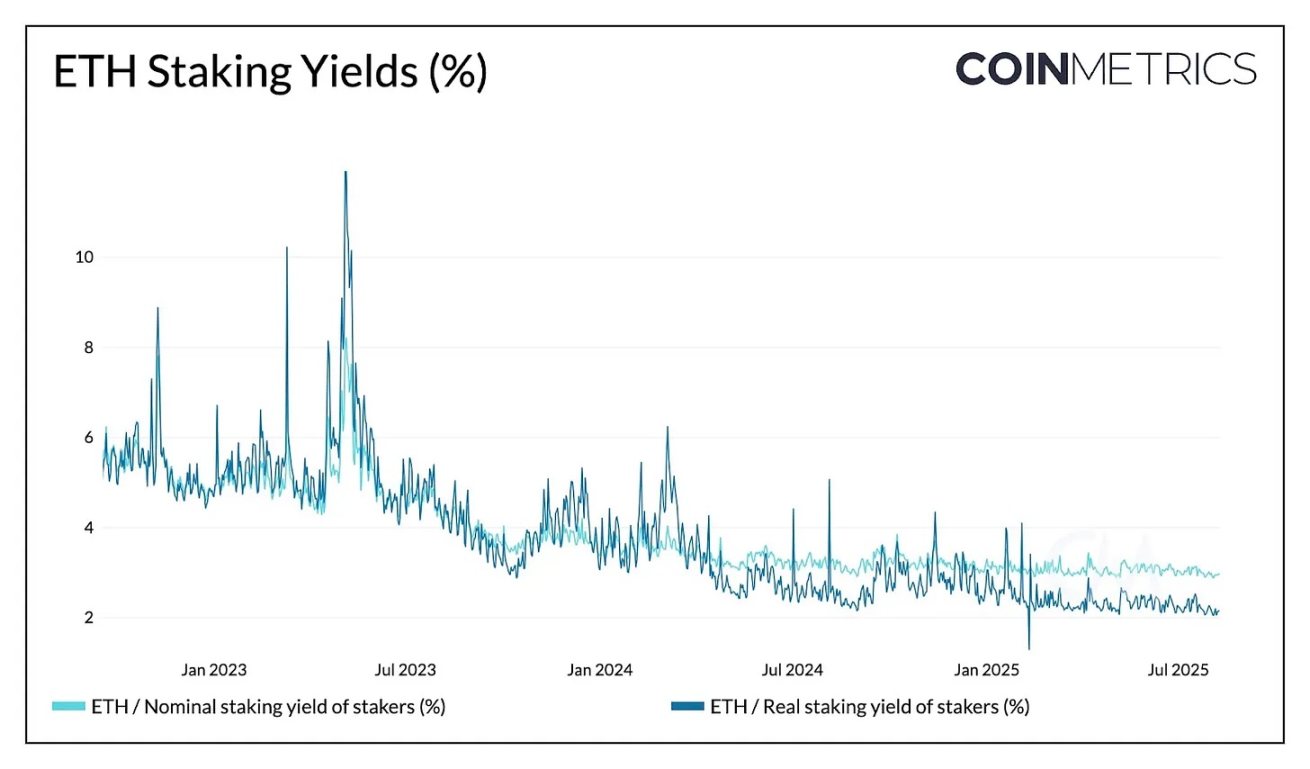
Currently, Ethereum offers a nominal yield of 2.95% and a real (inflation-adjusted) yield of 2.15% through staking rewards that support network security. This provides treasury companies not only with potential price appreciation but also a steady income stream. For example, if 30% of the current 2.2 million ETH held by treasuries were staked at today’s ~3% nominal yield and ETH is priced at $4,000, this would generate approximately $79 million in annual revenue. Although large inflows into staking could pressure yields downward, the impact is moderate due to Ethereum’s gradually declining reward rate as total staked ETH increases.
Corporate treasuries participate primarily in two ways: by running their own validator nodes or using liquid staking protocols. The U.S. SEC has clarified that liquid staking protocols are not considered securities, allowing companies to stake via third parties like Lido, Coinbase, or RocketPool and receive “liquid” tokenized receipts in return.
Source: Coin Metrics ATLAS
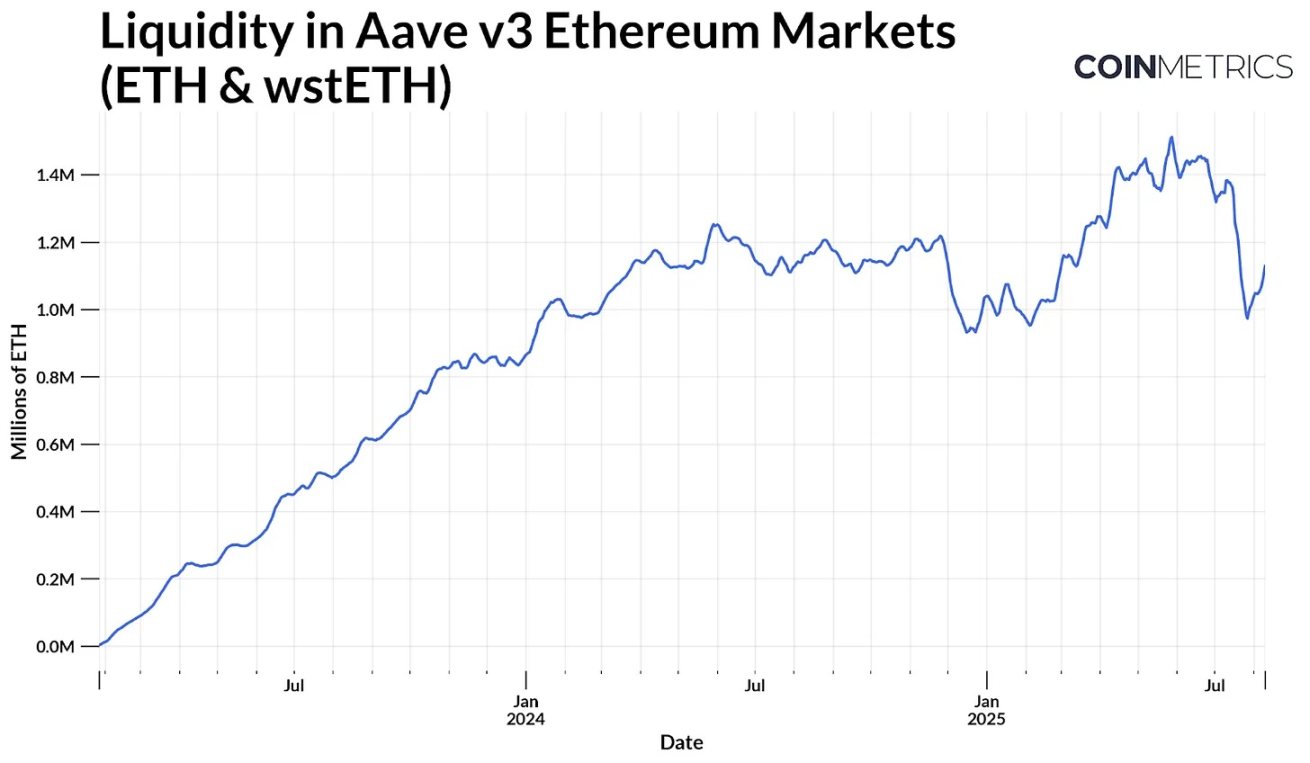
Despite additional risks, tokens like Lido’s stETH are widely used in DeFi for staking-backed lending or to earn incremental yield on top of base staking APR through capital-efficient strategies. For instance, on Aave v3, ETH and liquid staking tokens such as stETH form large pools of available liquidity (supplied assets available for borrowing). This pool has grown to around 1.1 million ETH, and the addition of treasury funds could further expand it, enhancing both yield and market liquidity.
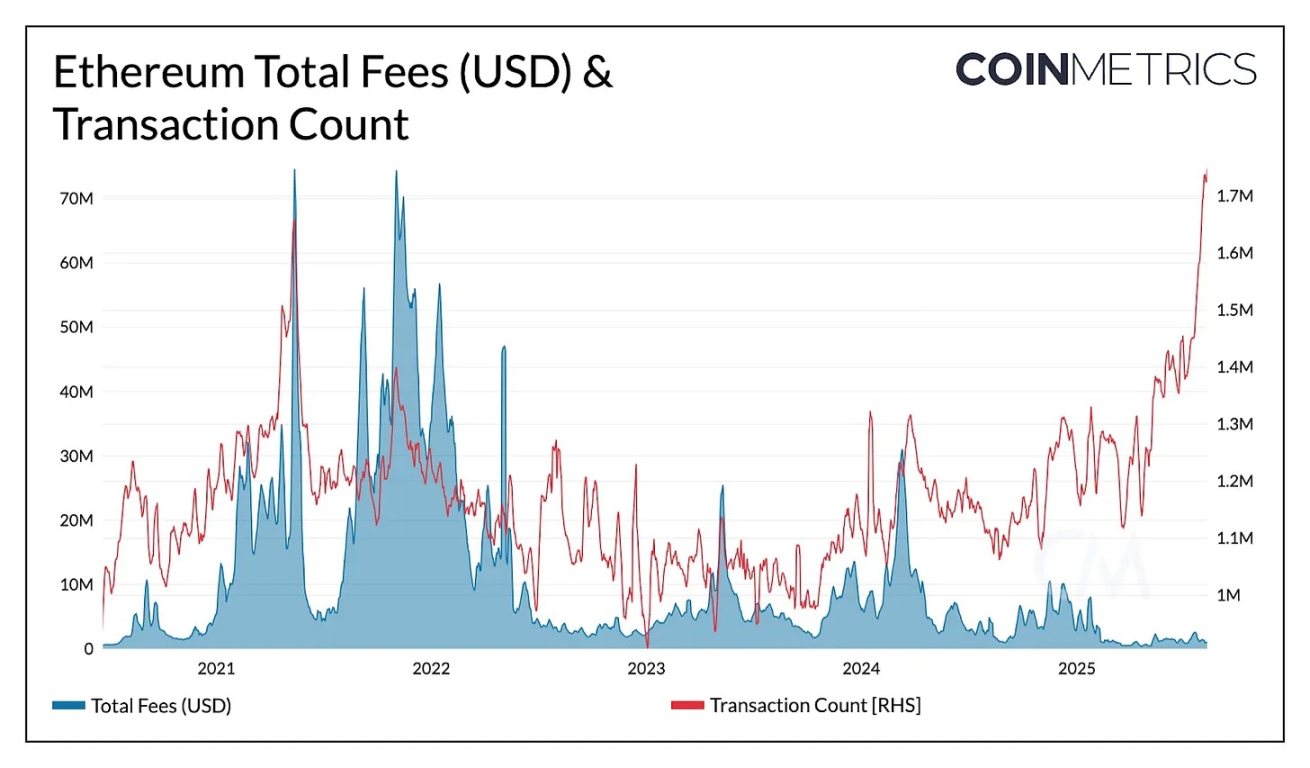
Source: Coin Metrics Network Data Pro
Although Ethereum mainnet transaction volume has now surpassed historical records (1.7–1.9 million daily), overall fees remain near multi-year lows due to recent gas limit increases and block capacity expansions that have alleviated congestion and shifted some activity to L2s. If treasury capital flows onto the chain at scale, high-value transactions on Ethereum L1 could drive growth in total block space demand and fee revenue, potentially creating a positive feedback loop between treasury activity, liquidity, and on-chain usage.
Linking Corporate Treasury Performance to On-Chain Health
As publicly listed Ethereum treasury companies expand their on-chain footprint, their financial performance increasingly influences the long-term health of the Ethereum network, linking off-chain corporate results to potential on-chain impacts. Large-scale, long-term holding can reduce circulating supply, boost credibility, and increase on-chain liquidity—but centralization, leverage, and operational risks mean that issues at the corporate level could spill over to the network.
Impact of Large ETH Treasury Holdings on the Chain
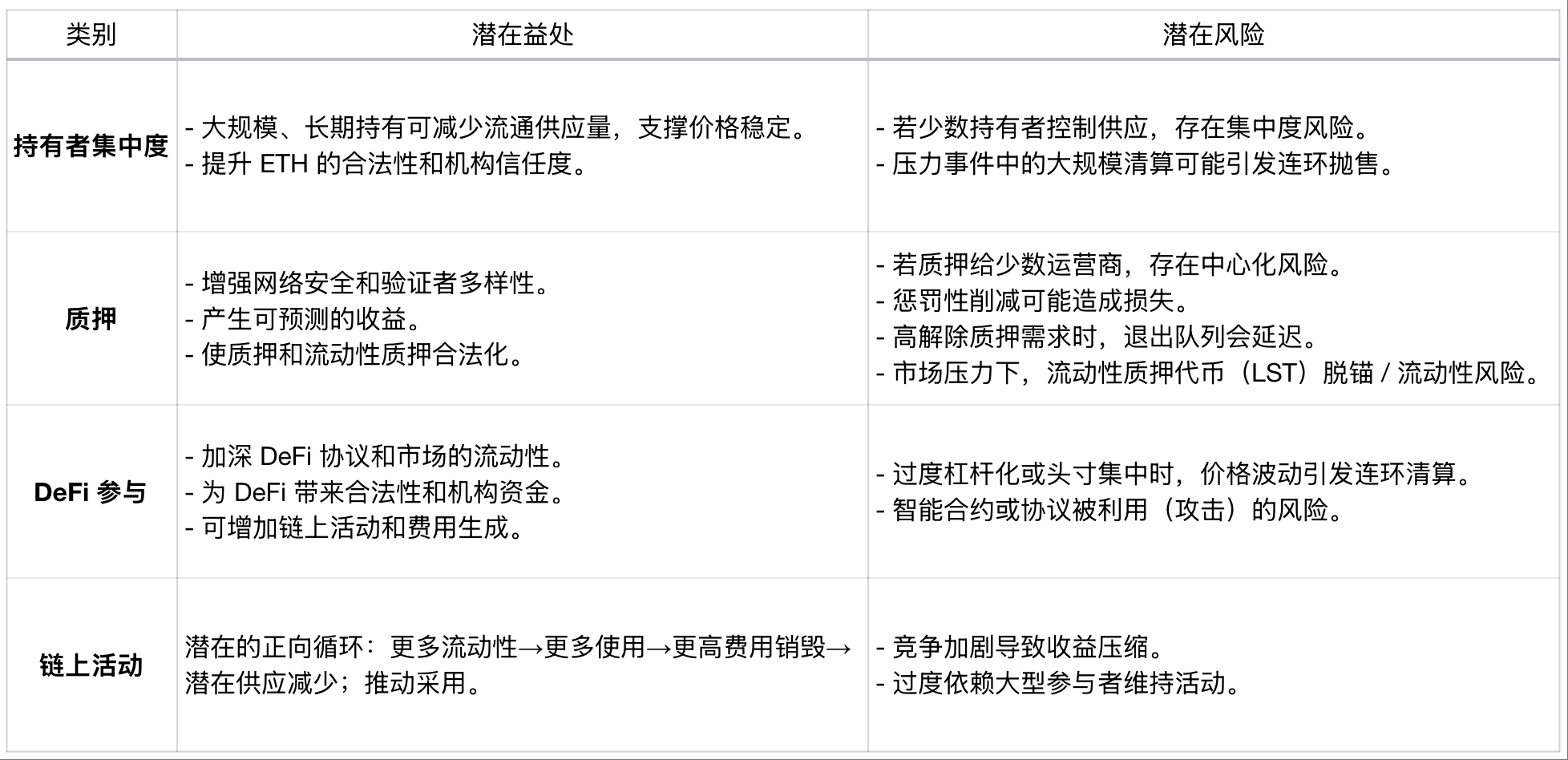
While these are network-level considerations, the treasuries themselves are also subject to market forces and investor sentiment. Strong balance sheets and sustained investor confidence enable treasuries to grow holdings and deepen participation. Conversely, sharp declines in underlying asset prices, tightening liquidity, or excessive leverage could trigger ETH sell-offs or reduced on-chain activity.
Metrics Related to Treasury Company Performance
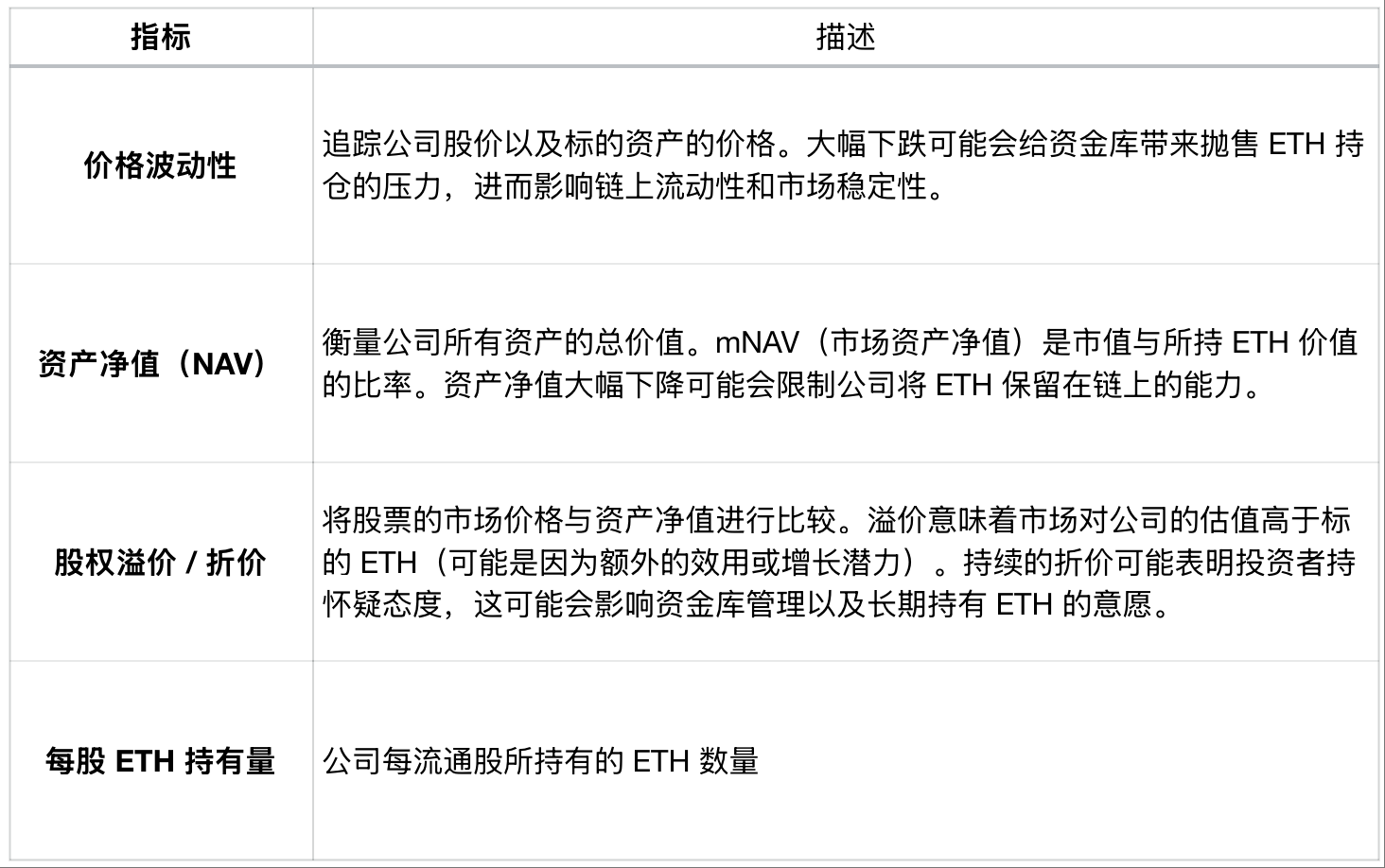
Price volatility tracks both company stock prices and underlying asset prices. Sharp declines may pressure treasuries to sell ETH holdings, affecting on-chain liquidity and market stability. Net asset value (NAV) measures the total value of all company assets. mNAV (market-to-asset value) is the ratio of market capitalization to the value of ETH holdings. A significant drop in NAV may limit a company’s ability to keep ETH on-chain. Equity premium/discount compares a stock’s market price to its NAV. A premium means the market values the company above its underlying ETH (possibly due to added utility or growth potential). Persistent discounts may signal investor skepticism, potentially affecting treasury management and willingness to hold ETH long-term. ETH per share measures the amount of ETH held per outstanding share.
By monitoring both network-level impacts and the financial health of these companies, market participants can better anticipate how corporate treasury behavior might affect Ethereum’s supply dynamics and overall network health.
Conclusion
The rapid rise of corporate Ethereum treasuries highlights Ethereum’s appeal as both a reserve asset and a source of on-chain yield. Their growing influence may boost liquidity and network activity, but also introduces risks related to leverage, financing, and capital management. As off-chain factors—such as stock performance and debt obligations—become more tightly linked to on-chain activity, their effects could quickly ripple through the network. As these institutions scale, tracking their balance sheet health and on-chain engagement will be key to understanding their broader impact.
Join TechFlow official community to stay tuned
Telegram:https://t.me/TechFlowDaily
X (Twitter):https://x.com/TechFlowPost
X (Twitter) EN:https://x.com/BlockFlow_News
 @coinmetrics