Ethereum targeting 10,000 TPS? How to crack the "impossible trinity" with ZK technology
TechFlow Selected TechFlow Selected
Ethereum targeting 10,000 TPS? How to crack the "impossible trinity" with ZK technology
A $7 Raspberry Pi can verify ZK proofs, and zkEVM could boost Ethereum's mainnet TPS by 100x in the next 6 years.
 Navigating Web3 tides with focused insights
Author: Andrew Fenton
Translation: imToken
Editor's Note: Ethereum is moving toward a new era of scaling to 10,000 TPS, with zero-knowledge (ZK) technology emerging as a key driver. This article is the first in our series "Ethereum's 10,000 TPS Roadmap," breaking down ZK technology, the zkEVM roadmap, and Ethereum L1 scaling plans in accessible terms. The next piece will delve into the challenges of ZK adoption, L2 ecosystem evolution, and its future impact on Ethereum's economic structure.
On July 30, 2025, Ethereum celebrated the 10th anniversary of its genesis block, and after a decade of exploration, Ethereum’s scaling roadmap is now charting new directions and ambitions.
Certainly, the recent rise in ETH price has renewed confidence in the community, but what’s truly exciting is that after years of focusing on L2 scaling, Ethereum L1 now has a credible path to extreme scalability while preserving maximum decentralization.
In short, from now on, Ethereum's gas limit and TPS are planned to increase several-fold each year. Validators will no longer re-execute every transaction (editor's note: i.e., they won't need to recalculate the state changes from scratch), but instead will only verify a zero-knowledge proof (ZK-proof) to confirm that a batch of transactions was correctly executed, enabling the base layer network to achieve over 10,000 TPS.
At the same time, L2s will also scale in parallel, reaching tens or even hundreds of millions of TPS, with a new type of L2 called "Native Rollup" operating like programmable shards, offering the same security as L1.
While these proposals have not yet been formally approved through Ethereum’s governance process, they build on ideas explored by Vitalik Buterin since 2017 and are actively championed by Ethereum Foundation core researcher Justin Drake.
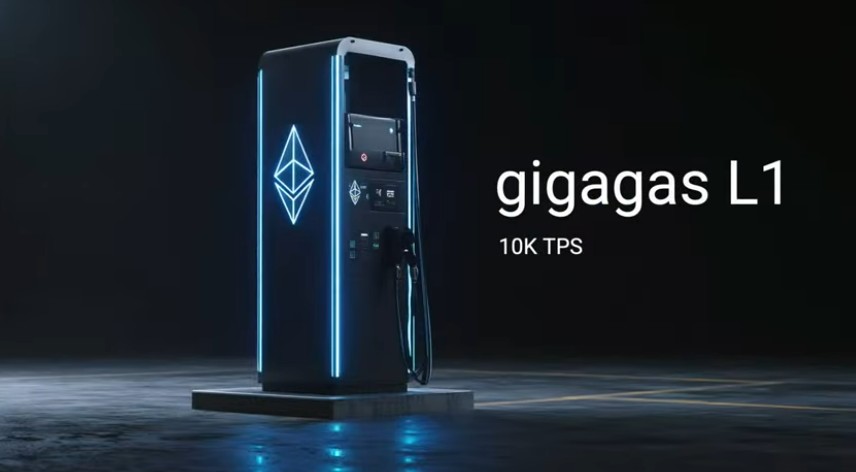
At July’s EthCC conference, Drake said: “We are at a pivotal turning point in Ethereum scaling. I firmly believe we’re entering the L1 GigaGas era—around 10,000 TPS—and the key to unlocking this era is zkEVM and real-time proving.”
Drake’s ultimate goal is to enable the Ethereum ecosystem to reach 10 million TPS within ten years. However, this means no single blockchain can meet such throughput demands. The future will inevitably be a “network of networks” architecture: different L2s handling distinct use cases, trade-offs, and advantages, collectively expanding the ecosystem to meet global needs.
Why Hasn’t Ethereum L1 Been Able to Scale Significantly Until Now?
While other blockchains have long experimented with more powerful hardware and computing capacity to boost throughput, Ethereum has maintained an almost ideological, some might say “utopian,” commitment to decentralization.
From the perspective of ETH maximalists, “data center chains” like Solana have centralized points of failure worth millions of dollars, making them vulnerable to government-led transaction censorship. Even chains like Sui, which require less demanding hardware, still impose prohibitive costs and bandwidth requirements, undermining decentralization.
In contrast, Ethereum can run on a Raspberry Pi. This low barrier to entry allows over 15,000–16,000 public nodes and millions of validators to participate, making transaction censorship nearly impossible and giving the network exceptional resilience against attacks.
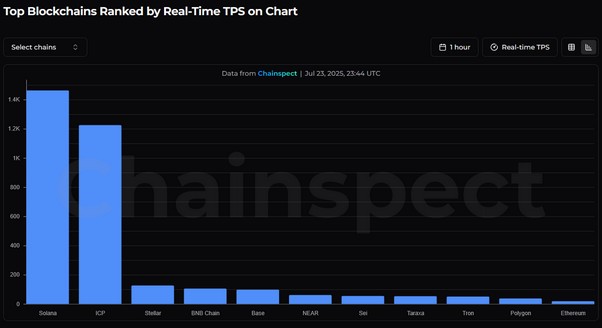
Of course, the cost is extremely slow speed—current TPS is around 18–20 transactions per second, compared to Solana’s ~1,500 TPS.
In a sense, blockchain architecture is inherently inefficient, somewhat like a Google Sheet where every time you edit a cell, every computer worldwide holding a copy must recompute the entire sheet before confirming and updating the change.
Uma Roy, co-founder of ZK tech company Succinct Labs, explains: “Ethereum was designed so that anyone can keep up with the network and re-execute all transactions,” meaning transaction volume cannot be arbitrarily expanded, as each transaction requires recomputation by participants.
Because mainnet scaling space is limited under the constraint of maintaining decentralization, Ethereum had to adopt the controversial L2 layered scaling approach starting in 2020.
How Does ZK Break the Blockchain Trilemma?
Ethereum founder Vitalik Buterin introduced the concept of the “blockchain trilemma,” describing the difficulty public blockchains face in achieving security, scalability, and decentralization simultaneously.
Almost all scaling solutions could previously satisfy only two of the three, necessarily sacrificing the third.
Until now.
Zero-knowledge proofs (ZK-Proofs)—a technology described by Drake as “moon math”—can mathematically prove that a large set of complex transactions has been correctly executed, without revealing any transaction details.
Generating a ZK proof is highly complex, but verifying whether a proof is correct is fast and lightweight.
Therefore, Ethereum’s future vision is: instead of requiring thousands of low-power Raspberry Pi nodes to recompute every transaction, validators only need to check the mathematical result of a tiny ZK proof.
Succinct Labs co-founder Uma Roy further explains, “Instead of having everyone re-execute all transactions, just give them a proof saying these operations have already occurred. Anyone can verify the proof without redoing the computation.”
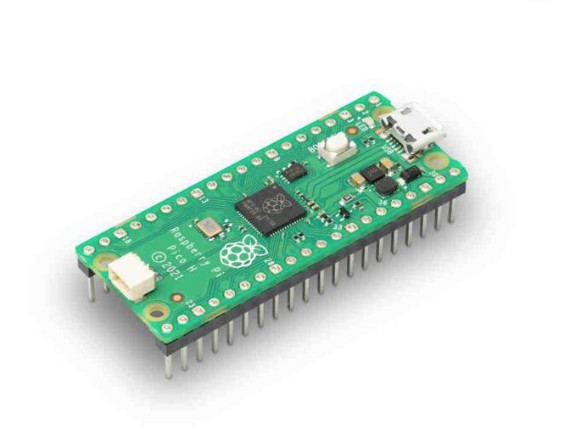
Drake even joked that the computational load for verifying ZK proofs in the future will be so small that even a $7 Raspberry Pi Pico—less than one-tenth the power of a regular Raspberry Pi—could handle it, eliminating the need for large data centers.
zkEVM: The Roadmap to 10,000 TPS
A recent blog post by Sophia Gold of the Ethereum Foundation sparked community discussion: within the next year, the L1 mainnet may integrate a zero-knowledge proof-powered Ethereum Virtual Machine (zkEVM).
Notably, much of the practical exploration of ZK technology began on L2 networks. For example, Linea, a ZK Rollup public chain incubated by Consensys under Ethereum co-founder Joe Lubin, is 100% EVM-compatible—any application running on Ethereum can operate seamlessly on Linea.
Linea even sees itself as an extension of Ethereum and recently announced it will burn 20% of ETH transaction fees to support value accrual back to L1.
Linea lead Declan Fox explains that ZK technology provides a solution to the blockchain trilemma: “The magic of ZK is that we can significantly raise the L1 gas limit, and scaling computation doesn’t make verification more complex.”
He adds that as ZK proof generation latency and cost continue to fall, we can handle higher throughput while keeping hardware requirements for verification extremely low—even a smartwatch could perform verification.
However, the community shouldn’t be overly optimistic—even if zkEVM is successfully integrated into L1 within the next year, it won’t instantly achieve 10,000 TPS on day one.
One Step at a Time, Then Suddenly It’s Done
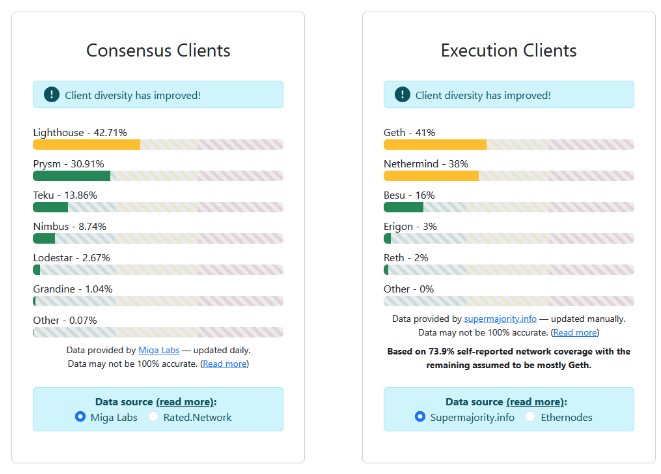
Ethereum currently has five major software clients for running the network, meaning the network won’t halt entirely due to a single client failure, unlike Solana.
In future upgrades, Ethereum plans to release two or three modified clients supporting ZK verification, allowing validators to choose to validate by checking zero-knowledge proofs (ZK-proofs) instead of re-executing every transaction.
Initially, only a small number of validators will switch to the new validation mode to help identify and fix potential issues early.
Ladislaus of the Ethereum Foundation’s protocol coordination team stated, “Transitioning to a snarkified EVM will be a gradual process”—where “snarkified” refers to using SNARK-type zero-knowledge proofs.
Users will primarily notice a rising L1 gas limit, indicating increased network economic capacity. While the transition of L1 to ZK verification will take time, the expansion of the gas limit is essentially inevitable.
Last week, the L1 gas limit was raised by 22% to 45 million. Researcher Dankrad Feist proposed an EIP suggesting clients automatically increase the gas limit three times per year. Under this plan, Ethereum mainnet could achieve approximately 2,000 TPS within four years.
Justin Drake has even suggested extending this pace by two more years, reaching 1 gigagas throughput by 2031 and achieving around 10,000 TPS.
Join TechFlow official community to stay tuned
Telegram:https://t.me/TechFlowDaily
X (Twitter):https://x.com/TechFlowPost
X (Twitter) EN:https://x.com/BlockFlow_News
 @Cointelegraph