Pantera Capital Partner: Our Decade-Long Journey with Ethereum and Future Strategy
TechFlow Selected TechFlow Selected
Pantera Capital Partner: Our Decade-Long Journey with Ethereum and Future Strategy
Entering its second decade, Ethereum is establishing itself as the foundational layer for stablecoins, DeFi, and tokenized assets.
 Navigating Web3 tides with focused insights
Author: Paul Veradittakit
Compiled by: TechFlow
Key Takeaways
In its second decade, Ethereum is establishing itself as the foundational layer for stablecoins, DeFi, and tokenized assets.
Digital Asset Treasuries (DATs) are reducing ETH circulating supply and driving institutional demand, creating structural price support.
With regulatory clarity and reforms at the Ethereum Foundation, Ethereum is poised to become core infrastructure for on-chain capital markets, enabling long-term growth.
The Origins of Ethereum's Vision
Prior to creating Ethereum, Vitalik Buterin was an early Bitcoin advocate and worked at Bitcoin Magazine. There, he realized Bitcoin lacked scripting capabilities necessary for application development. He then proposed a bold vision: building Ethereum with a general-purpose scripting language, designed as a computer running on a decentralized, permissionless network. This idea was highly unconventional at the time and drew skepticism—after all, it was just a young man without backing from a major company attempting to create an entirely new technological system.
What shifted many early investors' perspectives was the growing number of applications choosing to build on Ethereum rather than on Bitcoin or its Layer 2s, signaling Ethereum’s superior suitability for app development. One of the first "killer apps" validating this view was Augur—a decentralized prediction market. Augur demonstrated Ethereum’s powerful potential: supporting robust applications based on transparency, automation, and financial logic, while allowing developers to issue tokens, coordinate governance, and raise funds natively—directly fueling the ICO (Initial Coin Offering) boom.
Ethereum's Decade
Ethereum celebrates its 10th anniversary in a long-anticipated moment of triumph.
Since its 2015 launch, Ethereum pioneered programmable smart contracts, gathered a strong developer community, and laid the foundation for DeFi, gaming, and NFTs. Over the past decade, this ecosystem has continuously innovated, hosting the majority of DeFi protocols and becoming the cornerstone of stablecoins. As stablecoin infrastructure matures, the GENIUS Act has brought regulatory clarity while introducing royalty revenue streams to Ethereum and boosting demand.
Although stablecoins like USDC and USDT exist across multiple blockchains, Ethereum remains the dominant platform for stablecoin activity, accounting for nearly 50% of global stablecoin market capitalization. Ethereum’s robust ecosystem continues to drive price appreciation through stablecoin adoption and innovative scaling solutions, further accelerated by strategic investments from Pantera Capital.
Pantera’s Investments in the Ethereum Ecosystem
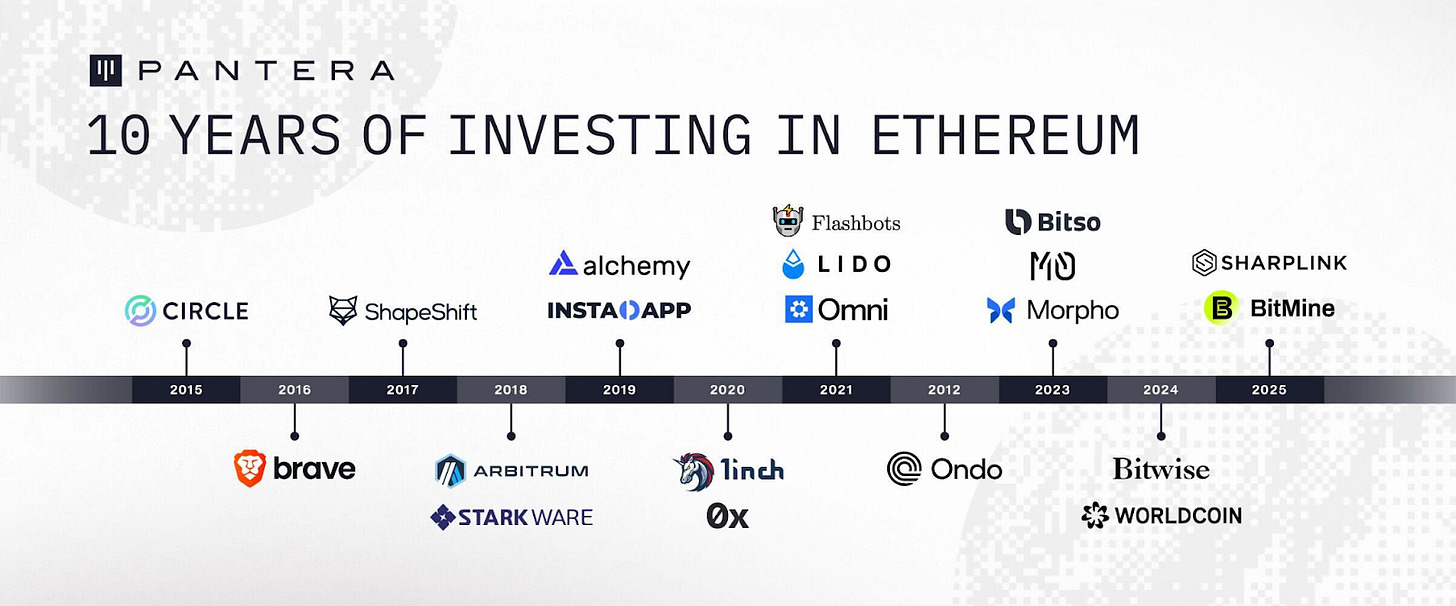
Over the past decade, Pantera Capital has consistently invested in the Ethereum ecosystem, backing transformative projects and founders closely aligned with Ethereum’s growth. Key investments include:
-
Circle: The force behind USDC, a stablecoin with over $60 billion in market cap, driving widespread adoption of Ethereum in DeFi and payments.
-
Arbitrum: A leading Layer 2 solution that captured 100% of Ethereum’s new transaction growth in 2023, offering 40x faster transactions and 20x lower costs, processing over 1.89 billion transactions and facilitating more than $545 billion in DEX trading volume—showcasing Ethereum’s scalability.
-
Ondo: A standout in the multi-billion-dollar tokenized asset management market, launching USDY in 2023 to connect real-world assets like U.S. Treasuries with on-chain finance, reinforcing Ethereum’s role as core infrastructure.
-
Morpho: Optimizing lending on Ethereum, reaching nearly $1 billion in deposits within a year—one of the fastest DeFi protocols to achieve this milestone.
-
Bitwise: Received early funding from Pantera for its spot Ethereum ETF, one of the first approved, attracting institutional capital. By 2025, Bitwise managed over $4 billion in assets, leveraging the Ethereum blockchain for DeFi and tokenized asset strategies.
-
BitMine and other enterprises: Together with companies like Bit Digital, added over 840,000 ETH to corporate treasuries, demonstrating Ethereum’s value as a reserve asset.
Through strategic investments, Pantera Capital strengthens Ethereum’s central role in on-chain finance, scaling solutions, and real-world asset connectivity, supporting continuous innovation and growth in the ecosystem.
Institutional Demand, Digital Asset Treasuries, and Shifting Ethereum Supply Dynamics
Ethereum surged 53% in July—not due to hype, but driven by structural forces: institutional momentum in ETFs and Digital Asset Treasuries (DATs), transformation at the Ethereum Foundation, and recent regulatory clarity.
Institutional interest in crypto is focused on ETFs and DATs. Last week, spot ETH ETFs in the U.S. attracted $1.8 billion in inflows, while DATs have begun accumulating ETH at scale. SharpLink (SBET) increased its reserves to 361,000 ETH, and BitMine surpassed $2 billion in ETH holdings in just 16 days. As Tom Lee of MicroStrategy and Pantera’s Cosmo Jiang noted in a recent call, these asset managers enjoy built-in advantages: low-cost capital, equity premiums, staking yields, M&A arbitrage, and operating income—allowing each share issuance to increase per-share ETH ownership. This unique structure continuously reduces Ethereum’s circulating supply, providing price support beyond simple demand.
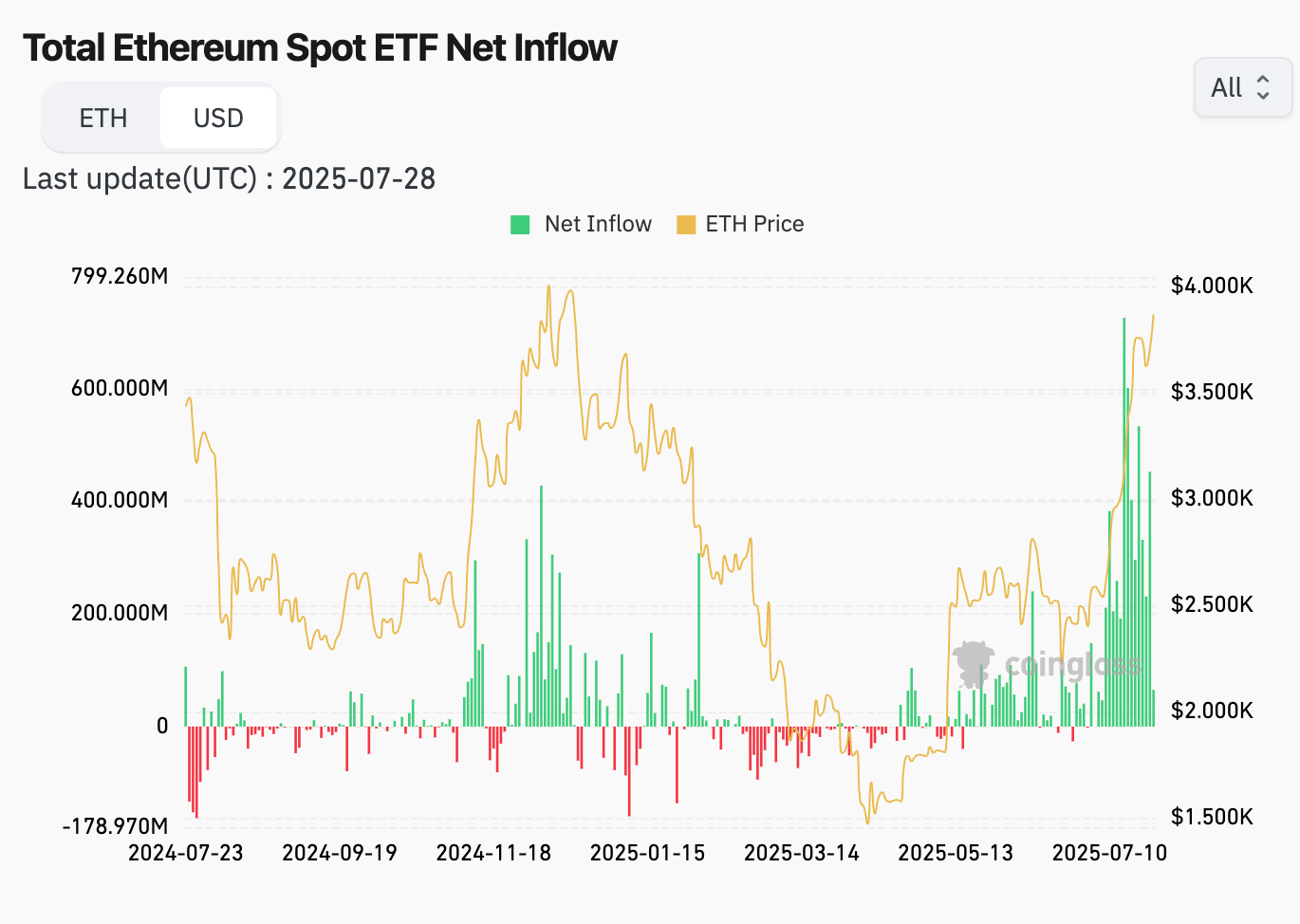
Source: https://www.coinglass.com/eth-etf
DATs are no longer just a novelty in the crypto-native space—they’re becoming entry points for institutional investors to gain exposure to crypto and Ethereum before buying spot or engaging in on-chain trading. As I discussed in my earlier blog post “Blockchain Going Public: The Convergence of Public Markets and Digital Assets”, these vehicles concentrate massive buying power, often absorbing more ETH than newly issued supply, increasing scarcity, and triggering broader capital rotation into other altcoins.
Regulatory Clarity and the Ethereum Foundation’s Strategic Shift
Improving regulatory conditions are turning former headwinds into tailwinds. In July, the GENIUS Act granted federally chartered status to regulated payment stablecoins. Stablecoins have quietly become crypto’s killer application, with over $250 billion in circulation, and Ethereum settles about half of all tokenized dollar transfers globally.
Meanwhile, the Ethereum Foundation’s (EF) new leadership and accelerated development pace are driving rapid chain iteration. This transformation includes leadership restructuring, reorganization of protocol teams, strict treasury policies, and an accelerated technical roadmap to address community concerns around efficiency, transparency, and competitiveness. By focusing on Layer 1 scaling, Blobspace (data storage), user experience (UX) optimization, and DeFi integration, EF aims to solidify Ethereum’s dominance in institutional adoption (e.g., Robinhood’s stock tokens on Arbitrum) and blockchain competition (e.g., against Solana). Despite ongoing challenges such as talent retention and managing community expectations, EF’s strategic shift lays the groundwork for Ethereum to seize opportunities in the migration of capital markets on-chain—highlighted by innovations like Robinhood Chain and Pantera’s ecosystem investments.
Final Thoughts
Stablecoins have finally locked onto a reliable trajectory, reinforced by regulatory clarity from legislation like the GENIUS Act, boosting their demand. Digital Asset Treasuries are the engine behind this demand. They absorb circulating supply, push prices higher, and offer institutions a turnkey solution for holding digital assets. In today’s market, which increasingly values structural yield, tokens with deflationary pressure and ties to real cash flows will become ideal underlying assets for DATs. This trend will further drive Ethereum’s price appreciation and surge demand for the Ethereum blockchain itself.
We are at a pivotal moment of major infrastructure transformation—one that doesn’t require silver bullets, but a series of solutions addressing complex, interlocking challenges. At Pantera Capital, we remain committed to investing in solutions that empower the next phase of on-chain capital markets, simplify financial infrastructure, and expand the frontiers of blockchain innovation. Ethereum sits at the heart of this transformation—it is the backbone of stablecoins, the platform of choice for institutions, and the catalyst for an evolving digital asset economy, leading the industry into a new future.
Join TechFlow official community to stay tuned
Telegram:https://t.me/TechFlowDaily
X (Twitter):https://x.com/TechFlowPost
X (Twitter) EN:https://x.com/BlockFlow_News
 Pantera Capital