








When brokers set their sights on cryptocurrency trading
TechFlow Selected TechFlow Selected
When brokers set their sights on cryptocurrency trading
This reshuffling of traditional brokers against crypto-natives is already underway, and we are right in the midst of it.
 Navigating Web3 tides with focused insights
Writing: Sleepy, Kaori, Peggy
"I've been on calls until 2 a.m. every day lately."
The speaker is a veteran in the traditional securities industry with over a decade of experience. He said this while placing his phone face down on the coffee table. His eyes were slightly red, yet his tone remained casual.
His office in Beijing is located in a courtyard house in Xicheng District. The two large gates are slightly chipped, and afternoon light slants into the courtyard, illuminating floating dust particles. Sitting beside an old wooden desk, he deals with regulatory matters, business collaborations, and project scheduling.
After more than a decade in finance—having weathered the last financial crisis, operated across global markets, managed funds, launched products, and led teams across continents—he has recently shifted toward a direction that once seemed "unrealistic" to the entire traditional financial sector: virtual assets.
Traditional finance's interest in Web3 didn't begin in 2025. If tracing back origins, many would point to Robinhood.
This platform, known for its "zero-commission stock trading," introduced Bitcoin and Ethereum trading as early as 2018. Initially just an addition to its product lineup, users could buy crypto just like Tesla stocks—no wallet required, no need to understand blockchain. Though not heavily promoted at the time, this feature later became a breakout success.
In the fourth quarter of last year, cryptocurrency accounted for over 35% of Robinhood’s total net revenue, with trading volume surging 455%. Transaction revenue jumped 733% year-on-year to $358 million, making crypto Robinhood the largest revenue contributor for the quarter. In Q1 2025, crypto contributed over 27% of total revenue, with transaction income doubling year-on-year to $252 million.
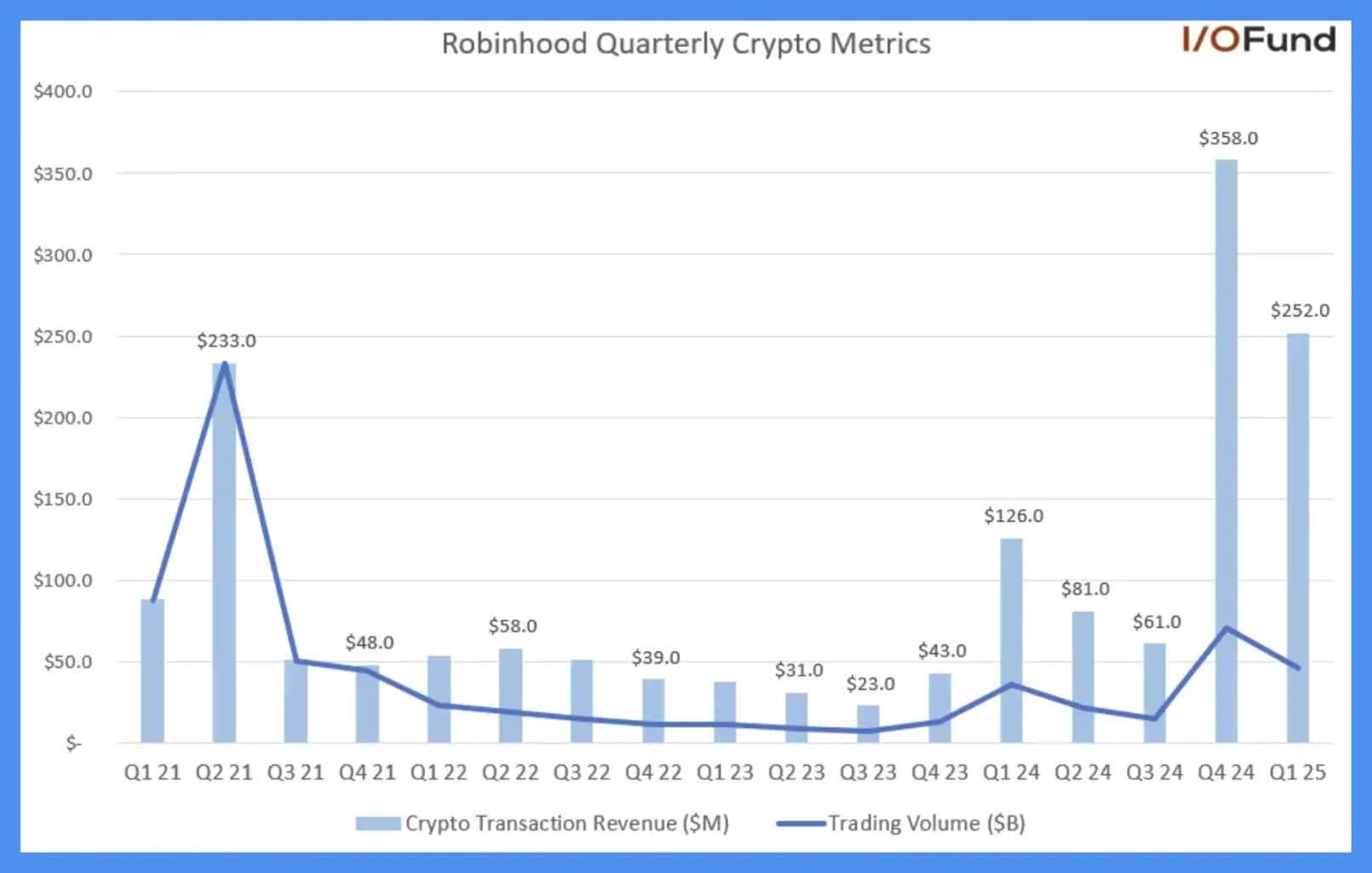
Robinhood quarterly crypto asset trend, image source: IO.FUND
What drove this shift wasn’t technology, but millions of user clicks. Robinhood didn’t push a Web3 narrative—it simply followed user trading habits—and discovered that crypto trading was no longer a marginal business but had become the core engine of growth.
Since then, Robinhood has gradually transformed from a centralized brokerage into a digital asset trading platform.
With Robinhood setting the example, traditional finance finally stopped merely observing the crypto industry in 2025 and decided to enter collectively. They aren’t here to experience Web3 or invest in projects. "Traditional finance will take over the crypto industry within 10 years."
We’re already in the middle of this reshuffling—a takeover of crypto-native players by traditional brokers.
In March 2025, Charles Schwab, one of the world’s largest retail brokerages managing over $10 trillion in assets, announced it would launch spot Bitcoin trading services within a year.
In May 2025, Morgan Stanley, one of Wall Street’s most influential investment banks, announced plans to integrate BTC and ETH into its E*Trade platform, offering direct trading access to retail investors.
Also in May 2025, JPMorgan Chase—the U.S. bank with the largest asset base and long-time critic of crypto—announced it would allow clients to purchase Bitcoin.
In July 2025, Standard Chartered, a veteran British bank with strong presence in Asia, the Middle East, and Africa, announced the launch of spot Bitcoin and Ethereum trading services for institutional clients.
These giants dominate the global financial system, controlling capital inflows and outflows, clearing networks, and fiat payment systems worldwide, holding tens of trillions in assets—compared to the current $4 trillion total market cap of the crypto space.
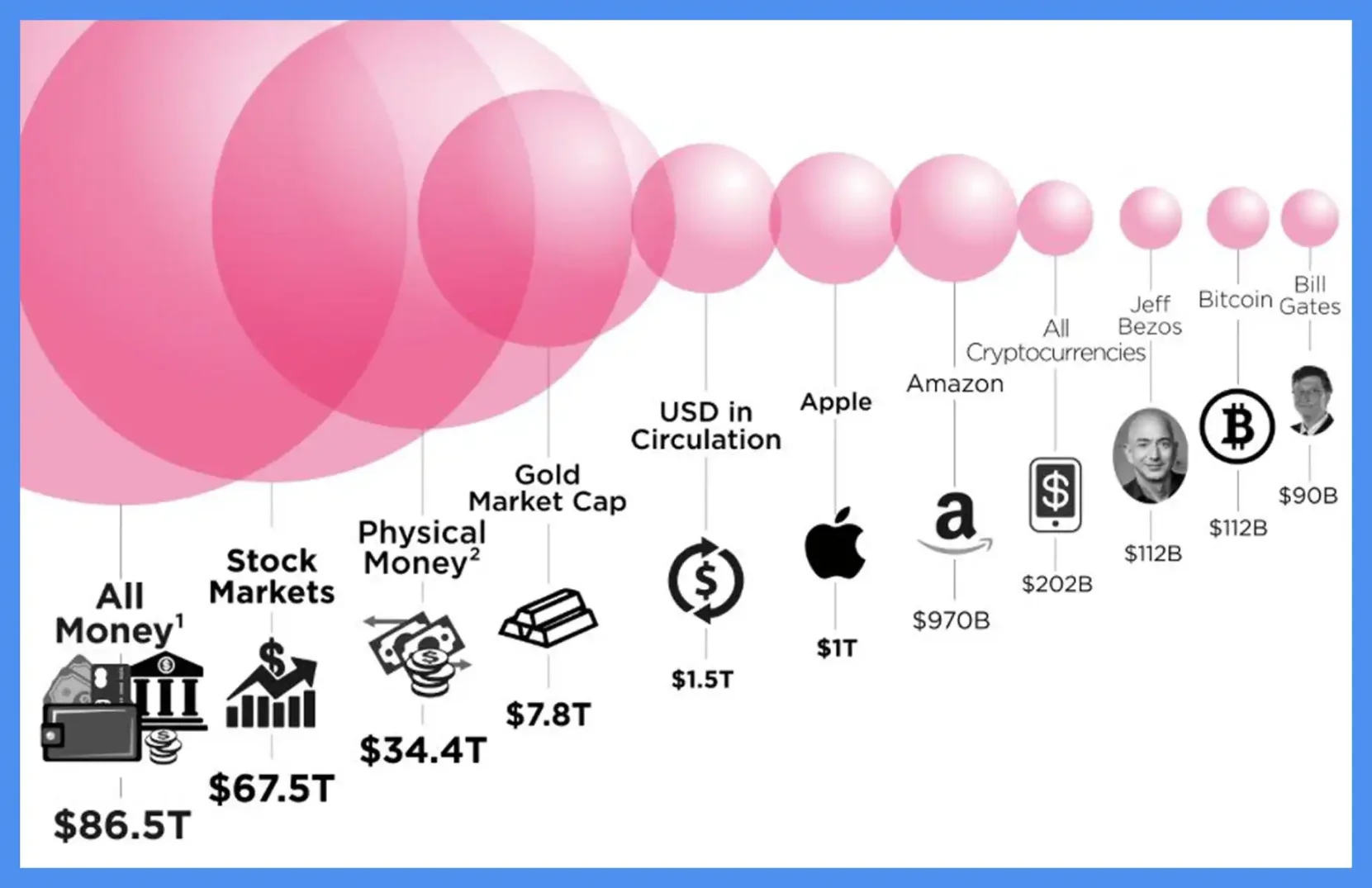
Mainstream asset market cap ranking, image source: Steemit Community
They are now building their presence in crypto based on traditional financial compliance frameworks. When an institution possesses regulatory trust, user traffic, and clearing/settlement capabilities, it holds all the elements needed to build a crypto trading network.
In the traditional financial system, whoever controls account opening controls capital flows, customer relationships, and ultimately, pricing power. For years, crypto exchanges defined narratives through token listings and controlled liquidity via deposits. But now, the role of "asset gateway"—seized by CEXs for nearly a decade—is gradually being reclaimed by traditional finance.
"It’s time for those crypto platforms to feel anxious."
His tone remains restrained, showing no hint of schadenfreude. The root of anxiety may not stem from any single institution’s entry or policy change, but from a collective realization: crypto exchanges may no longer be the only ones dealing cards at this financial table.
Staying at the Table
A crypto exchange insider told us he often replies to messages at 5 a.m. Days are spent negotiating partnerships, nights monitoring progress, late nights scanning user community feedback—hardly any sleep.
"We can only survive through anxiety."
This anxiety comes from competition among platforms—the daily struggle to grab users, products, and traffic.
The reason for this fierce battle lies in the shrinking growth space within the industry and the massive external pressure.
Traditional finance is steadily eroding the core capabilities that crypto exchanges rely on—from fiat onboarding to asset custody, from account opening to spot matching. Armed with regulatory licenses and millions of users, they are moving aggressively, seemingly uninterested in coexisting with crypto-native platforms.
Almost all crypto exchanges have quickly launched stock-token products: buying Apple with USDT, leveraged trades on NVIDIA, trading Tesla via on-chain contracts. These traditional asset-on-chain solutions have rolled out across multiple platforms, becoming a synchronized industry move.
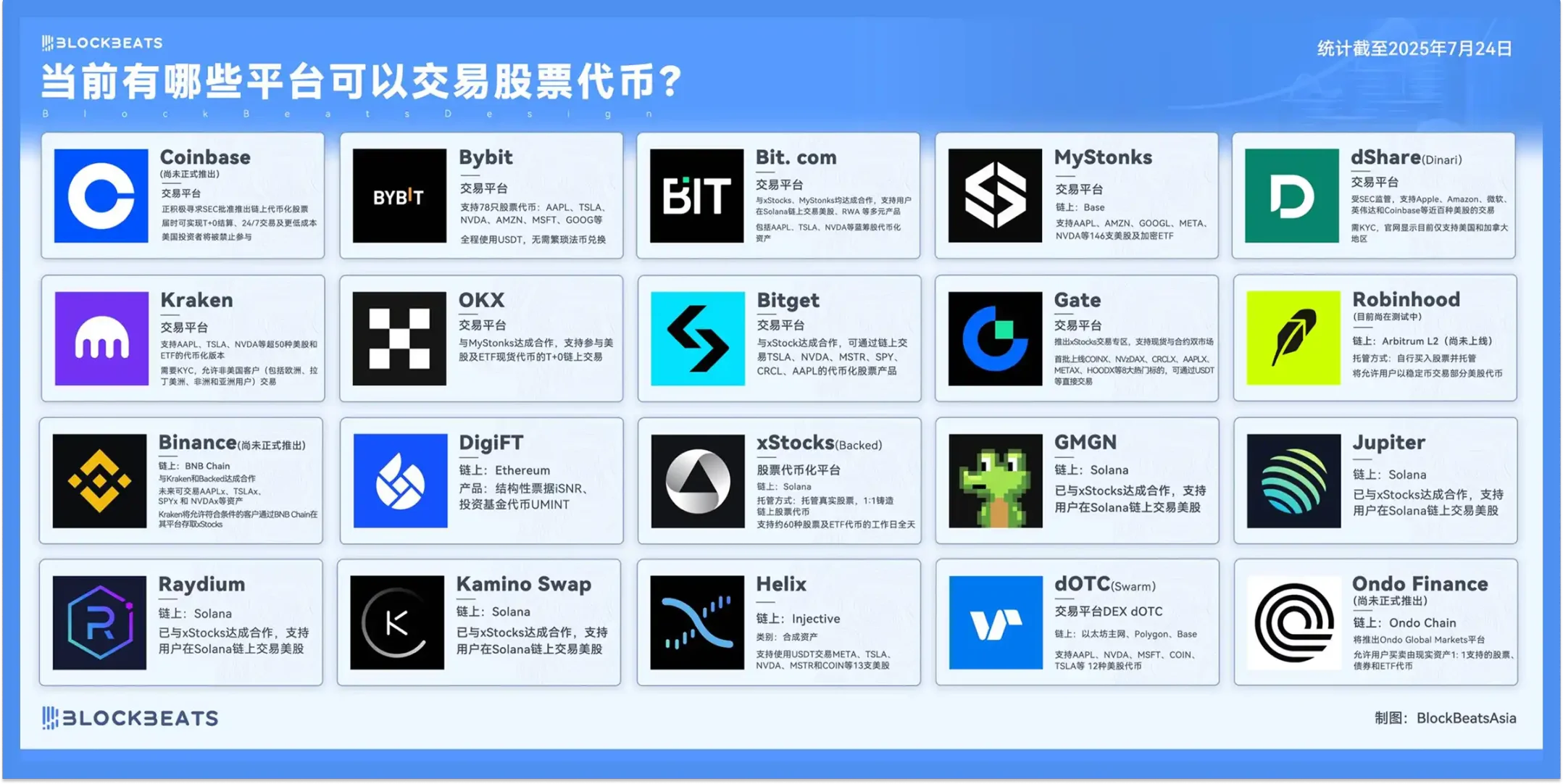
Bybit was the first mover. Within just two months, they completed the development and launch of stock-token products—from internal initiation to collaboration with XStocks and final rollout—at an extremely fast pace.
In Bybit’s view, the core advantages of centralized exchanges still exist. Years of accumulated real users, strong liquidity, and deep trading volumes remain resources that external brokers cannot easily replicate.
The launch of stock tokens responds to clear demand gaps—such as trading needs during market off-hours or geographic and regulatory barriers preventing users from accessing traditional stock markets. Crypto’s 7×24 nature opens new liquidity spaces for traditional assets.
Of course, this doesn’t guarantee victory. Emily, Bybit’s spot trading lead, admits stock tokens are still in early stages, with participation and热度 far below major new token launches.
Yet she remains optimistic because this represents crypto expanding its playbook into TradFi. DeFi, synthetic assets, on-chain staking—these new derivative scenarios for traditional assets on-chain may hold the true value of this path.
Still, while these features appear to be proactive market expansion, many see them as passive defense.
As exchanges lose control of the "asset gateway," they try to maintain the appearance of global connectivity. Thus, stock tokens have become the most common defensive move at this stage.
But stock tokens aren’t a new concept.
Go back to 2020, when FTX first proposed the model. They launched trading pairs like TSLA/BTC and AAPL/USDT, seen as attempts to challenge traditional financial pricing logic.
That was an era when the crypto world still had offensive momentum. What FTX aimed to do was rewrite traditional finance’s trading methods using crypto finance—to price Nasdaq with crypto.
Perhaps he already foresaw that crypto exchanges’ biggest future rivals would be brokers, so he moved first. Today, as the model is revived, its meaning has changed. After FTX’s collapse, stock tokens have become band-aids, not battering rams.
Data confirms this.
While stock tokens initially drew community attention upon launch, activity quickly dropped. Attempts across platforms failed to generate significant traction.
In contrast, meme coins on Solana followed a completely different trajectory. A single tweet from Musk could send related meme coin valuations soaring to hundreds of millions, with daily trading volumes reaching tens of millions—exceeding the weekly volume of many stock-token pairs.
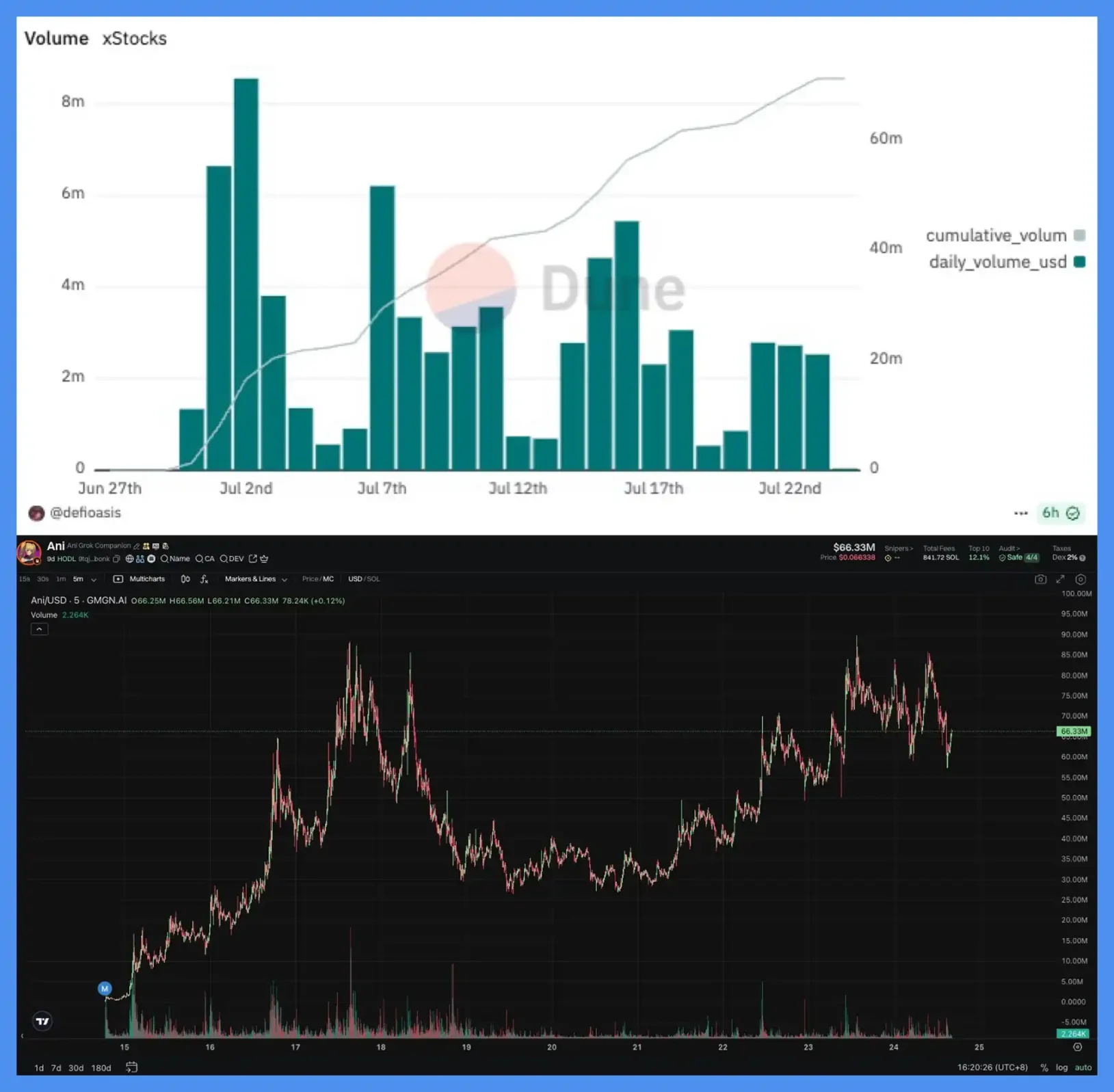
Top: XStocks trading volume, data source: Dune; Bottom: Meme coin Ani trading volume, data source: gmgn
New features, no new users.
At this stage, what CEXs launch no longer matters. What matters is why they’re launching them and whether these features can restore the role they’re losing.
This wave of stock-token enthusiasm isn’t due to industry progress—but because no one dares to do nothing.
Kant said: "Freedom is not doing whatever you want, but refusing to do what you don’t want."
Compliance Is Just an Illusion
Recently, nearly every crypto exchange talks about compliance. Each is rushing to obtain licenses, restructure operations, and hire executives from traditional finance, trying to prove they’ve evolved beyond the wild west era into institutions acceptable to regulators.
This reflects both industry consensus and collective anxiety.
Yet, to traditional finance professionals, this understanding of compliance remains too shallow.
"Many platforms get licenses from small countries to claim compliance. Those aren’t real licenses—they don’t grant table access," he says, not harshly, but stating what he sees as industry common sense.
By "table access," he doesn’t mean having a business license, but whether you can connect to the real financial system—can you open accounts at major banks, use clearing and settlement networks, earn regulator trust, and engage in actual business cooperation?
This reveals a reality: in traditional finance’s eyes, the crypto world has never been treated as an equal.
The traditional financial system is built on accountability chains and closed-loop trust—emphasizing traceable client structures, risk control, auditability, and explainable fund flows. Crypto platforms, however, grew in regulatory gray zones, relying on ambiguity for high profits and rapid growth, rarely developing these compliance foundations.
Insiders know these issues well. But previously, no one cared—because no one competed for the space. Now, with traditional institutions entering, playing by their own rules, the crypto industry’s "standard practices" have suddenly become critical flaws.
Some platforms are indeed adjusting—introducing compliance audits, establishing offshore trust structures, splitting operations—trying hard to appear legitimate.
Yet, many regulators remain unconvinced. They may cooperate superficially, but deep down, they never intend to include you as part of the formal financial system. No matter how much you resemble them, you’re only "appearing" to belong—not actually being accepted.
Still, not all platforms are just pretending. Bybit is one of the few that has truly broken through regulatory barriers. This year, they became one of the first centralized exchanges to obtain a European MiCA license and established their European headquarters in Vienna.
Bybit doesn’t deny the difficulty of the process or dismiss regulatory skepticism. As Emily notes, regulators are no longer the same as five years ago, struggling to understand crypto. Now, they’re beginning to grasp the industry’s business logic and technical architecture. Their understanding of technology, models, and market strategies is deepening, laying a firmer foundation for cooperation.
Besides, Jason Xie, Bitget’s Chinese-speaking markets lead, told us that Bitget has already obtained virtual asset licenses in multiple countries and built local compliance frameworks per regional requirements. He revealed that the team is actively pursuing a MiCA license to establish stable operations in Europe and lay groundwork for cross-border activities under unified regulation.
Yet even so, such cases remain rare. Most platforms lack the licenses, networks, and trust backing of traditional finance, while also losing the high-growth benefits once provided by regulatory vacuums. Attempting compliance transformation, they find the bar too high; returning to crypto-native roots, they face another set of formidable competitors.
So they continue moving toward regulators, talking compliance, applying for licenses, going through procedures. Often, these actions aren’t strategic choices but manifestations of anxiety-driven momentum.
Midgame of the Poker Table
At 5 a.m. in the online community, Jason Xie is still replying to user questions one by one. Some ask how to trade stock tokens, others inquire about recent compliance progress, or details about PUMP subscriptions and how they’ll be handled. He says he and his colleagues often pull all-nighters—one night means nothing.
On a hot Beijing afternoon, inside a courtyard house, a Hong Kong-based broker executive is sipping tea and discussing partnerships with senior executives from listed companies. Separated by a carved wooden door, outside lies a bluestone courtyard, cicadas chirping in the shade.
Further away, in Vienna, Austria, Bybit’s new European headquarters has just held its ribbon-cutting ceremony and officially opened. This outpost, established after securing the MiCA license, marks them as one of the first centralized exchanges to successfully cross the river—while knowing most peers are still feeling their way forward.
In different places, emotional states, and rhythms, their words subtly echo each other: all speak of "changes happening too fast," of "taking it slow," and of how the industry should move forward.
But the premise of moving forward is no longer what it was years ago.
Crypto exchanges may no longer be the central players in this world, no longer the starting point of all traffic and narratives. They stand at the edge of a new order, slowly pushed outward by invisible rules.
More complex systems, larger capital pools, are gradually replacing native narratives and structures.
Crypto exchanges still exist, new features keep launching, announcements keep coming. Their expression styles are changing, their communication rhythms shifting, the contexts they aim to join evolving—everything is changing.
Some changes are deliberate choices, some are passively accepted, but more often, they’re simply attempts to retain relevance without being left behind by the times.
Yet, not everyone is pessimistic. Both Jason Xie and Emily believe crypto’s impact on traditional finance outweighs the latter’s pressure on CEXs. They welcome the trend of traditional institutions entering, as every industry evolution requires new players. Centralized exchanges today are also expanding into institutional clients, wealth management, and asset allocation. Business areas are intersecting and merging. "Two financial worlds echoing each other—that’s a romantic moment."
Still, everyone knows this advantage alone won’t eliminate anxiety.
Many questions lack clear answers. Will regulators truly accept these crypto platforms? Are traditional institutions genuinely willing to co-build rather than replace?
And before the next industry theme emerges, will there be one last chance for these platforms to redefine themselves?
No one dares claim certainty. Everyone focuses on their tasks—meetings, product revisions, license applications, waiting for feedback—maintaining the status quo while waiting for opportunities to regain initiative.
Waiting for the tide of industry reshuffling to settle.
Join TechFlow official community to stay tuned
Telegram:https://t.me/TechFlowDaily
X (Twitter):https://x.com/TechFlowPost
X (Twitter) EN:https://x.com/BlockFlow_News
 BlockBeats






