The Era of Stablecoin "Regulatory Cleansing": How the GENIUS Act Will Reshape the Global Stablecoin Landscape?
TechFlow Selected TechFlow Selected
The Era of Stablecoin "Regulatory Cleansing": How the GENIUS Act Will Reshape the Global Stablecoin Landscape?
The introduction of the GENIUS Act sets a critical 300-day window for Tether.
 Navigating Web3 tides with focused insights
Author: Crypto Salad
With Trump officially signing the GENIUS Act at the White House, this marks the first time the United States has formally established a regulatory framework for digital stablecoins. It also means that many stablecoin issuing companies are about to face a new round of challenges. Many people may be unfamiliar with the GENIUS Act and might have questions such as:
-
What specific stablecoin regulations does the U.S. GENIUS Act include?
-
How exactly will the act affect USDT and Tether Inc.?
-
Can Tether take corresponding countermeasures?
-
How does this act differ from Hong Kong’s Stablecoin Bill?
The Crypto Salad team, with years of experience in cross-border blockchain compliance, will address each of these questions.
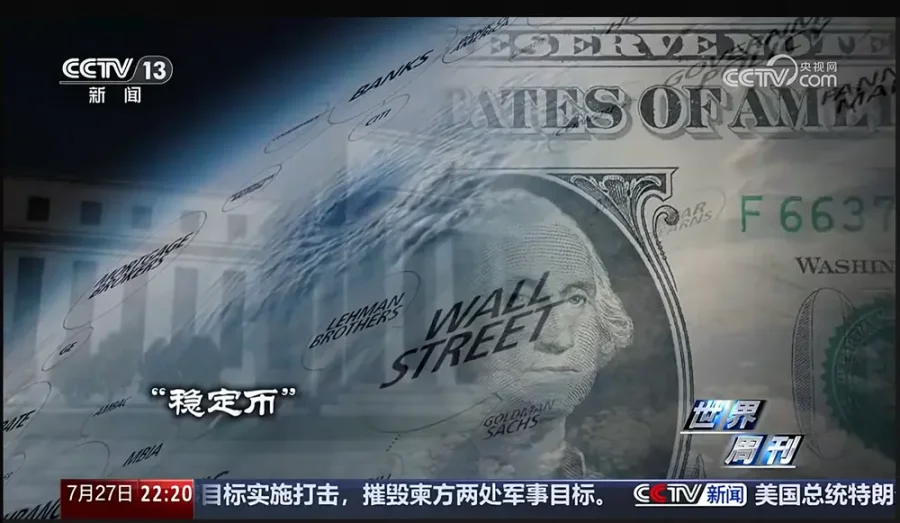
Image source: CCTV official website
I. What Does the GENIUS Act Actually Say?
First, the Crypto Salad team will help you understand the GENIUS Act. The GENIUS Act stands for the "Guiding Establishing National Innovation for U.S. Stablecoins Act," also known as America's "Stablecoin Bill." This bill aims to establish a comprehensive legal and regulatory framework for payment stablecoins in the United States to promote financial innovation, protect consumers, strengthen monetary sovereignty, and maintain financial stability. Below is a brief introduction to the regulatory framework of the GENIUS Act:
1. Core Definitions and Scope of the Act: The act primarily regulates payment stablecoins—digital assets defined as digital currencies used for payment or settlement and pegged to a fixed fiat value. The act requires that only "authorized payment stablecoin issuers" can issue stablecoins in the United States. Authorized issuers must be subsidiaries of insured depository institutions, federally qualified non-bank payment stablecoin issuers, or state-qualified payment stablecoin issuers. (Source: GENIUS Act, Section 2(22))
2. Regulatory Structure of the Act: The act establishes a unique dual-track regulatory system. For stablecoins with an issuance volume exceeding $10 billion, the Federal Reserve's regulatory framework for depository institutions and the Office of the Comptroller of the Currency's framework for non-bank issuers will apply. Issuers with volumes below $10 billion may opt for state-level regulation. Reserve requirements under the act: One of the most important consumer protection measures in the act is the 100% reserve requirement. Issuers must hold at least one dollar in permitted reserves for every dollar of stablecoin issued. Permitted reserves include: coins and currency, bank deposits, short-term Treasury securities, repurchase agreements, money market funds, and central bank reserve deposits. (Source: GENIUS Act, Section 4(a)(1))
3. Transparency and Disclosure Requirements: The act requires issuers to establish and disclose stablecoin redemption procedures and regularly report outstanding stablecoin supply and reserve composition. (Source: GENIUS Act, Section 6(a)(2))
4. National Security and Anti-Money Laundering Provisions: The act classifies payment stablecoin issuers as financial institutions under the Bank Secrecy Act, meaning they must: maintain effective anti-money laundering and sanctions compliance programs; keep appropriate records of stablecoin transactions; monitor and report suspicious activities; implement policies to block, freeze, and reject transactions violating federal or state laws; and establish customer identification programs. (Source: GENIUS Act, Section 8(a))
II. How Will This Act Affect USDT and Tether Inc.?
Let’s first explain what USDT is. USDT is one of the most representative stablecoins in the current cryptocurrency market, also known as Tether. Issued by Tether Inc., it aims to maintain price stability by being pegged to fiat currency (primarily the U.S. dollar), serving as a crucial liquidity tool and store of value in the crypto market. The core design of USDT promises that for every USDT issued, one dollar is held in a bank account as reserve, theoretically maintaining a 1:1 peg. Users can redeem USDT for dollars at any time, ensuring price stability. Compared to traditional cross-border remittance methods, USDT transactions are faster, have lower fees, and are not restricted by geography or banking hours, enabling more efficient cross-border fund transfers.
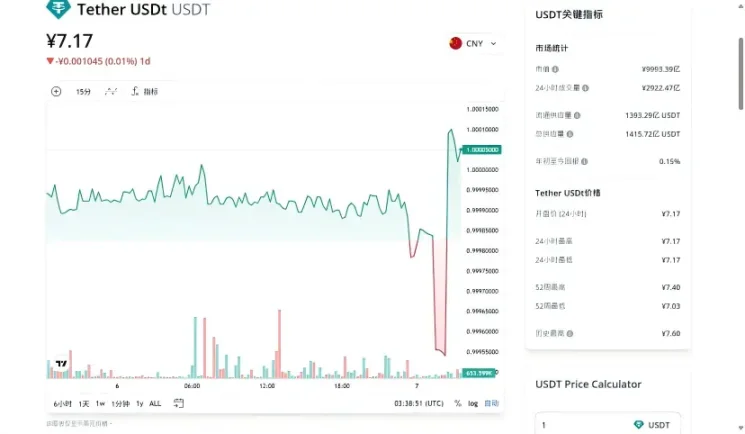
Image source: CoinMarketCap
Based on the content of the act, it is certain that it severely constrains the development of USDT. The GENIUS Act is a U.S. law, and USDT is also a product originating in the U.S. After the act takes effect, according to its provisions outlined above, Tether Inc. will almost certainly fail to meet full compliance requirements. As a result, Tether's market share in the stablecoin market will continue to erode until a viable alternative emerges. Even if Tether and USDT retain some presence in the future stablecoin market, their use will likely be confined to specific niche applications.
Why can't Tether meet these requirements? The Crypto Salad team will clarify several key points of the act:
-
First, the act explicitly states that stablecoins are not regulated under securities or commodities frameworks but primarily fall under banking regulation;
-
Second, required reserves must consist of high-quality liquid assets, such as U.S. cash, Federal Reserve deposits, demand bank deposits, Treasury securities maturing within 93 days, or overnight reverse repurchase agreements, and authorized payment stablecoin issuers must maintain reserve assets equal in value (1:1) to their issued payment stablecoins in circulation. (Source: GENIUS Act, Section 4(a)(1))
-
In addition, authorized payment stablecoin issuers with combined issuance exceeding $50 billion that are not subject to reporting requirements under the U.S. Securities Exchange Act of 1934 must prepare annual financial statements under U.S. GAAP to disclose any related-party transactions; (Source: GENIUS Act, Section 3(10)(A))
Image source: CCTV official website
-
Fourth, anti-money laundering and KYC ("Know Your Customer") are among the core regulatory requirements in finance and compliance, involving strict processes to verify customer identity and assess risks to prevent money laundering, terrorist financing, fraud, and other illegal activities. Issuers cannot misuse reserves, must publish monthly reserve attestations audited by registered accounting firms, and must comply with the Bank Secrecy Act; (Source: GENIUS Act, Section 3(5)(A))
-
Fifth, the act grants stablecoin holders super-priority status, meaning that in the event of issuer bankruptcy, stablecoin holders' claims rank ahead of all other creditors, thereby achieving "priority repayment." This "priority repayment right" encourages more people to purchase issued stablecoins and further protects the legitimate rights of stablecoin investors. (Source: GENIUS Act, Section 10(3))
For Tether Inc., the issuer of USDT, it fails to meet many of the requirements set forth in the GENIUS Act.
First, the act requires "full reserve backing," but Tether's current reserves are inadequate—only around 85%—thus failing to meet the standards of the GENIUS Act, which could lead to price volatility and loss of user trust.
Second, Tether’s auditor is BDO Italia, which itself does not meet the standards of the Public Company Accounting Oversight Board (PCAOB).
Third, Tether must sell its non-compliant reserve assets, such as Bitcoin, precious metals, corporate notes, and secured loans, and replace them with compliant assets.
Additionally, Tether has a very high market capitalization, already reaching the threshold requiring direct federal oversight. Therefore, the Crypto Salad team believes that Tether would struggle to meet the monthly disclosure requirements and stringent anti-money laundering obligations (annual audits required for issuers with over $50 billion in stablecoin issuance who are not SEC-reporting entities).
Besides Tether, other companies like Circle (issuer of USDC), Paxos (issuer of PAX and USDP), and Gemini (issuer of GUSD) will also face varying degrees of constraints under the GENIUS Act, such as requirements on reserve asset liquidity and audit disclosures. Therefore, the impact of the GENIUS Act extends beyond a single issuer—it will significantly disrupt the entire stablecoin market.
Image source: CCTV official website
According to the GENIUS Act, if stablecoin issuers like Tether fail to meet the act’s requirements, they will face severe penalties.
First, if Tether fails to complete U.S. entity registration or reserve restructuring during the transition period, its USDT will be deemed an "illegal payment instrument," making the issuance itself unlawful and potentially leading to criminal charges (Source: GENIUS Act, Section 4(a)(12)).
Furthermore, three years after the act takes effect, any foreign stablecoin issuer not licensed in the U.S. (including Tether) will be prohibited from issuing, selling, or providing trading services in the United States. Digital asset service providers (e.g., exchanges) violating this rule face daily fines up to $100,000, and Tether as an issuer may be added to the Treasury Department’s "non-compliance list," resulting in mandatory delisting of its stablecoin from U.S. platforms (Source: GENIUS Act, Section 18(a)(4)).
Naturally, for violations such as holding non-permitted reserve assets, failing to disclose reserve reports on time, or breaching AML obligations, the Treasury may impose daily fines of up to $1 million on Tether (Source: GENIUS Act, Section 18(a)(4)).
Facing so many adverse consequences, it can be said that the implementation of the GENIUS Act has delivered a "final ultimatum" to stablecoin issuers like Tether.
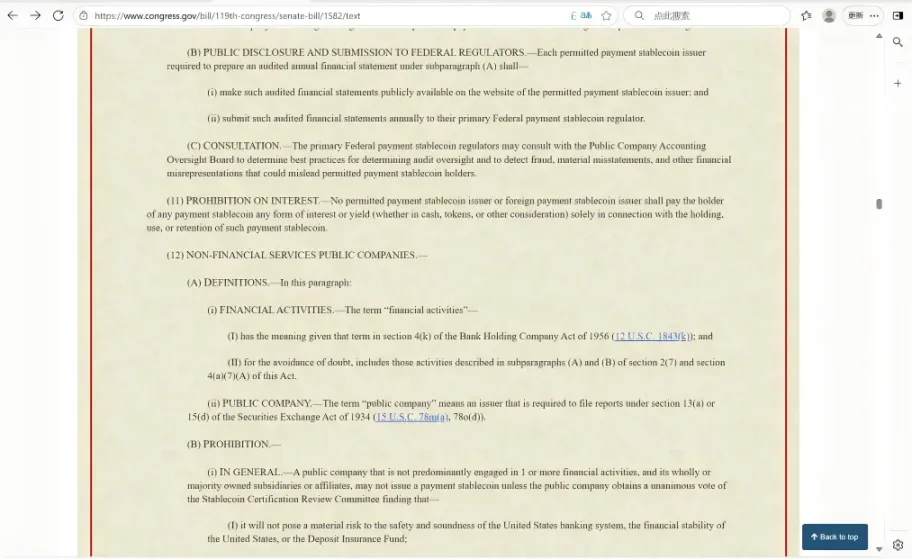
Image source: Congress.Gov
III. What Are the Differences Between the GENIUS Act and Hong Kong’s Stablecoin Ordinance?
Now that Trump has officially signed the GENIUS Act into law, and coincidentally, Hong Kong’s Stablecoin Ordinance is set to take effect on August 1, 2025, both regulations target stablecoins in the cryptocurrency space. So many may wonder: What are the differences between these two stablecoin regulations from different jurisdictions? In other words, what are the differences between operating under U.S. versus Hong Kong regulation when issuing stablecoins? The following section provides answers.
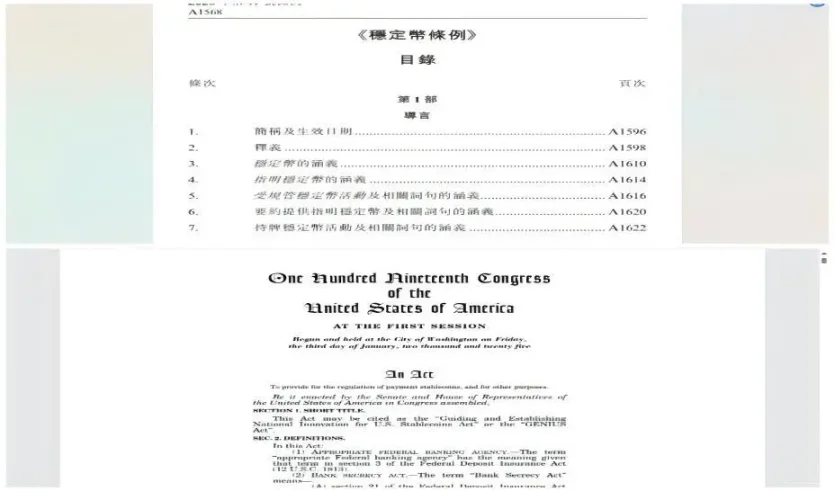
First, the准入 requirements for issuers differ between the two regions. To register in the U.S., entities must either be U.S.-registered or foreign entities registered via the OCC (with proof of equivalent home-country regulation), and must complete compliance adjustments within three years or be barred from the U.S. market. In Hong Kong, issuers must be locally incorporated companies or overseas banks recognized by the HKMA (e.g., HSBC, Standard Chartered); non-bank institutions must have paid-in capital of HK$25 million (exempt for banks).
Second, reserve asset requirements differ. The U.S. restricts reserves to cash and U.S. Treasuries maturing within 93 days, prohibiting investments in corporate notes, crypto assets, or other non-compliant assets. Hong Kong requires reserve assets to strictly match the pegged currency (e.g., Hong Kong dollar stablecoins must hold HKD cash or short-term bonds) and prohibits paying interest to holders, directly restricting the "interest-bearing stablecoin" business model.
Third, transparency and audit standards differ. The U.S. mandates monthly public disclosure of reserve composition, market value, and audit reports, with annual audits conducted by PCAOB-certified firms and compliance certifications signed by CEO/CFO (Source: GENIUS Act, Section 4(10)(a)(iii)).
Hong Kong also requires regular disclosure of reserve composition, market value, and audit results, but does not mandate PCAOB certification—only "independent audits."
Fourth, penalties for violations differ. In the U.S., violations may incur daily fines up to $1 million and trigger civil liability or criminal charges (e.g., up to 10 years imprisonment for securities fraud). In Hong Kong, unlicensed issuance carries maximum fines of HK$5 million and 7 years imprisonment; fraudulent conduct faces up to HK$10 million and 10 years imprisonment.
Comparing these four dimensions, Hong Kong appears to balance stability and innovation more effectively, offering greater policy inclusiveness but fiercer competition for licenses. In contrast, the U.S. prioritizes maintaining dollar hegemony, imposing stricter limits on USD stablecoin issuers. Thus, choosing where to issue stablecoins involves trade-offs.
IV. Crypto Salad Interpretation
Based on the above, the Crypto Salad team believes the introduction of the GENIUS Act sets a critical 300-day window for Tether Inc. Although the act provides an 18-month (approximately 540-day) transition period, if Tether fails to present a compliant solution within 300 days, the market outlook for USDT will essentially be sealed. If USDT fails to gain U.S. regulatory approval, its global market expansion will face fundamental constraints—even if Tether continues issuing more USDT and increasing token supply, a decline in market share will become inevitable.
Regarding its future trajectory, several possibilities can be anticipated:
-
First, Tether may adopt an "offshore niche" strategy, actively avoiding countries and regions with strict stablecoin regulations, and instead indirectly accessing local markets through intermediaries;
-
Second, if the company cannot overcome compliance hurdles, loss of market confidence could trigger systemic risk, eventually pushing Tether out of the mainstream market by compliant competitors;
-
Third, maintaining a "lukewarm" existence—given that some regulatory gray areas in stablecoin issuance still exist, USDT may persist in specific early-adopted use cases, neither exiting the market abruptly nor regaining its dominant global position.
Moreover, the Crypto Salad team observes that the GENIUS Act and Hong Kong’s Stablecoin Ordinance (effective August 1) share common features: both center on "stablecoin issuance rules" as their legislative focus and maximize investor protection through mandatory redemption mechanisms and disclosure requirements for stablecoin issuers. Therefore, despite differing regulatory details across jurisdictions, investor rights are strictly safeguarded in both regions.
The views expressed are solely those of the author and do not constitute legal advice or opinion on specific matters.
Join TechFlow official community to stay tuned
Telegram:https://t.me/TechFlowDaily
X (Twitter):https://x.com/TechFlowPost
X (Twitter) EN:https://x.com/BlockFlow_News