WSJ: Stablecoins—Innovation or a Modern Version of 19th-Century Financial "Pipes"?
TechFlow Selected TechFlow Selected
WSJ: Stablecoins—Innovation or a Modern Version of 19th-Century Financial "Pipes"?
Under the "Genius Act," stablecoins no longer trust blockchain, but the United States.
 Navigating Web3 tides with focused insights
Source: WSJ
Translation: Odaily Planet Daily Golem
Stablecoins: The Modern "Narrow Bank"
Washington once again promises to reshape money with code. The political headwinds behind the newly passed U.S. GENIUS Act have breathed new life into this recurring fantasy—that technology can finally eliminate the core instability of finance. While alluring, reality is harsh: we may modernize money, but we're still delivering it through 19th-century "pipes."
This appealing idea partly stems from Silicon Valley Bank's collapse in 2023. It wasn't a new crisis caused by subprime mortgages or exotic derivatives, but a replay of the oldest flaw in banking: maturity mismatch. Depositors—especially those without insurance—can withdraw funds on demand, while banks make long-term investments. When interest rates spike and trust breaks down, withdrawals surge, assets are sold at fire-sale prices, and governments must step in again.
The "narrow bank" was once seen as a solution—an institution that holds only cash or short-term Treasuries. (Odaily note: The concept of "narrow banking" originated in the aftermath of the U.S. Great Depression in the 1930s. It refers to a banking model that accepts deposits but invests them entirely or almost entirely in highly liquid, ultra-low-risk assets such as short-term government bonds or central bank reserves.)
While extremely safe, narrow banks lack vitality—they cannot create credit, issue loans, or drive growth.
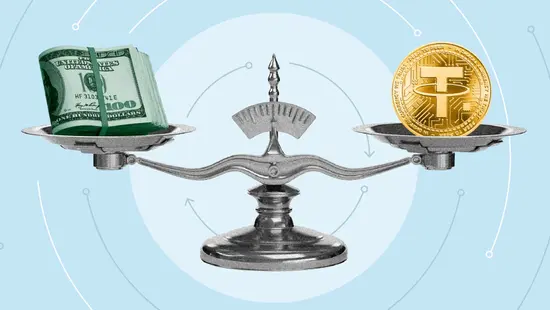
Stablecoins are the technological reimagining of the narrow bank: private digital tokens pegged to the dollar and claiming to be backed one-to-one by liquid reserves. For example, Tether and USDC claim to offer programmable, borderless, tamper-proof deposits, free from regulatory burdens.
But strip away the digital gloss, and the old financial fragility remains: these tokens still depend entirely on trust. Reserves are often opaque, custodians may be offshore, audits are selective, and redemption remains just a promise.
When trust wavers, the entire system collapses. The stablecoin TerraUSD crashed in 2022 because it tried to maintain its dollar peg using algorithms rather than real reserves. Its value relied on another redeemable token, Luna. But when confidence unraveled, investors rushed to redeem TerraUSD, flooding the market with massive amounts of Luna. With no reliable collateral and escalating panic, both tokens collapsed within days. Beyond this extreme case, even so-called "fully collateralized" stablecoins today experience price volatility when markets question the authenticity behind their reserves.
The GENIUS Act Reinforces the Dollar’s “Exorbitant Privilege”
The GENIUS Act is Washington’s attempt to bring order to stablecoins. It creates a formal category of “payment stablecoins,” prohibits issuers from paying interest—to emphasize utility over speculation—and requires full backing by cash or Treasury securities. Issuers must obtain licenses, register in the United States, and submit to a new certification regime. Foreign participants must gain U.S. approval and comply with U.S. rules—or exit the market.
The bill’s strengths are clear: no flashy algorithms, no unregulated wildcards, no mixing speculative functions with payment functions. It delivers on many long-held demands. It provides consumer protection, prioritizes redemption in bankruptcy, and promises monthly reserve disclosures. Scholars who criticized crypto chaos have finally gotten their wish.
But clarity does not mean safety. The act formally defines stablecoins as "narrow banks." This means they avoid maturity mismatch, but also eliminate the trust intermediary—the financial system’s core engine that transforms savings into investment. Risk-averse funds become idle capital.
At the same time, the bill leaves strategic loopholes. Issuers with less than $10 billion in assets can opt for state-level oversight, encouraging regulatory arbitrage. In a crisis, redemption demands for stablecoins could trigger Treasury sell-offs, disrupting the very safe-haven asset markets that back them.
Some economists warn that by anchoring stablecoins to Treasuries, we’re merely shifting systemic risk to a new corner—one politically popular but operationally untested at scale. Yet supporters sing praises of geopolitical benefits. The law ensures stablecoins are tied to the dollar, backed by dollar-denominated reserves like Treasuries, and settled through U.S. institutions. As non-dollar stablecoins remain stalled, U.S.-backed digital tokens will become the default tools for global payments, savings, and cross-border transfers.
This is Bretton Woods meets Silicon Valley—a regulatory gamble aimed at extending the dollar’s “exorbitant privilege” into the internet age. The GENIUS Act could do more to cement dollar dominance than any Federal Reserve currency swap line or trade agreement.
Another notable benefit is that by providing regulatory clarity, the bill may help bring cryptocurrency innovation back to U.S. soil. In recent years, legal uncertainty in the U.S. has driven blockchain talent and capital overseas. Despite stablecoins’ flaws, they may serve as a foothold for broader digital finance experimentation to occur within, rather than outside, American institutions.
Stablecoins Have Not Transcended Banking
But trust cannot be outsourced to code. It is built by institutions, audits, and rules. Ironically, blockchain—a technology born from resistance to financial regulation—is now seeking legitimacy through the very disclosure and oversight it once sought to escape. The GENIUS Act provides this clarity, but the trade-offs are now fully visible.
In finance, as in fables, great power often masks greater fragility. If stablecoins become embedded in daily transactions, their failure would no longer affect only the crypto world—it would become a shared problem for households, businesses, and taxpayers.
The bill also opens the door for big tech firms or corporate giants to enter the payments space under relatively lenient rules, raising concerns about privacy, competition, and market concentration in a digital dollar infrastructure dominated by scale rather than security.
Despite constant hype, stablecoins have not transcended banking. They merely replicate banking’s contradictions in new form. Blockchain’s true vision was to end reliance on trust. Yet now, we’re doubling down on trust—under federal regulation.
Money remains a social contract: a promise that someone, somewhere, will make good on your loss. No amount of code or collateral can eliminate the need for credibility in that promise. Likewise, no regulatory action can abolish the fundamental trade-off in finance: security comes at the cost of efficiency. Forget this, and the next crisis is inevitable.
Stablecoins repack old risks as innovation. The danger isn’t what they are—but what we pretend they aren’t.
Join TechFlow official community to stay tuned
Telegram:https://t.me/TechFlowDaily
X (Twitter):https://x.com/TechFlowPost
X (Twitter) EN:https://x.com/BlockFlow_News