Hong Kong stablecoin regulation set to take effect, sparking race for licenses
TechFlow Selected TechFlow Selected
Hong Kong stablecoin regulation set to take effect, sparking race for licenses
HKMA sets limits but no quotas, "JCOIN" and "JOYCOIN" emerge.
 Navigating Web3 tides with focused insights
Author: ChandlerZ, Foresight News
Only days remain before Hong Kong's stablecoin licensing regime officially takes effect. The Hong Kong Monetary Authority (HKMA) has released several documents regarding the regulatory framework for stablecoin issuers, including the Supervisory Guide for Licensed Stablecoin Issuers, the Anti-Money Laundering and Counter-Terrorist Financing Guide (for Licensed Stablecoin Issuers), the Summary of the Stablecoin Issuer Licensing Regime, and the Summary of Transitional Provisions for Existing Stablecoin Issuers.
Meanwhile, the HKMA held a technical briefing on the stablecoin issuer regulatory system. According to the established timeline, institutions intending to apply are encouraged to contact regulators by August 31, and must submit formal applications by September 30. It is expected that only a single-digit number of licenses will be issued initially, with the first approvals potentially coming by year-end.
As policies gradually take shape, market players have also begun moving. According to the Ming Pao newspaper, JD Blockchain, a subsidiary of JD.com, has registered the names "JCOIN" and "JOYCOIN," which the market speculates could be the names of its stablecoins. A consensus is forming: Hong Kong is formally entering the era of regulated stablecoins. Compliance definitions are becoming clearer, and the intentions of participating institutions are starting to emerge.
Licensing numbers unconfirmed; initial stablecoin holders required to be identified
Regarding the application process, the HKMA encourages interested applicants to express their intent by August 31, 2024, and to submit formal application materials by September 30. Entry into the "sandbox testing" phase does not guarantee automatic license approval. Even those who did not participate in the sandbox may still apply—the key lies in the maturity and compliance of the proposed plan. Regulatory requirements cover multiple areas including reserve asset management, risk control, corporate governance, issuance and redemption mechanisms, anti-money laundering, and counter-terrorist financing, and must comply with international standards such as the FATF "Travel Rule."
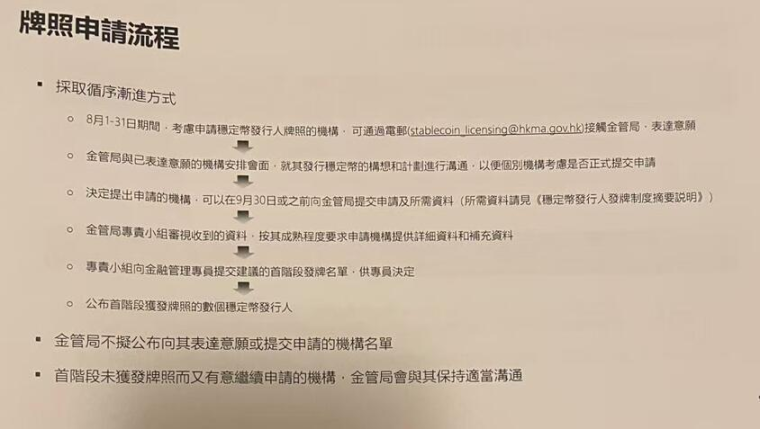
Image source: Every Day Economic News
According to the latest HKMA guidance, there is no fixed quota for stablecoin issuer licenses. Approvals will be assessed case by case based on the maturity of application materials, risk management capabilities, and business feasibility. There are no quotas, nor will participation in the sandbox confer priority in approval. Moreover, the HKMA will not disclose the list of applying institutions, emphasizing that the licensing process will remain highly cautious and non-public.
On the issue of fiat currencies pegged by stablecoins, the HKMA maintains an open stance, supporting pegs to either a single fiat currency or a basket of currencies. However, for currencies such as the RMB that are not fully freely convertible, assessments will be made carefully based on specific use cases and reserve mechanisms. To accommodate existing stablecoin issuers operating in Hong Kong, the regulatory regime includes "transitional arrangements," allowing qualified entities to operate under temporary licenses for six months.
To support stablecoin issuers already conducting substantial operations in Hong Kong prior to the implementation of the new regime, the HKMA has established transitional arrangements. Relevant institutions may submit license applications within three months after the ordinance takes effect. Once confirmed to possess compliance capability, they may operate under a temporary license for six months until final approval is granted.
Different from the previously more relaxed whitelist model, the new regulatory framework emphasizes strong oversight and high transparency. Licensed stablecoin issuers must implement real-name management, with holder identities verified by the issuer, regulated financial institutions, or trusted third parties. Additionally, application materials must comprehensively cover reserve asset arrangements, compliance governance, anti-money laundering mechanisms, technical architecture, and risk control plans—raising higher operational expectations from regulators.
Notably, the HKMA has repeatedly emphasized that the decision to grant a license is not solely based on reserve asset levels, but more importantly on whether the applicant’s proposed stablecoin business model has practical use cases and long-term sustainability. In this regard, regulators maintain a "strict first, gradual easing" approach, keeping a cautious pace in licensing during the initial phase to prevent market bubbles and speculative hype, and emphasizing steady progress toward long-term sustainable development of Hong Kong's digital asset ecosystem.
Regulatory framework fully clarified ahead of effective date
In terms of regulatory structure, the HKMA's Supervisory Guide for Licensed Stablecoin Issuers forms the core of the entire regime, setting high-standard, fine-grained compliance requirements across seven key areas: reserve asset management, issuance and redemption mechanisms, scope of business activities, financial resource requirements, risk management, corporate governance, and conduct of operations. The reserve asset management section explicitly requires 100% full backing of stablecoins, limiting reserve assets to highly liquid, low-risk cash management instruments such as cash, short-term bank deposits, high-credit-rated short-term bonds, and overnight reverse repos. These reserves must be held in trust structures with segregation, and custodians must meet minimum standards. Furthermore, stablecoin issuers may not pay interest to users, must maintain internal accounting records daily, disclose core data weekly, and undergo regular independent auditor reviews.
Regarding issuance and redemption, the regulatory guide requires licensed stablecoin issuers or their distribution partners to strictly adhere to client suitability rules, refrain from offering services in prohibited jurisdictions, and use identity verification and geolocation technologies to mitigate compliance risks. Detailed disclosure requirements are also imposed on redemption policies, including clear statements of user redemption rights, processing timelines, and fees, with periodic reviews required to assess the reasonableness and effectiveness of the issuance and redemption mechanisms themselves.
On financial resources, applicants must have a minimum of HK$25 million in paid-up capital, and net assets must not originate from external borrowing—highlighting the HKMA's emphasis on the sustainability and risk-bearing capacity of stablecoin operations. If an applicant intends to issue multi-currency stablecoins, additional discussions with the HKMA on currency composition ratios and potential mismatch risks will be required.
On management and governance structure, regulators require applicants to be corporate entities, with directors, senior management, and stablecoin managers possessing relevant knowledge and experience. Key personnel must be ordinarily resident in Hong Kong, and individual interviews with the HKMA may be required during the application stage.
Combined with the application process outlined in the Summary of the Licensing Regime, the entire procedure includes five steps: preliminary intent communication, cross-border regulatory coordination (if applicable), document preparation, review by an advisory committee, and final approval—emphasizing prudence and information transparency. The document also lists a detailed application checklist, including a business plan covering over three years, financial projections for the next three years, and a compliance strategy.
JCOIN and JOYCOIN come into view
JD Blockchain, a subsidiary of JD.com, has registered the names "JCOIN" and "JOYCOIN," which the market believes could be the names of its stablecoins. Registration details indicate that related services include blockchain-based electronic funds transfer and cryptocurrency financial transactions. JD Blockchain is one of the participants in the HKMA's stablecoin issuer sandbox program and previously collaborated with Airstar Bank in July last year to test a stablecoin-based cross-border corporate payment solution.
JD Blockchain Technology was incorporated in Hong Kong in March 2024 and became one of the first three institutions admitted into the HKMA's "Stablecoin Issuer Regulatory Sandbox" in July. In an interview with Bloomberg Businessweek, JD Blockchain CEO Liu Peng stated that the company plans to launch payment-oriented stablecoins pegged to the Hong Kong dollar and other major fiat currencies, aiming to complete license applications, stablecoin issuance, and listing on compliant trading platforms simultaneously in early Q4.
Unlike cryptocurrencies with asset characteristics, JD's stablecoin is positioned as a "payment tool." Built on a public chain architecture, it emphasizes transparency, auditability, and regulatory compliance. Against the backdrop of the Hong Kong Stablecoin Ordinance taking effect on August 1, JD Blockchain is leveraging its parent company JD Group's end-to-end resources in e-commerce, payments, and supply chains to conduct application testing on retail platforms such as JD Global's Hong Kong and Macau sites. Future expansion is planned into cross-border trade settlement and compliant investment transaction scenarios.
Technically, JD's stablecoin enables second-level transaction processing, with costs significantly lower than traditional cross-border payment models. Initial tests show clear advantages in cost reduction and efficiency gains. Additionally, according to Liu Peng, while the current stablecoin market is dominated by USDT and USDC, compliant stablecoins based in Hong Kong, issued by licensed institutions, and serving traditional trade and payment enterprises have the potential to open a new front. JD Blockchain aims to leverage compliance as its core competitive advantage, partnering with regulated financial institutions to provide SMEs with on-chain payment and financing services, and enhancing capital settlement efficiency across industries through customized scenario solutions.
Summary
As Hong Kong's stablecoin regulatory regime enters the countdown phase, market participants are already mobilizing, and the regulatory framework is nearing completion. At this juncture of policy clarity and rule implementation, stablecoins are transitioning from crypto narratives toward real-world applications in payment infrastructure and trade clearing and settlement. While the first batch of licensed institutions has yet to be announced, regulators have clearly signaled that quality and sustainability matter more than quantity. Those who can strike a balance among compliance, risk control, and practical deployment will be best positioned to open the true interface between on-chain finance and the real economy.
Join TechFlow official community to stay tuned
Telegram:https://t.me/TechFlowDaily
X (Twitter):https://x.com/TechFlowPost
X (Twitter) EN:https://x.com/BlockFlow_News
 Foresight News