The risk dilemma behind Ethereum's treasury
TechFlow Selected TechFlow Selected
The risk dilemma behind Ethereum's treasury
Ethereum treasury enterprises must balance liquidity and yield optimization of ETH.
 Navigating Web3 tides with focused insights
By: James Rubin
Translated by: Saoirse, Foresight News
Wall Street investment firm Bernstein noted in a report on Monday that there are significant differences between Ethereum treasuries and Bitcoin treasuries when managing assets: Ethereum treasuries earn returns through staking, but this process comes with risks such as liquidity constraints and smart contract security, requiring companies to strike a balance amid limitations in capital deployment.
Analysts believe these factors are key considerations for enterprises balancing liquidity of Ethereum assets against "yield optimization."
Analysts pointed out: "If an Ethereum treasury stakes ETH for yield, although staking contracts typically offer liquidity, unlocking may sometimes require queuing for several days. Therefore, Ethereum treasury companies must find a balance between ETH liquidity and yield optimization. Moreover, more complex yield optimization strategies—such as restaking (e.g., Eigenlayer’s restaking model) or DeFi-based yield generation—also require addressing smart contract security risk management."
Bernstein added: "The advantage of the Ethereum treasury model is that staking yields can generate actual cash flow for operations, but liquidity risks and security issues still require close attention."
Staking refers to the process of locking tokens into a network to support its operation. Proof-of-Stake (PoS) networks like Ethereum and Solana differ from Proof-of-Work (PoW) systems such as Bitcoin, which rely on resource-intensive mining operations.
Currently, more and more companies are building Ethereum treasuries. Bernstein mentioned that Ethereum-related firms including SharpLink Gaming (SBET), Bit Digital (BTBT), and BitMine Immersion (BMNR) collectively held 876,000 ETH by July.
Last week, BMNR's Ethereum holdings surpassed $2 billion in value, with the company also stating its goal is to hold and stake 5% of the total Ethereum supply. SharpLink holds over $1.3 billion worth of ETH.
"Driven by digital dollars and tokenized assets, the growth of the internet financial economy will expand transaction volumes and user bases across the Ethereum ecosystem—including Layer2 chains operated by platforms like Coinbase and Robinhood. As the underlying native asset, Ethereum stands to benefit from this expansion through value appreciation fueled by staking yields generated from transaction fees and token buyback-and-burn mechanisms."
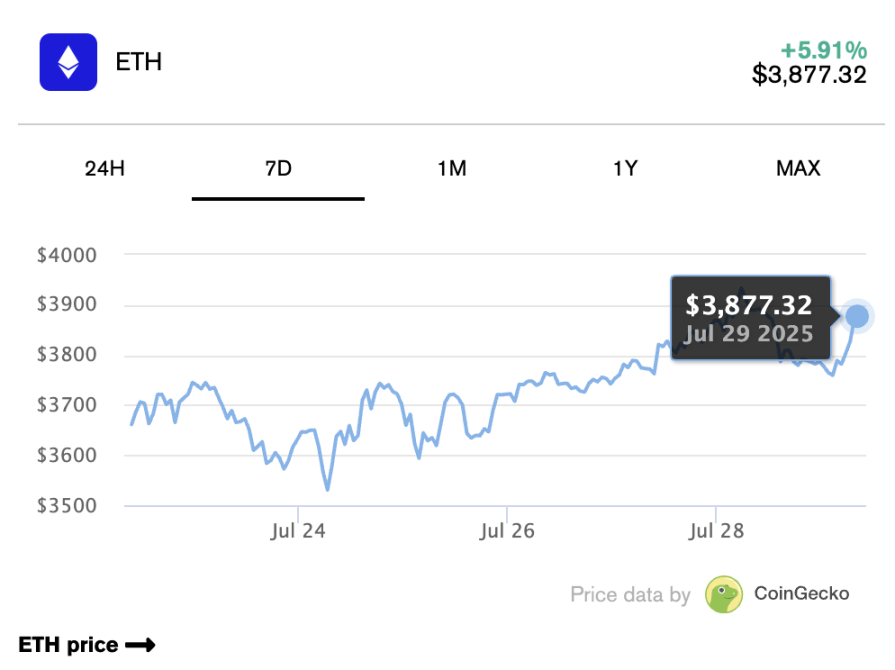
Ethereum briefly broke above $3,900 during Monday trading, reaching its highest level since early December, before pulling back. Over the past month, the asset has risen more than 50%, driven by the rise of Ethereum treasuries, improved Ethereum ecosystem conditions following the passage of the GENIUS Act, and growing market recognition of its application potential.
Several analysts predict ETH could surpass its previous all-time high of $4,800 this year, with BitMEX founder Arthur Hayes recently forecasting ETH could reach $10,000 within the year.
Tom Lee, chairman of BitMine Immersion, stated in a report on social media platform X that based on reset value data provided by research analysts, ETH could reach up to 18 times its current price—approximately $60,000. Of course, BitMine, as a holder, has inherent vested interests in such projections.
The Ethereum treasury model draws inspiration from Strategy (formerly MicroStrategy). After years of poor performance and stagnant stock prices, the company pivoted from software development to buying Bitcoin in 2020, and now holds nearly $72 billion worth of Bitcoin at current prices. However, analysts noted, "Risk management for Ethereum treasuries is more complex than the Strategy model."
Analysts said: "Michael Saylor insists on holding Bitcoin in liquid form on the balance sheet without lending it out for passive yield. Strategy places extreme emphasis on asset-liability management (ALM) and liquidity management."
"Moreover, Strategy frequently adjusts between debt and equity financing based on market sentiment to maintain a conservative debt level."
Join TechFlow official community to stay tuned
Telegram:https://t.me/TechFlowDaily
X (Twitter):https://x.com/TechFlowPost
X (Twitter) EN:https://x.com/BlockFlow_News
 Decrypt