








BNB hits new high: Is Binance considering a SPAC listing?
TechFlow Selected TechFlow Selected
BNB hits new high: Is Binance considering a SPAC listing?
BNB recently continued to hit new all-time highs, driven by a strategic transformation: shifting from an exchange token to an institutional-grade reserve asset backed by multiple listed companies.
 Navigating Web3 tides with focused insights
Author: Luke, Mars Finance
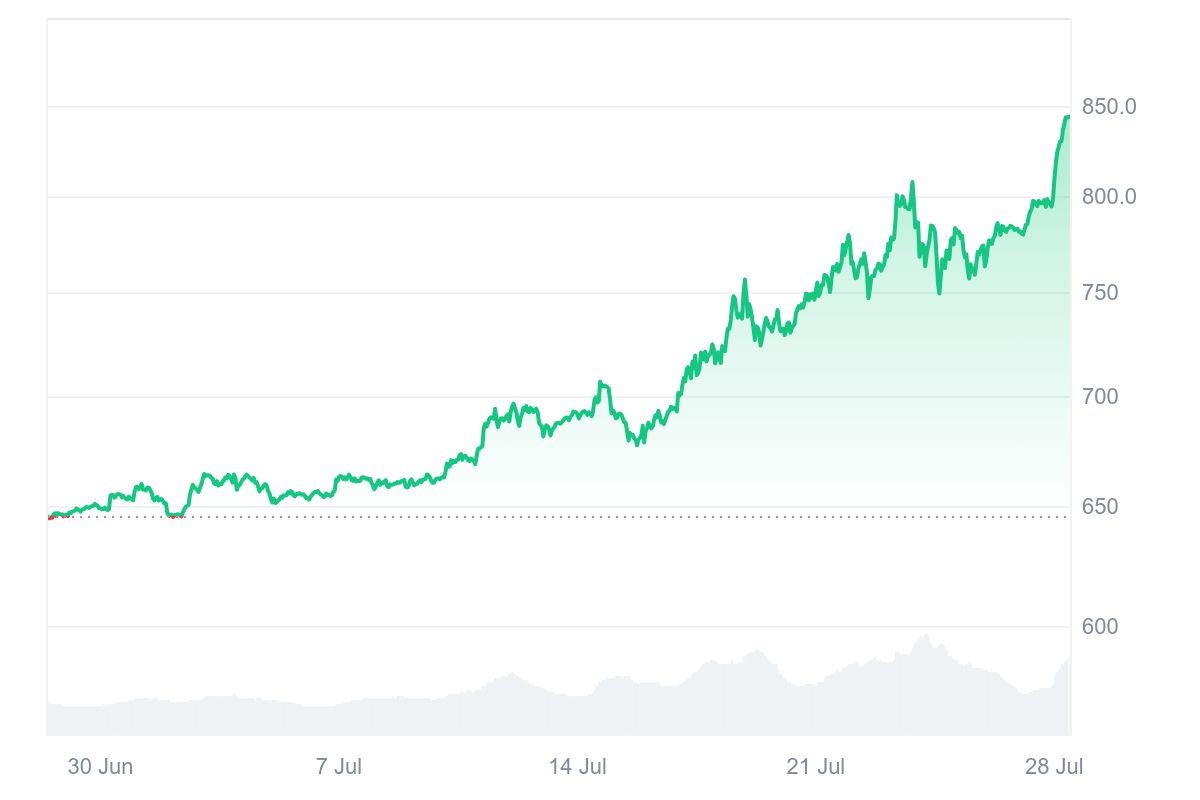
Recently, BNB's price movement has broken its long-standing dormancy, surging past $850 with astonishing force and continuously setting new all-time highs. This explosive rally has triggered widespread market discussion and investigation, leaving many observers puzzled. The market, accustomed to BNB’s stablecoin-like volatility, suddenly struggles to understand the driving forces behind this surge. However, the surface-level price spike is merely the tip of the iceberg. At its core lies what may be a carefully orchestrated, fundamental strategic shift: BNB is transforming from a functional token deeply tied to the fate of a single exchange into an institutional-grade reserve asset backed by the balance sheets of multiple public companies, aimed at traditional capital markets.
The heart of this transformation lies in the重塑 of its value capture mechanism. In the past, it was widely assumed that if Binance wanted to embrace mainstream finance, it would inevitably pursue a traditional initial public offering (IPO) path. While conventional, this route is fraught with obstacles—especially in heavily regulated markets like the United States. It would require BNB to be legally "de-risked" to avoid being classified as a security, but this very process imposes a heavy valuation constraint on BNB.
Now, a completely new and more Web3-native pathway is emerging. Instead of focusing on the compliant listing of a single entity, it aims to build a "BNB reserve asset alliance" composed of multiple independent public companies, creating a more decentralized and resilient bridge between BNB and Wall Street. The market’s recent dramatic reaction represents the first and most direct pricing of this nascent capital narrative.
Valuation Prison: The Self-Imposed Constraints of the IPO Path
BNB’s historically lackluster performance may stem from the central limitation of the traditional IPO path—the Howey Test. According to the U.S. Securities and Exchange Commission (SEC), a transaction qualifies as an "investment contract," or security, if it meets four criteria: investment of money, in a common enterprise, with an expectation of profit, derived primarily from the efforts of others. For exchange tokens, benefits such as participation in new project launches via platforms like Launchpad easily cross the line into "profits derived from the efforts of others (project teams and the exchange)."
To clear these regulatory hurdles, Binance has over the past several years conducted a series of precise, legally intentional iterations of its product suite. This was not mere feature upgrading, but rather a systematic "surgical operation" designed to strip away BNB’s securities characteristics.
The original Binance Launchpad followed a classic Initial Exchange Offering (IEO) model, where users holding BNB could participate in new project investments—a setup highly analogous to an investment contract. Later, Binance introduced Launchpool, shifting the model to liquidity mining. Users staked BNB and other assets to provide liquidity for projects and earned new token rewards. This subtly reframed the narrative from "investment" to "yield farming," weakening the legal connection to a "common enterprise" and "efforts of others."
The latest evolution is Megadrop, which not only requires users to lock up BNB but also introduces a system of completing Web3 tasks. This means part of the user’s return now depends on their active participation and "proof of work," rather than passive reliance on third parties. From Launchpad to Launchpool to Megadrop, BNB’s utility has progressively shifted from direct investment returns to reward mechanisms requiring greater user engagement—closer to native DeFi models.
The cost of these changes is evident. They diluted the strongest and most direct economic incentives for holding BNB, causing its performance during bull markets to lag far behind other major public chain tokens, with price volatility even approaching that of stablecoins. This "valuation prison," built in pursuit of a traditional IPO, while legally prudent, directly suppressed BNB’s market cap for years and laid the groundwork for the subsequent strategic pivot.
Pioneer Tron: A Financial Masterclass for Wall Street
Just as BNB struggled along the compliance path, another player in the crypto world—Justin Sun and his Tron—executed a textbook capital markets breakout, offering a fresh blueprint for mainstream crypto assets. Rather than pursuing the long and uncertain traditional IPO route, Tron entered the U.S. capital markets through a reverse merger with SRM Entertainment, a Nasdaq-listed toy manufacturer.
The brilliance of this move lay not in a simple shell listing, but in a sophisticated financial engineering feat. The pivotal step was when entities affiliated with Justin Sun used $100 million worth of TRX tokens to subscribe for shares in the newly restructured company (Tron Inc.). This created a precedent: using crypto assets themselves as capital to directly purchase entry into the traditional financial system. After the deal closed, Tron Inc.’s balance sheet prominently held hundreds of millions of TRX tokens, making it the world’s largest publicly listed TRX reserve. Justin Sun ringing the opening bell at Nasdaq symbolized a successful convergence between the crypto world and Wall Street.
Deeper analysis reveals the power of this financial strategy. It not only created a compliant, publicly tradable proxy vehicle for TRX—accessible to traditional investors who cannot or will not hold crypto directly—but also provided founders and early investors with an efficient value realization channel. Analysts noted that by injecting nearly zero-cost tokens into a public company at a protocol-determined price, then leveraging public market valuation premiums, one could theoretically generate billions in paper gains. This model simultaneously advances the asset narrative and solves the challenge of large-scale founder exits, delivering massive demonstration effects. It proved that bypassing the stringent scrutiny of direct IPOs and instead building public company asset reserves can achieve market cap revaluation and institutional acceptance.
BNB’s New Institutional Pathway
Inspired by Tron’s case, a broader and more sophisticated strategic blueprint centered on BNB is rapidly unfolding. It is no longer a solo act by one company, but an ambitious plan to create a "constellation of BNB reserve asset companies" made up of multiple public firms—diversified and generating sustained institutional demand.
The foundation of this initiative stems from a collaboration between CZ’s family office, YZi Labs, and investment firm 10X Capital. As reported by multiple outlets (e.g., CoinDesk, The Block), YZi Labs—formerly Binance Labs and managing over $10 billion in assets—publicly announced support for 10X Capital to launch a new company focused on purchasing and holding BNB, with plans to list on a major U.S. securities exchange. Crucially, the new company’s leader was confirmed to be David Namdar, co-founder of Galaxy Digital, a well-known Wall Street digital asset financial services firm. This appointment sends a clear signal: this is not an internal crypto play, but a serious effort led by top-tier traditional finance talent to open institutional funding channels.
Meanwhile, a market rumor sparked intense speculation: "CZ set up a public company, owns 28%, and is raising funds as a 'microstrategy for BNB.'" The rumor quickly spread, suggesting CZ was orchestrating the move behind the scenes. In response to the speculation, CZ himself briefly replied on X (formerly Twitter): "scam / fake." This initially confused the market, but soon deeper analysis clarified the facts: CZ’s response did not deny the entire BNB reserve strategy, but specifically refuted the inaccurate claim that he personally founded a public company and raised funds directly. The more accurate interpretation is that a new company with BNB as a strategic reserve does exist, led by CEO David Namdar, managed by 10X Capital, and with CZ’s YZi Labs as one of several investors—not the direct operator. This separation aligns with CZ’s current legal standing and explains why he labeled personal attribution claims as "fake."

Beyond this main thread, a "vanguard fleet" of pioneers has already launched, demonstrating remarkable capital firepower. Nasdaq-listed Chinese chip design firm Nano Labs announced a $1 billion BNB acquisition plan, funded by a $500 million convertible note issuance, aiming to hold 5% to 10% of BNB’s circulating supply long-term. Recently, the company has already purchased 120,000 BNB via over-the-counter (OTC) transactions, totaling approximately $90 million. Another Nasdaq-listed company, biotech firm Windtree Therapeutics, also announced a strategic pivot, securing financing commitments of up to $720 million through equity credit facilities, most of which will be used to buy and hold BNB.
The true scale of ambition was revealed in a comment by CZ elsewhere: "Over 30 teams" are exploring the creation of public companies with BNB as a reserve asset. This indicates that what we are witnessing is not isolated incidents, but an emerging, coordinated capital movement.

Compared to Tron’s single-point breakthrough, BNB’s "constellation" strategy is clearly a significant advancement. By cultivating a decentralized network of public companies, it builds a more resilient and scalable capital bridge. This structure diversifies risk, avoids dependence on any single entity, and creates persistent, multi-dimensional demand for BNB—an insightful application of Web3 decentralization principles to solve the problem of integration with traditional finance.
Mutual Wins: Building a Value Flywheel
Behind this strategic shift lies a sophisticated, mutually beneficial value model that skillfully integrates BNB, key stakeholders, and traditional capital market demands into a powerful positive feedback loop.
First, for the BNB asset itself, this strategy creates an unprecedented "permanent demand pool." When BNB is embedded in the balance sheets of multiple public companies, its identity shifts from a simple utility token dependent on on-chain activity to a digitally recognized commodity or strategic reserve asset endorsed by institutions. These corporate purchases, typically financed through capital market instruments like stock or convertible bond issuances, are structural and long-term, not short-term speculation. This provides solid floor support for BNB’s price and introduces a grand new narrative into its valuation framework—one based on institutional asset allocation.
Second, for CZ and the broader ecosystem, this is a highly intelligent move in the post-regulatory settlement era. By investing and supporting through his family office YZi Labs, CZ maintains legal and operational distance from Binance, the exchange from which he has stepped down as CEO. This allows him to comply with legal agreements while still advancing the BNB ecosystem. As one of the largest BNB holders, his core asset value rises in tandem with the success of the "BNB reserve constellation," without needing to sell tokens directly on the open market—perfectly balancing personal legal constraints with maximum ecosystem influence.
Finally, for traditional capital markets, this model solves the critical "access" problem. Countless institutions and individual investors are unable to invest directly in crypto due to compliance, custody, and other issues. But buying a Nasdaq-listed stock like Nano Labs (NA) or Windtree (WINT) is a simple, mature, and fully compliant process. These public companies act as "converters," encapsulating the complexity of the crypto world and providing traditional capital with a seamless interface—potentially channeling trillions of dollars from global equity markets into the BNB ecosystem.
Dawn of a New Paradigm
In summary, BNB’s recent price breakout is neither random nor baseless. It is an external signal of a profound internal transformation: from a utility token constrained by regulatory shackles to an institutional-grade reserve asset supported by public market capital. This transition does not follow the traditional IPO path, but instead draws inspiration from—and surpasses—Tron’s financial engineering by innovatively constructing a "constellation of reserve asset companies" composed of multiple public firms.
This model has the potential to create a powerful value flywheel: public companies buy BNB, driving up its price; rising BNB prices increase these companies’ asset values, boosting their stock prices; higher stock prices enable easier fundraising in capital markets; and the newly raised funds can then be used to buy even more BNB. Once this self-reinforcing cycle takes hold, it could provide sustained upward momentum for BNB.
Even more significantly, BNB’s experiment may herald the birth of a new paradigm—the "Asset-Backed Network." In this model, the value of a mature decentralized network is no longer defined solely by its on-chain economic activity, but also by the value of compliant, publicly traded assets backing it. This may point the way for all major crypto ecosystems to deeply integrate with the global financial system and draw strength from it. Thus, the record highs we are seeing for BNB may not mark the end of this cycle, but rather the beginning of a much larger narrative.
Join TechFlow official community to stay tuned
Telegram:https://t.me/TechFlowDaily
X (Twitter):https://x.com/TechFlowPost
X (Twitter) EN:https://x.com/BlockFlow_News






