








The tokenized stock market size is expected to grow 2,600 times—who will benefit?
TechFlow Selected TechFlow Selected
The tokenized stock market size is expected to grow 2,600 times—who will benefit?
From 500 million to 1.34 trillion: infrastructure, participants, and the path to mass adoption.
 Navigating Web3 tides with focused insights
Author: Tiger Research
Translation: AididiaoJP, Foresight News
Executive Summary
Market Opportunity: The tokenized stock market is currently valued at $500 million. However, if just 1% of global equities were tokenized, the market could reach $1.34 trillion by 2030—a potential 2,680x growth. This expansion would be driven primarily by regulatory clarity and mature infrastructure expected in 2025.
Value Proposition: Tokenized stocks enable 24/7 global trading and ownership of equity-linked tokens. Their key differentiation lies in integration with decentralized finance (DeFi), allowing investors to use stocks as collateral for lending and yield generation without selling their positions.
Why It Works: Unlike other real-world assets (RWA) that require creating demand from scratch, tokenized stocks tap directly into the $134 trillion global equity market and address well-defined pain points. The combination of existing demand and solvable inefficiencies makes this category one of the most promising for mass adoption within RWA.
Merging Worlds: Crypto and Traditional Finance Converge
Traditional finance and the crypto industry are moving toward each other.
On one hand, institutions like Citigroup and Bank of America are preparing to issue stablecoins. On the other, projects such as Injective and Backed Finance are tokenizing stocks like Apple and Tesla and bringing them on-chain.
As traditional institutions adopt blockchain technology and Web3 projects tokenize equities, the boundary between these two industries is gradually dissolving.
This convergence has accelerated after "Crypto Week," a period of regulatory activity focused on digital assets, during which the GENIUS Act brought stablecoins under federal oversight. Rather than competing, Wall Street and DeFi are increasingly becoming complementary.
Traditional finance has clear incentives to integrate crypto. Beyond innovation potential, crypto markets have proven profitable, while traditional financial brands can offer the trust currently lacking in the crypto space. Yet the reverse logic—why crypto platforms should tokenize stocks—is less obvious. The market remains early, with diverse and often speculative motivations.
This report explores this question by analyzing the structure of the tokenized stock market and its key players.
What Is the Tokenized Stock Market?
The tokenized stock market refers to converting traditional stocks into digital tokens on a blockchain. These tokens aim to reflect the value of the underlying stock but typically do not confer shareholder rights. Most tokenized stocks exist in derivative form rather than representing direct stock ownership.
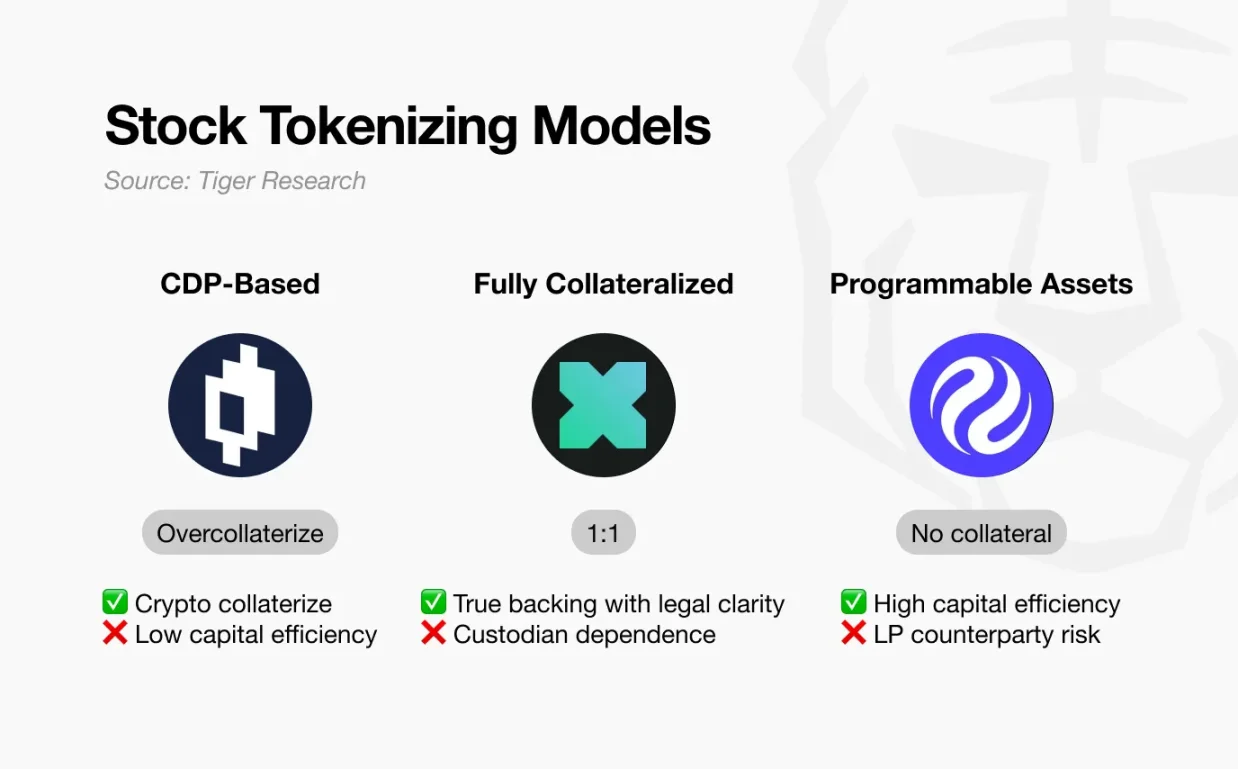
Although the first wave of tokenized stocks emerged in 2021, most early models (such as Mirror Protocol) failed to scale due to inefficiencies and systemic risks—especially within ecosystems like Terra. Recent approaches have introduced improved mechanisms with stronger capital dynamics and compliance frameworks, led by platforms like Injective and xStocks.
Interest in tokenized stocks has surged alongside the rise of RWA (real-world assets), now a central narrative in the crypto market.
Beyond these direct advantages, tokenized stocks unlock new use cases through composability. Existing outside traditional regulatory constraints, they can serve as collateral in lending protocols or generate yield within DeFi applications.
For example, an investor in Indonesia seeking exposure to Tesla stock traditionally needs to open a foreign brokerage account, complete paperwork, pay currency conversion fees, and trade only during limited hours. With tokenized stocks, the same investor can instantly purchase a Tesla token via smartphone and deploy it in DeFi protocols for lending, liquidity provision, or yield generation.
Possible Scenario: 1% Tokenization of Global Equities
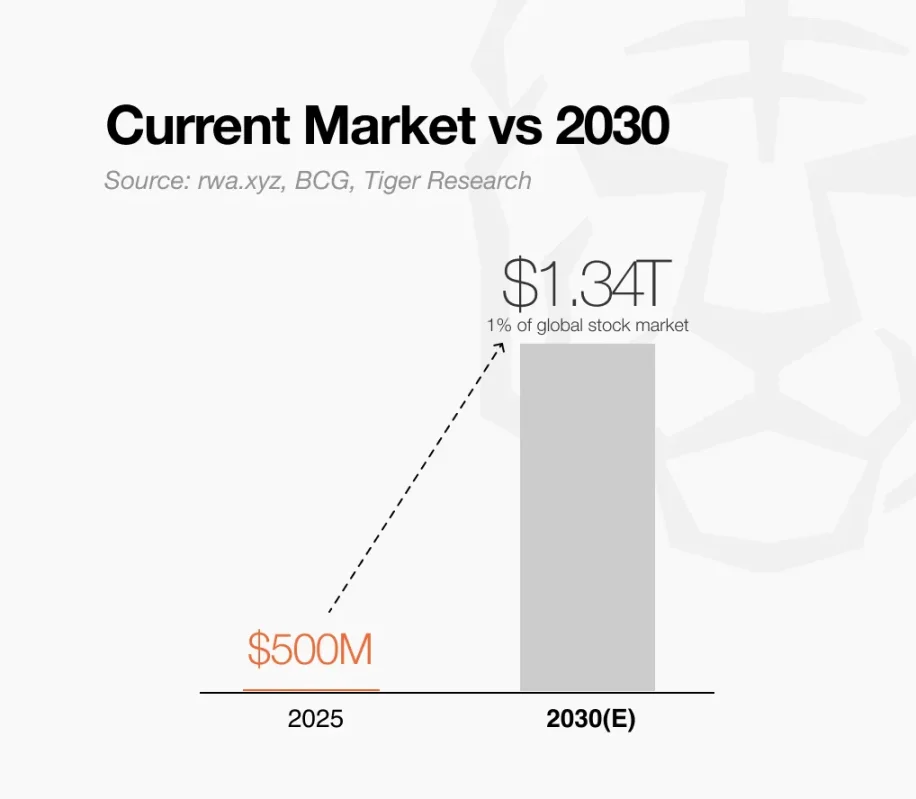
The tokenized stock market is still in its infancy. According to data from rwa.xyz, the current market size is approximately $500 million. Compared to the $134 trillion global equity market, this represents only 0.0004%. However, if just 1% of global equities become tokenized over the next decade, the market could grow to $1.34 trillion—2,680 times its current size.
A Turning Point in 2025
The second half of 2025 may prove pivotal. While still early, trading volume for tokenized stocks within the Solana ecosystem surged from $15 million to $100 million in one month—an increase of 566%.
More importantly, regulated participants are entering the space. Major fintech firms are expanding tokenization services globally, with Robinhood announcing launches in Europe. As the market expands from North America into Europe and Asia, regulatory clarity will act as a catalyst. In particular, once stock tokenization begins under the EU's MiCA framework, rapid market growth is expected.
Conditions for Success by 2030
Achieving 1% tokenization of the global equity market by 2030 requires compelling justification. Investors must have strong incentives to shift from traditional systems to tokenized platforms. This transition will only occur when four key conditions align.
First, cost savings must be demonstrated.
Theoretically, brokerage, settlement, and administrative costs could be reduced by 50–70%, but this must be proven in practice. If tokenization significantly lowers foreign exchange and cross-border transaction costs, it will offer a powerful alternative for global investors.
Second, the utility of 24/7 trading must be validated.
Tokenized stocks should support continuous trading across Asian, European, and U.S. markets. By eliminating time restrictions of traditional exchanges, they can provide higher liquidity and real-time responses to global events, improving overall trading efficiency.
Third, DeFi-based secondary yield generation must become a core feature.
Tokenized stocks should not only function as tradable assets but also serve as foundational components in DeFi protocols. If investors can use them as collateral for loans, participate in AMM-based options, provide liquidity, or execute automated portfolio strategies, they gain additional returns without selling. As these mechanisms mature, they reinforce tokenization’s main advantages—cost efficiency, accessibility, and continuous trading—making the shift away from traditional systems increasingly attractive.
Key Players in the Tokenized Stock Market
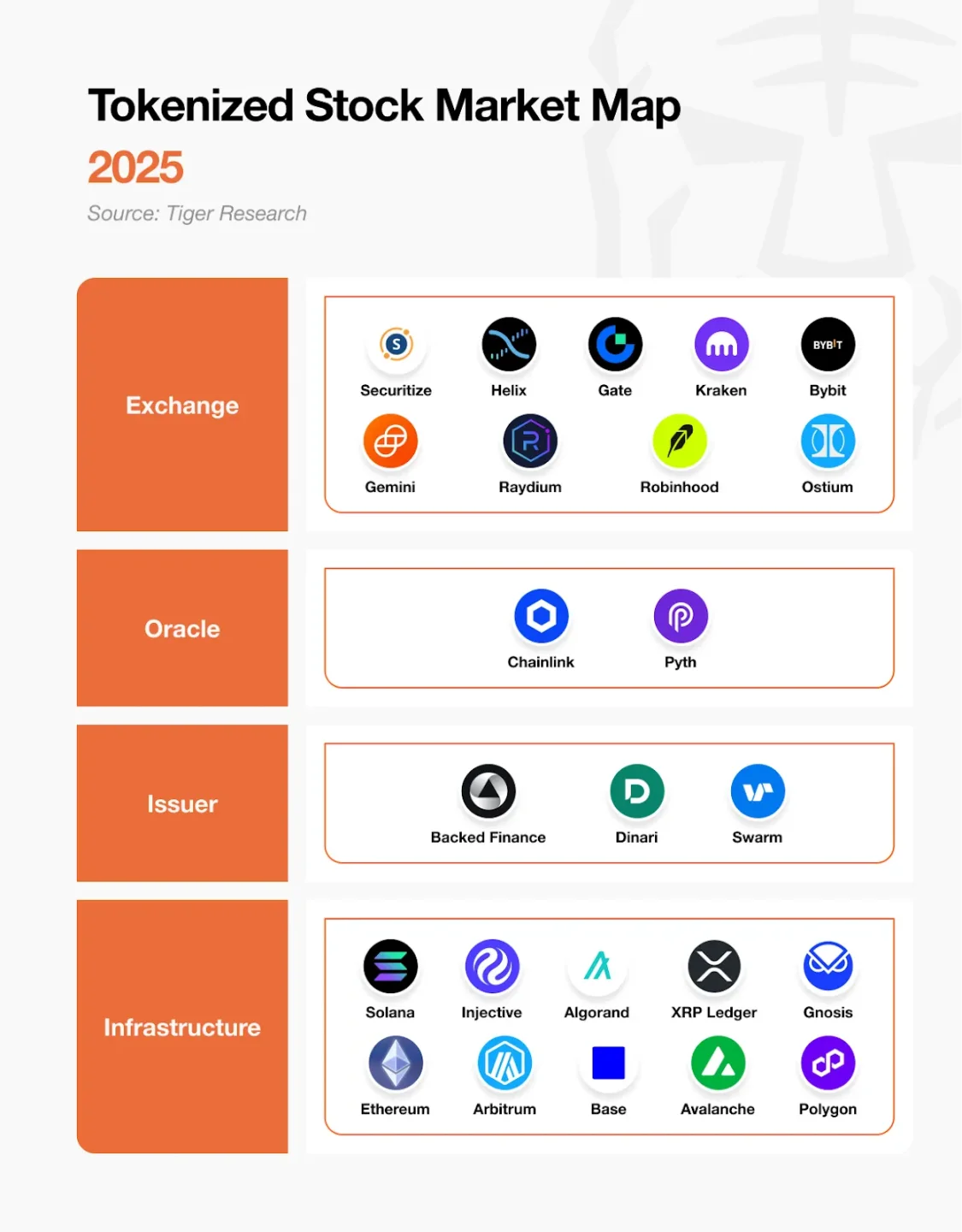
The tokenized stock market operates across four core layers that work in coordination.
The base layer is the infrastructure layer, consisting of blockchain networks where all transactions occur. Above it are issuers responsible for creating tokenized representations of traditional stocks. To ensure accurate price tracking, oracles deliver real-time market data and maintain the link to the underlying asset. Finally, exchanges allow investors to buy and sell tokenized stocks.
A fully functional tokenized stock ecosystem requires all four layers. Missing any one component leaves the system without essential elements for secure issuance, pricing, and trading.
How Tokenization Works in Practice
Suppose an investor wants exposure to Apple ($AAPL) in tokenized form. They could trade iAAPL with up to 25x leverage on Helix, purchase the spot token $xAAPL issued by Backed Finance on Kraken, or, as a European resident, access U.S. equities around the clock via Robinhood EU. Each exchange operates under different regulatory environments and trading models, catering to diverse investor needs.
To ensure tokenized stocks accurately reflect real stock prices, reliable market data is critical. For instance, Chainlink pulls Apple’s real-time price from Nasdaq and uploads it on-chain. It also provides proof of reserves, verifying that each token is backed 1:1 by the corresponding Apple stock. This ensures investors can trust the price integrity of the token.
Issuers convert traditional stocks into tokenized assets. Backed Finance holds actual Apple shares in custody at a Swiss bank and issues $xAAPL tokens at a 1:1 ratio. In contrast, Injective’s $iAAPL uses iAssets without holding the underlying stock, synthetically tracking the price via oracle data to enable leveraged trading without physical settlement. These two approaches represent different paths for connecting traditional equities with blockchain infrastructure.
All trades and token transfers occur on blockchain networks. On Solana, Backed Finance’s xStocks enables low-latency, low-cost trading. Injective supports high-performance order book-based trading. On Ethereum and Arbitrum, Dinari’s dShares operates under U.S. regulatory compliance. Each chain offers distinct technical capabilities to meet the infrastructure needs of tokenized stock platforms.
Major Participants in the Tokenized Stock Market
Key players in the tokenized stock market are shaping the ecosystem through different strategies and capabilities. Below is a summary of major companies and their current positioning:
Injective: Leader in tokenized stock perpetual contracts. Cumulative trading volume exceeded $1 billion by the first half of 2025. Through its Helix DEX, it offers up to 25x leverage, driving liquidity in the derivatives segment.
xStocks (Backed Finance): Accounts for 80% of the top 10 tokenized stocks by market cap. Uses a 1:1 backing model with shares held in custody at a Swiss bank, widely adopted within the Solana ecosystem.
Robinhood: Expanded into Europe in 2025, offering over 200 tokenized U.S. and private stocks. Provides zero-fee trading on Arbitrum with 24/5 availability.
Gemini: Partnered with Dinari Global to offer more than 60 tokenized stocks to EU investors. Compliant with MiFID II, operating within European regulatory frameworks.
Securitize: A leading platform for tokenizing real-world assets, including U.S. Treasury tokens like $BUDIL. Also offers $312 million worth of stock tokenization products, with the largest single asset deployment on Algorand.
Chainlink: Provides critical data infrastructure, including real-time stock and ETF price feeds, and verification of reserve backing for asset collateral.
The Role of Tokenized Stocks in the RWA Market
A Narrow but Highly Viable Niche
Tokenized stocks represent only one segment within the broader real-world asset (RWA) market. Without regulatory clarity, adoption will remain constrained. However, this barrier is beginning to ease. Robinhood has announced tokenized stock offerings in Europe, with other major platforms following suit. As more jurisdictions align with these developments, regulatory acceptance is likely to expand.
Proven Demand and Clear Pain Points
The strength of this market lies in its fundamentals. Stocks are already widely traded assets with clearly established demand. At the same time, long-standing inefficiencies persist in trading processes—particularly regarding access, settlement speed, and geographic limitations. The combination of proven demand and addressable pain points makes equities an ideal starting point for tokenization.
Unlike other RWA categories that must first create demand, tokenized stocks build directly on the $134 trillion global equity market. The case for tokenization is strengthened by tangible benefits: lower costs, broader access, 24/7 trading, and DeFi integration. As regulatory frameworks mature, these advantages will drive accelerated adoption of tokenized stocks.
Join TechFlow official community to stay tuned
Telegram:https://t.me/TechFlowDaily
X (Twitter):https://x.com/TechFlowPost
X (Twitter) EN:https://x.com/BlockFlow_News
 @tiger_research


