Who defeated the "gold standard"?
TechFlow Selected TechFlow Selected
Who defeated the "gold standard"?
Virtual currencies outperform due to payment convenience, technological innovation premium, and supply scarcity, offering investors an alternative allocation to hedge against weakening dollar credibility, especially during periods of frequent geopolitical conflicts
 Navigating Web3 tides with focused insights
Author: Li Xiaoyin, Wall Street Insights
Against the backdrop of normalized global geopolitical risks, weakening of the dollar's credit system, and rising economic uncertainty, gold has become the "benchmark" for measuring asset value.
In a research report released on the 16th, Zhejiang Commercial Securities analysts Liao Jingchi, Wang Daji, and others stated that under a hypothetical "gold standard" framework reviewing asset performance, very few assets have outperformed gold since 2018, with only select cryptocurrencies, micro-cap stock indices, precious metals sectors, and small-cap size factor strategies achieving positive returns.
The report said this reflects macro characteristics such as a weakening dollar credit system, normalized global geopolitical risks, and rising economic uncertainty, highlighting gold’s long-term allocation value as a safe-haven asset.
By sector, Zhejiang Commercial Securities pointed out that only high-dividend stocks have been relatively resilient in the long term, while fintech—especially cryptocurrencies—has significantly led recently. Among secondary industries, precious metals stand alone, with new drivers outperforming old ones. From the perspective of style and strategy factors, small-cap市值 is the absolute winner, with the micro-cap stock index outperforming gold across all periods.
Major Asset Classes: Cryptocurrencies Stand Out, Others Mostly Driven by Liquidity
According to the Zhejiang Commercial Securities report, from March 2018 to June 2025, among major asset classes priced in gold, only a few cryptocurrencies achieved positive returns, while other categories generally underperformed.
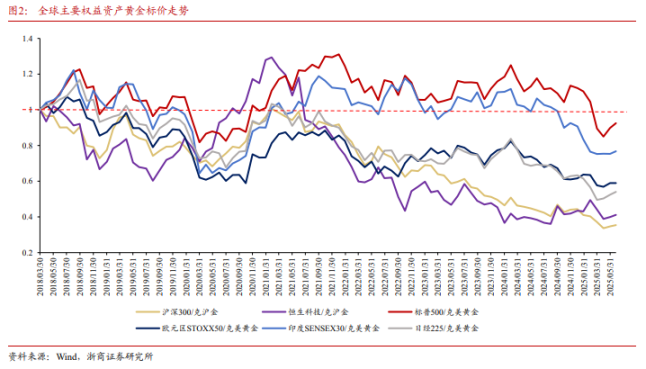
The report noted that cryptocurrencies outperformed due to payment convenience, technological innovation premiums, and supply scarcity. For example, Bitcoin's halving mechanism reinforces its "digital gold" attribute, offering investors an alternative allocation to hedge against a weakening dollar credit system, especially during frequent geopolitical conflicts.
Equity assets showed strong nominal growth but were relatively weak when measured in gold, mainly relying on liquidity injections. For instance, the peak 26.7% growth rate of U.S. M2 fueled U.S. stocks, but after removing "money illusion," real returns were limited, warning investors of downside risks during liquidity drawdowns.
The weak performance of fixed income and commodities reflects rising economic uncertainty. Silver’s relative resilience stems from tight supply and demand, while crude oil fell 61.7% due to increased shale oil production, potentially exacerbating volatility exposure for energy investors.
In real estate, U.S. and Indian housing prices underperformed less, benefiting from economic resilience and demographic dividends, but overall still lagged behind gold.
Sector Performance: New Drivers Outperform Old, High Dividends Provide Buffer
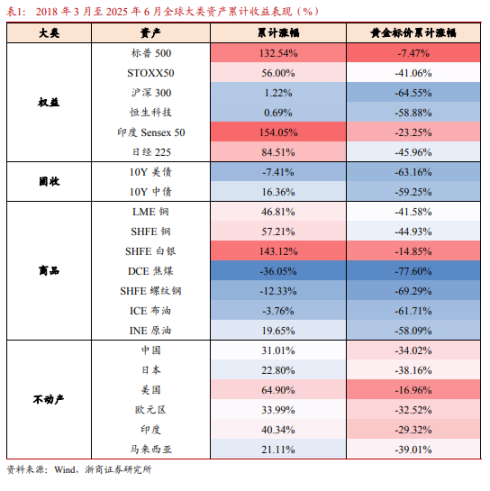
The report shows that since 2018, all CSI primary sectors underperformed gold, but resources and new drivers were relatively stronger. Coal and banking high dividends (averaging 5.8% and 4.8%, respectively) narrowed the gap; including dividends, the underperformance was smaller.
Meanwhile, new-driver sectors represented by electric new energy and TMT underperformed less than old-driver sectors represented by the real estate chain.
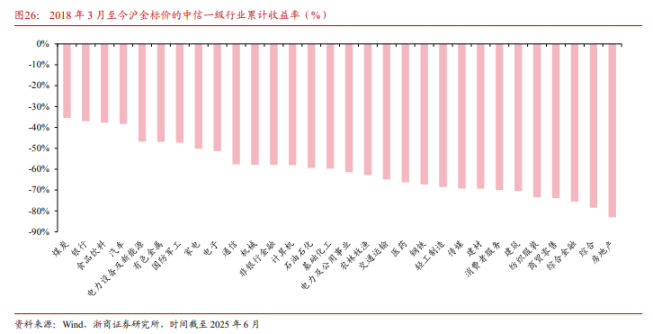
In the past year, along with China’s economic transition from old to new drivers, large finance and technology sectors outperformed comprehensive finance, non-bank finance, and sectors such as computing, media, and defense military industries outperformed gold, primarily benefiting from rising risk appetite, virtual asset theme catalysts, and tech asset revaluation. In contrast, resources, consumer goods, and real estate chains significantly underperformed.
Among secondary industries, since 2018, only precious metals have outperformed. Emerging technologies such as semiconductors have performed better than traditional technologies since 2018. A barbell allocation (e.g., banks + consumer electronics) could reduce losses by 39.8%, achieving more stable performance.
In the past year, large finance, new consumption, technology, and military sectors emerged victorious, with emerging financial services II (related to digital currency), securities II, cultural entertainment (self-pleasure new consumption), semiconductors, and arms and equipment II outperforming gold, primarily driven by rising risk appetite, virtual asset theme catalysts, and tech asset revaluation.
The weakness in resources and real estate chains reflects insufficient demand, suggesting investors may need to shift toward varieties with higher earnings certainty.
Style and Strategy: Small-Cap Dominates, Micro-Cap Reverse Mechanism Stands Out
From the perspective of style and strategy factors, small-cap市值 has become the absolute winner.
Among A-share weighted styles, the report shows that since 2018, only the micro-cap stock index outperformed gold, benefiting from contrarian investment mechanisms, low valuations, and liquidity premiums. Its price movements are negatively correlated with ROE and positively correlated with PB.
In the past year, micro-cap stocks and financial styles outperformed gold. Notably, dividend style underperformed significantly, with severe internal divergence—only banks held up well, while other cyclical dividend sectors performed poorly.
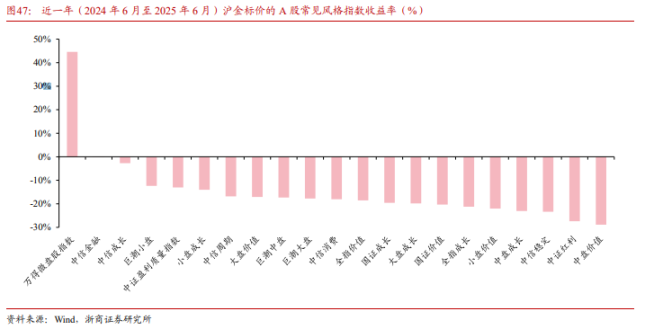
In terms of strategy indices, small-cap factors clearly led, with earnings pre-increase strategies performing relatively well. Since 2018, the small-cap size factor has outperformed Shanghai gold, while large-cap lagged, reflecting industrial transformation favoring emerging small-caps.
The main views in this article are derived from the July 16 report by Zhejiang Commercial Securities analysts Liao Jingchi, Wang Daji, and Gao Qisheng titled "Who Has Defeated the 'Gold Standard'? — A Deep Review of Assets, Styles, Industries, and Gold."
Join TechFlow official community to stay tuned
Telegram:https://t.me/TechFlowDaily
X (Twitter):https://x.com/TechFlowPost
X (Twitter) EN:https://x.com/BlockFlow_News