Huang Renxun: 30 Years After Financial Freedom, I Have No Dreams
TechFlow Selected TechFlow Selected
Huang Renxun: 30 Years After Financial Freedom, I Have No Dreams
Few CEOs can be so poised during difficult times.
 Navigating Web3 tides with focused insights
Author: Jingyu, GeekPark
The last foreigner in China to wear a Tang suit and cause a sensation was Don King, former manager of boxing champion Mike Tyson. More than two decades later, the second is Jensen Huang, founder of Nvidia, whose current standing in the tech world may even surpass that of Tyson at the peak of his boxing career.
On July 16, Beijing time, at the "Chain Expo" held in Beijing, Huang, visiting China for the third time within a year, swapped his signature leather jacket for a Tang suit during his speech—marking another shift from his formal suit appearance three months earlier when meeting with senior officials.
"I look pretty good in a Tang suit, don't I? Someone gave it to me as a gift."
During media interviews on the afternoon of the 16th, Huang switched back into his leather jacket and joked with reporters in Chinese, clearly in high spirits—understandably so. The day before the Chain Expo, Nvidia's H20 chip, previously banned from export, had regained its export license, meaning it could resume supplying Chinese tech companies. Additionally, a new RTX Pro chip designed specifically for digital twins and robotics will also be launched in China.
Huang shared his views on topics ranging from his photo-op with Lei Jun, Huawei's chips, to the recent AI talent war frenzy sweeping Silicon Valley.
Just days ago, Nvidia became the first company globally to surpass a $4 trillion market cap. Yet this creator of the world's most valuable company claims he has "no dreams."
Talking AI with Lei Jun, eager to buy an SU7 Ultra
Two days before the Chain Expo, photos of Huang and Lei Jun went viral across social media. During the event, Huang spoke highly of Lei Jun and Xiaomi, saying he had met Lei decades ago and already predicted he would build a highly successful company—just like Xiaomi today.
Years later, reuniting once again, Huang said he discussed AI and Xiaomi's cars with Lei Jun. Regarding Xiaomi's hottest current product—the Xiaomi SU7 Ultra—he expressed strong interest in purchasing one, praising China's new energy vehicles as excellent. However, since the popular electric car isn't sold in North America, he said he could only feel "very regretful."
Of course, Huang also praised products from Geely, XPeng, and Li Auto, calling them equally outstanding. Unsurprisingly, these companies are direct customers of Nvidia's Orin and Thor autonomous driving chips. Nvidia covers every aspect of autonomous driving—from chips and design to simulation and training—generating $5 billion annually for the company. With the rollout of Thor chips, the market size continues to expand, and Nvidia still faces no truly capable challengers in the high-end intelligent driving chip sector.
"We’re always grateful and look for smart customers who try to innovate, because they help keep our technology innovative," Huang said.
H20 isn’t the best, but it’s still excellent
One day before the event, Nvidia announced that the U.S. had approved export licenses for the H20 chip. This AI chip, banned for several months, will soon resume supply to Chinese customers.
This is good news for both Chinese AI and internet giants, as well as for Nvidia itself—AI chips are essential for model training and inference; for Nvidia, the Chinese market accounts for 15% of global revenue, making it critically important, hence Huang’s third visit within six months.
Compared to Nvidia’s latest chips such as the GB300 unveiled at GTC in March, the H20 is clearly not Nvidia’s top-tier AI chip. But Huang insists the H20 remains "very excellent."
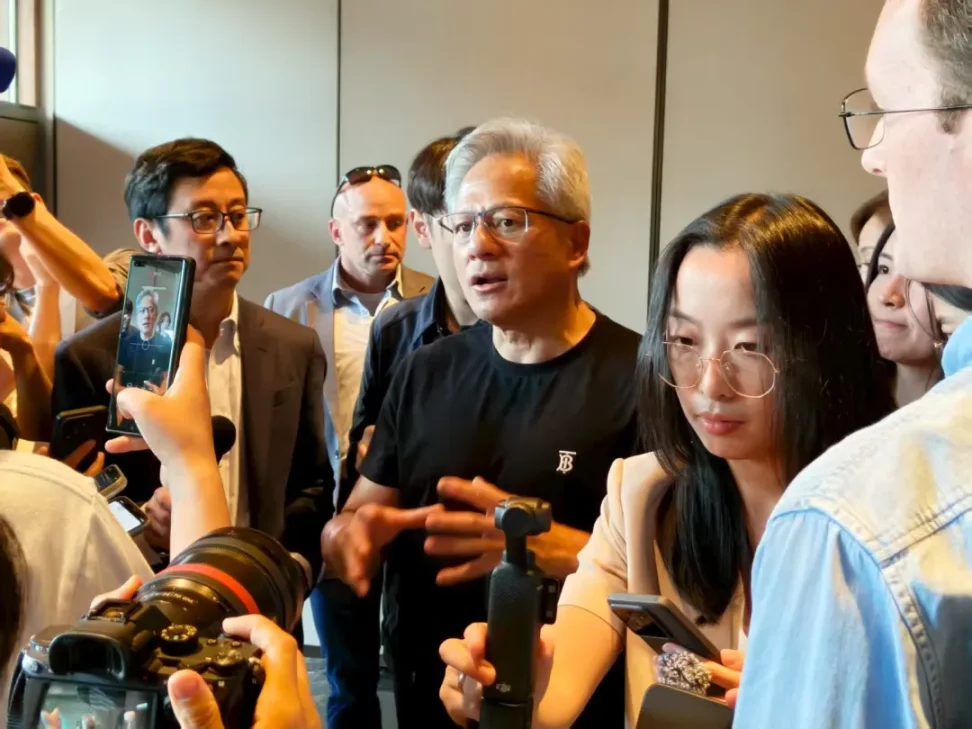
Huang is surrounded by reporters, again!|Image source: GeekPark
"The H20 isn’t our best product, but you know, I have many 'children'—I won’t rank them."
Huang explained that different products are designed for different use cases. He noted that H20 excels in system memory bandwidth and efficiency. For models currently being developed like DeepSeek, Qwen, and Kimi, the H20 chip is particularly suitable.
Meanwhile, Nvidia will also launch the RTX Pro chip in China, based on the Blackwell architecture. Its key advantage lies in computer graphics and ray tracing capabilities. Ray tracing is crucial for sensor simulation—such as lidar and radar—as well as computer graphics. With this technology, users can simulate sensors inside digital factories, autonomous vehicles, or robots.
In other words, the primary application of RTX Pro is digital twin, serving as critical hardware infrastructure for Nvidia’s evolving Omniverse platform. Customers use Omniverse not only to build digital factories but also for design, simulation, and training—making it one of Nvidia’s most important business segments and growth drivers.
Meta’s “money-burning talent grab” proves Zuckerberg’s vision
Nvidia isn’t the only one obsessed with AI. Across Silicon Valley, "talent acquisition" has become the hottest trend. For instance, Meta spent $14.5 billion acquiring half of Scale AI, bringing its founder Alexandr Wang onboard and establishing a new AI lab, effectively draining talent across Silicon Valley.
Huang believes AI is clearly destined to become a multi-trillion-dollar industry. Meta sees this opportunity, and its founder Mark Zuckerberg wants Meta to become an "AI First" company—especially since Meta has already built massive AI data centers.
"I think his decision to go all-in on AI is a very good one."
While Meta may be advancing rapidly, other companies losing talent might not be happy—Apple, for example, recently lost key foundational model engineers to Meta. Apple has faced criticism for repeated delays of its AI product, Apple Intelligence, and is seen as lagging behind in this wave of AI advancement.
However, Huang, holding a Google Pixel phone, believes Apple has ample talent and resources. Their apparent delay, he says, is simply because they are "moving on their own timeline." As for why he uses a Google Pixel, it’s because Nvidia also develops Android systems, and the Pixel runs pure, stock Android.
"No extra stuff, simple and clean—I really like it."
Financially free for a long time, no dreams
Last week, Nvidia became the first company globally to exceed a $4 trillion market cap—an extraordinary achievement for any founder and CEO.
Yet Huang doesn’t seem particularly excited by it.
"I’m probably the only person in the world who has enjoyed being CEO of both the lowest-valued and highest-valued company." Huang explained that Nvidia once hit rock bottom, with its market value nearly zero, and he himself stayed low-key for a long time. Now, with the highest market cap globally, what matters more than valuation is what the company does—creating a new computing paradigm (accelerated computing) and leading the recent AI revolution.
That said, with Nvidia’s market cap surpassing $4 trillion, Huang’s net worth has risen to $143.6 billion, ranking him seventh on the global billionaire list.
Still, for Huang, this isn’t something worth boasting about—at least not something that gives him grand new dreams.
"I’ve been wealthy for a very long time. Being wealthy just means you have enough money. When you have enough, you don’t worry about your children or family—you can send them to school, provide a good life for your loved ones—and then you can focus on doing other things, like building Nvidia, taking bigger risks, maybe contributing to others, helping others."
Still, until the end of the interview, Huang did not reveal who exactly gave him the Tang suit.
Join TechFlow official community to stay tuned
Telegram:https://t.me/TechFlowDaily
X (Twitter):https://x.com/TechFlowPost
X (Twitter) EN:https://x.com/BlockFlow_News
 极客公园
极客公园