A New Dawn for the "World Computer": Envisioning the Emerging Future of Ethereum
TechFlow Selected TechFlow Selected
A New Dawn for the "World Computer": Envisioning the Emerging Future of Ethereum
From account abstraction and interoperability to rollup collectives, a unified, open, permissionless internet of value is rapidly taking shape.
 Navigating Web3 tides with focused insights
Author: imToken
You may have heard these claims:
-
Solana is about to overtake Ethereum
-
Ethereum's transaction fees are too high; its ecosystem is declining
-
Ethereum's upgrades are too slow, lacking narratives to support its price...
But is that really true?
If you're an OG who joined the space in 2017, you might remember what crypto was like back then: fast transactions, low fees, simple operations, no need to switch networks in your wallet—everything was straightforward.
Today, Ethereum is returning to that "simple yet powerful" user experience—and going even further. Just as Emperor Qin unified China with standardized axles and script, Ethereum is reshaping its foundation through a modular strategy: the mainnet focuses on security and settlement, while Layer2 handles performance and user experience.
Can you imagine:
-
Smart contract wallets becoming increasingly common?
-
Paying less than one cent in transaction fees on Ethereum?
-
Enjoying Web2-level smoothness when using on-chain applications?
All of this is already happening. Technologies like Rollup, EIP-4844, and account abstraction are building a fluid, flexible, secure, and unified Ethereum (Unified Ethereum).
The Foundation of Trust: The Unshakable Ethereum Mainnet
We observe that despite high-frequency activity shifting to Layer2 and TRON gaining stablecoin market share, the Ethereum mainnet remains the core hub for capital, protocols, and developers.
1. Data Speaks: Economic Dominance
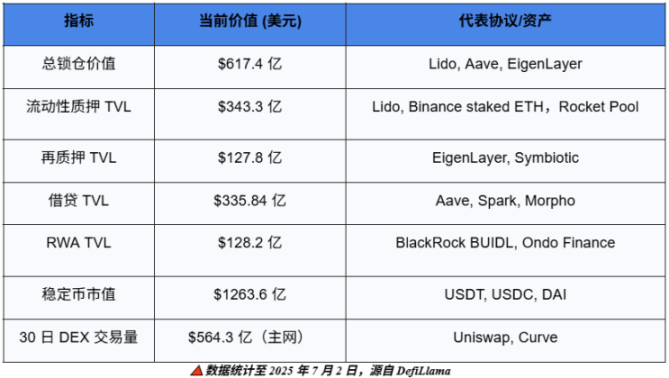
On-chain data doesn't lie. Ethereum’s total value locked is approximately $62 billion, far surpassing other blockchains. Its stablecoin market cap exceeds $126 billion, making it the world’s largest stablecoin issuance and circulation network. Its ecosystem drives the majority of thousands of billions in monthly trading volume across decentralized exchanges (DEXs).
2. Strategic Shift: Becoming the Secure Base for Trillion-Dollar Assets
Today, Ethereum’s vision of being a “world computer” has evolved into a more practical near-term role: the “world ledger”—a neutral, secure settlement layer for global finance and digital assets. The Ethereum Foundation’s “Trillion-Dollar Security” initiative aims to make Ethereum robust enough to securely handle assets equivalent to the entire UK stock market, paving the way for “World Onchain.”
3. Institutional Adoption: Traditional Finance Building on Ethereum
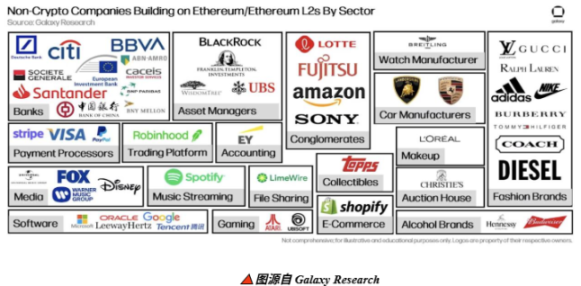
From JPMorgan Chase’s JPM Coin, Franklin Templeton’s on-chain funds, to BlackRock’s BUIDL, Wall Street is building its future on Ethereum. Regulatory frameworks like MiCA (Markets in Crypto-Assets Regulation) are clearing the path for large-scale compliant capital inflows.
The Engine of Growth: The Full Bloom of Layer2
Ethereum scaling has moved from theory to reality, reshaping the blockchain landscape with new divisions of labor:
1. Costs Plummet, Transaction Volume Surpasses Mainnet
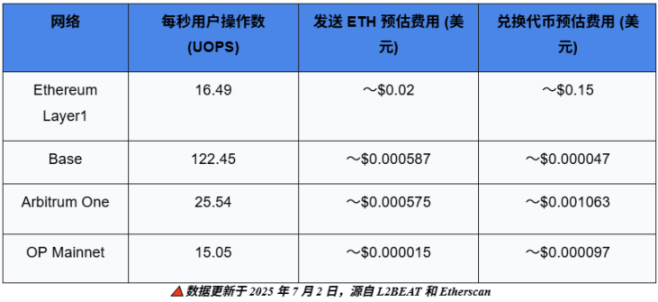
Today, daily transaction volumes on major Layer2s like Base, Arbitrum, and OP collectively far exceed the mainnet, thanks to cost reductions of 10x to 100x. This makes “free transactions” not just a commercial dream but a real possibility. With entrants like Robinhood launching tokenized stocks, Layer2 is set to welcome even higher-frequency and more diverse transaction flows.
2. Dencun Upgrade: A Dedicated Highway for Layer2
The Dencun upgrade introduced “Blobs”—temporary data spaces designed specifically for Layer2. Unlike the expensive permanent storage on the mainnet, Blobs reduce Layer2 data publication costs by 100–200x, marking a pivotal moment in the scaling revolution. Future technologies like PeerDAS and ePBS will further expand this data highway.
Experience Revolution: Account Abstraction, the Final Mile to Mass Adoption
If Layer2 solves the problem of being “expensive,” account abstraction tackles the issue of being “hard to use.” This is Web3’s final hurdle before welcoming the next billion users.
Account abstraction aims to turn your wallet into a programmable “smart account,” delivering transformative experiences:
1. Say Goodbye to Gas Fees Forever
In the future, using DApps won’t require worrying about Gas or buying ETH. Through the Paymaster mechanism, DApps can pay Gas for you, or you can directly use stablecoins like USDT. Transactions become as natural as breathing.
2. End the Anxiety of Seed Phrases
Forget that nerve-wracking 12- or 24-word seed phrase! With social recovery (verified by friends or family) or email recovery (via zk-Email technology), recovering your account becomes simple and secure.
3. Web2-Level Smooth Login and Payments
No more constant pop-up signature requests!
-
Passkey: Authorize transactions directly with Face ID or fingerprint—private keys and signatures vanish from view.
-
Session Keys: When playing a blockchain game or performing frequent actions, authorize once and enjoy uninterrupted access within a defined time window, free from repeated signing.
The Unified Landscape: From “Islands” to a Connected Continent
After solving the problems of “high cost” and “difficulty of use,” Ethereum’s final challenge is fragmentation. Assets and identities remain trapped on isolated Layer2 “islands,” and cross-chain experiences are still complex and slow.
Interoperability technologies are the missing puzzle pieces that connect these islands into a unified continent.
-
Intents: From “How” to “What”
In the future, you won’t need to worry about complicated cross-chain steps. Simply state your goal—e.g., “I want to swap 100 USDC on Arbitrum for as much ETH as possible on Base.” Specialized “Solvers” in the system will automatically calculate and execute the optimal path, completing everything seamlessly in the background without your involvement.
-
Shared Sequencers: Atomic Cross-Chain Operations
They ensure that complex cross-chain transactions (like arbitrage or lending) either fully succeed or fully fail, completely eliminating the risk of losing assets mid-cross-chain. This provides a solid foundation for advanced cross-chain applications.
-
Cross-Chain Session Keys: The Ultimate Fusion of Account Abstraction and Interoperability
One-time authorization allows DApps to automatically execute tasks across multiple chains. Imagine one-click automation that stakes your idle assets across multiple Layer2s into the highest-yielding protocol network-wide.
The ultimate future experience will be: In your Web3 wallet, you initiate an “intent” with a single fingerprint verification. Then, the Paymaster covers the Gas, the Solver plans the route, the Shared Sequencer ensures safety, assets flow seamlessly across multiple Layer2s, and final settlement occurs on the Ethereum mainnet.
The front end feels as smooth as Web2; the back end is a highly coordinated modular network. This is the “Unified Ethereum.”
Welcome to the Unified Ethereum
Unified Ethereum is no longer a future vision—it’s already here. The mainnet secures trust, Layer2 delivers performance, account abstraction opens the door, and interoperability technologies seamlessly connect it all.
In this new paradigm, Web3 wallets will play a role far beyond just storing assets—they’ll be intelligent gateways into the unified ecosystem, personal assistants managing programmable accounts, and trusted guides delivering the best multi-chain experiences.
We stand at the beginning of a brand-new value internet—one that is unified, open, easy to use, and unlike anything we’ve seen before.
Join TechFlow official community to stay tuned
Telegram:https://t.me/TechFlowDaily
X (Twitter):https://x.com/TechFlowPost
X (Twitter) EN:https://x.com/BlockFlow_News
 @imTokenOfficial