








Why Have Crypto Perpetual Contracts Become Popular, but Not Options?
TechFlow Selected TechFlow Selected
Why Have Crypto Perpetual Contracts Become Popular, but Not Options?
Capital efficiency determines survival.
 Navigating Web3 tides with focused insights
Author: Sumanth Neppalli, Joel John
Translation: Luffy, Foresight News
Remember Sam Bankman-Fried? He used to work at Jane Street and later became famous for his "effective altruism" experiment and misappropriating funds. Over the past month, Jane Street has made headlines for two reasons:
One is allegedly helping orchestrate a coup; the other is conducting arbitrage trading experiments in India's options market (again, allegedly—after all, I can't afford lawyers who could beat them in court).
Some of these trades were so large that the Indian government decided to ban Jane Street from operating in the country entirely and seized their funds. Matt Levine gave an excellent summary in his Bloomberg column. To cut a long story short, this kind of "arbitrage" works as follows:
-
Sell put options in a liquid market (e.g., with $100 million in size);
-
Gradually buy the underlying asset in a less liquid market (e.g., with only $10 million daily volume).
In markets like India’s, options volumes often exceed those of the underlying stocks by multiples. This isn’t a bug—it’s a feature. Markets always find liquidity, even when fundamentals are strained. For instance, gold ETFs collectively represent far more gold than physically exists; similarly, GameStop's price surge in 2022 was partly due to short positions exceeding available shares. Back to Jane Street.
When you "buy" a put option, you're betting the price will fall—you’re purchasing the right to sell an asset at a predetermined price (the strike price). Buying a call option is the opposite: you're buying the right to purchase an asset at a preset price. Let me explain using the upcoming PUMP token as an example.
Suppose I bet that PUMP’s fully diluted valuation (FDV) at launch will be below $4 billion (perhaps due to skepticism toward VCs and meme markets). I’d buy a put option. The counterparty selling me the option might be a VC holding an allocation of PUMP tokens, who believes the price will be higher at launch.
The VC selling the put collects a premium. Say I pay $0.10. If the token launches at $3.10 and my strike is $4.00, exercising the put earns me $0.90, netting $0.80 after the premium. Meanwhile, the VC is forced to sell tokens at $3.10 instead of a higher expected price, effectively losing $0.90 per token.
Why do this? Because of extreme leverage: I risk $0.10 to short $4.00 worth of assets. Why such high leverage? Because the seller (the VC) believes the price won’t drop below $4. Worse, the VC (and their network) may actively buy PUMP around $4 to ensure the price stays above $4.50 at expiry. This is exactly what the Indian government accused Jane Street of doing.
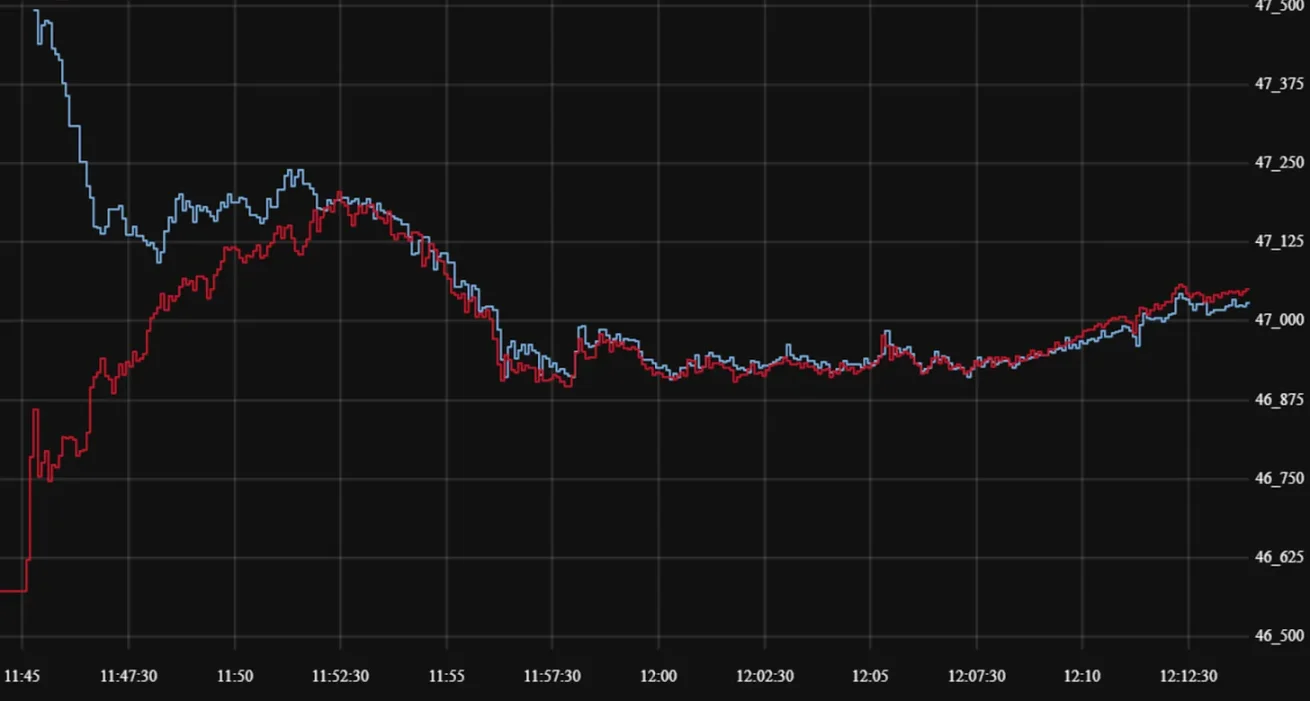
Source: Bloomberg
But in Jane Street’s case, they weren’t trading PUMP tokens. They were trading Indian equities—specifically, the NIFTY bank index. With high leverage available, retail traders frequently trade options on this index. Here’s how it worked: first, buy relatively illiquid component stocks of the index.
Then, as spot purchases push up the index price, sell index call options at higher premiums, buy index puts, and finally sell the stocks to pull down the index. Profits come from call premiums and put gains. Spot trades may incur small losses, but put profits usually cover them.
The chart above illustrates this trade: the red line shows the index price, the blue line the options price. In practice, they sold options (lowering prices, collecting premiums) while buying the underlying (raising prices without paying for options)—all arbitrage.
What does this have to do with today’s topic?
Nothing. I just wanted to clarify terms like put, call, and strike price for newcomers.
In this piece, Sumanth and I explore a simple question: Why haven’t crypto options markets taken off? As Hyperliquid leads the narrative and on-chain perpetuals heat up again—with stock perps coming soon—what about options? Like most things, we’ll start with historical context, analyze market mechanics, then look ahead. Our hypothesis: if perps can succeed, options will follow.
The challenge: which teams are building options products? What mechanisms will they use to avoid repeating the mistakes of DeFi Summer 2021?
We don’t have clear answers yet—but we can offer some clues.
The Perpetual Puzzle
Remember the pandemic? That “golden era” when we sat at home wondering how long this massive social isolation experiment would last. It was during that time we saw the limitations of perpetual contracts. Like many commodities, oil has a futures market where traders can bet on its price. But like all commodities, oil is only valuable when there's demand. Restrictions during the pandemic crushed demand for oil and related products.
When you buy a physically settled futures contract (not cash-settled), you gain the right to receive the underlying asset at a future date. So if I go long oil, at expiry I’d “receive” physical oil. Most traders don’t want to hold the commodity—they’d rather sell it to someone with logistics (like a tanker company) or a factory.
But in 2020, things went haywire. No one wanted oil. Traders who bought futures had to take delivery. Imagine: I’m a 27-year-old analyst at an investment bank, suddenly responsible for receiving 1 million gallons of oil—and my 40-something compliance officer makes sure I sell it all immediately. That’s exactly what happened.
In 2020, oil prices briefly turned negative. This vividly exposed the flaw in physical futures: you must take delivery, and storage costs money. If I’m just speculating on the price of oil, chicken, or coffee beans, why should I have to receive the goods? How do I ship them from origin to Dubai? This is the structural difference between crypto and traditional futures.
In crypto, receiving the underlying is nearly costless: just transfer it to your wallet.
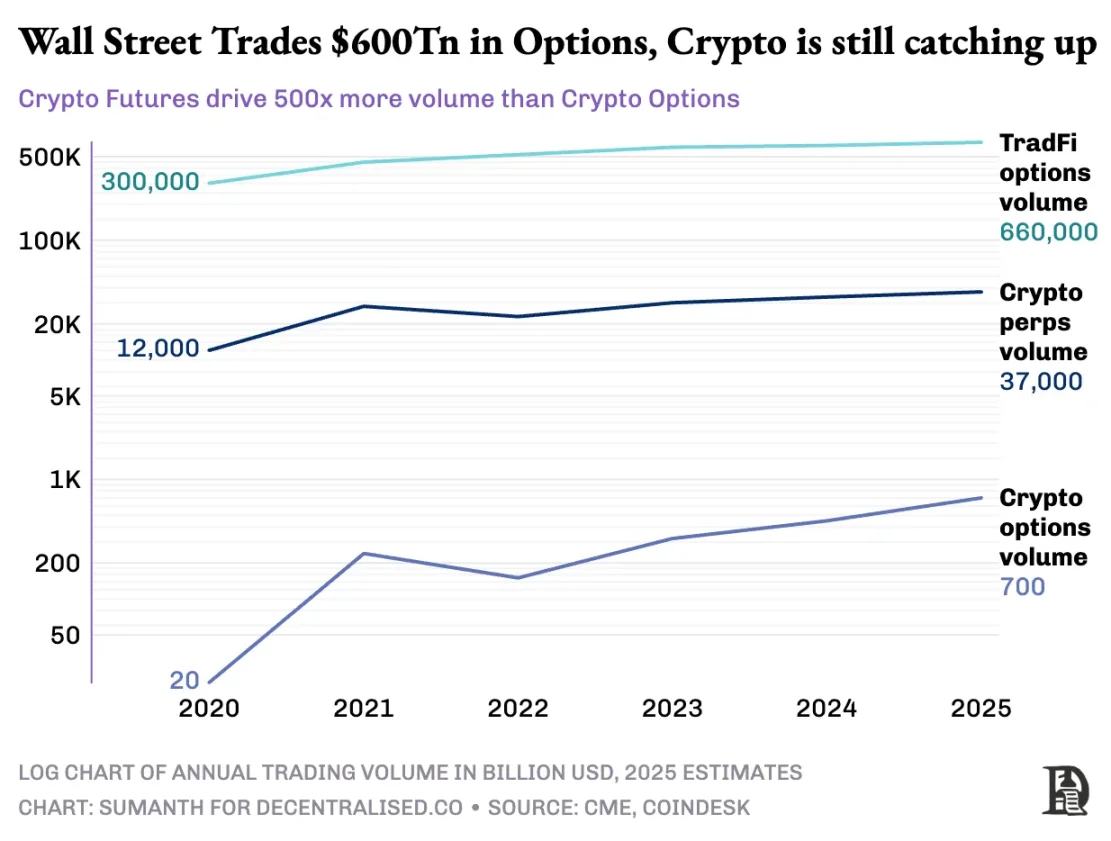
Yet crypto options markets have never truly exploded. In 2020, U.S. options markets traded about 7 billion contracts; today, that number is nearing 12 billion, with notional value around $45 trillion. The U.S. options market is roughly seven times larger than its futures counterpart, with nearly half the volume coming from retail traders—especially those who love short-dated options expiring daily or weekly. Robinhood’s business model thrives on this: offering fast, easy, free options trading and monetizing via payment-for-order-flow (PFOF), where market makers like Citadel pay for order flow.
But crypto derivatives are different: Perpetuals trade around $2 trillion monthly—20 times the ~$100 billion in monthly options volume. Instead of inheriting traditional finance’s structures, crypto built its own ecosystem from scratch.
Regulation shaped this divergence. Traditional markets, regulated by the CFTC, require futures rollover, creating friction. U.S. rules cap stock margin leverage at about 2x and ban “20x perpetuals.” So options became the only way for Robinhood users (say, retail traders with $500) to turn a 1% Apple stock move into over 10% returns.
Crypto’s unregulated environment allowed innovation. It started with BitMEX’s perpetual futures: as the name suggests, no expiry date—perpetual. You don’t need to hold the underlying; just keep trading. Why do traders prefer perps? Two reasons:
-
Lower fees compared to spot trading;
-
Higher leverage.
Most traders appreciate the simplicity of perps. Options, by contrast, require understanding multiple variables: strike selection, underlying price, time decay, implied volatility, and delta hedging. Most crypto traders jumped straight from spot to perps, skipping the options learning curve entirely.
In 2016, BitMEX launched perpetuals and instantly became crypto traders’ favorite leveraged instrument. That same year, a small Dutch team launched Deribit—the first exchange focused solely on crypto options. Bitcoin was under $1,000 then, and most traders thought options were too complex and unnecessary. Twelve months later, sentiment flipped: BTC surged to $20,000, and miners with large inventories began buying puts to lock in profits. In 2019, ETH options launched; by January 2020, open interest exceeded $1 billion for the first time.
Today, Deribit handles over 85% of crypto options volume—showing how concentrated the market remains. When institutions need large trades, they bypass order books, instead calling a quote desk or messaging on Telegram, then settling via Deribit’s interface. A quarter of Deribit’s volume comes through these private channels, highlighting institutional dominance in a market seemingly driven by retail.
Deribit stands out by allowing cross-margining across products. For example, you go long futures (BTC at $100k) and buy a $95k put. If BTC drops, your long loses money, but the put gains value, preventing liquidation. There are nuances—like option expiry or futures leverage—but Deribit’s cross-margining is key to its dominance.
Theoretically, on-chain options could do this easily: smart contracts can track strikes and expiries, hold collateral, and settle payouts without intermediaries. Yet after five years of experimentation, decentralized options exchanges account for less than 1% of options volume, while decentralized perp exchanges handle about 10% of futures volume.
To understand why, we need to revisit three eras of on-chain options.
The Stone Age of Options
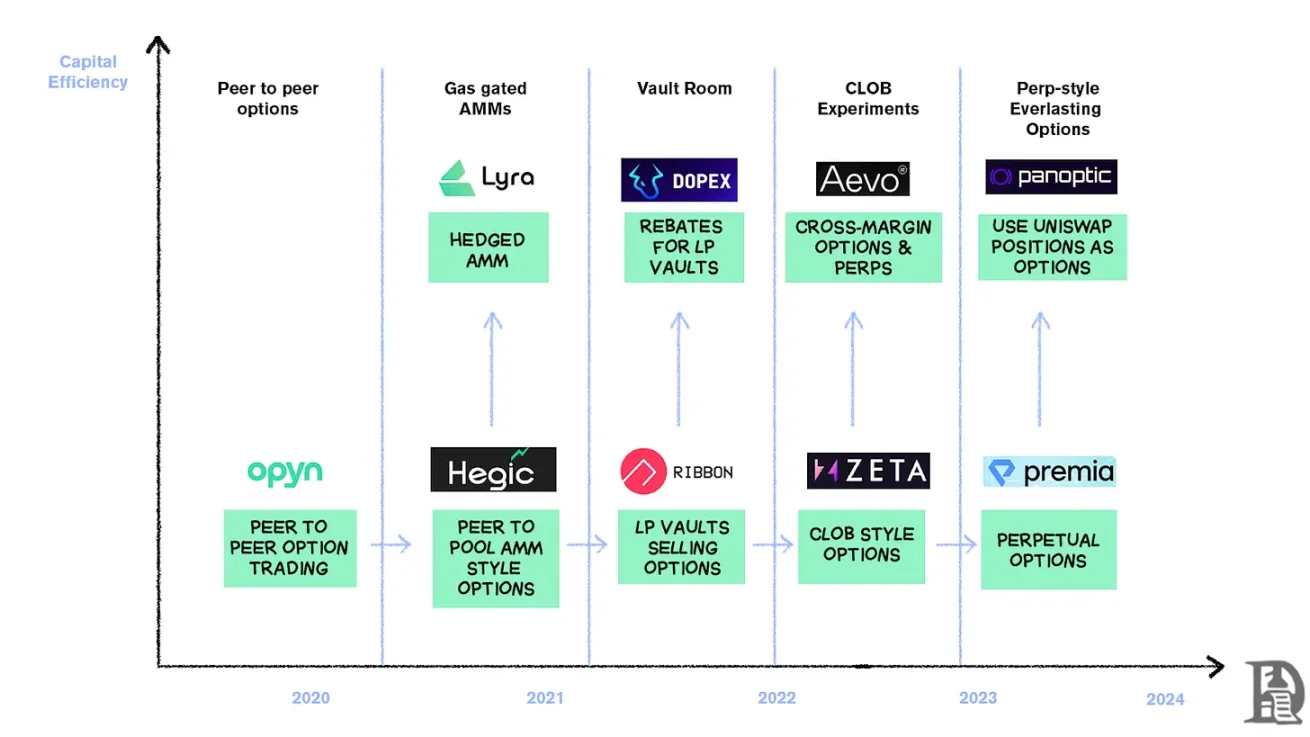
In March 2020, Opyn democratized option issuance: lock ETH as collateral, pick a strike and expiry, and a smart contract mints an ERC20 token representing the right. These tokens can trade anywhere supporting ERC20—Uniswap, SushiSwap, even direct wallet transfers.
Each option is a separate tradable token: a July $1,000 call is one token, a $1,200 call another—leading to fragmented UX, but functional markets. At expiry, in-the-money holders exercise and collect payouts; leftover collateral goes back to the seller. The bigger issue: sellers had to lock full notional value. Selling a 10 ETH call required locking 10 ETH until expiry—even if the premium was only 0.5 ETH.
This system worked—until DeFi Summer hit. When gas fees spiked to $50–$200 per transaction, issuing an option often cost more than the premium itself. The entire model collapsed almost overnight.
Developers pivoted to Uniswap-style liquidity pools. Hegic led this shift, letting anyone—from retail to whales—deposit ETH into a shared treasury. Liquidity providers (LPs) pooled collateral, and smart contracts quoted prices for options. Hegic’s interface let users choose strike and expiry.
If a trader wanted to buy a 1 ETH next-week call, an automated market maker (AMM) priced it using Black-Scholes, pulling ETH volatility from external oracles. After clicking “buy,” the contract pulled 1 ETH from the pool as collateral, minted an NFT recording strike and expiry, and sent it directly to the buyer’s wallet. The buyer could resell it on OpenSea or wait for expiry.
To users, it felt like magic: one transaction, no counterparty, premiums flowing to LPs (minus protocol fees). Traders loved the one-click experience; LPs loved the yield. The treasury could issue multiple strikes/expiries without active management.
The magic lasted until September 2020. Ethereum crashed violently, and Hegic’s simplistic pricing caused puts to be sold too cheaply. Put holders exercised, forcing the treasury to pay out far more ETH than anticipated. In one week, a year’s worth of premium income vanished. LPs learned a harsh lesson: writing options in calm markets seems easy, but without proper risk management, one storm can wipe you out.
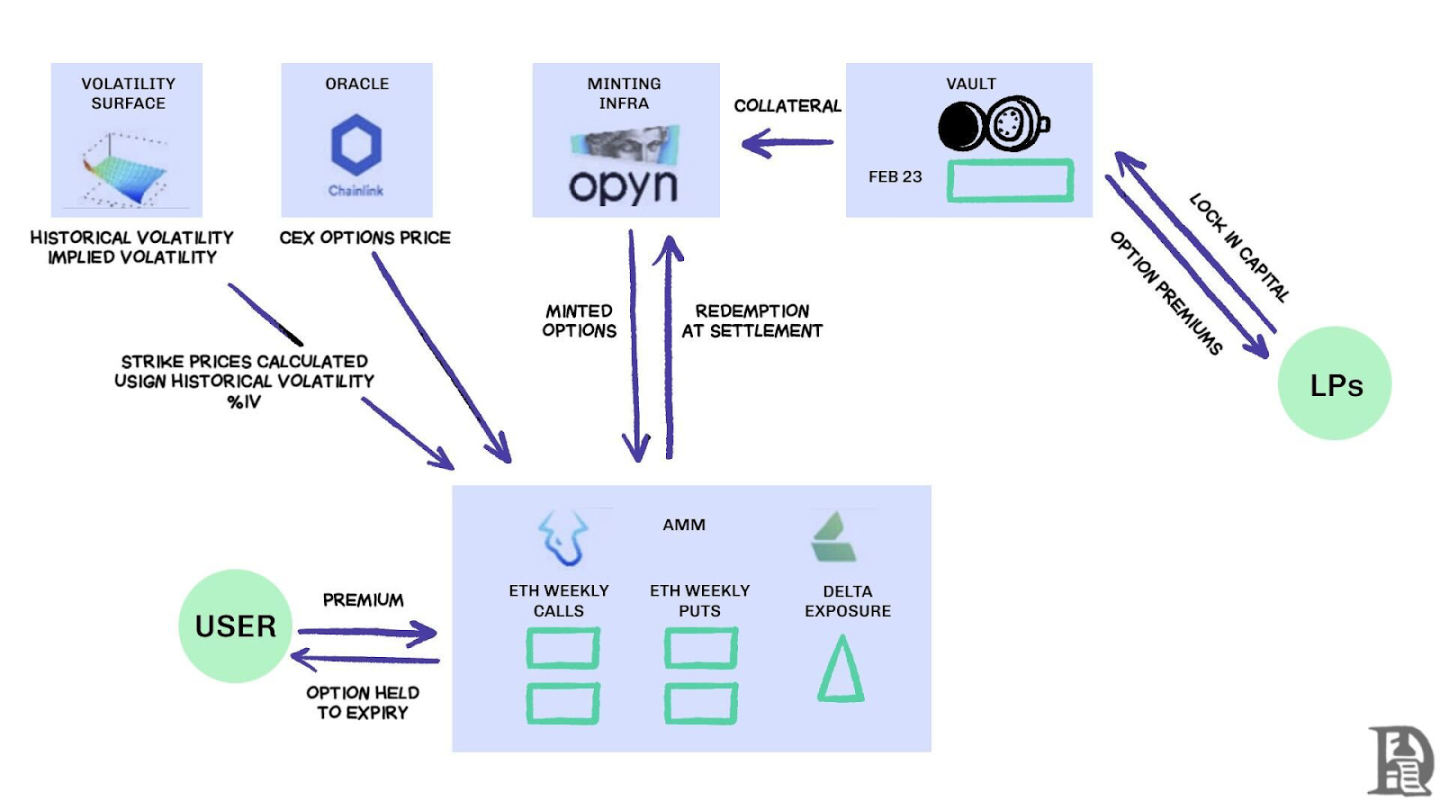
AMMs must lock collateral to underwrite options
Lyra (now renamed Derive) tried combining liquidity pools with automated risk management. After each trade, Lyra calculated the pool’s net delta exposure (sum of deltas across all strikes and expiries). If the treasury had a net short exposure of 40 ETH, meaning it lost $40 for every $1 rise in ETH, Lyra would hedge by going long 40 ETH on Synthetix perpetuals.
The AMM used Black-Scholes pricing, offloading expensive on-chain computation to off-chain oracles to control gas costs. Compared to unhedged strategies, this delta hedging halved treasury losses. Elegant design—but it depended on Synthetix liquidity.
When Terra Luna collapsed, panic drove traders from Synthetix staking pools. Liquidity dried up, spiking Lyra’s hedging costs and widening spreads. Sophisticated hedging needs deep, reliable liquidity—a challenge DeFi still struggles with.
Searching for Fire
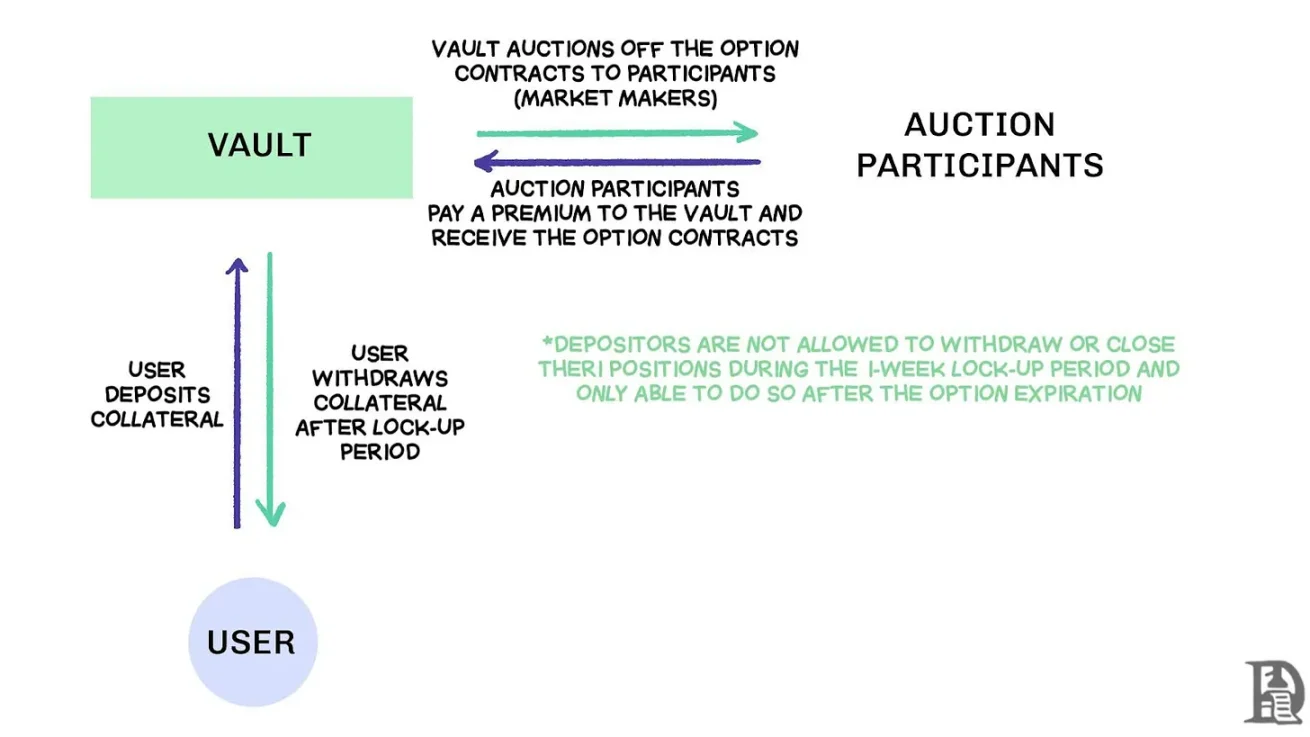
Decentralized Options Vaults (DOVs) sell order flow via auctions. Source: Treehouse Research
In early 2021, Decentralized Options Vaults (DOVs) emerged. Ribbon Finance pioneered this: deposit ETH into a vault, and every Friday, sell covered calls via off-chain auctions. Market makers bid for order flow; premiums are distributed to depositors. On Thursday, options settle, collateral unlocks, and the cycle resets.
During the 2021 bull run, implied volatility (IV) stayed above 90%, turning weekly premiums into eye-popping annual percentage yields (APYs). Weekly auctions generated solid returns, and depositors enjoyed what looked like risk-free ETH yield. But when the market peaked in November and ETH started falling, vaults posted negative returns—premiums couldn’t offset ETH’s decline.
Rivals Dopex and ThetaNuts copied the model, adding rebate tokens to cushion drawdowns, but still failed to solve the core vulnerability to large volatility swings. In both AMM and DOV models, capital is locked until expiry. Users earning premiums by depositing ETH can’t exit when ETH drops—leaving them trapped.
The Order Book Era
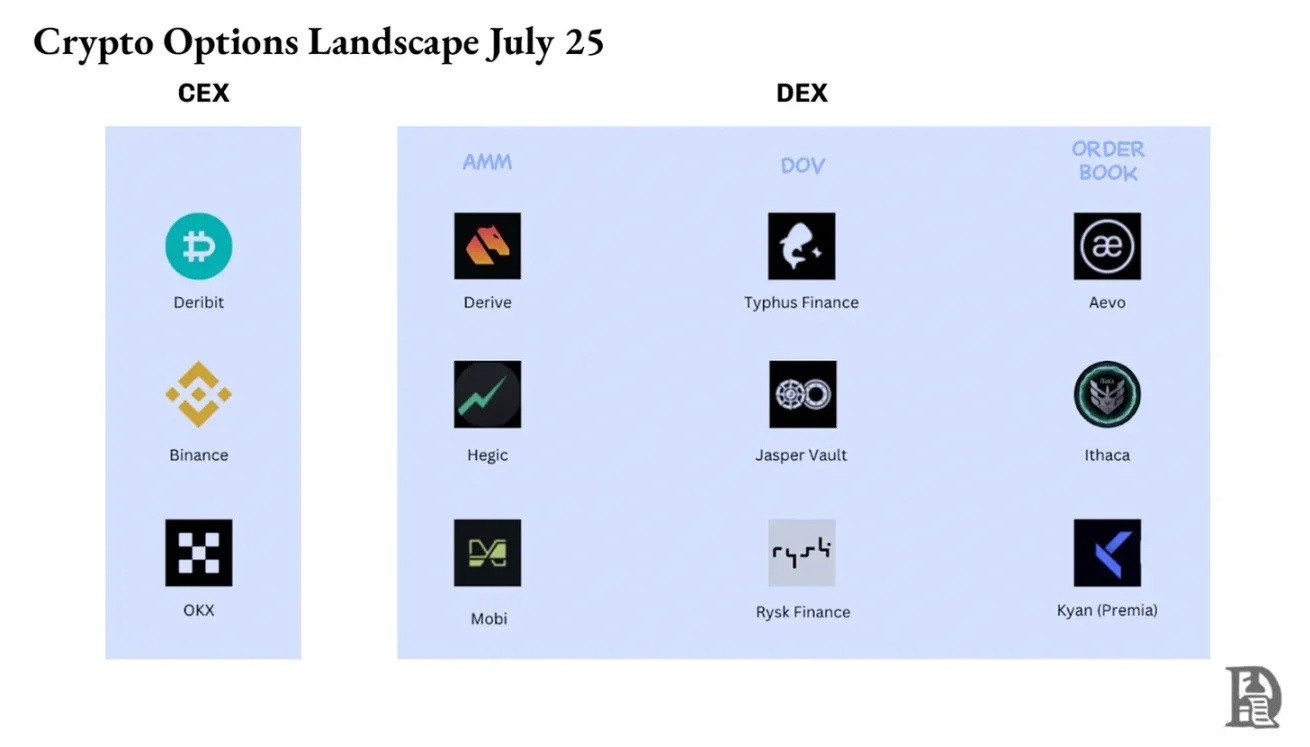
Solana-based teams learned from the limitations of early AMM-based protocols and took a different path. They attempted to replicate Deribit’s centralized limit order book (CLOB) on-chain, using sophisticated matching engines for near-instant settlement, with market makers acting as counterparties for every option trade.
First-gen products like PsyOptions kept the entire order book on-chain—each quote consumed block space, and market makers had to lock 100% collateral, leading to sparse quotes. Second-gen platforms like Drift and Zeta Markets moved order books off-chain, matching trades before settling on-chain. Ribbon returned with Aevo, placing the order book and matching engine on Optimism’s high-performance Layer 2.
More importantly, these platforms support both perps and options on the same interface, with portfolio margining that calculates a market maker’s net exposure. This mirrors Deribit’s success—allowing reuse of collateral across positions.
Results were mixed. With market makers able to update quotes frequently without high gas costs, spreads narrowed. But CLOBs revealed weaknesses during non-trading hours: when U.S.-based professional market makers logged off, liquidity evaporated, leaving retail traders facing wide spreads and poor execution. This reliance on active makers created temporary “dead zones”—something AMMs, despite flaws, never experienced. Teams like Drift eventually abandoned options entirely, focusing only on perps.
Others, like Premia, explored hybrid AMM-CLOB models—seeking a middle ground between fully on-chain order books offering 24/7 liquidity and market makers adding depth. Yet total value locked (TVL) never exceeded $10 million, large trades still required maker intervention, and slippage remained high.
Why Options Struggle
Liquidity in options is shifting from AMMs to order books. Derive shut down its on-chain AMM, rebuilt around an order book, and added a cross-margin risk engine. This upgrade attracted firms like Galaxy and GSR. The platform now handles about 60% of on-chain options volume, becoming DeFi’s largest decentralized options exchange.
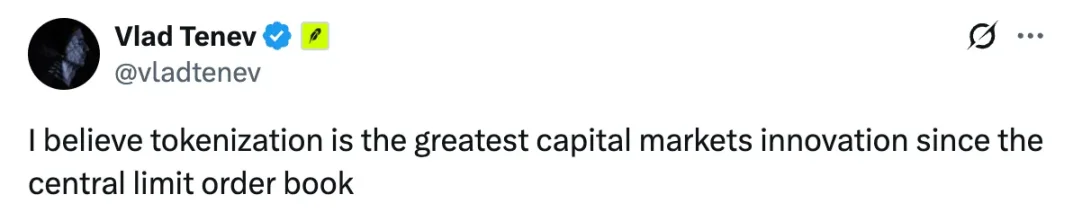
Vlad on limit order book design
When a market maker sells a $120K BTC call and hedges with spot BTC, the system recognizes offsetting positions and calculates margin based on net portfolio risk, not individual positions. The engine continuously assesses each position—underwriting a Jan 2026 $120K call, shorting next week’s weekly, buying spot BTC—and requires margin based on net directional exposure.
Hedging offsets risk, freeing up collateral to deploy into new quotes.
On-chain protocols break this loop by tokenizing each strike/expiry into separate ERC-20 vaults. A $120K call issued next Friday cannot recognize a hedge in a BTC perpetual. While Derive partially solved this by integrating perps into its clearinghouse for cross-margining, spreads remain far wider than Deribit’s—typically 2–5x higher for equivalent positions.
Note: Let’s use mango prices. Suppose I sell someone the right to buy my mangoes at $10, collecting a $1 premium. These mangoes ripen in three days. As long as I have the mangoes (spot), I can collect the premium ($1) without worrying about market price increases.
I won’t lose money (i.e., I’m hedged), except for opportunity cost if prices rise. If Sumanth buys this option (paying me $1), he can resell the mangoes at $15, netting $4 after the premium. Those three days are the option’s expiry. At settlement, I either still have my mangoes or have $11 total ($10 from sale + $1 premium).
In a centralized exchange, my mango farm and the market are in the same town—the exchange knows my backing, so I can use Sumanth’s premium as collateral to offset other costs (like labor). But in an on-chain market, the two markets are theoretically in different places, distrustful. Since most rely on credit and trust, this model is capital inefficient—I might lose money just transferring Sumanth’s payment to a logistics provider.
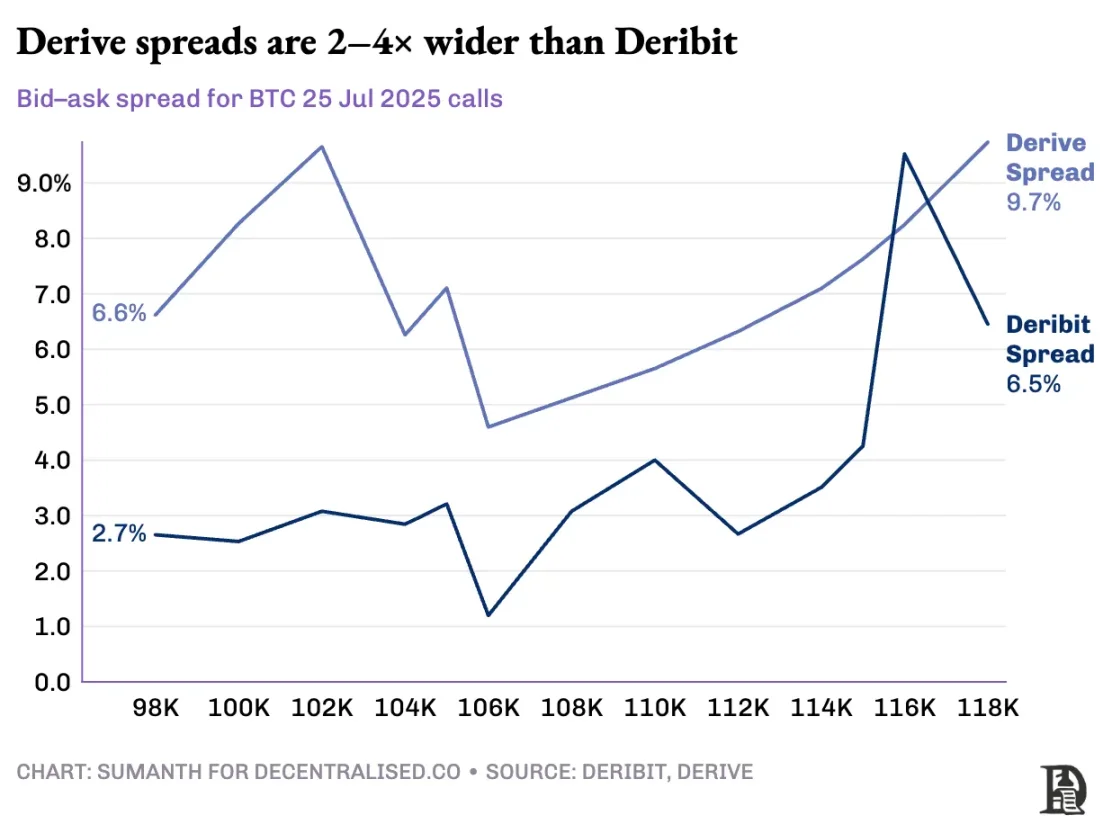
Deribit benefits from years of API development and algorithmic trading systems optimized specifically for its platform. Derive’s risk engine has been live for just over a year and lacks the deep order books in spot and perp markets needed for effective hedging. Market makers need instant access to deep liquidity across multiple instruments to manage risk—they need to hold options and easily hedge via perps simultaneously.
Decentralized perp exchanges solved liquidity fragmentation by eliminating it entirely. All perpetuals for the same asset are fungible: one deep pool, one funding rate. Whether a trader uses 2x or 100x leverage, liquidity is unified. Leverage affects margin requirements only—not market structure.
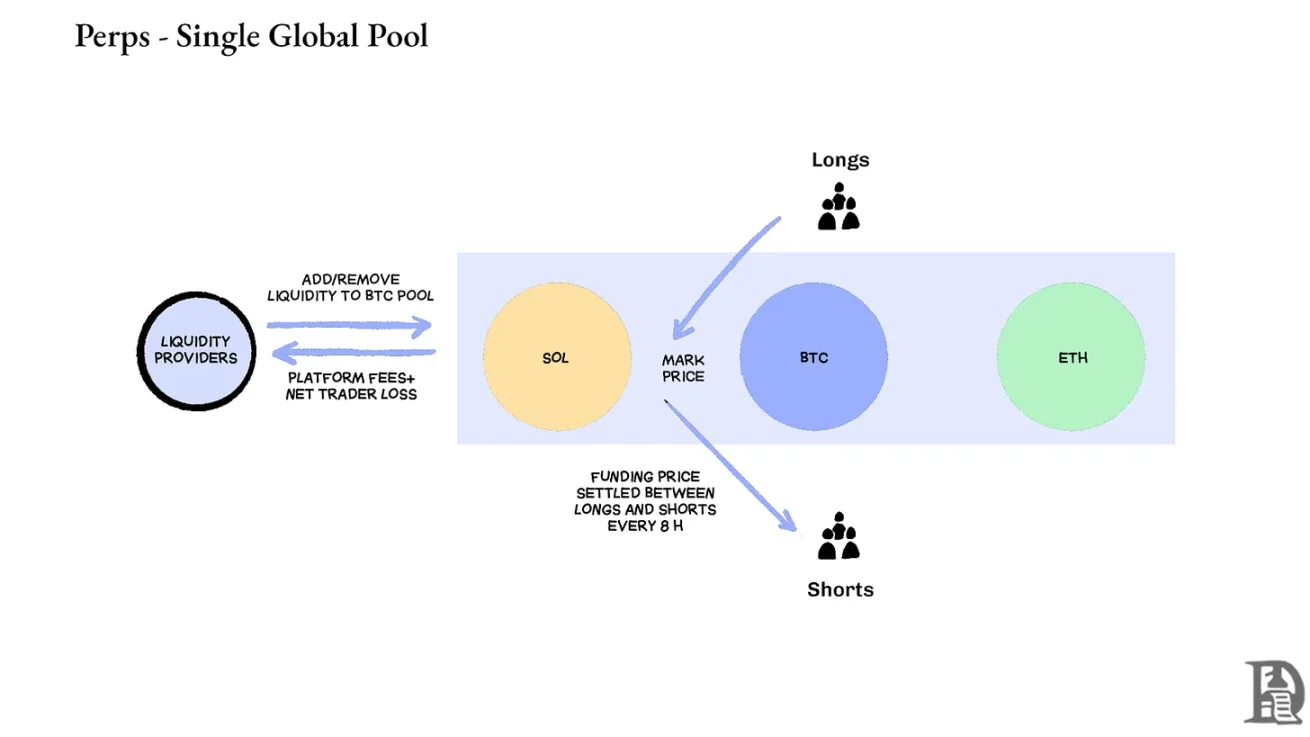
This design enabled significant success for platforms like Hyperliquid: their treasury often acts as counterparty to retail trades, distributing fees to depositors.
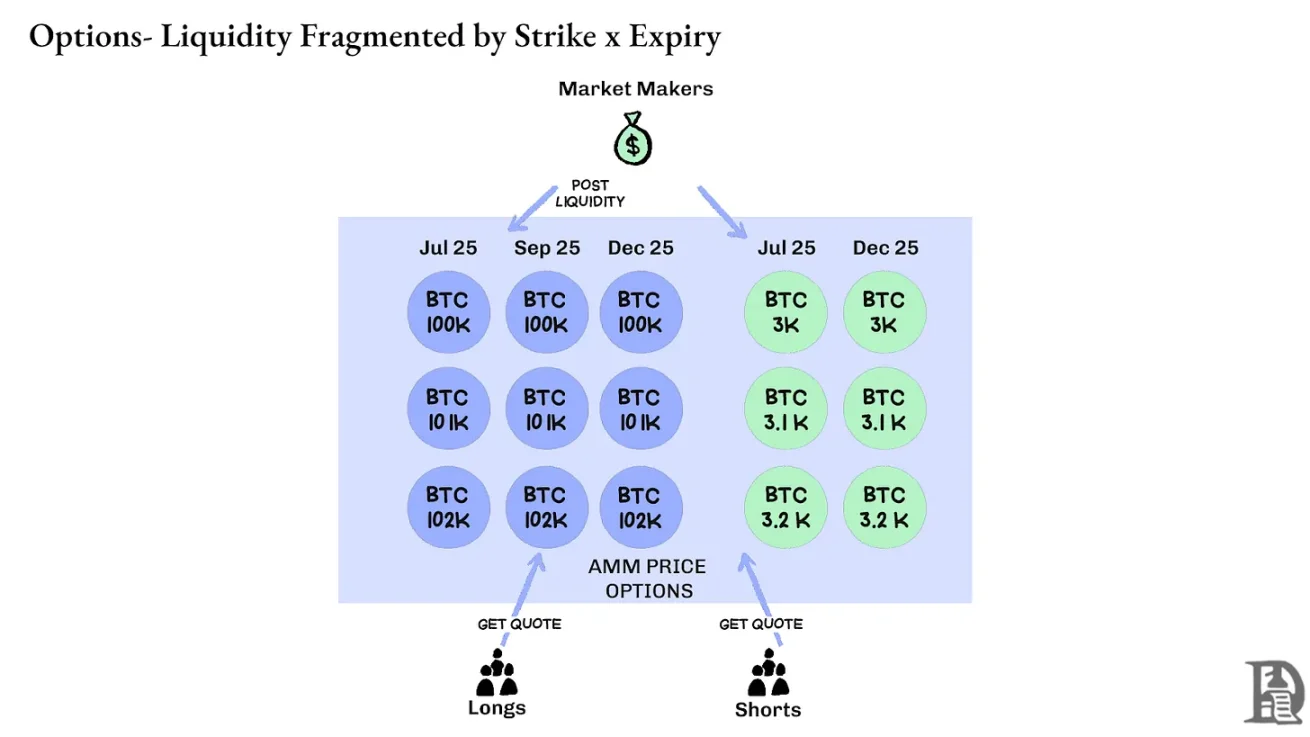
In contrast, options fragment liquidity across thousands of “micro-assets”: each strike-expiry combo forms its own market with unique traits, scattering capital and making it nearly impossible to achieve the depth required by serious traders. This is the core reason on-chain options haven’t taken off. However, given the liquidity emerging on Hyperliquid, this could change soon.
The Future of Crypto Options
Looking back at every major options protocol launch over the past three years, a clear pattern emerges: Capital efficiency determines survival. Protocols that force traders to lock separate collateral for each position—no matter how elegant their pricing model or UI—ultimately lose liquidity.
Professional market makers operate on razor-thin margins. They need every dollar to work efficiently across multiple positions. If a protocol requires $100K collateral for a BTC call and another $100K for the hedging perp, instead of recognizing offsetting risk (requiring maybe $20K net margin), participation becomes unprofitable. Simply put: no one wants to tie up huge capital for tiny returns.
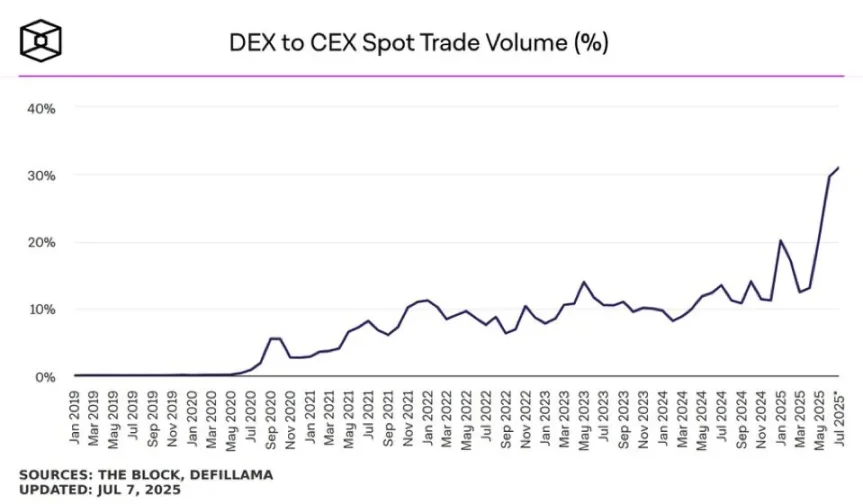
Source: TheBlock
Spot markets on platforms like Uniswap routinely see over $1B in daily volume with minimal slippage; decentralized perp exchanges like Hyperliquid process hundreds of millions daily, with spreads competitive with centralized exchanges. The foundational liquidity that options protocols desperately need now exists.
The bottleneck has always been infrastructure—the “plumbing” that professional traders take for granted. Market makers need deep liquidity pools, instant hedging, immediate liquidation when positions deteriorate, and a unified margin system that treats the entire portfolio as a single risk exposure.
We’ve written about Hyperliquid’s shared infrastructure approach, which creates the long-promised but rarely achieved positive-sum state in DeFi: each new application strengthens the whole ecosystem instead of fighting over scarce liquidity.
We believe options will eventually come on-chain through this “infrastructure-first” approach. Early attempts focused on mathematical complexity or clever tokenomics, while HyperEVM solves the core plumbing: unified collateral management, atomic execution, deep liquidity, and instant settlement.
We see several key shifts in market dynamics:
-
After the 2022 FTX collapse, fewer market makers were willing to take risks on new primitives. Now, traditional institutional players are returning to crypto.
-
More battle-tested networks can now meet higher throughput demands.
-
There’s greater acceptance of solutions where not all logic and liquidity are fully on-chain.
If options are to return, they’ll need three kinds of talent: developers who understand product mechanics, experts in market maker incentives, and builders who can package these tools into retail-friendly products. Can on-chain options platforms enable life-changing wealth? Memecoins already did—they made it possible to turn a few hundred dollars into millions. Memecoins worked because of extreme volatility, but lack “Lindy effect” (longevity implies stability).
In contrast, options have both Lindy effect and volatility—but remain hard for ordinary people to grasp. We believe a new class of consumer apps will emerge to bridge this gap.
Today’s crypto options market resembles the pre-CBOE era: a collection of experiments, lacking standardization, driven by speculation rather than hedging. But as crypto infrastructure matures and real businesses begin operating on-chain, this will change. Institutional-grade liquidity will come on-chain via robust infrastructure, supporting cross-margining and composable hedging mechanisms.
Join TechFlow official community to stay tuned
Telegram:https://t.me/TechFlowDaily
X (Twitter):https://x.com/TechFlowPost
X (Twitter) EN:https://x.com/BlockFlow_News
 @Decentralisedco






