Interview with WEEX Co-Founder: Hyperliquid's Rise and the Survival Strategies for CEXs in Futures Competition
TechFlow Selected TechFlow Selected
Interview with WEEX Co-Founder: Hyperliquid's Rise and the Survival Strategies for CEXs in Futures Competition
"We are not in competition with decentralized exchanges, but rather working together to grow the market size."
 Navigating Web3 tides with focused insights
By: TechFlow
In this cycle marked by favorable policies and institutional inflows driving surging trading and user volumes, exchange competition has become increasingly dynamic.
At the recent TOKEN 2049 industry summit in Singapore, we observed unprecedented exchange activity. Platforms went all-in on brand innovation, differentiated marketing, and new user acquisition. Among them was WEEX, a platinum sponsor of the event, with nearly 7 million users globally, averaging over $15 billion daily futures trading volume and over $2 billion in spot trading volume.
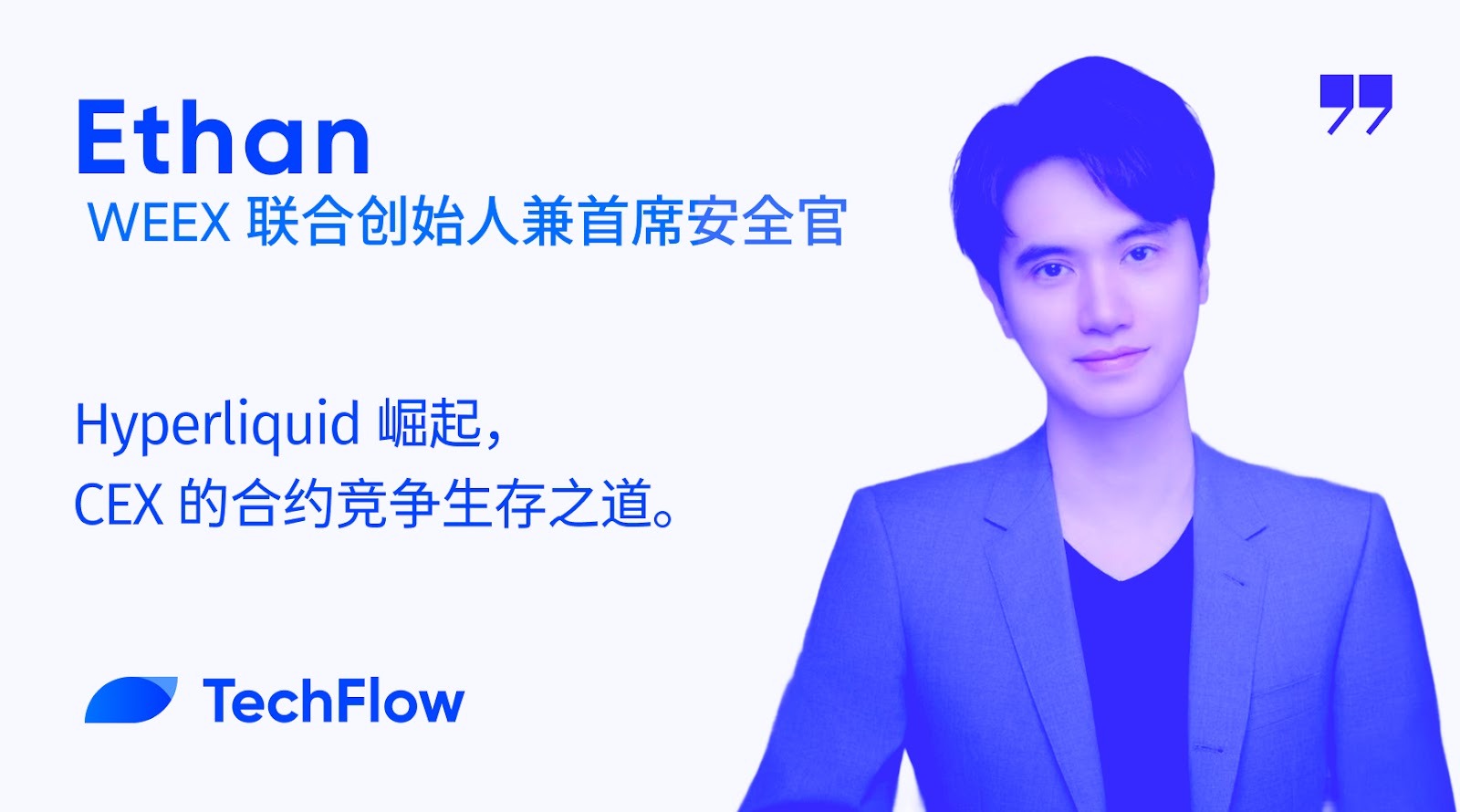
At the venue, WEEX’s grand golden booth in a central location, along with WEEX’s young and charismatic co-founder and Chief Security Officer Ethan, instantly captured attention. Seizing this opportunity, TechFlow sat down with Ethan for an in-depth face-to-face conversation.

When discussing technical expertise, Ethan clearly articulated WEEX’s core advantages:
Through fully in-memory operation and sharding design, WEEX has largely overcome the "low latency, high concurrency, consistency" trilemma common to exchanges. Its TPS reaches the million level, with core path latency around 6 milliseconds—meeting top-tier industry standards.
On how WEEX attracts users, Ethan—a quant trader with over a decade of frontline trading experience—shared deep user-centric insights:
What users really want is a secure environment where they can trade what they desire. WEEX strictly adheres to the highest industry security standards and established a 1,000 BTC protection fund so users can trade with confidence. Additionally, WEEX offers unique advantages such as low latency, high liquidity, extensive coin pair support, and up to 400x leverage, delivering a more user-friendly experience.
Finally, on the rising influence of Hyperliquid and its impact on futures—and the entire CEX futures market—Ethan said:
We don’t see ourselves in competition with decentralized exchanges (DEXs), but rather growing the overall market size together. Compared to DEXs, CEXs offer broader coin pair support, lower entry barriers, and more stable, efficient performance. For users, choosing between CEX and DEX ultimately comes down to meeting different needs.
In this edition, join WEEX co-founder and Chief Security Officer Ethan as he shares insights into the continuous technological upgrades and global brand expansion behind WEEX’s rapid growth over recent years, and WEEX’s differentiated strengths amid intensifying exchange competition.
Quarterly Futures Trading Volume Up 4x: Four Core Reasons Users Choose WEEX
TechFlow: We’re glad to have this opportunity for an in-depth conversation. Some Chinese-speaking users may not be familiar with your background—could you start by introducing yourself?
Ethan:
Hi everyone, I’m Ethan, co-founder and Chief Security Officer at WEEX.
At WEEX, I primarily oversee trading operations, including development and maintenance of the second-generation trading systems like Contracts Pro and Spot Pro, security architecture design, and corporate strategy growth. I have a computer science background and worked over ten years as a quant trader at investment banks and hedge funds after graduation.
After joining the WEEX team, we entered a period of rapid growth—both in customer base and market speed—with expanding support for spot and futures coin pairs. This led to system saturation and lag issues that affected user experience, which is why I joined to lead the upgrade of WEEX’s second-generation trading system.
My long-standing frontline quant experience gives me deeper insight into optimizing trading pathways. As a high-frequency trader myself, I also understand exactly what features users need, and I'm thrilled to contribute to WEEX’s growth.Over the past few years, WEEX has indeed become one of the fastest-growing exchanges, with quarterly futures trading volume increasing fourfold.
Today, WEEX’s system performance has significantly improved—TPS now reaches the million level, roughly a 100x increase, with core path latency around 6 milliseconds, placing us firmly among the industry’s top tier.
TechFlow: If you had to summarize in one or two sentences why users should choose WEEX, what would you say?
Ethan:
I’d highlight two key dimensions: capital safety and compliance, and user experience.
On security, we’ve set aside 1,000 BTC as a reserve, Many large exchanges establish protection funds to cover unexpected user losses, while smaller platforms often lack sufficient capacity. WEEX truly holds 1,000 BTC on-chain, verifiable via our website—this greatly demonstrates our risk-bearing capability, so users can simply focus on trading.
In terms of coin pair support, whether spot or futures, WEEX ranks among the industry leaders, including trending and new launch projects—we ensure users can trade virtually any coin pair on our platform.
Additionally,our trading depth rivals top-tier exchanges: For major coins, trades worth tens of millions of dollars are no problem; even for smaller coins with market caps in the tens of millions, we maintain solid depth.
Moreover,we support up to 400x leverage, We specialize in futures trading—offering only USDT-margined contracts, concentrating all liquidity into USDT. If users want high-leverage, high-multiplier new contract trading, WEEX is the place to be.
Whether it’s coin pairs, liquidity, latency, or security—we’ve optimized across the board, making everything highly user-friendly.
Ultimately, users just want a safe trading environment—where their money won’t be hacked and the platform won’t run away—and the ability to buy and sell what they want. WEEX meets both needs effectively.
Fully In-Memory Operation and Sharding Design: 100x System Performance Boost
TechFlow: As a rapidly growing exchange, could you share some key milestones or metrics WEEX has achieved since you joined?
Ethan:
Our growth over the past few years has been remarkable.For example, WEEX now has over 6 million, approaching 7 million users, with average daily futures trading volume around $15 billion and daily spot trading volume around $2 billion. On CoinGecko’s futures trading rankings, we’ve successfully entered the top ten—every metric has multiplied since my arrival.
Our BD team has worked hard, and partners have brought in many users, but previously, system architecture limited user experience. Now, with the upgraded system, things are completely different.
If you don't mind a slightly technical explanation, our original system used a relatively single, standalone architecture, unsuitable for high concurrency. Exchange systems face a "trilemma":
-
Low Latency
-
High Concurrency
-
Consistency
It's difficult to achieve all three simultaneously. For instance, enabling simultaneous trading for users worldwide requires deploying servers across regions, but maintaining data consistency means spending time achieving final consistency—which conflicts with low-latency goals. Every exchange strives to balance these three: low latency during trading, high concurrency support, and data consistency.
Our technical upgrades include several key aspects.
First,the second-generation system runs entirely in memory, eliminating database dependency throughout the trading process.
Second,we designed an optimized sharding mechanism. For example, we shard by user, assigning different users to different servers, and also by coin pair, distributing different pairs across shards. The system uses a highly modular architecture, enabling easy horizontal scaling. When user count or number of coin pairs increases, we simply add more servers—superior to previous vertical scaling, where CPU or memory upgrades hit physical limits.
Of course, sharding has limitations—for example, a given coin pair must still be processed on a single server. So we’ve also heavily optimized order execution, where my high-frequency trading experience proved invaluable, focusing on faster, more efficient trade matching.
Thanks to these upgrades,our current transaction processing speed (TPS) reaches the million level, placing us among leading exchanges.
TechFlow: May I follow up—when you mentioned using in-memory processing, is WEEX exclusive or leading in this area? Where does WEEX stand technologically compared to other exchanges?
Ethan:
These technologies aren’t mysterious. Anyone who’s built trading or backend systems understands them.The key lies in practical implementation, engineering capability, and legacy system evolution. We couldn’t rebuild from scratch—we had to iteratively upgrade within the existing framework, requiring significant engineering finesse.
Nowadays, core members at many exchanges come from traditional stock exchanges, high-frequency trading firms, or hedge funds. My background was in high-frequency trading for U.S. and Japanese equities, where we placed trading servers right next to exchange data centers to reduce latency to nanoseconds.
Essentially, we’re applying traditional finance techniques to crypto. But differences exist—traditional markets like the Nikkei concentrate servers in Japan, while crypto users are global. Thus, our latency requirements are less extreme: traditional finance targets nanoseconds, while we aim for milliseconds.
Those familiar with stock HFT know these concepts aren’t secrets.The difference lies in end-to-end optimization: Where are users concentrated? What are terminal devices and network conditions like? Every detail matters.
Our tech team has diverse backgrounds—some from other exchanges, some from traditional equity trading systems, others from IoT giants. Overall, I believe our technical strength is now in the industry’s top tier. Of course, some peers are stronger—we’re continuously learning and catching up. In terms of progress, I feel our pace is now broadly aligned with the leaders.
From 1,000 BTC Fund to Anti-Slippage Measures: WEEX Adheres to Highest Industry Security Standards
TechFlow: You're primarily responsible for security—can you explain what efforts WEEX has made in security and what advantages we have?
Ethan:
We fully adhere to the highest industry security standards.
For example,we strictly separate hot and cold wallets: Only minimal funds are kept in hot wallets. Cold wallets use multi-layer management—not one wallet holding all funds, but distributed across multiple wallets at different levels.
Additionally,all cold wallets are protected by MPC, requiring multiple third parties to participate in any operation. Funds must pass independent audit verification before moving from primary cold wallets to secondary ones, then to hot wallets when withdrawals are needed—all processes conducted offline.
We’ve also invested heavily in third-party audits, launched bug bounty programs, and partnered with white-hat hacker teams for penetration testing to continuously strengthen system security.
Most importantly,we’ve established a 1,000 BTC protection fund, unlike many exchanges. While others may allocate part of user profits or fees as reserves, our fund is fully funded by management and investors, with 1,000 BTC held on-chain specifically for user compensation—this is a crucial source of trust for our users.
TechFlow: During volatile market conditions, certain trading pairs often experience "slippage spikes"—a phenomenon seen across multiple exchanges. Why do you think this happens, and how can it be prevented?
Ethan:
Slippage spikes in major pairs are usually due to system errors or sudden large orders causing sharp price swings. For example, a $1 billion fund trade might cause Bitcoin to spike 3%-5% momentarily.
Smaller coins are more prone to slippage spikes—even top exchanges struggle to avoid them entirely. Key reasons include:
First, the exchange’s own system may be at fault. For instance, if the system crashes and fails to process user orders promptly, a flood of sell orders upon recovery can trigger slippage.
Second, insufficient liquidity is a critical factor. If there are few third-party market makers or weak liquidity, even a moderately sized user order can cause severe price swings due to inadequate market depth. Unreliable market makers might even withdraw orders unexpectedly.
Additionally, if project teams engage in Rug Pulls or massive dumps, slippage spikes are inevitable. Suppose total market liquidity is $10 million—if the team suddenly sells $2 million worth of tokens, a slippage spike is unavoidable.
To minimize such risks, we’ve implemented multiple measures.
First, we continuously optimize system architecture to ensure low latency and high stability, avoiding technical anomalies. We also employ AI for real-time liquidity monitoring and never rely on a single market maker. Each coin on WEEX connects to multiple liquidity providers, ensuring sufficient depth even if one provider fails.
Meanwhile,we conduct strict reviews of listed projects, rigorously screening out malicious teams. While we can’t eliminate all risks, we carefully assess project background and financial strength to reduce risks at the source.
Lastly, if such incidents do occur,we have our protection fund—users suffering losses due to our system issues will receive appropriate compensation.
Focus on Futures: After Product Refinement, Launch Global Branding
TechFlow: Exchange competition is fierce. From your perspective, what are WEEX’s competitive and growth strategies?
Ethan:
Since our founding in 2018, WEEX has pursued a global strategy.We’re not limited to Asia—WEEX holds strong market shares in the Middle East, Europe, Africa, and South America.
Many exchanges aim to do everything, building broad, all-in-one platforms.We currently focus more on futures trading, where we excel—including the security, liquidity, wide coin pair selection, and high leverage I mentioned earlier, giving us an edge over competitors. Of course, we’re actively expanding spot trading, wealth management, and other services to gradually build a comprehensive trading ecosystem.
Additionally, we have a fantastic community. We value community engagement and brand communication. For example, WEEX has been a platinum sponsor at recent TOKEN 2049 in Singapore and previous events in Dubai—we use these opportunities to boost visibility and interact with users.
As you experienced today, our booth was centrally located and highly visible. Our marketing team put great effort into the setup—we’re working hard on brand building. We want to send a clear message:Previously, we focused on product refinement. Now that our product is mature, we’re shifting focus toward brand development.
Personally, I value user interaction. I’m active on X and participate in AMAs periodically. Feel free to reach out—I read and respond to messages. Our customer support is also available 24/7. Going forward, I’ll continue sharing WEEX’s latest updates and development plans via X.
TechFlow: WEEX seems to attend every Singapore event, but appears less at Korean or Japanese events. What’s the reasoning? Are there different growth strategies per region?
Ethan:
As I mentioned, WEEX has a global presence with strong footholds across Asia, the Middle East, Europe, Africa, and South America.
We’ve consistently supported TOKEN 2049 in Singapore as a platinum sponsor. TOKEN 2049 has strong global appeal and is Singapore’s largest crypto event, attracting participants worldwide.
In other regions, we mostly host side events or smaller gatherings. Since brand building is still early-stage, we’re starting with major international events to boost exposure. In the future, we’ll expand into markets like Japan and Taiwan. In fact, we already host numerous events globally each month.
Frankly, we’re still prioritizing product refinement and can’t attend every event. But we’ll keep pushing to increase visibility, helping more users who haven’t heard of WEEX discover us and learn we’re a platform dedicated to serving customers.
TechFlow: Many exchanges this year are integrating or promoting AI features. Do you have related plans? How might AI integrate with WEEX?
Ethan:
I’m personally very interested in AI—I studied computer science in college.
As soon as ChatGPT began gaining popularity, we started exploring its integration into exchange operations. Currently, we apply AI internally—our risk control systems and liquidity monitoring modules already fully utilize AI. We’ve also launched an AI customer service assistant and introduced traders offering AI-powered strategies in our copy trading section for users to follow.
Regarding features like clicking a trading pair and receiving AI-generated investment suggestions—we’re actively developing these and expect to launch such services soon.However, as a trading platform, we must remain neutral. We primarily provide trading services—users bring their own strategies, execute them, and we support them, rather than directly advising buys or sells. So we’re being extra cautious here.
Providing investment advice and operating an exchange involve inherent conflicts of interest, so we must be extremely careful about boundaries, especially in feature design and user feedback.
Hyperliquid vs WEEX: Different Needs, Different Choices
TechFlow: In your view, how has Hyperliquid’s rise impacted your futures trading or the broader CEX futures market? Do you plan to launch your own on-chain futures platform?
Ethan:
I believe on-chain futures growth is positive for the industry. Users typically enter crypto gradually—first hearing news or recommendations, learning about Bitcoin and major assets, trying spot trading, then gradually moving to futures.
Therefore, we’re happy to see DEXs like Hyperliquid growing in trading volume—it shows more users are recognizing and embracing futures trading.This is a win-win. We don’t compete with DEXs—we grow the market together.
Specifically, most DEXs still support limited coin pairs—Hyperliquid offers only dozens, while WEEX supports over 600 futures pairs. If users want to trade a coin not available on DEXs, they naturally turn to centralized platforms.
Also, DEXs have higher entry barriers—new users must manage their own wallets and private keys, posing security challenges. WEEX offers a simple signup process—users can open an account and deposit funds within minutes, dramatically lowering entry difficulty.
Moreover, during extreme market conditions, DEXs often face liquidity drops, increased slippage, and soaring gas fees. Although Layer2, Layer3, and new high-throughput chains are improving these issues, CEXs still hold clear advantages in system stability, trading performance, and low latency.
TechFlow:You mentioned CEXs have better liquidity for coin pairs—is that due to market makers? And as more market makers operate on-chain and Hyper EVM enables Hyperliquid to support more pairs, do you think these DEX issues will be well resolved?
Ethan:
Honestly, I think Hyperliquid is more like a CEX—for example, Hyperliquid’s HLP slippage rollback was even faster than most CEXs. So to achieve lower latency, faster support for more pairs, and better market-making, Hyperliquid will need some gasless design.
Specifically, market makers need to constantly adjust and update orders—requiring frequent high-frequency operations. If every action incurs gas fees, even low per-transaction costs add up quickly. Therefore, Hyperliquid will need a gas-free mechanism to enable frequent updates—but this is technically challenging and would make Hyperliquid increasingly resemble a CEX. CEXs inherently have advantages here.
Furthermore, we have clear advantages in lowering user barriers. A crypto newcomer might find managing wallets, private keys, seed phrases, and gas fees overwhelming and confusing. They may also distrust whether their money is safe.
More critically, new users often fall into on-chain security traps when authorizing transactions. For example, hackers have created tokens and added liquidity on Uniswap, then airdropped them widely. Some users seeing free tokens try to sell them, but once they click “Approve,” hackers can drain their wallets through pre-set traps.
Such risks are hard for beginners to guard against.CEXs effectively prevent these issues, offering users a lower-barrier, safer trading experience.
In the end, I believe CEX vs DEX comes down to different users meeting different needs:
If you’re comfortable with on-chain operations and want full asset control, platforms like Hyperliquid suit you. But if you prefer convenient, friendly, secure, low-barrier trading with fee discounts, community events, and 7×24 support, a centralized exchange like WEEX is the better choice.
TechFlow:We know WEEX has its own platform token $WXT. Could you explain its current and future utilities?
Ethan:
Yes, our platform token has been live for about two to three years.It has already delivered roughly a 4x return on investment. For early holders, that’s a solid performance.
Holding our platform token allows participation in platform governance and various community activities—such as chances to receive airdrops for new projects.
Additionally, we regularly allocate a portion of profits for buybacks and burns. We conducted burns in January and August this year and will continue this mechanism going forward.
We also aim, like other exchanges, to expand our token’s utility—whether in online communities, new project subscriptions, governance, or elsewhere—to maximize its role.
TechFlow:We’ve seen your commitment to “building WEEX into a safer, more efficient, and more trustworthy platform.” What are your next steps toward this vision, and which metrics will you prioritize?
Ethan:
We focus on two core metrics: user growth and trading volume growth.
More users attract quality projects to list on our exchange, giving our users access to better assets. For example, with a large community, projects often offer more airdrop tokens, which we can distribute to our users.
On the other hand, higher trading volume means deeper markets. As volume grows, more market makers invest resources into our platform, further enhancing liquidity and improving user experience. These factors reinforce each other, creating a virtuous cycle.
Technically, we’ll continue scaling and optimizing our systems to ensure users worldwide enjoy low-latency, high-liquidity trading experiences, continuously attracting new users.
Additionally, our user protection fund will remain permanent, strengthening user confidence. If users suffer losses due to system issues, the fund will ensure their rights are protected.
Join TechFlow official community to stay tuned
Telegram:https://t.me/TechFlowDaily
X (Twitter):https://x.com/TechFlowPost
X (Twitter) EN:https://x.com/BlockFlow_News
 深潮TechFlow