As the wave of tokenization sweeps through U.S. stocks, Hong Kong chooses to remain silent
TechFlow Selected TechFlow Selected
As the wave of tokenization sweeps through U.S. stocks, Hong Kong chooses to remain silent
Missed stablecoins ten years ago—will you miss tokenized stocks a decade later?
 Navigating Web3 tides with focused insights
Author: Zhou Zhou, Foresight News

As the wave of U.S. stock tokenization sweeps across the globe, Hong Kong remains silent.
"In the short term, no company will attempt to tokenize Hong Kong stocks," executives from three Hong Kong-based crypto firms separately told me.
Ten years ago, Hong Kong missed the best opportunity to develop stablecoins for the Hong Kong dollar and renminbi, falling significantly behind USD stablecoins (annual trading volume of $28 trillion) and EUR stablecoins (annual trading volume of $2 trillion). Now, as the "stock tokenization" market is just beginning to emerge, Hong Kong appears poised to miss it again.
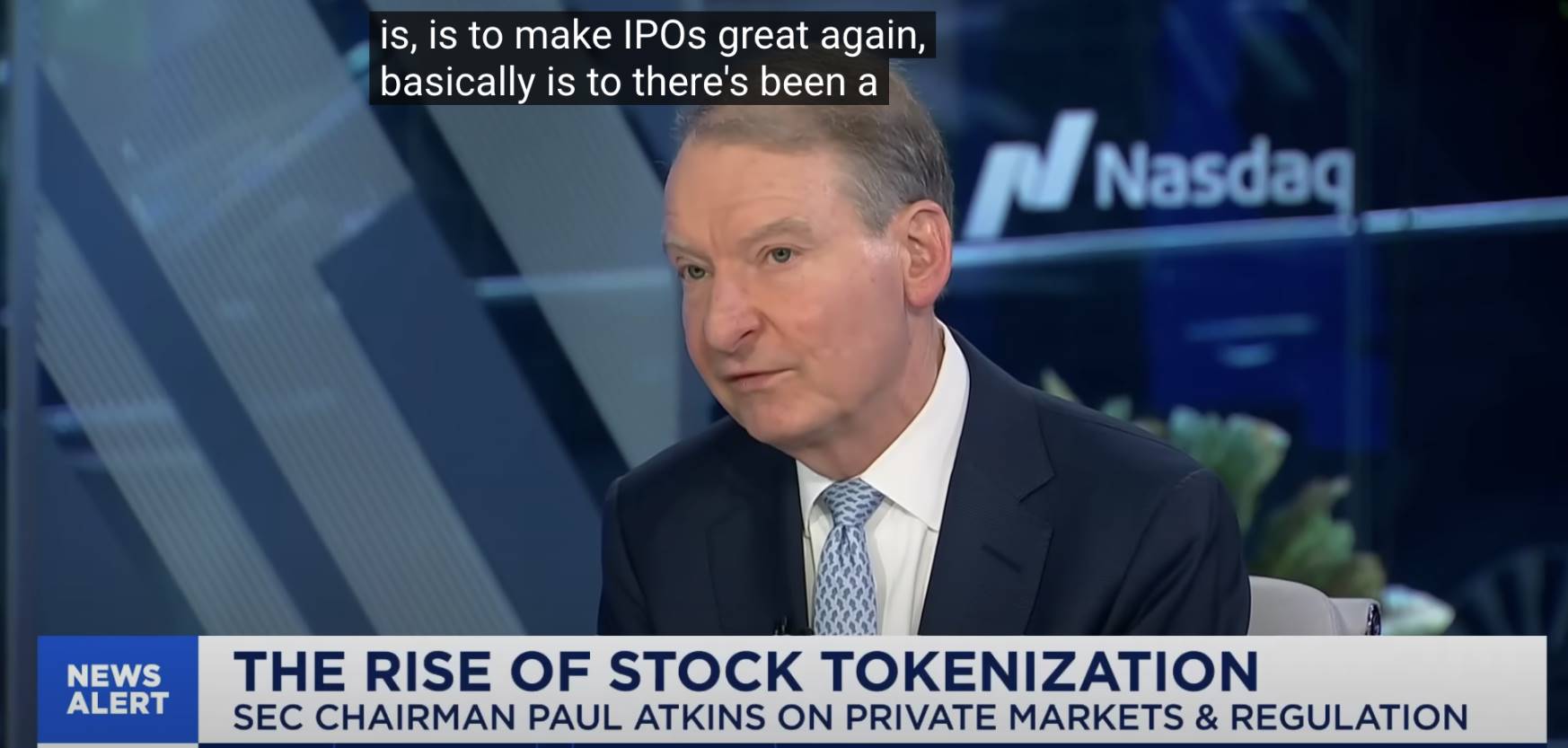
At the beginning of July 2025, U.S. regulators and corporate giants launched an innovation surge in "U.S. stock tokenization." Robinhood and Kraken officially announced their tokenized stock products, allowing ordinary users to buy U.S. stocks like Tesla and Apple on blockchains without requiring permission. Robinhood even introduced tokenized shares for private companies such as SpaceX and OpenAI, sparking widespread market discussion. U.S. Securities and Exchange Commission (SEC) Chair Paul Atkins recently appeared directly on CNBC to express his support for stock tokenization technology.
Yet, on the other side of the Pacific, Hong Kong's crypto companies remain quiet.
I reached out to professionals at three regulated Hong Kong crypto firms including HashKey and OSL, learning that while they are actively monitoring developments, none have actually begun exploring practical applications in stock tokenization.
Facing a market that, though still early-stage, could become the next billion- or even trillion-dollar sector after stablecoins, Hong Kong seems to have chosen not to participate—even as U.S. stock tokenization efforts gain momentum and despite its vast potential.
Some industry practitioners cannot help but ask: Why has Hong Kong, which has strongly supported cryptocurrency development over the past three years, chosen silence this time?
Why Is Hong Kong Silent?
Missed stablecoins ten years ago—will it also miss stock tokenization a decade later? Why does Hong Kong, which supports ETFs, RWA, and stablecoins, hesitate specifically on stock tokenization?
A senior executive at a Hong Kong crypto firm told me that forward-thinking players in the local crypto industry had actually pushed early for Hong Kong stock tokenization.
"Two years ago, Xiao Feng (founder of HashKey) actively advocated for the Hong Kong government to experiment with HK stock tokenization. Many industry leaders supported the idea, but it didn't go through."
In Hong Kong, laws explicitly state that only exchanges recognized by the Securities and Futures Commission (SFC) may legally operate stock trading markets—a structure that grants the Hong Kong Exchanges and Clearing Limited (HKEX) a de facto monopoly over stock trading. Any trial of stock tokenization would inevitably disrupt HKEX’s long-standing exclusive position.
"HKEX holds the exclusive right to trade Hong Kong stocks. No one wants to be the first to break that exclusivity and become a historical villain."
"If you were HKEX, would you revolutionize yourself?" asked the executive.
The resistance is strong, and neither Hong Kong regulators nor HKEX itself appear to have sufficient motivation or incentive to push forward stock tokenization—this may well explain Hong Kong’s current silence.
The situation in the United States, however, is different. Since Trump took office, the current U.S. regulatory environment has been highly supportive of crypto innovation. Whether it's USD stablecoins or tokenized U.S. stocks, these innovations strengthen the dominance of the U.S. dollar and U.S. equities, making it easier for global users to access American assets while bypassing traditional regulatory barriers.
Moreover, America's financial innovation ecosystem is more dynamic and powerful. Major players such as Robinhood—the largest online brokerage in the U.S.—Coinbase, the largest U.S. crypto exchange, and Solana, the leading U.S. public blockchain—all see themselves as challengers to traditional finance. Some even openly target Nasdaq. They have successfully lobbied regulators to allow experimentation with tokenized U.S. stocks.
This marks a key difference between this cycle of stock tokenization and the previous one.
An insider at Bybit pointed out: During the last market cycle, there were indeed some early attempts—such as Mirror Protocol and FTX's tokenized stock projects. However, most faced unclear regulation, lacked sustained liquidity, suffered from weak interoperability with other DeFi protocols, and failed to establish solid partnerships with compliant custodians or infrastructure providers—factors that contributed to their ultimate failure.
"Early setbacks should not hinder innovation in this space. With technological advancements, clearer regulations, and stronger infrastructure, tokenized stocks still hold great potential to play a pivotal role in the next wave of financial transformation," said the Bybit insider.
Notably, participants in this new cycle include not only powerful regulated institutions like Robinhood, Coinbase, and Kraken, but also experienced crypto exchanges such as Bybit, Crypto.com, and Gate, all of which have weathered multiple market cycles.
Unfortunately, among this growing list of innovators, Hong Kong-based crypto firms may no longer have a place. The excitement around stock tokenization appears, for now, destined to pass Hong Kong by.
Stock Tokenization Has Trillion-Dollar Potential
Ten years ago, China missed the optimal window to develop RMB stablecoins; ten years later, Hong Kong risks missing stock tokenization. Perhaps in another decade, people will look back with regret—just as they do today about RMB stablecoins—and wonder why tokenized Hong Kong stocks weren’t developed earlier.
Ten years ago, when exploration into RMB stablecoins was abandoned, it paved the way for USD stablecoins to achieve a market cap in the hundreds of billions and annual trading volumes in the trillions. In 2024, the annual trading volume of USD stablecoins—$28 trillion—surpassed the combined total of Visa and Mastercard.
Stock tokenization is the next major mass-adoption frontier after stablecoins—the next potentially trillion-dollar market. This assessment is far from baseless. Multiple industry experts believe the tokenized equity market could reach "several trillion dollars" in scale.
Data shows: As of 2025, the total market capitalization of U.S. stocks stands at $52 trillion, while the total circulating supply of U.S. dollars is only $20 trillion. In terms of overall market size, the potential for U.S. stock tokenization vastly exceeds that of dollar tokenization. Yet today, while USD stablecoins (tokenized dollars) have a market cap in the hundreds of billions, tokenized U.S. stocks sit at merely tens of millions—less than one ten-thousandth of the former.
Beyond sheer scale, global demand for tokenized U.S. stocks mirrors the demand for USD stablecoins. Currently, regions like Europe and China restrict individuals' direct access to U.S. stocks due to regulatory constraints. Stock tokenization, issued on public blockchains, naturally circumvents these restrictions, enabling unrestricted access for all users.
Beyond accessibility, stock tokenization enables functionalities impossible in traditional markets.
Andy from HashKey Tokenization believes tokenized stocks offer significant advantages over traditional ones.
"For example, users can conduct 24/7 spot trading; they can engage in 24/7 on-chain derivatives trading; they can tokenize shares of private companies, allowing ordinary investors early access to pre-IPO equities in firms like OpenAI, SpaceX, ByteDance, or Ant Group; users worldwide—including those in Europe and China—can bypass regulations to buy U.S. stocks, just as they do with USD stablecoins," Andy explained.
Currently, not only regulated exchanges like Kraken, Robinhood, and Coinbase are exploring U.S. stock tokenization, but platforms such as Bybit, Crypto.com, and Gate have already launched related products. A clear trend is forming.
Final Thoughts
Although the current market size of U.S. stock tokenization is only in the tens of millions—just one ten-thousandth of the USD stablecoin market—many industry insiders emphasize that this space should not be underestimated.
Tether, founded in 2014, saw annual trading volumes of only tens of millions during its first three years. But during the 2017 bull run, its volume surged ten thousandfold within a single year to reach hundreds of billions. Today, its annual trading volume exceeds $10 trillion.
The path for tokenized stock products may follow a similar trajectory. It may simply be waiting for its own "ChatGPT moment." And the vision of everyone buying U.S. stocks on blockchain might, like the stablecoin space, arrive overnight—quietly and suddenly.
When that moment comes, let us hope Hong Kong won’t miss the opportunity again.
Join TechFlow official community to stay tuned
Telegram:https://t.me/TechFlowDaily
X (Twitter):https://x.com/TechFlowPost
X (Twitter) EN:https://x.com/BlockFlow_News
 Foresight News