Payment Party: Will Visa and Mastercard Be Left Out?
TechFlow Selected TechFlow Selected
Payment Party: Will Visa and Mastercard Be Left Out?
If Web3 wallets become the new payment standard, those who built the underlying infrastructure may also benefit.
 Navigating Web3 tides with focused insights
Author: Prathik Desai
Translation: Block unicorn
From the first paper note in China’s Tang Dynasty to a functional check system, nearly a millennium passed. Then came wire transfers, accelerating cross-border trade in the 19th century. But what truly transformed payments was a forgotten wallet.
In 1949, Frank McNamara forgot his wallet while dining with clients at Major's Cabin Grill in Manhattan, New York. The embarrassment sparked an innovation to ensure it would never happen again. A year later, he returned with the world’s first credit card—the Diners Club Card—a cardboard card that eventually evolved into a network processing billions of transactions daily.
Soon after, Mastercard and Visa emerged from a chaotic mix of bank alliances and rebranding—driven largely by necessity.
As Bank of America’s BankAmericard (later renamed Visa) gained traction in the 1960s, other regional banks feared missing out on the credit card opportunity. In response, a group of banks formed Interbank in 1966, later renamed Master Charge and ultimately Mastercard, enabling them to pool resources, share infrastructure, and build a scalable competitive network.
This race for competitiveness became one of the most successful collaborations in banking history. Payments became easier—but more importantly, they became "invisible." Swiping or tapping wasn’t just convenient; it laid the foundation for modern commerce.
People could now carry purchasing power in their pockets. Merchants received faster payments. Banks unlocked new revenue streams. And the middle layer—the card networks—became among the most valuable businesses in the world.
In 2024, Mastercard and Visa generated $17 billion and $16 billion respectively from payment services alone. Digital transaction volumes continue to grow year over year.
Transaction volume surged from 645 billion in 2018 to 1.65 trillion in 2024—an increase of 2.5 times. According to Capgemini’s World Payments Report 2025, volumes are projected to rise another 70% from 2024 levels by 2028, reaching 2.84 trillion.
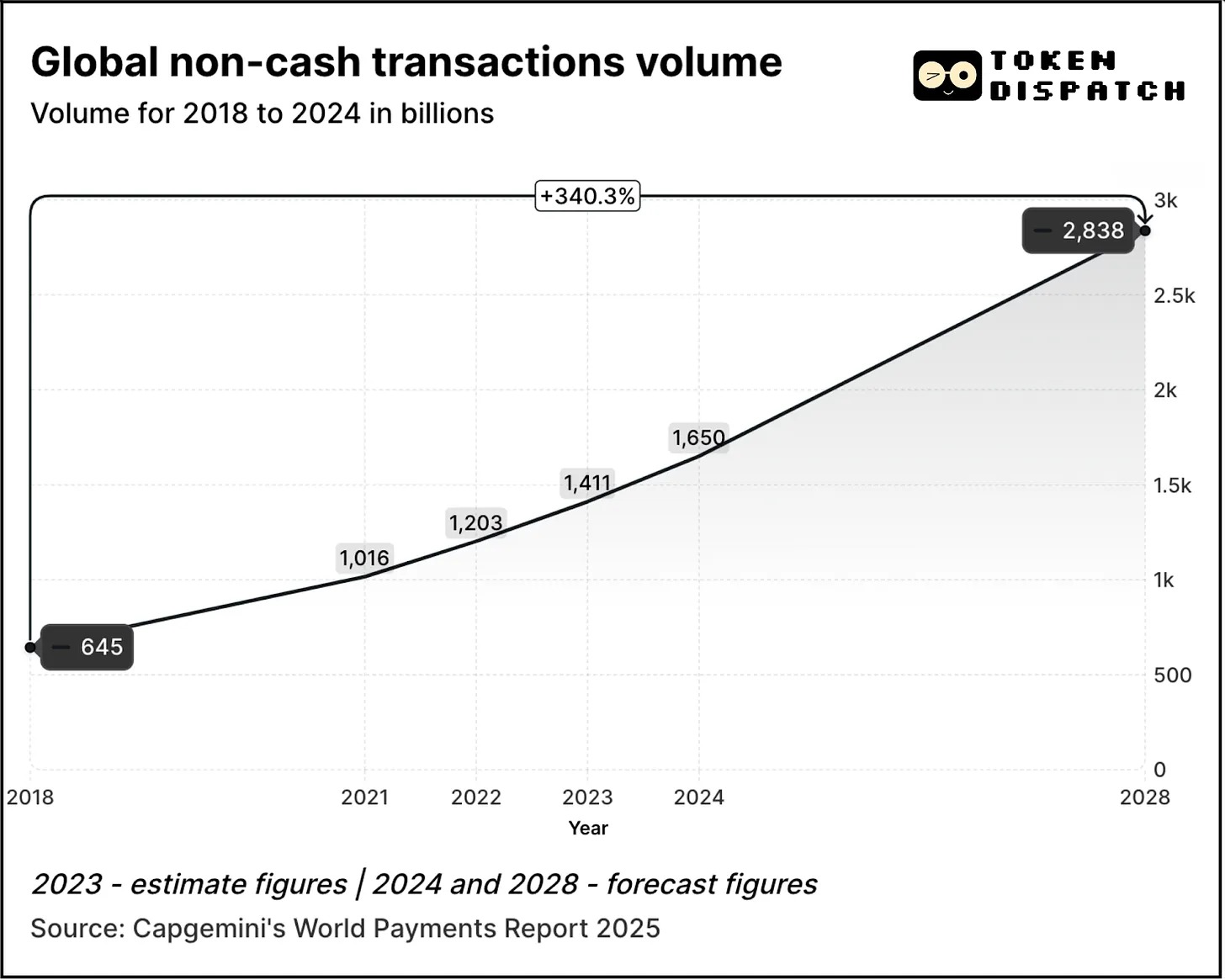
In 2023, about 57% of global non-cash transactions were completed via debit or credit cards, typically requiring 1 to 3 days for settlement. Each transaction often passes through multiple institutions before the merchant receives funds. Yet the system works well. You can swipe the same card in Tokyo, Toronto, or Thiruvananthapuram. Payments have become invisible.
Visa and Mastercard don’t actually issue cards or hold your money. What they own is a channel built on trust between unfamiliar financial institutions. When you tap or swipe, their network decides whether to approve the transaction, matches the correct accounts, clears the bill, and ensures funds are ultimately transferred.
For this, merchants pay around 2–3% of the transaction value, distributed among the issuing bank, acquiring bank, processor, and card network. In return, everyone gets a fundamentally reliable system. You don’t need to know who settled the payment—only that it worked.
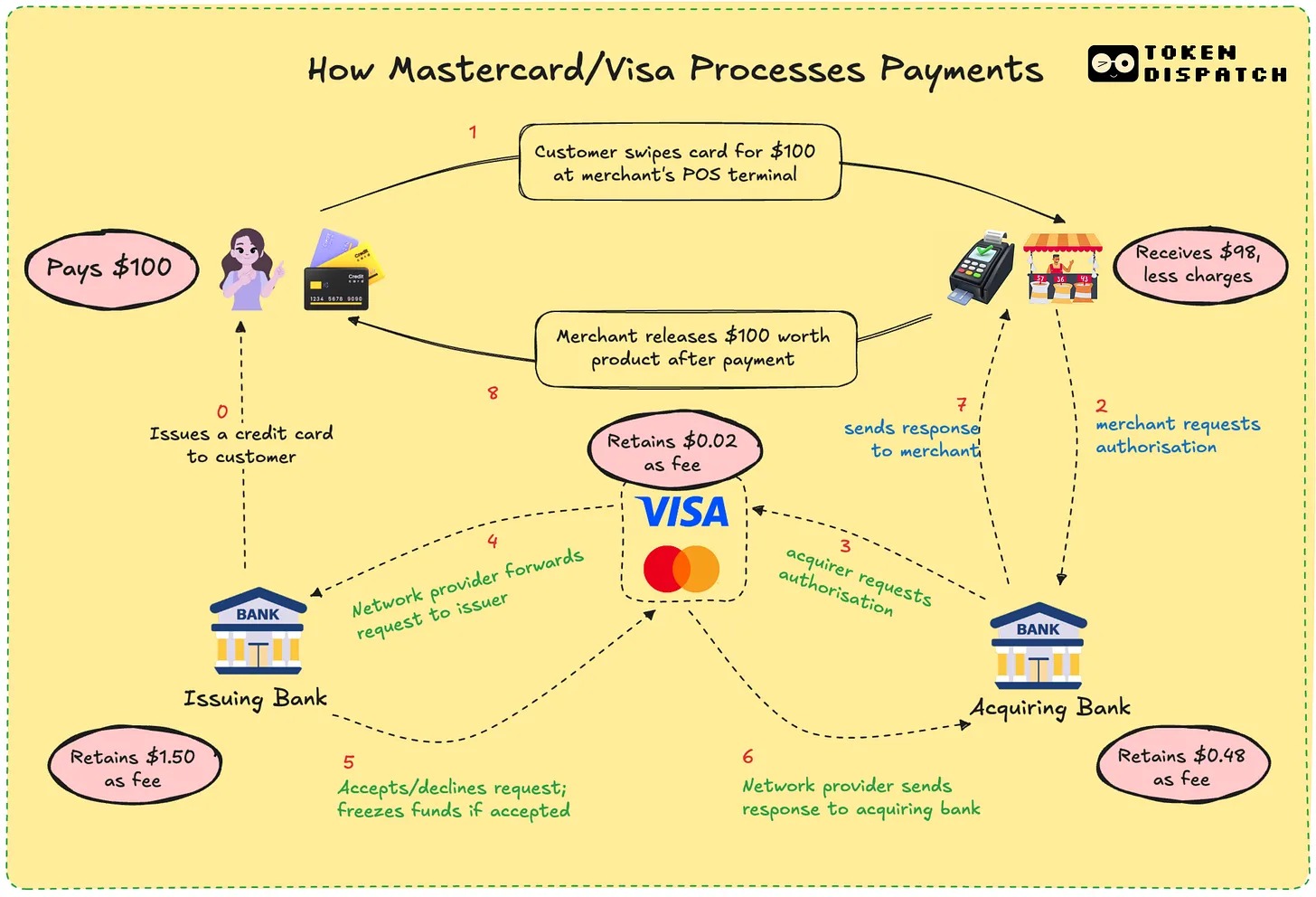
As a user, you likely never question this process. When did you last ask how your favorite café receives money after you swipe? You pay, they smile, and life goes on. But for merchants, those few percentage points add up—especially for small businesses operating on thin margins.
Have you ever been frustrated by paying a few extra dollars because card payments cost more than cash or other digital methods? Now you know why.
Imagine if they could eliminate delays, receive payments instantly, and pay minimal fees. This is blockchain’s promise. Visa and Mastercard are either trying to emulate this model—or risk being overtaken by it.
The dynamics shift further with stablecoins. In the past 12 months, stablecoin monthly transaction volume has already surpassed Visa’s.
With stablecoins, transactions settle directly from one wallet to another in seconds. No banks, no processors, no delays—just code. On networks like Solana or Base, fees are just a few cents, and transactions are nearly instantaneous.
This isn’t theoretical. Freelancers in Argentina are already accepting USDC. Remittance platforms are integrating stablecoins to bypass traditional banking systems. Crypto-native wallets let users pay merchants directly without a card.
The threat facing Visa and Mastercard is existential. If the world starts transacting on-chain, their role could vanish. So they’re adapting.
Mastercard’s moves over the past year are hard to ignore.
Its recent collaboration with Chainlink aims to connect over 3.5 billion cardholders directly to on-chain assets—more than 40% of the global population. The system leverages Chainlink’s secure interoperability infrastructure and combines the power of payment processors like Uniswap and Shift4 to create fiat-to-crypto bridges.
Additionally, it partnered with Fiserv and launched its own stablecoin, FIUSD, which Mastercard plans to integrate across more than 150 million merchant touchpoints. Their goal? To enable merchants to seamlessly convert between stablecoins and fiat anytime, anywhere—like email for money.
Through its Multi-Token Network (MTN), Mastercard is also laying the groundwork for stablecoin-linked cards, digital asset merchant settlements, and tokenized loyalty programs. Why give up card-linked rewards just because you choose on-chain payments?
What’s in it for Mastercard? Quite a lot. Enabling on-chain settlement can reduce internal processing costs by cutting out intermediaries.
Mastercard’s $300 million investment in April 2025 in Corpay’s cross-border payments division signals its bet on high-volume, low-margin businesses where cost efficiency is critical. Consider cross-border payments—one area where Mastercard differentiates itself from rival Visa. In 2024, Mastercard’s cross-border transaction volume grew 18% year-over-year.
They’re also creating new fee structures: while traditional per-transaction fees may decline, they can now charge for API access, compliance modules, or MTN integration.
Meanwhile, Visa is partnering with Africa’s Yellow Card to pilot cross-border stablecoin payments—an urgent need in Africa. It teamed up with Ledger to launch cards allowing users to spend crypto and earn cashback in USDC or BTC. Visa continues developing its Visa Tokenized Asset Platform, designed to help banks issue digital fiat instruments on-chain.
With stablecoin settlement, Visa won’t need to route transactions through multiple banks or suffer as much foreign exchange slippage. The motivation is clear: lower costs and higher margins.
Both companies are shifting their mindset. They’re programming themselves into the infrastructure layer for programmable money. They realize the future may not be dominated by swipes—but by smart contract calls.
Beneath all this lies a deeply personal undercurrent.
I’ve waited three days for a refund after canceling a booking. I’ve seen international freelancers struggle with wire transfer delays and costs. I’ve wondered why my cashback took weeks to arrive. For users like us, these inefficiencies are inconvenient but have quietly become normalized. Web3 now offers an alternative.
For payment giants, the biggest hurdle will be cost. For merchants, traditional card transactions can cost 2% or more. With on-chain stablecoins, fees can drop below 0.1%. For users, this means faster rewards, real-time settlement, and lower prices. For developers and fintechs, it means building apps that plug directly into the global payment network—without legacy banking friction.
Web3 still comes with trade-offs. Card networks offer fraud protection, refunds, and dispute resolution. Stablecoins do not. Send funds to the wrong wallet, and they’re likely gone forever. While on-chain money movement is highly efficient, it still lacks the consumer safeguards we value. Recent Senate passage of the GENIUS Act may have addressed some of these consumer protection concerns.
Visa and Mastercard aren’t waiting idly. Instead, they see this gap as an opportunity. By overlaying traditional compliance, risk scoring, and security features onto stablecoin transactions, they aim to make Web3 safe for everyday users. The strategy? Let others build the protocols—and sell them the rails needed for scale.
They’re also betting on volume—not speculative trading, but real-world use cases: remittances, payroll, e-commerce. If this traffic shifts on-chain, companies that help manage it will benefit—even if they’re no longer the toll collectors of old.
Visa and Mastercard want to be enablers in building such ecosystems from the ground up. So when your preferred crypto wallet needs a trusted KYC layer, or your bank requires cross-border compliance, a branded API will be ready.
What does this mean for users? Possibly a future where your wallet functions like a bank. You receive payments in stablecoins, spend via a Visa or Mastercard interface, earn tokenized loyalty points—all settling instantly. You might not even notice which chain it runs on.
For someone like me—who’s experienced everything from bank apps to UPI to buying coffee with crypto—the appeal is obvious: I want payments that are simple and effective. I don’t care if it’s tokens or rupees. I care that it’s fast, cheap, and error-free. If these legacy giants can deliver that, perhaps they deserve to endure.
In the end, this is a race to remain indispensable. If Web3 wallets become the new payment standard, the beneficiaries might still be those who built the underlying rails. The card giants are betting that even if the money changes, the infrastructure may still belong to them.
They hope to fade into the background once again. Only this time, the pipes will be made of code.
Join TechFlow official community to stay tuned
Telegram:https://t.me/TechFlowDaily
X (Twitter):https://x.com/TechFlowPost
X (Twitter) EN:https://x.com/BlockFlow_News