Detailed Explanation of Backed xStocks: On-chain Experimentation and Breakthrough Path for Tokenized Stocks
TechFlow Selected TechFlow Selected
Detailed Explanation of Backed xStocks: On-chain Experimentation and Breakthrough Path for Tokenized Stocks
xStocks and bTokens offer on-chain tokenized securities services covering global blue-chip stocks, index funds, and short-term bonds.
 Navigating Web3 tides with focused insights
Text: Wu Shuo Blockchain
On June 30, 2025, cryptocurrency exchanges Bybit and Kraken announced the listing of xStocks products provided by Swiss regulated asset tokenization platform Backed Finance. xStocks are tokens fully backed 1:1 by real stocks, with underlying assets held by regulated third-party custodians such as InCore Bank and Maerki Baumann—Swiss banks. These tokens are issued on the Solana blockchain as SPL standard tokens, enabling 7×24 trading and instant on-chain settlement, breaking traditional stock market constraints of time and geography. Due to compliance requirements, xStocks are currently only available to non-U.S. users; U.S. persons may not purchase or hold these products. Subsequently, numerous major platforms including Crypto.com and GMGN also listed xStocks.
Team Background
According to LinkedIn, the three co-founders of Backed Finance previously worked at DAOstack, a now-defunct project. DAOstack raised nearly $30 million from private sales, pre-sales, and public fundraising between Q4 2017 and May 2018, with token prices ranging from $0.708 to $0.9423. Key investors included Cultu.re, Endor Protocol, Gnosis, and Menlo One. However, the project's GEN token price sharply declined after May 2021, eventually approaching zero. DAOstack officially shut down by the end of 2022. This relatively negative team history has sparked community discussion.
In 2021, inspired by the widespread adoption of stablecoins, the three founders left DAOstack to establish Backed Finance, aiming to bring traditional assets like equities into the blockchain ecosystem in a compliant manner. Between 2021 and 2022, Backed completed feasibility validation and seed funding, established partnerships with custodian banks and brokers, and obtained EU regulatory approval for its prospectus. The first products launched in 2023, with cumulative issuance surpassing $50 million. In April 2024, Backed raised $9.5 million in a Series A round led by Gnosis, with participation from Exor Seeds, Cyber Fund, Mindset Ventures, and other institutions.
Product Architecture and On-Chain Deployment
Backed Finance currently offers tokenized securities services covering global blue-chip stocks, index funds, and short-term bonds through two main product lines—xStocks and bTokens. All tokens are backed 1:1 by physical assets and carry ISIN codes approved under EU regulations. Products have been deployed across major public blockchains including Ethereum, Solana, Avalanche, Base, and Polygon, and integrated with DeFi protocols such as Kamino Finance, Raydium, and Jupiter Exchange, supporting on-chain strategies like lending, market making, and arbitrage.
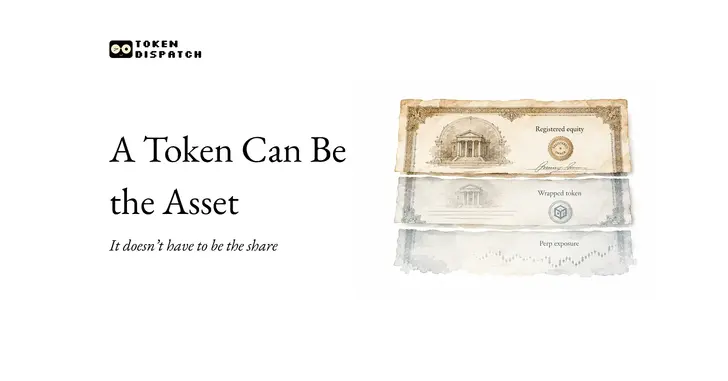
Ryan, an analyst at DigiFT, pointed out that xStocks tokens are essentially corporate debt instruments (tracking underlying assets), not equity tokens. Since the issuer of debt does not require custody licenses, Backed’s issuing entity is a special purpose vehicle (SPV) without distribution rights. The actual distribution is handled via PDSL, a Bermuda DA-licensed entity and subsidiary of Kraken.
Because it is structured as debt, dividend distributions are handled via direct token airdrops. The tokens do not participate in corporate actions. Debt instruments can be issued as bearer bonds, meaning ownership transfer does not require registration (unlike equity), thus avoiding stamp duties (a cumbersome tax in traditional finance) and enabling free on-chain transfers.
Purchase processes involve bridging capital and stablecoin conversion, resulting in per-transaction purchase limits. Combined with traditional brokers operating only during market hours (plus BlueOcean pre- and post-market sessions), spreads are set at 1% to compensate market makers, with relatively high fees at 0.5%. Overall, this setup provides users exposure to U.S. equities but offers limited additional functionality—for now, sufficient. For institutional-scale adoption, alternative issuance structures will be required.
Trading Experience: Liquidity Constraints and Entry Barriers
Despite support from Bybit and Kraken, actual trading activity for xStocks remains highly concentrated. Only six symbols—NVDAx, MSTRx, TSLAx, CRCLx, SPYx, and AAPLx—show meaningful trading volume. According to on-chain data from DefiOasis, on the launch day (June 30, 2025), total on-chain trading volume reached $1.338 million, with 1,225 unique traders completing 2,510 transactions. Trading activity surged on July 1, with daily volume hitting $6.64 million, 6,565 new unique users, and 17,879 transactions. Trading was primarily focused on TSLAx ($1.71 million), SPYx ($1.53 million), and CRCLx ($940,000). Most other symbols saw minimal on-chain activity, with some pools having zero liquidity and fewer than 20 trades, leading to widespread slippage issues.
Besides on-chain trading, xStocks can also be traded via internal exchange matching. Bybit offers USDT-based trading pairs, while Kraken supports fiat-mediated trading but has not yet introduced stablecoin pairs and enforces minimum purchase amounts. Notably, both on-chain and exchange-based trading currently suffer from insufficient liquidity, resulting in low execution efficiency, shallow market depth, and an overall trading experience that lags significantly behind traditional CFD platforms.
Target Users and Structural Advantages
The Backed model primarily serves non-U.S. users who face difficulties accessing U.S. equities through traditional brokers—especially crypto-native users. Its advantages include stablecoin payments, micro-investments, no need for a U.S. brokerage account, 7×24 on-chain order matching and settlement, real asset custody, and EU regulatory compliance.
Expansion Paths: Derivatives and Private Equity Tokenization
While xStocks provide foundational infrastructure for on-chain U.S. equity investment, liquidity bottlenecks in the spot market hinder the formation of a scalable trading ecosystem. As a result, industry attention is turning toward more trade-oriented derivative solutions, particularly stock perpetual contracts ("stonk perps"). High-volatility tech stocks, combined with high leverage, can generate returns similar to altcoins, making them more appealing to crypto users. Such products eliminate the need for physical stock delivery and can operate purely on-chain using oracle pricing and funding rate mechanisms. This technical path is mature and well-suited for early deployment on decentralized platforms like Hyperliquid. Compared to centralized exchanges facing regulatory hurdles, decentralized derivatives platforms offer greater flexibility and room for experimentation.
Another promising direction is the tokenization of private company equity. Unlike traditional private markets—characterized by information opacity and limited exit options—on-chain issuance of transferable equity tokens, combined with mechanisms like DAO governance, contract-based lockups, and accredited investor filters, could enable efficient and transparent early-stage equity circulation. This would be especially valuable for high-profile companies like OpenAI and SpaceX. However, this path still faces regulatory uncertainty and complex structuring challenges, and in the short term is more likely to emerge as pilot programs or gray-zone compliant models.
Conclusion
xStocks demonstrate a viable pathway for compliant asset tokenization, showcasing strong product design through their on-chain architecture, cross-chain deployment, and DeFi integration. However, limited spot market liquidity and constrained user growth mean they cannot single-handedly drive the expansion of tokenized stock markets. Going forward, breakthroughs combining perpetual derivatives and early-stage equity tokenization may become the key catalysts transforming on-chain securities from "utility tools" into "tradable assets."
Join TechFlow official community to stay tuned
Telegram:https://t.me/TechFlowDaily
X (Twitter):https://x.com/TechFlowPost
X (Twitter) EN:https://x.com/BlockFlow_News
 吴说区块链
吴说区块链