









2025 Perpetual DEX Rankings: Trading Volume Surges, Closing In on Centralized Giants
TechFlow Selected TechFlow Selected
2025 Perpetual DEX Rankings: Trading Volume Surges, Closing In on Centralized Giants
Perpetual DEX has matured.
 Navigating Web3 tides with focused insights
Author: Launchy
Translation: TechFlow
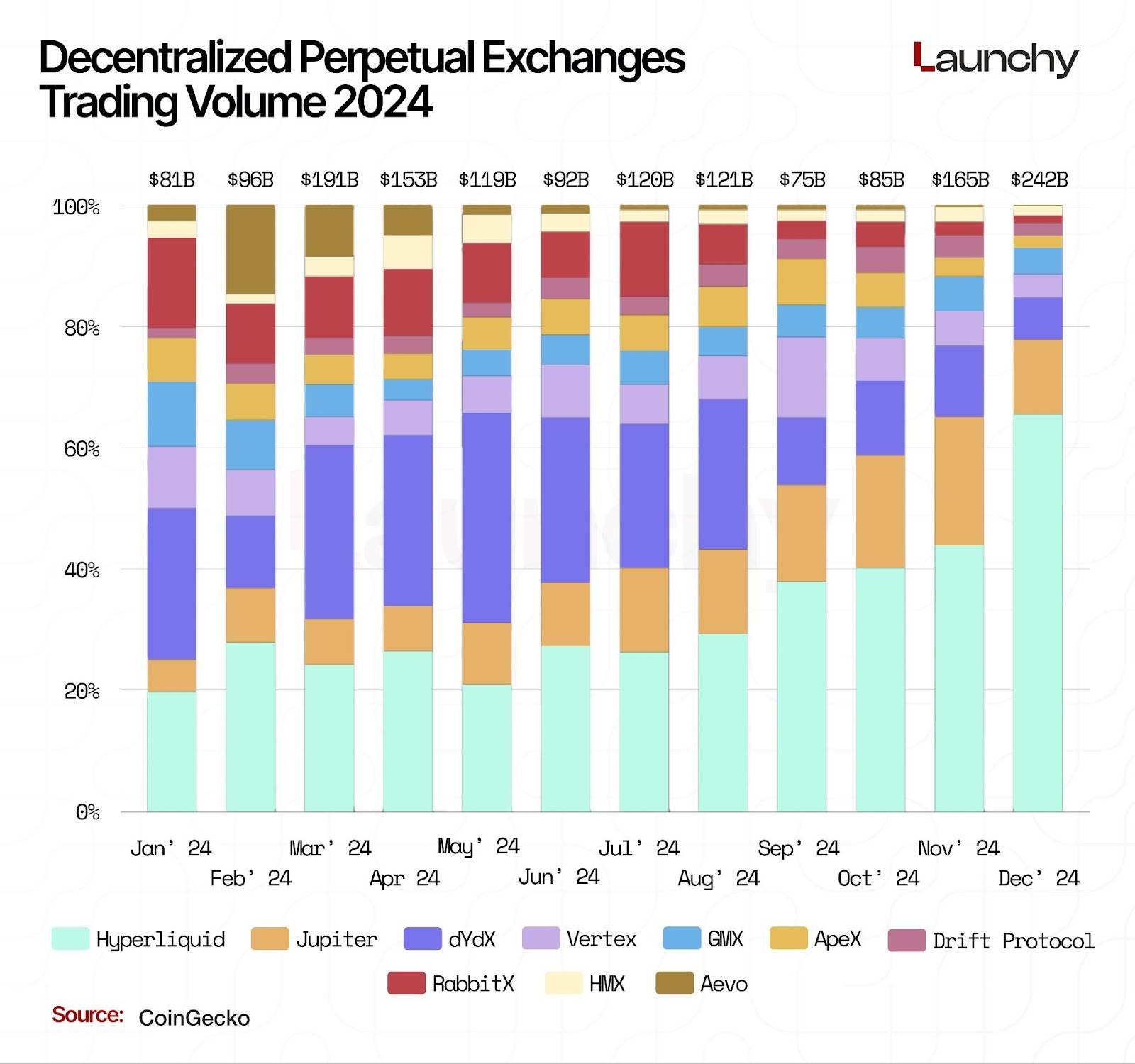
Perpetual decentralized exchanges (Perpetual DEXs) have rapidly evolved from experimental DeFi tools into major contenders in the crypto derivatives market. In 2024, the sector experienced explosive growth, with total trading volume across Perp DEXs reaching $1.5 trillion—more than doubling the $647.6 billion recorded in 2023. December alone saw a record-breaking $344.75 billion in trading volume, marking an all-time high for a single month.
Source: CoinGecko
This surge has been driven primarily by platforms like Hyperliquid, whose annual trading volume skyrocketed from $21 billion in 2023 to $570 billion in 2024—a 25.3x increase. Drift and Jupiter also achieved significant breakthroughs, posting year-on-year volume growth of 628% and 5176%, respectively.
With innovations such as native order books, fast-finality chains, zk-enabled features, and app-specific ecosystems emerging, 2025 is laying the foundation for the next phase of Perp DEXs—mainstream adoption.
This report explores the data behind this evolution, the leading platforms driving progress, and the technological and market trends that will shape the future of Perp DEXs.
Key Takeaways
-
Hyperliquid Dominates the DeFi Perpetual Market:
Hyperliquid currently commands 80% of the decentralized perpetual DEX market, with monthly trading volume reaching $165 billion. Its retail-first token model has fueled strong momentum without relying on venture capital backing.
-
Perp DEX Trading Volume Surged in 2024:
The market grew from $647.6 billion in 2023 to over $1.5 trillion in 2024. December alone accounted for $344.75 billion, reflecting rapid acceleration in user activity.
-
Top Platforms Are Consolidating Market Share:
A small number of platforms now dominate Perp DEX activity. Hyperliquid, Jupiter, ApeX, RabbitX, and MYX lead in both trading volume and user base due to strong execution and network effects.
-
Solana and Arbitrum Emerge as Key Enablers:
These blockchains support the fastest-growing DEXs with low-latency and scalable infrastructure. Jupiter runs on Solana, while Hyperliquid operates on Arbitrum—highlighting chain-specific advantages.
-
CEX Still Leads, But the Gap Is Narrowing:
In May 2025, Binance’s trading volume reached $1.7 trillion, but Hyperliquid already accounted for approximately 9% of that. As more traders favor self-custody and transparency, DEXs are catching up at an accelerating pace.
Market Overview of Perp DEXs
Entering 2025, the perpetual decentralized exchange (Perp DEX) market has reached historic highs in both usage and innovation. Trading volume grew over 138% year-over-year, with top DEXs surpassing $1.5 trillion in cumulative volume.
In Q4 2024, Hyperliquid captured over 55% of trading volume, peaking at 66% in December following a large-scale airdrop campaign. Meanwhile, former market leader dYdX saw its share plummet from 73% in January 2023 to just 7% by the end of 2024. Jupiter, built on Solana, rose rapidly to become the second-largest Perp DEX, with Solana itself contributing 15% of total Perp DEX volume.
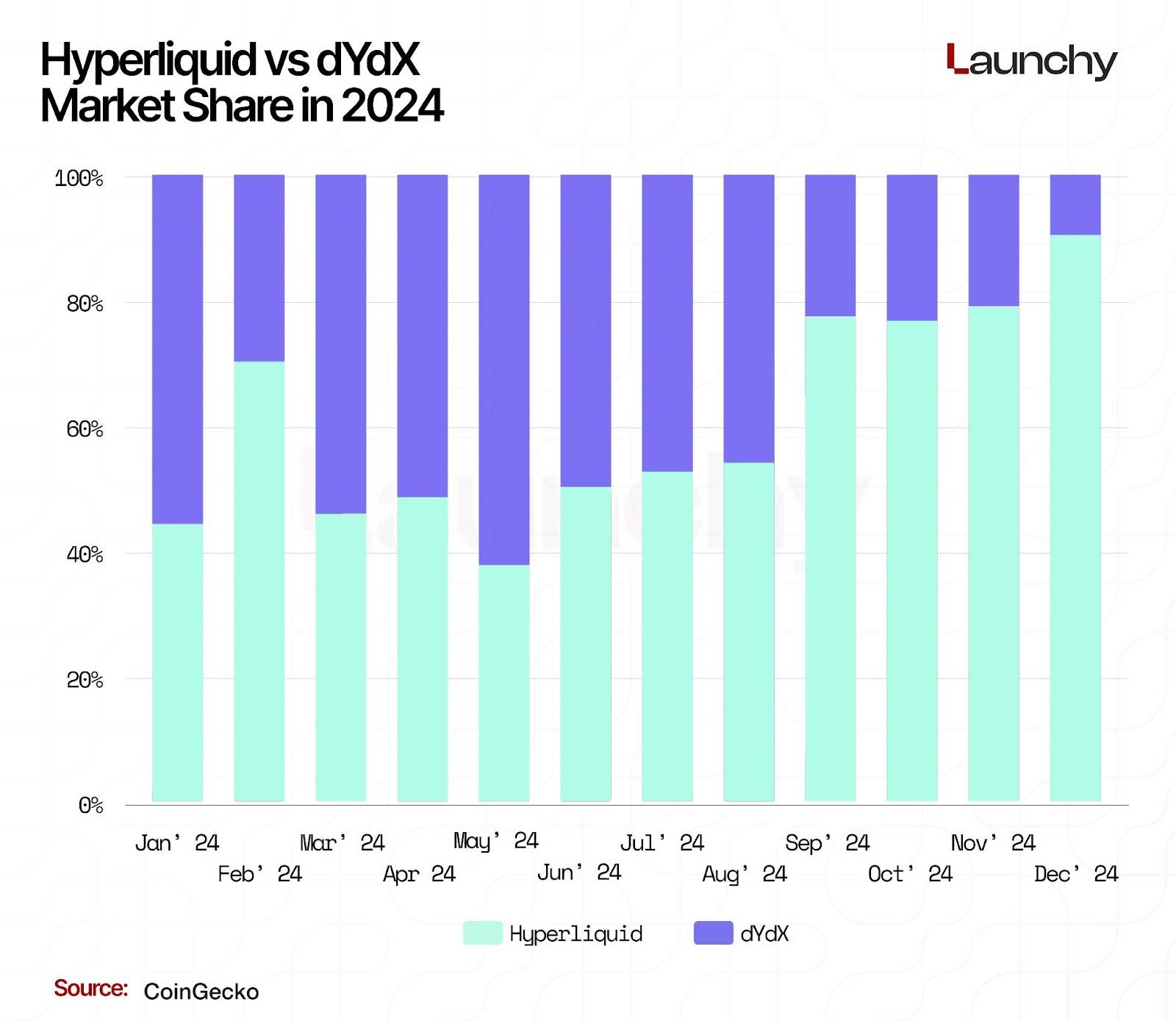
By November 2024, the total open interest in centralized perpetual markets had exceeded $100 billion, but decentralized platforms are quickly closing the gap. Perp DEXs are now competitive in liquidity, execution speed, and composability. 2025 could be the pivotal year when the shift from centralized to decentralized derivatives trading gains real momentum.
Current Landscape
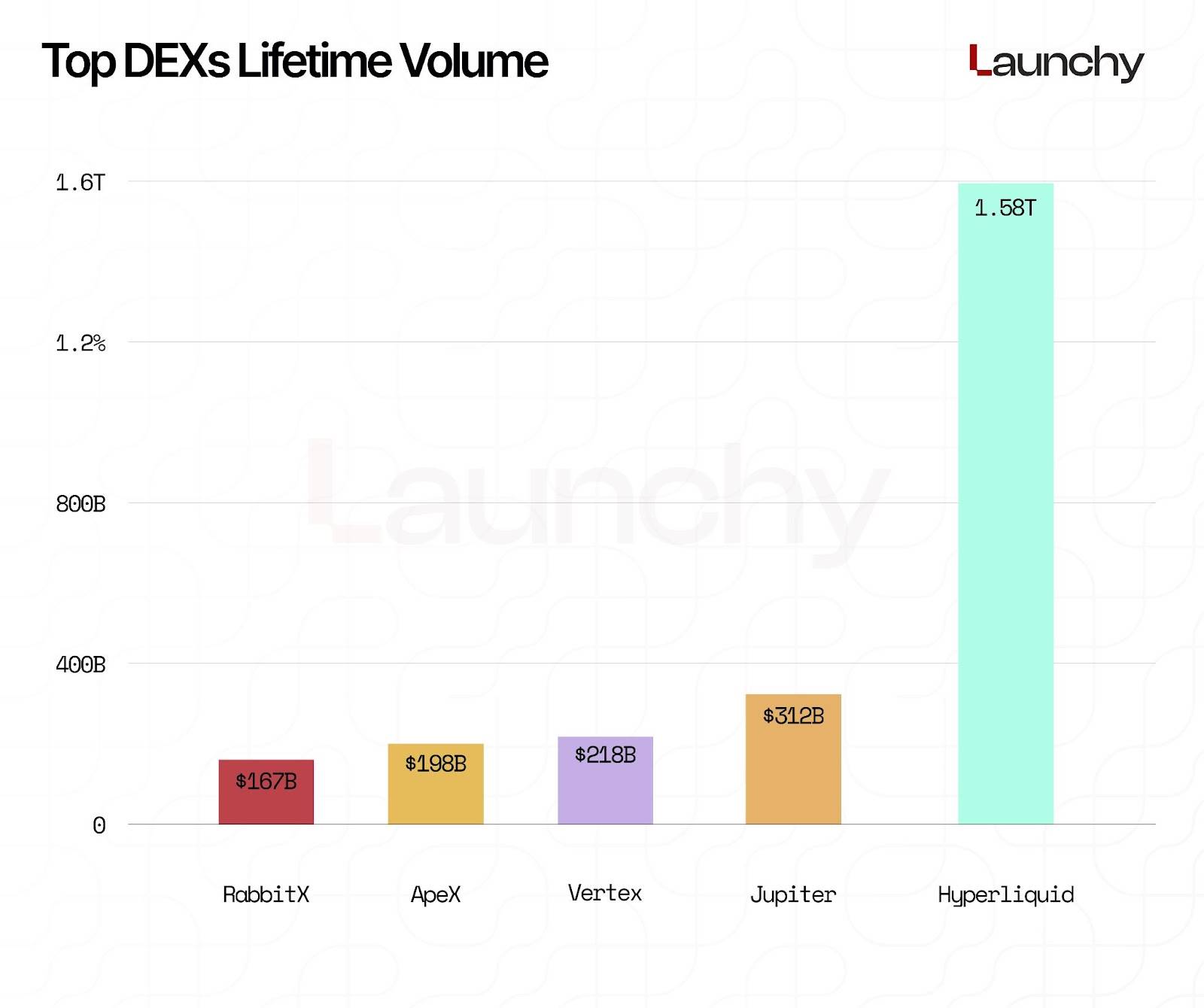
As of mid-2025, the Perp DEX landscape is consolidating around a few dominant players, with Hyperliquid far ahead. It currently reports a 24-hour trading volume of $11.25 billion and a cumulative volume of $1.58 trillion—far exceeding its nearest competitors. This growth is powered by robust infrastructure, support for 130 assets, and its platform advantage on Arbitrum.
Trailing closely is Jupiter, Solana's leading Perp DEX, with a daily volume of $570.85 million and $312.13 billion in cumulative volume, carving out a niche thanks to Solana’s ultra-low latency environment. Other notable platforms include Vertex ($217.91 billion cumulative volume), ApeX ($197.99 billion), and RabbitX ($166.95 billion). Many of these support multi-chain deployments, expanding user access and deepening liquidity pools.
Leverage offerings on DEXs are also becoming more aggressive. Gains Trade offers up to 500x leverage across 230 assets; ApolloX provides 1001x leverage, and Equation offers 150x—drawing interest from high-risk traders. At the same time, platforms like RabbitX and Drift emphasize cost efficiency for active users by offering 0.00% maker and taker fees.
Solana and Arbitrum remain the most common underlying chains, with multiple platforms—including SynFutures, GMX, and Drift—leveraging rollup scalability or application-specific L1 chains. Despite dYdX’s declining dominance, it still holds $1.49 trillion in cumulative volume and operates across five major chains.
With deepening liquidity, accelerated multi-chain expansion, and intensifying competition over user incentives, the Perp DEX space is evolving rapidly. The race is no longer about “who launches first,” but “who can scale quickly, execute reliably, and deliver the best trading experience.”
Top 10 Perp DEXs by Trading Volume
As of mid-2025, the perpetual decentralized exchange (Perp DEX) sector is dominated by a handful of leading platforms, with trading activity increasingly concentrated among the top ten protocols. The ranking below reflects current 24-hour and cumulative trading volumes, highlighting each platform’s scale and competitiveness.
-
Hyperliquid
-
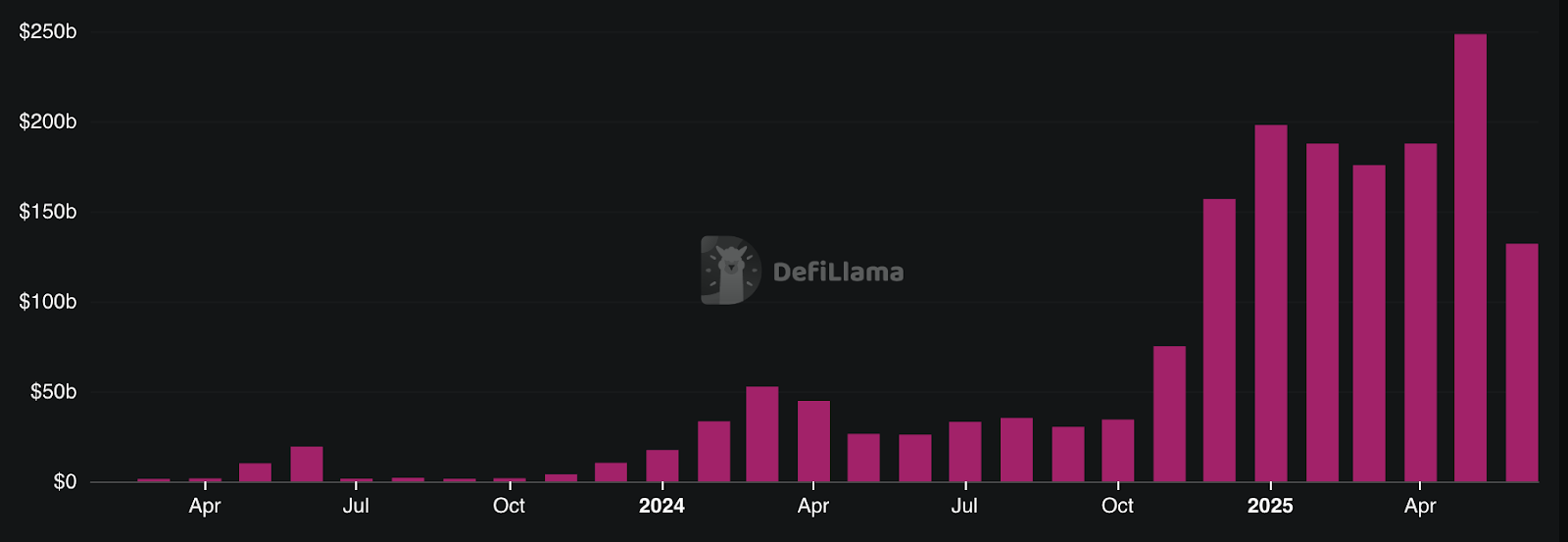
30-day Volume: $254.81 billion
-
Cumulative Volume: $1.58 trillion
-
Supported Chains: 1 (Arbitrum)
Hyperliquid continues to dominate the Perp DEX market thanks to its high-performance, Arbitrum-native infrastructure, support for 130 trading pairs, and a highly active user base. Its cumulative volume has surpassed $1.5 trillion, and its daily volume even exceeds that of many centralized exchanges (CEX).
-
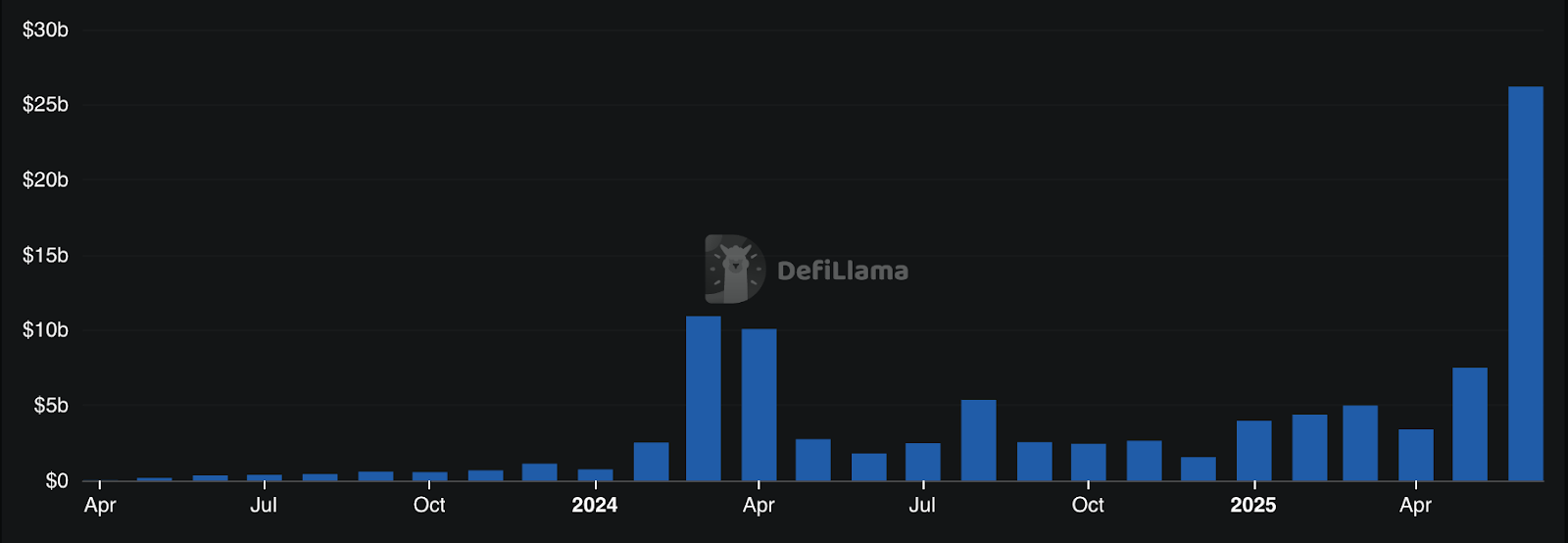
Aster
-
30-day Volume: $28.16 billion
-
Cumulative Volume: Unknown
-
Supported Chains: 4 (BNB Chain, Ethereum, Solana, Arbitrum)
Aster is the biggest newcomer on the list, leaping into second place with strong multi-chain support. Its rapid rise signals growing trader interest in alternatives that offer broader accessibility.
-
Jupiter
-
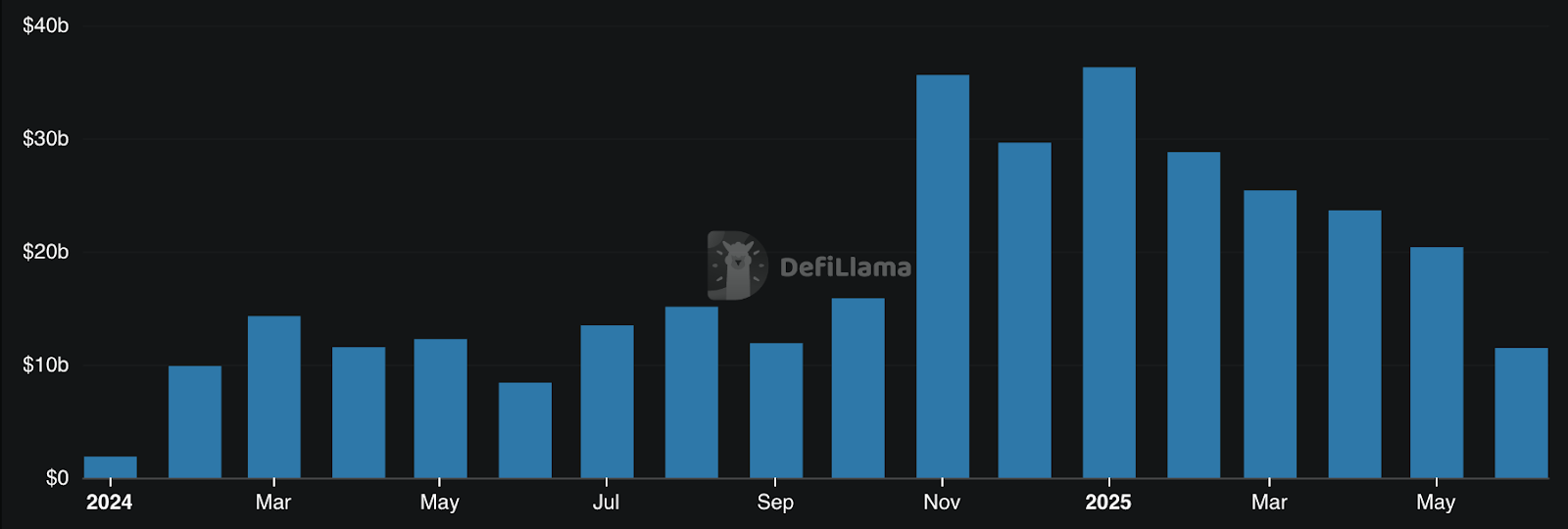
30-day Volume: $19.61 billion
-
Cumulative Volume: $312.13 billion
-
Supported Chains: 1 (Solana)
Jupiter remains a key player on Solana, focusing on a limited set of trading pairs while delivering deep liquidity. While its 30-day volume has dipped compared to others, its long-term growth trajectory remains strong.
-
ApeX Protocol
-
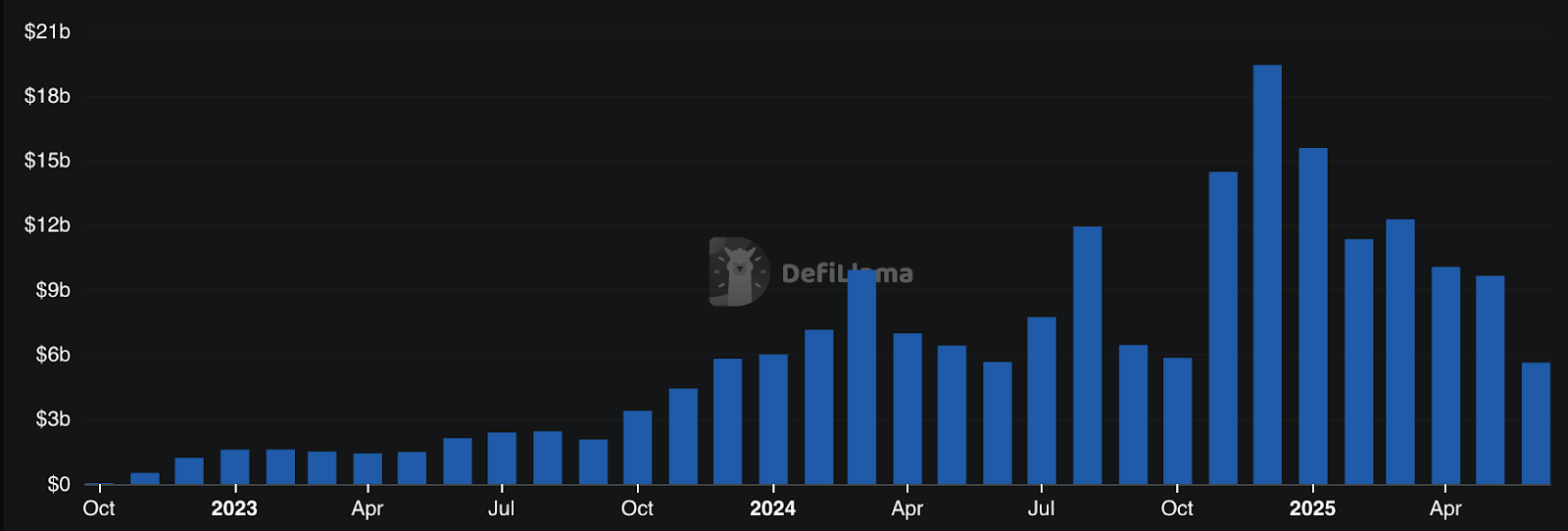
30-day Volume: $8.98 billion
-
Cumulative Volume: $197.99 billion
-
Supported Chains: 1 (Ethereum-compatible Layer 2 based on StarkWare)
Despite focusing on a single chain, ApeX maintains solid volume through strong liquidity, support for 20 tokens, and a streamlined user experience (UX).
-
RabbitX Fusion
-
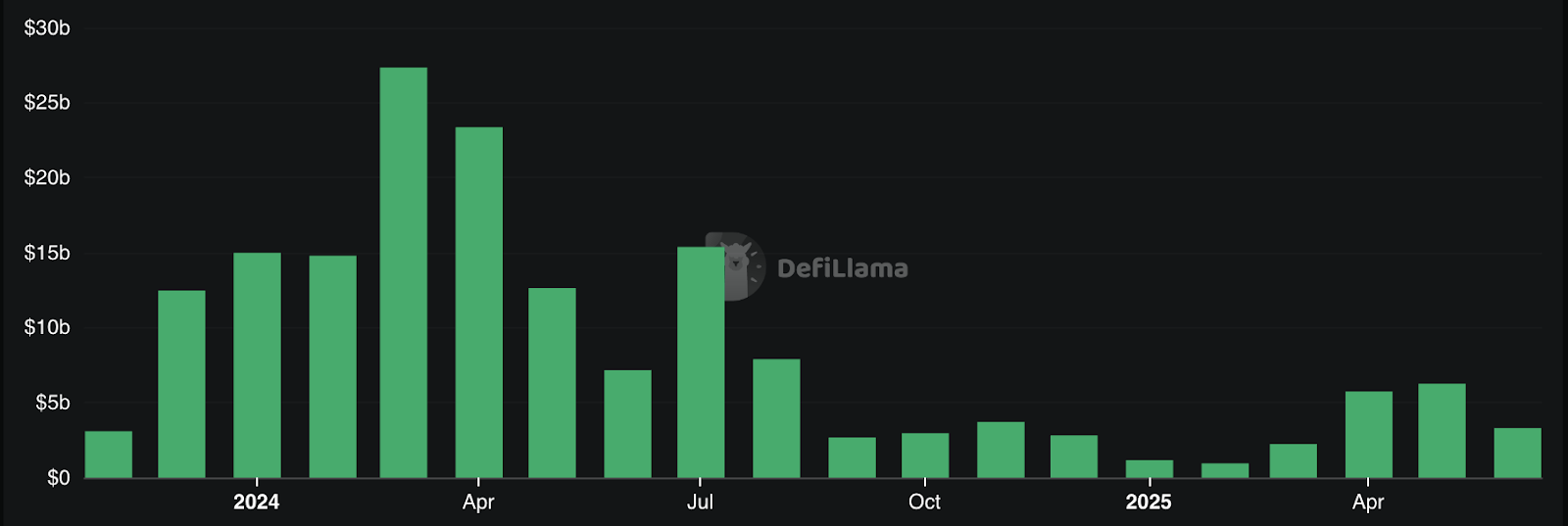
30-day Volume: $5.84 billion
-
Cumulative Volume: $166.95 billion
-
Supported Chains: 1 (StarkNet)
RabbitX stays competitive with a zero-fee structure and institutional-grade infrastructure, making it particularly attractive to cross-exchange arbitrage traders.
edgeX
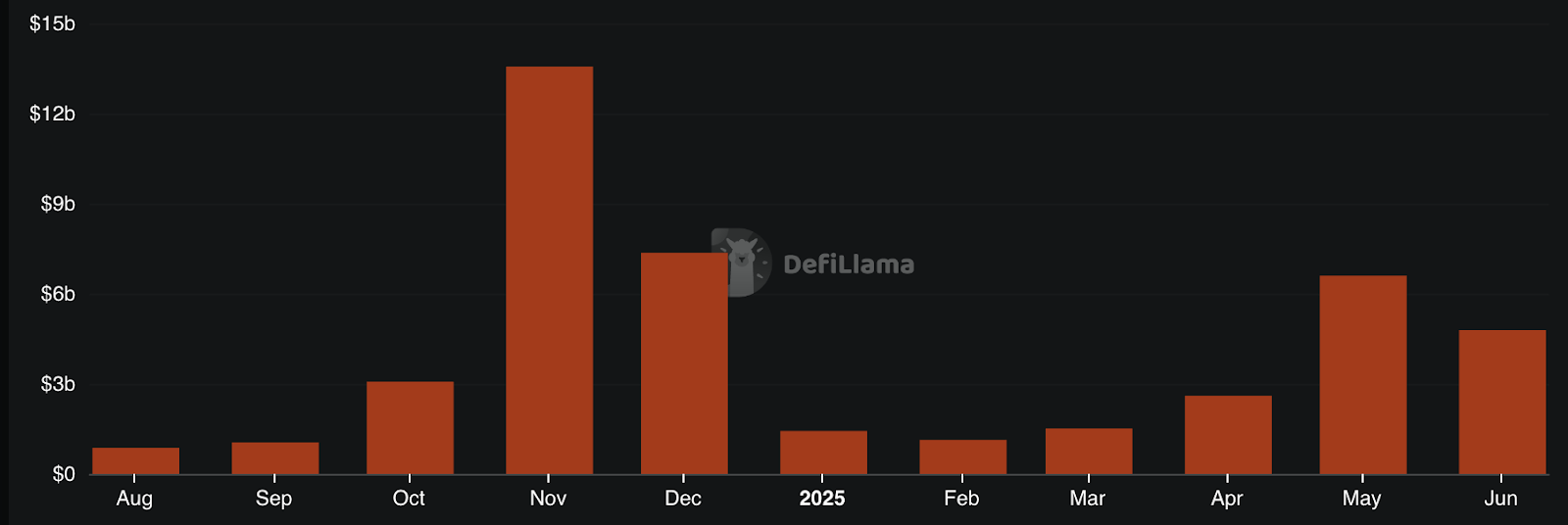
edgeX Perps Data / DefiLlama
-
30-day Volume: $7.52 billion
-
Cumulative Volume: Unknown
-
Supported Chains: 1 (Ethereum-compatible Layer 2 based on StarkWare)
As a dark horse, edgeX has shown strong early trading metrics thanks to a simplified UX and single-chain deployment.
MYX Finance
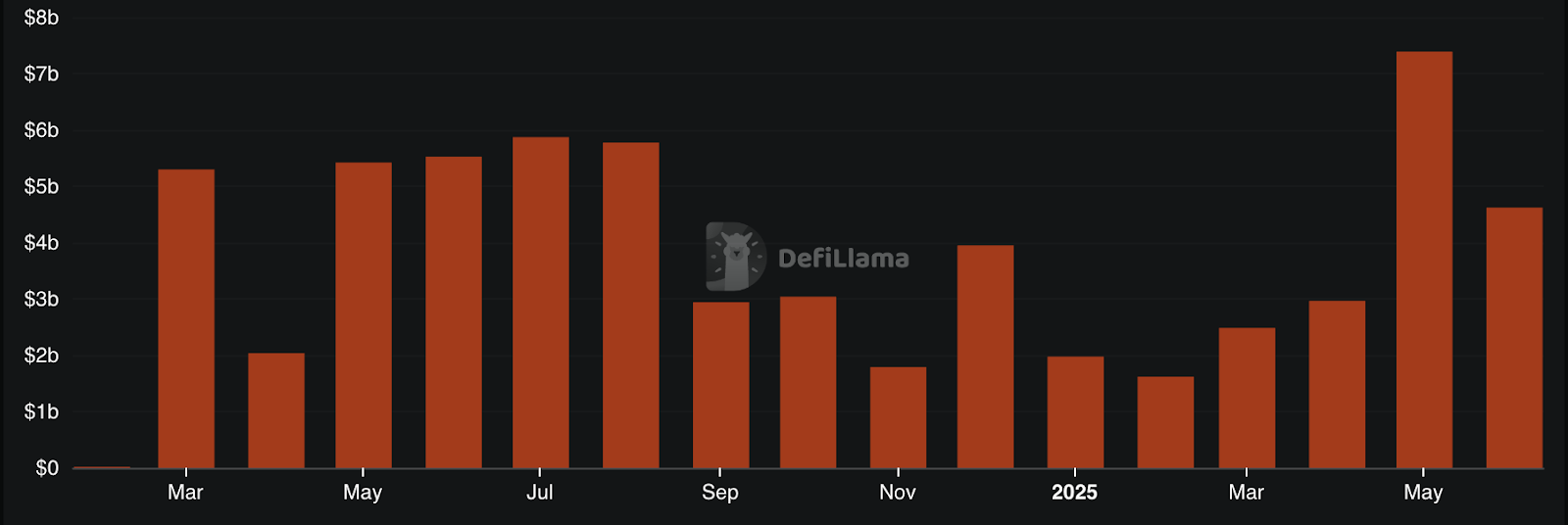
MYX Finance Perps Data / DefiLlama
-
30-day Volume: $7.5 billion
-
Cumulative Volume: Unknown
-
Supported Chains: 4 (Arbitrum, BNB Chain, Linea)
MYX diversifies risk through multi-chain expansion, capturing liquidity across different ecosystems. Its flexibility stands out during periods of market volatility.
GMX
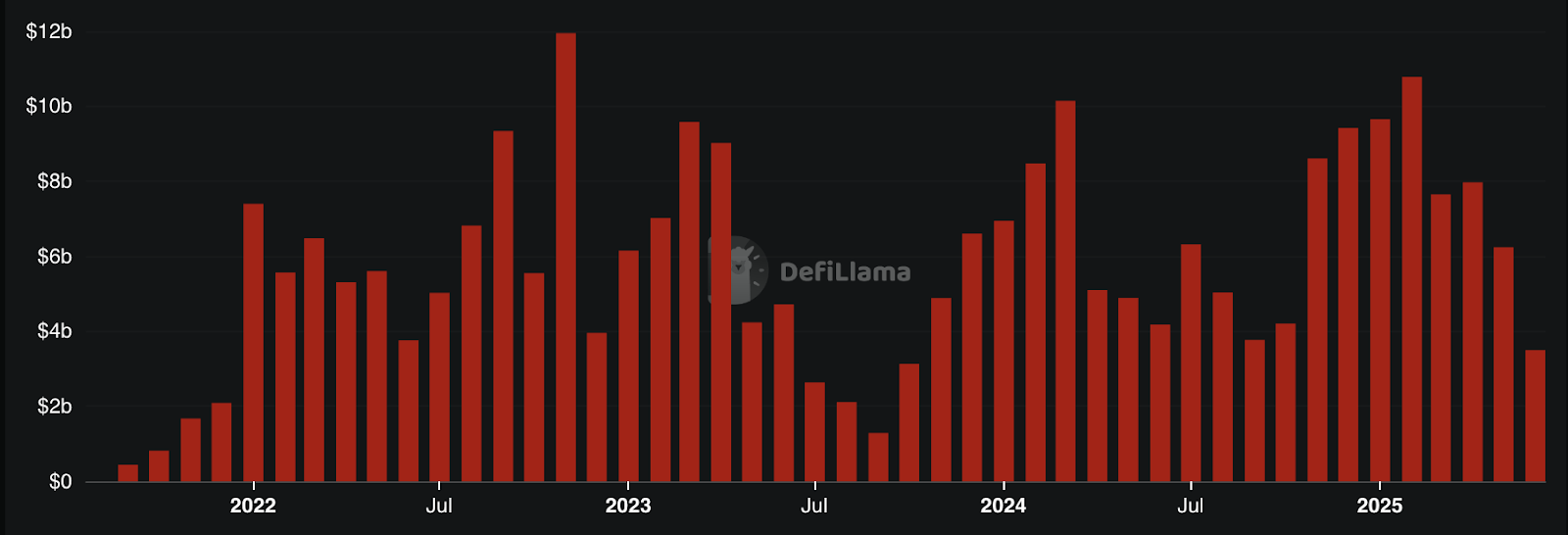
GMX Perps Data / DefiLlama
-
30-day Volume: $6.02 billion
-
Cumulative Volume: $261.91 billion
-
Supported Chains: 3 (ARB, AVAX, etc.)
As a veteran in the Perp DEX space, GMX retains a strong position amid fierce competition due to community trust and deeply rooted liquidity.
dYdX
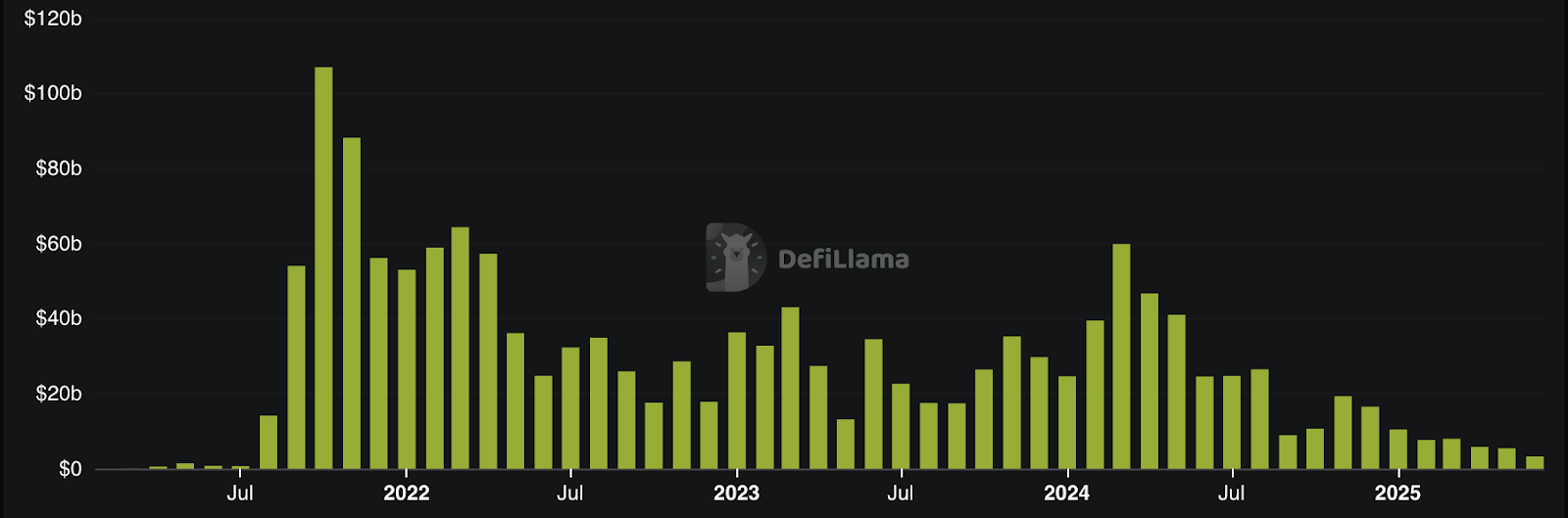
dYdX Perps Data / DefiLlama
-
30-day Volume: $5.42 billion
-
Cumulative Volume: $1.49 trillion
-
Supported Chains: 2 (ETH, Cosmos)
dYdX remains one of the most mature platforms. Its transition to a Cosmos-based dedicated chain (V4) reduced latency, though its relative volume share has declined.
Paradex
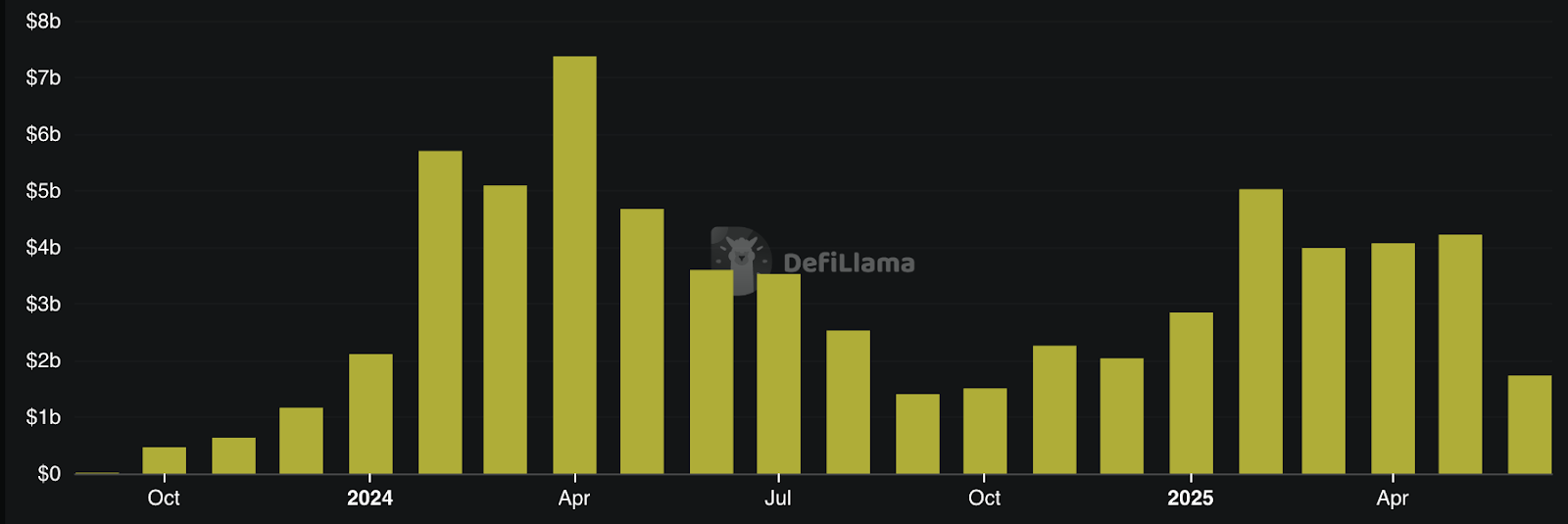
Paradex Perps Data / DefiLlama
-
30-day Volume: $3.35 billion
-
Cumulative Volume: Unknown
-
Supported Chains: 1 (Paradex Chain)
Paradex enters the top 10 as a rising contender with rapidly growing usage. Its single-chain setup simplifies execution and concentrates liquidity.
Full List of Perp DEXs
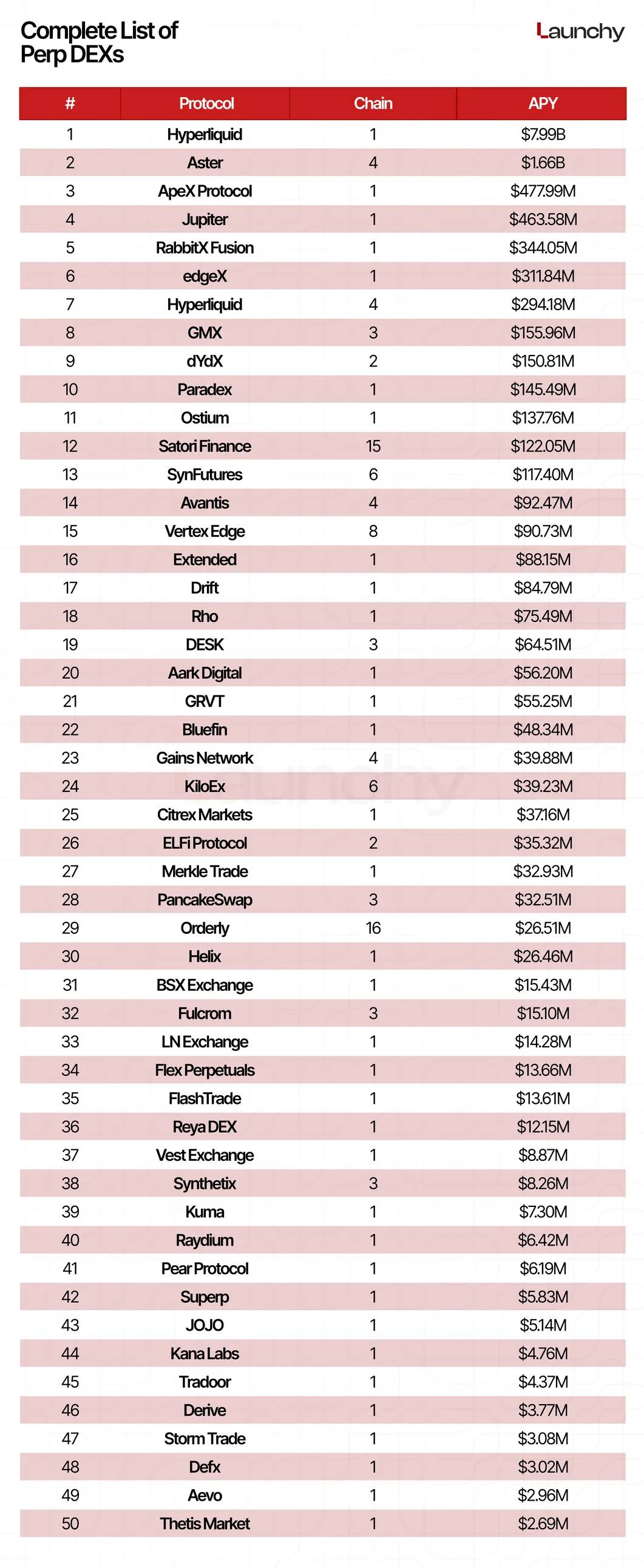
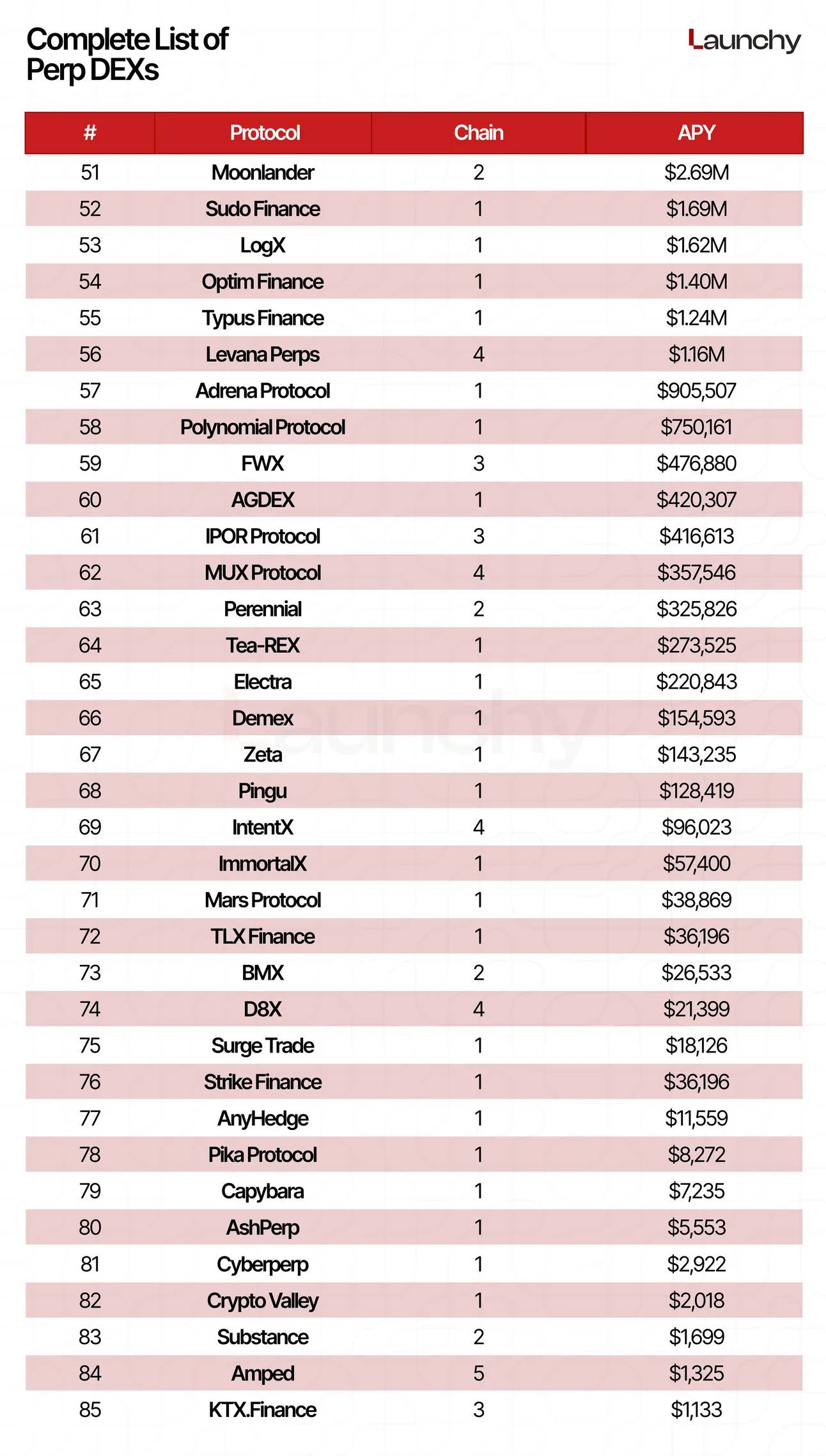
Market Share Battle Between CEX and DEX
For years, centralized exchanges (CEXs) like Binance, OKX, and Bybit have dominated the perpetual contracts market, consistently recording monthly trading volumes in the trillions of dollars. However, decentralized perpetual exchanges (DEXs) are rising steadily—and one protocol is leading the charge: Hyperliquid.
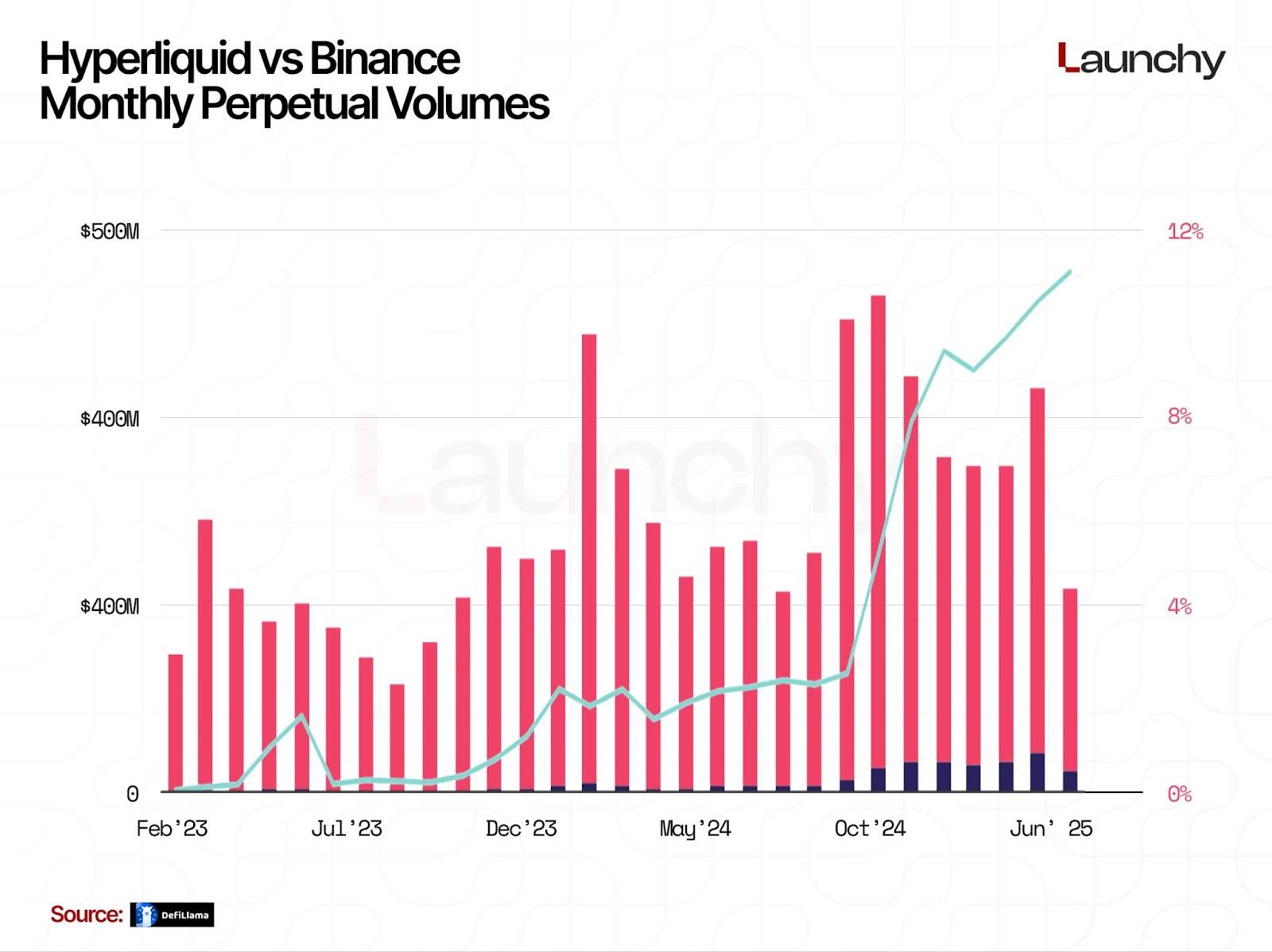
As of May 2025, Hyperliquid holds 80% of the decentralized perpetual market share—an impressive jump from 30% in November 2024. In just six months, the protocol more than doubled its market share, signaling growing demand for platforms that support self-custody, permissionless access, and minimal counterparty risk.
Hyperliquid is not a typical DEX. Unlike many projects launched with venture funding, it developed independently without VC backing. As a result, all token holders—including institutions—must acquire HYPE through the open market. This model avoids common issues associated with token unlock schedules and enables a more organic, retail-driven growth path.
While Hyperliquid dominates the DEX segment, its share of the overall perpetual market remains relatively small. In May 2025, the protocol recorded $165 billion in trading volume, compared to Binance’s $1.7 trillion. Hyperliquid’s volume represents about 9% of Binance’s, but this ratio is steadily increasing.
Overall, Binance still leads the centralized market by a wide margin—but the gap is narrowing. Latest data shows Hyperliquid’s volume has reached 12% of Binance’s, up from nearly zero in early 2023.
With rising regulatory pressure on centralized exchanges and growing trader demand for greater control and transparency, DEXs like Hyperliquid are becoming viable alternatives. If current trends continue, the line between centralized and decentralized perpetual markets will blur further in the coming months.
Final Thoughts
Perp DEXs have come of age. Once niche DeFi experiments, these protocols now stand as credible challengers to centralized giants. Hyperliquid’s model and performance demonstrate that users are willing to adopt decentralized platforms if the user experience is competitive enough.
While centralized platforms face regulatory uncertainty, decentralized technologies are advancing rapidly—the industry’s momentum is shifting.
The 2025 competition is no longer just about innovation, but about scale, reliability, and user experience. The next generation of crypto traders may never need to use a centralized exchange at all.
Disclaimer: This article and related content are for educational purposes only and should not be considered or construed as financial, legal, investment, or any other form of advice.
Join TechFlow official community to stay tuned
Telegram:https://t.me/TechFlowDaily
X (Twitter):https://x.com/TechFlowPost
X (Twitter) EN:https://x.com/BlockFlow_News
 @launchy_






