Level Two Revelation: Counterintuitive (Anti-Intui: Things That Gain from Dislogic)
TechFlow Selected TechFlow Selected
Level Two Revelation: Counterintuitive (Anti-Intui: Things That Gain from Dislogic)
We will touch upon the most tricky, obscure, and yet sexiest thing in the market: counterintuition.
 Navigating Web3 tides with focused insights
By: Dave
The Secondary Market Unveiled series has quietly reached its final chapter. Throughout this series, we've emphasized tight reasoning and logical structure. But in this last piece, we'll touch on the most tricky, profound, and arguably sexiest element of all: counterintuition in markets. This article covers all asset classes within capital markets, not limited to cryptocurrency—readers from diverse backgrounds are welcome!
The Secondary Market Unveiled series centers on market trading. Trading is a three-dimensional structure:
-
The first dimension is technical analysis, akin to grammar and syntax in writing—it's foundational. Mastering technical analysis means you’ve passed entry level; you can now become one of those perpetual "call-out" influencers on Twitter who shout buy/sell signals. These influencers often lose money trading, but they profit through rebates and sponsored content—truly achieving “perpetual earnings.”
-
The second dimension is position and system management. With solid technical analysis skills and strong position management, you qualify as a professional trader. We all have two emotional organs: our gut and our positions. If your stomach is in knots or your positions are opened and closed chaotically, it means your mindset has been compromised. People often talk about maintaining mental stability in trading—but this really manifests in how well you manage your positions. I hope to demystify what might otherwise seem like abstract psychological discipline.
-
The final dimension is understanding capital markets. Combine solid technical fundamentals, stable position management, and deep market insight, and you begin walking the path of legendary traders—figures like Ao Ying, Ban Muxia, BitKing, or historical icons such as Livermore and Wyckoff. The same technical pattern can lead to completely opposite conclusions depending on the asset and time frame. Knowing when to buy makes you an apprentice; knowing when to sell makes you a master; knowing when to wait makes you a grandmaster. All these decisions hinge on market understanding.
This trilogy of long-form articles focuses entirely on that third dimension: market understanding. Technical analysis? You can learn that from textbooks or YouTube videos. Emotional regulation requires personal character development—it’s highly individual and difficult to teach. Only market understanding must be forged through real-world experience. It’s one of the core competitive edges built solely through trial and error in the trenches. The difference between elite traders isn’t chart-reading ability. Just like in *Kingdom of Heaven*, when Sultan Saladin faces off against King Baldwin IV of Jerusalem, their duel involves no swords or shields:
Saladin: "I pray you pull back your cavalry and leave this matter to me."
Baldwin: "I pray you retire unharmed to Damascus. Reynald of Chatillon will be punished, I swear it. Withdraw, or we will all die here. Do we have terms?"
Saladin: "We have terms."

Perception is the most powerful weapon. I hope you’ve enjoyed the Secondary Market Unveiled series. Without further ado, let’s dive into the main content.
1. No Logic
Retail investors have a bad habit: asking, "Why is it going up?" When you ask this question, you implicitly assume there must be logic behind the move—a clear, immediate cause. This reflects a fundamental misunderstanding of capital markets.
The truth is, asset price increases often start with no logic at all—not just for retail investors, but for the vast majority of market participants. A typical market cycle unfolds like this:
-
A stock suddenly begins rising over a period, and nobody knows why. Everyone just watches the price climb. Financial news outlets quickly report on the surge (they react fast to volatility), but offer no insightful analysis—only highlighting the eye-catching fact of sharp price appreciation. This is the beautiful, seductive, yet dangerous phase of “no logic.”
-
With widespread media coverage and dramatic price moves, the stock becomes a market sensation. Everyone scrambles to find reasons. I call this effort futile because such attribution is rarely sound reasoning—it’s usually driven by post-FOMO anxiety among retail investors. They simply want justification to buy, fearing they’ll miss out on further gains.
-
As more people engage in this attribution game, certain narratives gradually emerge as dominant consensus views. After all, markets are made of people—when enough individuals repeat similar stories, one or two gain legitimacy. Prices often continue rising, and with retail investors now having a rationale, a feedback loop forms between fundamentals and sentiment, fueling even stronger momentum.
-
This stage is dangerous. Rising prices appear to validate the very narratives investors invented—self-fulfilling prophecies that inflate massive bubbles and reinforce false beliefs. At this point, many believe a new era has begun—that current gains are merely the beginning. Euphoria reigns supreme. And right here, the turning point arrives.
-
Overheated markets cannot sustain themselves forever. Prices typically reverse after excessive speculation, which torments retail investors—they had just found what they thought was confirmed truth, only to see reality slap them in the face. Market voices grow fragmented: some declare the bubble burst, others see normal correction, while a few view it as a buying opportunity. Yet, during such divergence, trends often persist—in this case, downward momentum.
-
Does the story end when prices fall? Not at all. Listed companies, funds, and ultra-high-net-worth individuals have remained calm observers throughout. They rationally assess valuation logic. If they genuinely believe in the asset’s potential, they begin accumulating positions once the bubble deflates—laying the groundwork for the next wave. This phase marks a shift in valuation/pricing logic—one with long-term impact.
The first two stages described above represent price surges devoid of logic. And I believe many of you have felt the significance of such illogical moves recently. Let’s take one of the hottest recent examples: Circle (CRCL).

Circle gave us a crystal-clear window into market psychology. Its share price surged 90% within three days of listing. Search the headlines from that time—you’ll see global astonishment. Crypto natives thought the company wasn’t worth much, while traditional stock investors couldn’t grasp what it actually did. Yet, the wild price action captured everyone’s attention.
This was the classic “no logic” rally—you couldn’t explain it, didn’t understand the business, dared not buy—and so, likely missed it. Much like young love: your heart races, you don’t know if the relationship will last, whether they’ll reciprocate—but fear holds you back, so you miss out.
After several days of consolidation, Circle’s price didn’t collapse. Instead, collective hesitation set in. Then, as prices climbed further, theories began flooding in.
See the second upward arrow in the chart. During this phase, numerous narratives emerged—stablecoins, decentralized payments, replacing banking systems, a new form of American hegemony. Even Ma Gang’s viral video about investing in Bitcoin surfaced around then. Clearly, people were scrambling for explanations. Of course, not all these reasons are delusional—some would later become serious considerations for institutional investors. But at this stage, causality and price spiral together: narratives justify higher prices, which fuel more narratives—a self-reinforcing loop.
Eventually, overheating leads to reversal. What happens next isn't our focus here. But these thunderclap-like, logic-defying rallies are something we must adapt to, study, and strive to understand in today’s market environment.
At minimum, we should break one habit: stop asking “why is it rising?” every time prices go up. If your fundamental analysis stops at business operations—ignoring capital flows and market sentiment—and treats only quantifiable, rigorous logic as valid fundamentals, then countless market phenomena will remain inexplicable.
2. No Pricing
From Aristotle 2,300 years ago to atomic clocks aboard spacecraft today, humans crave certainty. First, let’s be clear: certainty is genuinely useful. Take cesium atoms—they emit electromagnetic waves at a precise frequency when transitioning between hyperfine energy levels. This emission is incredibly stable and accurate. To me personally, this trait seems useless—I drink three jin of water daily too; everything has quirks, right? But here’s the catch: cesium’s predictability is so extreme that scientists use it to build space-grade atomic clocks, accurate to within one second per year. Bitcoin is similarly certain—only 21 million exist, generated by fixed algorithms. Thanks to this certainty, an intangible string of code has become a global pricing system.
I digress slightly, but my point is: certainty truly drives human progress. However, this article’s focus lies elsewhere—on uncertainty. When no one knows how to price something, enormous profit and loss opportunities arise. So if an asset has the potential to enter an “unpriceable” zone—where no framework exists to assess its value—that’s when caution and opportunity coexist.
No pricing means no limits.
The examples in this section will span broadly—as promised, covering the entire capital market. We’ll start with a case where “news” itself becomes unpriceable. And revisit crypto’s ancient fear: March 12 (312).
On March 11, 2020, the World Health Organization (WHO) officially declared COVID-19 a global pandemic—the first since H1N1 in 2009. Capital markets had no way to price this event. The world had changed drastically in ten years. The virus’s biological impact, economic damage, and death toll were unimaginable early on—because pathogens are uncontrollable and unpredictable. Early modeling results were terrifyingly extreme. If you remember early 2020, it genuinely felt like a bio-apocalypse scenario.
For financial markets: first, this was bad news—so prices should fall. Second, nobody knew how far it should fall—because there was no reference point. So where would it bottom? Answer: wherever fear took it.
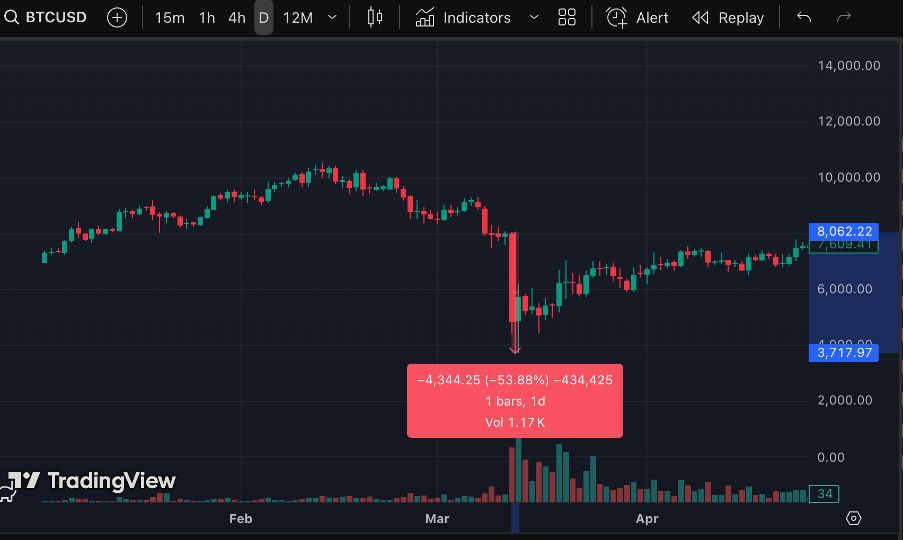
Bitcoin, now celebrated, crashed 60% in two days.
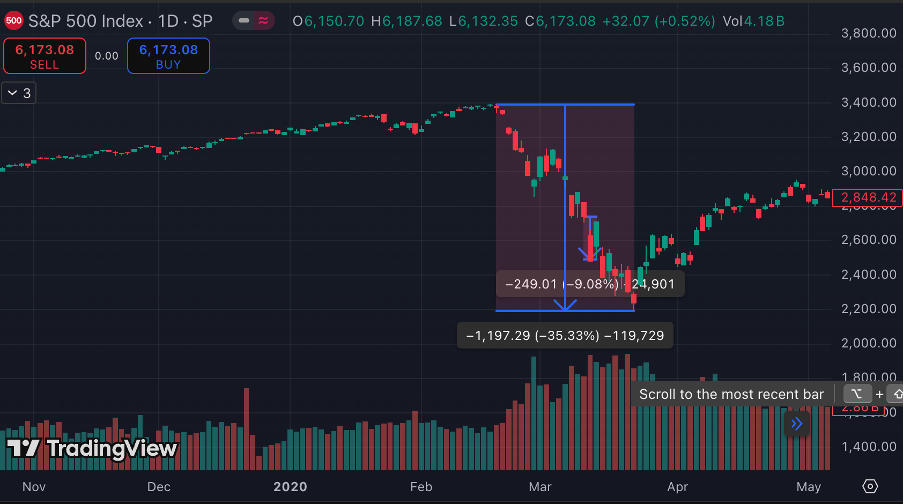
The supposedly ever-bullish S&P 500 plunged 9% in a single day and fell 35% during the crisis. Remember the meme: Buffett had seen one U.S. market circuit breaker in his first 80 years, then four in two months in 2020—leading him to quip, “Guess I’m still too young.”
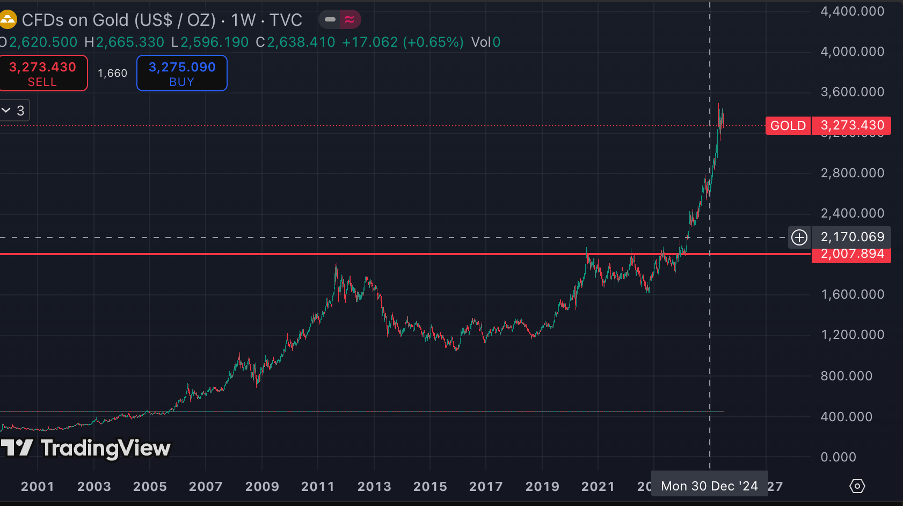
Now, a tangible example: gold, one of the hottest trades of 2024–2025. As shown clearly in the chart, gold lingered near the red horizontal line—the previous all-time high—for a prolonged period. With no major catalyst, the pricing logic was simply “this is the prior peak,” so traders thought, “Okay, time to take profits and wait.” But once price broke above that historical level, we momentarily lost any pricing anchor. How much *should* gold be worth? Blank stares all around. Dear readers, do not assume “pricing” requires a strict mathematical formula. As long as you can find a reason convincing enough for yourself, you’re still in a “priced” zone. But with gold, we entered true “no pricing” territory—the moment when gains accelerate fastest and furthest.
Bitcoin’s current situation mirrors this closely. In 2024, BTC lingered around $70,000—the prior all-time high—for a long time. Once it broke through, it rocketed toward $100,000 because that number resonates psychologically—it looks good. But now that Bitcoin has decisively surpassed $100k, how do we price it? There’s no answer. Every imaginative theory suddenly sounds plausible:
-
Historical pattern followers believe this cycle peaks at $120k.
-
Valuation purists link Bitcoin to gold—by “blue-chip logic,” Bitcoin’s market cap should reach one-third of gold’s. Many traditional institutions actually adopt this view.
-
Early geeks and maximalists dream of $1 million.
-
Narrative believers argue Bitcoin will become the future anchor of the U.S. dollar—limitless upside.
All arguments sound reasonable. Pick your favorite flavor. My point is simple: when no one knows how to price something, it often possesses massive two-way volatility potential.
3. Despair Reversal: “Upsets” in Capital Markets
There’s a popular saying: “Buy when no one’s interested, sell when everyone’s cheering.” This perfectly captures market counterintuition. Big opportunities often hide in neglected, unfashionable assets—while universally loved “hot picks” tend to offer limited returns.
Especially powerful are reversals born from utter despair—these often deliver outsized rewards. Let me give two direct examples. First: the 1998 FIFA World Cup Final. Readers may be confused—what is Dave talking about? Allow me to clarify: virtual economies aren’t limited to finance and real estate. They also include sports, gambling, and collectibles. Sports, at its core, functions much like finance—a form of virtual economy. The 1998 World Cup Final is a textbook “upset.”
Before kickoff, the world unanimously expected Brazil to crush France. Brazil fielded a dream team: Ronaldo the “alien,” Roberto Carlos, Taffarel—no weak spots. Star striker Ronaldo was also the tournament’s top performer: 4 goals, 3 assists. Plus, Brazil had never lost a World Cup final before.
The consequence? Massive betting imbalance. Rumors suggest odds reached 6-to-1 on Brazil. Across Asian betting markets alone, this match drained $25 billion—meaning legions of retail punters were directly opposing bookmakers. Bookies kept offering rolling bets: each French goal increased odds that Brazil wouldn’t score, pulling global wagers deeper into the trap. Then France won 3–0. Brazil’s star Ronaldo played like a zombie. Team doctors later admitted “a medication error” caused adverse reactions—the entire squad performed terribly.
France’s parliament later investigated match-fixing allegations and concluded there was no fraud. Players issued clarifications. But this remains a legendary betting upset—immortalized in films like *God of Gamblers*.

So the saying goes: “Bet against football favorites, and you’ll own a seaside villa.” Don’t get played by the house, folks.
Another tangible example: Ethereum. After a long bear market and dismal price performance, nearly all market participants—including me, a professional speculator—lost faith in ETH. “Despair” is not too strong a word. Cold, forgotten assets don’t always rebound—but when they do, the explosion is earth-shattering.

Ethereum surged 44% in three days—leaving 2023’s dark horse SOL stunned. That’s the raw power of despair reversal. As Buffett said: “Be fearful when others are greedy, and greedy when others are fearful.” A concise revelation of how underdogs become champions.
4. Buy the Rumor, Sell the News
Also known as “expectations priced in.” Good news hits → turns bearish. Bad news hits → turns bullish. If you fail to grasp this market counterintuition, you’ll struggle to interpret price reactions—like why stocks drop on positive announcements. The secret lies in the quantum leap from expectation to reality. Expectation is the sexiest thing in markets. If I could leave only one word for secondary markets, it would be ‘expectation.’ Reality? Not sexy. Reality is often harsh and disappointing. So when expectation becomes reality—when the hot fantasy turns cold—we must reverse our interpretation of the news.
Classic example: blockchain mainnet upgrades. When upgrade news breaks, market expectations rise, pushing token prices higher. But once the upgrade goes live and promised features become real, prices often fall.
The quintessential example: January 10, 2024—Bitcoin ETF approval. I was interning in Shanghai then, setting an alarm for 3 a.m. to catch the news. From late 2023 to early 2024, BTC rose from ~$30K to ~$48K—classic “buy the rumor.” On January 10, 2024, the SEC approved ETFs. Then:

Curious readers can look up why Bitcoin dropped post-ETF approval. Detailed analyses already exist—many excellent ones. But purely intuitive thinking fails here. Before ETF approval, no external capital could flow in. Afterward, inflows became possible. So why did prices rise without inflows, then fall once inflows started? Expectation. Again, expectation.
Quick summary: For unexpected news, interpret directionally—e.g., if the Fed suddenly cuts rates (unexpected), prices rise. For expected news, interpret inversely—e.g., GLD (Gold ETF) launched in 2004; gold briefly corrected afterward because the market had already priced in the利好 (bullish signal).
Conclusion:
The entire Secondary Market Unveiled series has focused on rigorous logic and reasoning. But this final piece shifts tone—to explore market irrationality. We must recognize macro-level paradigm shifts. Since the 2020 economic inflection point, global uncertainty has intensified: Russia-Ukraine war, China’s 20th Party Congress and zero-COVID policy, endless Middle East conflicts, Trump returning to the White House—all injecting uncomfortable turbulence into the macro backdrop.
Irrational markets aren’t new. Soros articulated market reflexivity in *The Alchemy of Finance*, challenging the century-old assumption of rational markets. But today, three forces amplify emotional distortions like never before: information explosion driven by technological advancement, political uncertainty and polarization, and structural economic changes since the Third Industrial Revolution reshaping younger generations’ values and spending power. These layers interact—triple resonance magnifying sentiment’s influence, causing prices to deviate significantly from rational valuation.
Subtle shifts in asset trading patterns reflect evolving market participant structures. Looking across financial history, we’ve evolved from Cambridge-educated philosophers with artistic flair (the classical investor), to MIT-trained statisticians with technical precision (the modern investor), to now: a Gen-Z dropout from HKUST chasing rock stardom (the contemporary investor). From Buffett to Ken Griffin to Labubu.
These transformations force us to confront raw human nature—so complex, so ambiguous, so elusive—yet brimming with immense opportunity. Like pirates discovering Treasure Island, Qin Shi Huang finding the elixir of life, or Bai Suzhen meeting Xu Xian. It’s the thrill of hearing the Dao in mortal danger—worth dying for at dusk if heard at dawn. This article attempts only to scratch the surface of that vast, hidden iceberg.
Join TechFlow official community to stay tuned
Telegram:https://t.me/TechFlowDaily
X (Twitter):https://x.com/TechFlowPost
X (Twitter) EN:https://x.com/BlockFlow_News