The Korean Won Stablecoin Race Heats Up: Banking Consortium, Tech Giants, and Web3 Companies Enter the Fray — Who Will Take the Lead?
TechFlow Selected TechFlow Selected
The Korean Won Stablecoin Race Heats Up: Banking Consortium, Tech Giants, and Web3 Companies Enter the Fray — Who Will Take the Lead?
Systematically梳理 and in-depth analyzed the major participants, business models, and innovative developments in South Korea's stablecoin market, with a focus on reviewing several key potential issuers.
 Navigating Web3 tides with focused insights
Author: Zen, PANews
Prior to his official inauguration, South Korean President Lee Jae-myung explicitly advocated for the innovative initiative of a "domestic currency-pegged stablecoin" in his campaign platform, aiming to curb capital outflows and enhance the competitiveness of the nation's digital finance ecosystem. After Lee's administration took office, the South Korean cryptocurrency industry immediately stirred into action: not only are eight major commercial banks preparing to launch a joint project for a won-pegged stablecoin, but traditional tech giants and Web3 firms have also begun positioning themselves to seize a first-mover advantage in the increasingly competitive regional and global stablecoin race.
Meanwhile, the National Assembly is reviewing the Digital Asset Basic Act, which will provide a legal basis for private institutions to issue won-pegged stablecoins. Financial regulators are also accelerating efforts to establish operational standards aligned with international norms. As such, the period from late 2025 to the first half of 2026 may mark a window of explosive growth for South Korea’s stablecoin market. This article by PANews systematically reviews and analyzes key participants, business models, and innovation trends in South Korea's stablecoin market, with a focus on several potential issuers.
Banking Consortium
Given that stablecoins could significantly impact monetary policy and payment settlement systems, while the Bank of Korea (BOK) acknowledges their innovative potential in fintech, it remains cautious about whether they can serve as substitutes for legal tender. On mid-June, BOK Governor Lee Chang-yong stated that the central bank is collaborating with relevant agencies to develop a regulatory framework for stablecoins, ensuring their stability and utility while preventing their use in circumventing foreign exchange controls. Governor Lee subsequently expressed caution regarding won-pegged stablecoins.

Bank of Korea Governor Lee Chang-yong
Under this cautious policy direction, banks remain the most competitive players in the won-pegged stablecoin space. According to Reuters, on June 24, BOK Senior Deputy Governor Ryoo Sang-dai stated at a press conference that won-denominated stablecoins should be introduced gradually and initially issued by strictly regulated commercial banks. Once sufficient experience has been accumulated, issuance could then expand to non-bank entities to mitigate risks to monetary policy and payment systems.
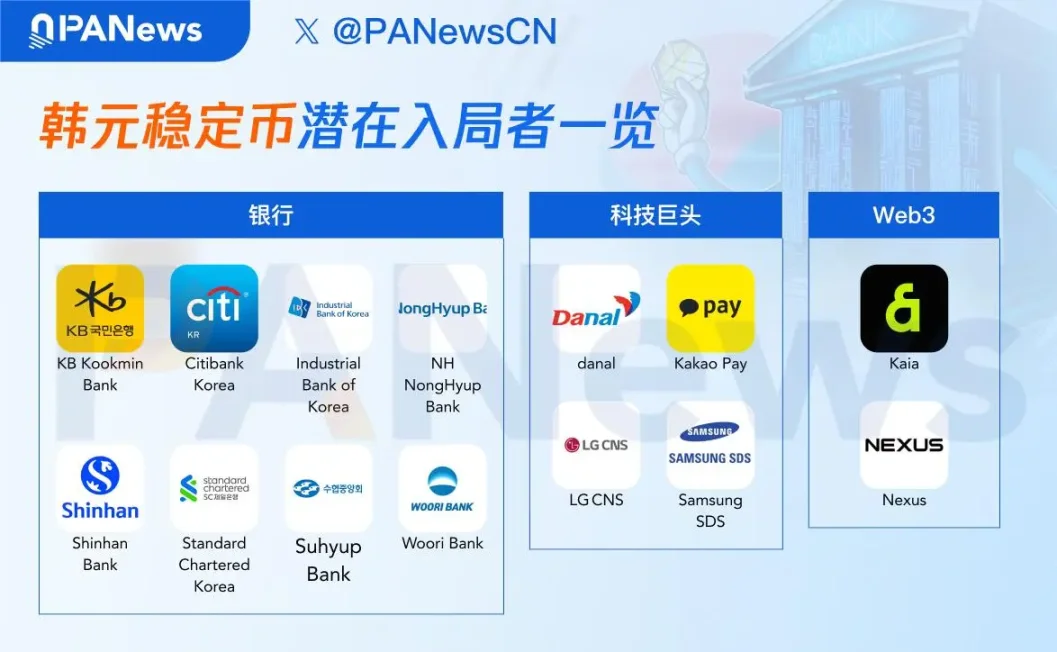
On June 25, South Korean media outlet Economic Review reported that eight major South Korean banks plan to form a joint venture to issue a won-pegged stablecoin. Participating banks include KB Kookmin Bank, Shinhan Bank, Woori Bank, NH NongHyup Bank, Industrial Bank of Korea, Suhyup Bank, Citibank Korea, and Standard Chartered Korea. Additionally, the Open Blockchain & Decentralized Identifier Association (OBDIA) and the Korea Financial Telecommunications & Clearings Institute (KFTC)—a nonprofit organization managing interbank payment infrastructure—will coordinate and support the initiative.
The project team is currently considering two issuance models: a trust model, where customer funds are held in separate trusts before stablecoin issuance; and a deposit-token model, linking stablecoins directly to bank deposits. The banks are now discussing shared infrastructure development, and the joint venture could be established as early as the end of this year or early next year once the legal framework is finalized.
Among the eight banks, KB Kookmin Bank—the largest retail bank in South Korea—is the most actively involved in stablecoin initiatives. It has already initiated procedures to secure trademark rights related to stablecoins, filing applications for combinations of "KB" and the Korean won symbol "KRW," including KBKRW, KRWKB, KBST, and KRWST. This marks the first time a traditional South Korean bank has formally entered the stablecoin arena. With over 1,000 branches and a vast retail customer base, KB Kookmin Bank is poised to be a core leader in the joint venture.
Shinhan Bank, another leading player in South Korea’s retail banking sector alongside KB, has made multiple attempts to integrate with virtual assets. In 2021, it partnered with Hedera to pilot a won-pegged stablecoin to assess its feasibility for financial use cases—specifically whether it could offer lower transaction fees, faster processing times, and enhanced transaction traceability compared to existing systems. In 2022, Shinhan provided select companies with virtual accounts capable of trading digital assets. In April this year, the bank participated in a Japan-South Korea cross-border remittance pilot using stablecoins—Project Pax—led by Japan’s Programat, Korea’s Fair Square Lab, and the Korean Digital Asset Custodian (KDAC), aiming to build a next-generation global remittance and payment system based on digital assets.
Woori Bank and NH NongHyup Bank bring extensive experience in international payments and have played key roles in CBDC trials, real-time gross settlement (RTGS) systems, and blockchain projects. Industrial Bank of Korea brings deep expertise in SME lending and trade finance, offering cost advantages for enterprise-level applications. Meanwhile, the local branches of Standard Chartered and Citibank leverage their parent banks’ global networks, potentially providing offshore clearing and liquidity support for the stablecoin.
Kakao Pay and Kaia
In the realm of South Korean payments, Kakao Pay stands out as one of the most proactive large-scale players in the won-pegged stablecoin space.
Founded in 2014 and built upon the KakaoTalk instant messaging app, Kakao Pay surpassed 10 million users within just 20 months and secured a $200 million strategic investment from Ant Financial (Alibaba Group) in 2017, cementing its leadership in mobile payments. By mid-2025, Kakao Pay’s penetration rate in offline and online QR code payments, P2P transfers, and e-commerce settlements exceeded 60%. In terms of market share and active user scale, Kakao Pay holds a position in South Korea comparable to Alipay and WeChat Pay in China.
Following the pro-crypto stance of President Lee Jae-myung, the Kaia team swiftly announced plans to collaborate with super apps like Kakao Pay and LINE NEXT to launch a won-pegged stablecoin. Upon news of the announcement, Kakao Pay’s stock surged nearly 30%. On June 22, Kakao Pay officially launched its won-pegged stablecoin initiative, aiming to capture first-mover advantage. According to Seoul Economic Daily, Kakao Pay filed 18 trademark applications with the Korean Intellectual Property Office combining "KRW," "K," and "P," such as "KRWKP" and "KWRP," covering areas including virtual asset financial transactions, electronic transfers, and intermediary services—indicating high expectations for its stablecoin business.
Kakao Pay intends to align closely with the legislative process of the Digital Asset Basic Act to become one of the first compliant stablecoin issuers once regulations are enacted. Leveraging its existing strengths, Kakao Pay can tightly integrate with other members of the Kakao ecosystem—including Kakao Bank and Kakao T—to achieve deep convergence of social networking, payments, and financial services, creating massive-scale application scenarios for its stablecoin.
Kaia is an EVM-compatible Layer 1 public blockchain formed in August 2024 through the merger of Klaytn (a subsidiary of Kakao’s Ground X) and Finschia (a subsidiary of LINE). Designed to connect the combined 250 million users of KakaoTalk and LINE, Kaia aims to enable seamless cross-platform experiences. In early June 2025, KaiaChain Chairman Sam Seo clearly stated on social media that the network would “fully promote the issuance of won-pegged stablecoins” and declared, “the stablecoin summer has just begun.” Earlier, Kaia had already launched native USDT and collaborated with Tether to bring USD₮ into the Kaia ecosystem, laying technical and ecological groundwork for future KRW-pegged stablecoins.
Related reading: Riding South Korea's Policy Tailwinds, Can Kaia Chain Enter Its 'Stablecoin Summer'?
Through collaboration between Kaia, Kakao Pay, LINE NEXT, and other super apps, the project aims to achieve integrated cross-chain and cross-platform circulation combining “on-chain + social + payments.” Thanks to synergies between underlying public chain infrastructure and terminal payment ecosystems, once regulatory approval is granted, the stablecoin project could rapidly launch and seize early market opportunities.
Danal
Danal, a well-established South Korean payment service provider, is another widely anticipated participant. In 2019, Danal launched PayCoin (PCI), an early experiment in virtual asset payments. PayCoin registered over 1 million users across various online and offline merchants but was eventually suspended due to regulatory uncertainty and obstacles in registering as a Virtual Asset Service Provider (VASP).
With the South Korean government accelerating the passage of the Digital Asset Basic Act and affirming policy support for domestic currency-pegged stablecoins, Danal has restarted its digital currency operations. According to MK News, in June 2025, Danal filed multiple patent applications with the Korean Intellectual Property Office for a “POS terminal supporting virtual asset payments and its operation method,” aiming to provide foundational technological support for future stablecoin payment scenarios.
Technologically, Danal holds inherent advantages in stablecoin operations due to its long-standing POS terminal network and payment clearing systems. On one hand, its POS terminals can directly recognize and settle on-chain tokens, simplifying the user payment journey. On the other hand, its back-end merchant settlement systems can seamlessly interface with off-chain reserve management, enabling compliance audits and proof-of-reserves mechanisms.
Nexus
On the same day Kakao Pay officially entered the stablecoin race, blockchain startup Nexus also expressed its ambition to become the first issuer of a won-pegged stablecoin.
According to ZDNet Korea, Nexus has already issued a won-pegged stablecoin named KRWx on the BNB Chain and submitted a trademark registration application for it with the Korean Patent Office. The company also filed trademark applications for other fiat-pegged stablecoins, including USDx, JPYx, and EURx.
Nexus CEO Jang Hyun-guk stated that launching KRWx on the BNB Chain was intended to gain first-mover advantage. He emphasized that the purpose of stablecoins lies in practicality and highlighted the opportunities they present within a globalized digital economy.
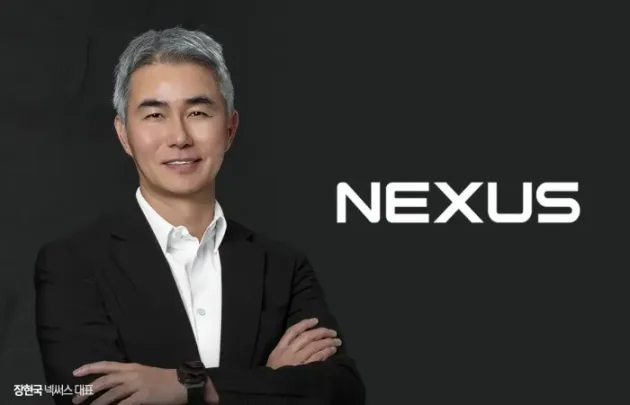
Nexus CEO Jang Hyun-guk
Additionally, gaming media G-Ennews reported that Nexus is preparing for the broader rollout of KRWx and other fiat-pegged stablecoins and plans to establish a Hong Kong subsidiary, Nexus Stable HK, to leverage Hong Kong’s favorable legal and trading environment and advance the international expansion of its stablecoins.
Other Potential Participants
Samsung SDS, the IT solutions and system integration subsidiary of Samsung Group, offers Nexledger—one of the most mature enterprise-grade private blockchain solutions in South Korea. Supporting multi-signature schemes, cross-chain interoperability, and high throughput, Nexledger already possesses the three core characteristics required for stablecoins: traceability, high reliability, and auditability. Industry insiders believe that once internal or partner decisions are finalized on issuance, technical preparations will be nearly complete.
According to Chosun English, amid the upcoming policy opening for domestic currency-pegged stablecoins, Samsung SDS has been identified as a potential “infrastructure provider.” Its enterprise clients may issue or custody stablecoins via the Nexledger platform.
Likewise, LG CNS—the IT solutions and system integration arm of LG Group—is also seen as a potential participant and beneficiary due to its robust infrastructure. It was selected as the official contractor for the Bank of Korea’s (BOK) wholesale CBDC/tokenized deposit system, responsible for building an open blockchain platform under a contract worth approximately 9.68 billion Korean won, spanning from Q3 2024 to March 2025.
As a core supplier for wholesale CBDC and digital currency solutions, LG CNS possesses critical capabilities in minting, clearing, auditing, and custodianship of on-chain assets. With the advancement of the Digital Asset Basic Act, as private institutions gradually gain eligibility to issue stablecoins, LG CNS is well-positioned to dominate as a technology provider and infrastructure enabler.
Join TechFlow official community to stay tuned
Telegram:https://t.me/TechFlowDaily
X (Twitter):https://x.com/TechFlowPost
X (Twitter) EN:https://x.com/BlockFlow_News
 PANews