Space Review|JustLend DAO and Sun.io Dual-Engine Drive TRON Ecosystem Efficiency Revolution
TechFlow Selected TechFlow Selected
Space Review|JustLend DAO and Sun.io Dual-Engine Drive TRON Ecosystem Efficiency Revolution
JustLend DAO and Sun.io: Building the Dual-Core System of Tron's DeFi "Yield Engine + Liquidity Gateway"
 Navigating Web3 tides with focused insights
The blockchain industry has undergone multiple cycles of consolidation, and TRON, with seven years of ecosystem development, is now driving a cognitive revolution around the concept of "value-backed coins." As a public chain supporting 300 million user accounts, TRON demonstrates unique vitality driven by stablecoins and DeFi. Recently, news that TRON is preparing for a major listing could elevate TRX from being merely an "on-chain fuel" to a "digitally recognized asset" acknowledged by capital markets. On the topic of how TRON builds its value moat, this edition of SunFlash Roundtable convened several veteran crypto KOLs to decode the underlying logic and future vision behind TRON’s transformation from a “payment infrastructure” to a “global digital asset hub.”
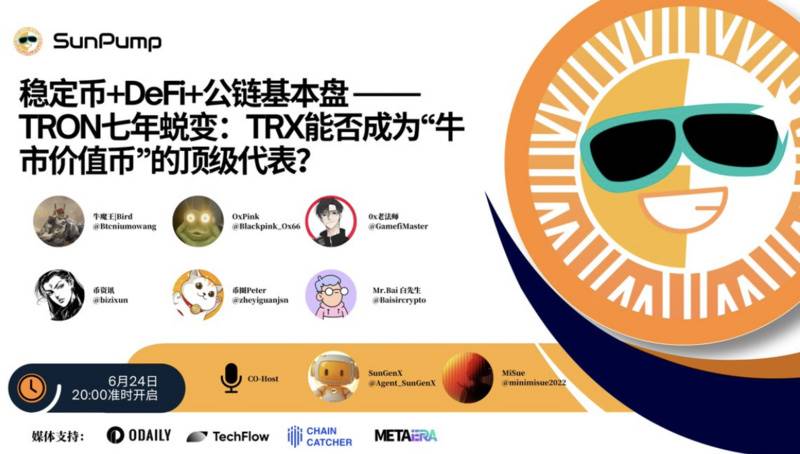
Seven years ago, TRON founder Justin Sun launched the project with the declaration: "Decentralize the internet once again." Today, TRON has long surpassed the role of a mere "technical testbed" for blockchains. Protocols such as JustLend DAO, Sun.io, APENFT, BitTorrent, and WINkLink have formed an interconnected ecosystem. TRON's stablecoin strategy has also achieved a critical leap: USDD adopted a decentralized over-collateralization model through its 2.0 upgrade, while USD1 leverages U.S. Treasury-backed mechanisms to connect directly with traditional financial systems. This dual-track design of “freedom + compliance” preserves the innovative DNA of crypto-native technology while building a compliant bridge for institutional capital entry.
Recently, Justin Sun has been frequently appearing at international events and signaling intentions to go public—marking a new global phase for TRON built on a dual-core strategy of "compliant capital engine + on-chain value engineering." The following sections will explore, through insights from roundtable participants, how TRON leverages capital synergy between stablecoins and DeFi ecosystems to build a three-dimensional moat across technology, compliance, and financial innovation—propelling TRX toward becoming a globally recognized financial asset.
1. TRON’s Seven-Year Evolution: From Blockchain War Champion to Stable Ecosystem Engine
Mr. Bai opened by highlighting TRON’s industry standing: “In terms of TVL ranking, TRON is actually second only to Ethereum.” This achievement stems from its core strength in “real-world application deployment.” Early users migrated to TRON due to high gas fees on Ethereum, making it the preferred chain for stablecoin settlements and laying the foundation for subsequent ecosystem expansion. Amidst public chains competing through narratives and hype, TRON carved out a unique path with its “slow but steady” rhythm, achieving a leap from infrastructure builder to global ecosystem empire—an approach distinguished by strategic discipline and resilience in the crypto space.
l Modular Development: From Stablecoins to Full Ecosystem Closure
Teacher Niumowang outlined TRON’s seven-year evolution, emphasizing its trajectory of “technological inclusivity → stablecoin & DeFi infrastructure → sovereign compliance,” marking a transition from independent protocols to global financial infrastructure:
1. Infrastructure Foundation Phase (2018–2022): Breaking Through from Zero to One
After launching its mainnet in 2018, TRON rapidly attracted developers with advantages including high throughput (2000+ TPS), low gas fees, and Ethereum compatibility—laying a solid foundation for ecosystem growth.
2. Stablecoin and DeFi Boom Period (2022–2024): Ecosystem Value Multiplication
In 2022, TRON targeted the stablecoin sector, using TRC20-USDT as a breakthrough. Thanks to low cross-border payment fees and instant settlement, TRON quickly captured over 50% of global USDT circulation, becoming a key hub for financial inclusion in emerging markets. The launch of lending protocol JustLend DAO and DEX SunSwap created a “deposit-borrow-earn” yield loop, attracting numerous on-chain participants. Meanwhile, native stablecoin USDD evolved via over-collateralization and compliance upgrades, penetrating offline consumption scenarios in Southeast Asia—achieving a closed loop of “decentralized finance + real-world applications.”
3. Compliance and Global Expansion Phase (2024–2025): From Grassroots to Sovereign-Level Ecosystem
Starting in 2024, TRON used RWA and sovereign partnerships as catalysts for ecosystem breakout. Recent integration of Donald Trump’s family-backed USD1 stablecoin into TRON, SEC acceptance of a TRX spot ETF filing, and TRON’s plan for a U.S. stock market listing all signal its compliance journey entering mainstream financial markets.
CryptoInsight further analyzed TRON’s value pillars from an ecosystem perspective: First, JustLend DAO has strong liquidity aggregation capabilities, reaching peak TVL exceeding $7.4 billion, making it one of the most profitable protocols within the ecosystem. Second, TRON leverages BitTorrent for multi-chain asset interoperability and Chainlink for real-time anti-fraud price feeds, ensuring on-chain financial security. Its base of 300 million users provides fertile ground for trending sectors like APENFT and SunPump. Finally, TRON was designated by the government of Dominica as its national blockchain infrastructure and issued the country’s digital currency DMV to pay civil servants. From performance to payments to ecosystem depth, TRON attracts users with high TPS and low costs, then expands through DeFi into meme and RWA use cases—earning recognition from grassroots communities all the way to sovereign governments.
l Slow-and-Steady Strategy: Resilience Through Patience
Niumowang contrasted TRON directly with other major public chains: “TRON didn’t start with inflated expectations, suffer technical halts, or face scaling difficulties—it simply advanced steadily.” He noted that while Solana generates frequent buzz, recurring technical failures cause cliff-like ecosystem volatility; Aptos, though highly anticipated as a new chain, suffers from immature technology and limited use cases; Ethereum upgrades slowly and caters to a niche, technically oriented community with high user barriers. In contrast, TRON focuses on building a triad of “real users, real capital, and real liquidity”—maintaining on-chain activity even during bear markets, earning its reputation as the “undying chain.”
0x Master pointed out TRON’s core competitiveness lies in authenticity: “Daily billions in on-chain transactions on TRON aren't artificially inflated by subsidies—they reflect seven years of cultivated user habits. Its DEX may not be flashy, but it's fully functional, and modules like oracles and cross-chain bridges have been battle-tested.” 0x Pink backed this with data: “Slowness isn’t about development pace—it’s about avoiding unnecessary disruptions. While other chains create artificial booms via airdrops, TRON builds its moat with $80 billion in real USDT settlement volume and 315 million users.” This accumulation has transformed TRON from a blockchain competitor into a “stable output engine,” establishing defensible positions in deep domains like RWA and compliant payments. Crypto Circle Peter added: “TRON’s ‘slowness’ is essentially ‘strategic discipline’—not chasing airdrop incentives or narrative hype, but focusing on its positioning as a stablecoin hub and robust ecosystem infrastructure. It embodies a survival philosophy where gradual optimization triumphs over radical overhaul.”
2. JustLend DAO and Sun.io: Building TRON’s DeFi Dual-Core System of “Yield Engine + Liquidity Gateway”
TRON channels capital pools accumulated from high-frequency stablecoin payment scenarios through a “sandwich architecture” with layered flows: base layer (payment: USDT/USDD), middle layer (yield: JustLend DAO), and top layer (trading: Sun.io)—forming a self-sustaining financial operating system.
As the lending and trading center of the TRON ecosystem, JustLend DAO and Sun.io drive efficient capital circulation through protocol-level synergy and tiered user design. Users can stake USDT to earn 8%–15% annual yields, then borrow TRX as collateral to participate in liquidity mining on Sun.io, boosting composite returns above 25%. Crypto Circle Peter emphasized: “JustLend DAO and Sun.io form a ‘deposit-lending-arbitrage’ triangle cycle, significantly improving capital utilization.” For small holders, JustLend DAO offers GasFree service allowing USDT to cover transaction fees, completely eliminating the need to hold TRX—and attracting long-tail traffic.
As TRON’s native DEX, Sun.io serves as the ecosystem’s liquidity hub thanks to low slippage and aggregated routing. 0x Master noted that Sun.io builds a closed-loop DeFi capital flow system through stablecoin trading and cross-protocol interoperability, achieving substantial progress in three areas: First, liquidity has become increasingly stable, with deep order books and high volumes in pairs like USDD-TRX and USDD-USDC. Second, the user experience is simple and cost-effective, fostering habitual usage. Third, interconnectivity across the ecosystem continues to deepen—Sun.io and JustLend DAO are tightly integrated, forming a “deposit-borrow-earn” loop where users can stake USDT on JustLend DAO, borrow assets, and deposit them into Sun.io liquidity pools. Mining rewards can then be re-staked or converted back into stablecoins, reinforcing internal capital recycling.
0x Master concluded: “Once users transact, collateralize, and earn interest with USDT on TRON, they develop muscle memory. This stickiness driven by real demand represents the final mile of a true moat.”
3. The On-Chain Value Logic of TRX: Triple Leap from ‘Silent Token’ to Revalued Asset
The roundtable discussion revealed TRX’s value logic: moving beyond short-term speculation, rooting itself in real demand, and achieving organic growth through economic models and on-chain closure. As 0x Master put it: “If you’re chasing 10x daily gains, TRX isn’t your answer. But if you believe in ‘it’s not about who starts first, but who lasts longest,’ then TRX might be the most undervalued value carrier in Web3.” With the rise of RWA and compliance trends, TRX may transform from an “ecosystem fuel” into a “digital hard currency”—a value asset bridging bull and bear markets and connecting traditional and crypto worlds.
l Threefold Economic Support for Value
Crypto Circle Peter pointed out that TRX has long been undervalued because it’s simplistically seen as just a “gas token,” when in fact it plays far more complex roles within the TRON ecosystem:
1. Stablecoin Reserve Asset: USDD, as an over-collateralized stablecoin, relies on TRX staking for backing. With over $500 million in circulation, locked TRX forms a pool of rigid demand. Integration with USD1 will further expand TRX staking use cases, creating a virtuous cycle of “staking → stablecoin issuance → ecosystem expansion.”
2. DeFi Liquidity Engine: In the JustLend DAO lending protocol, TRX serves as a primary collateral asset. On SunSwap, TRX trading pairs act as the “ballast” of DEX liquidity. In 2024 alone, TRON protocols generated $760 million in revenue. Simultaneously, part of TRON’s gas fees are returned to holders through a TRX burn mechanism, gradually revealing deflationary effects.
3. Compliance Expectations: Justin Sun recently revealed plans for TRON’s public listing and confirmed that a TRX spot ETF has been submitted to the SEC. If approved, TRX would become a compliant public chain token, opening the door to traditional capital—with immense potential upside.
l Internal Value Loop: From On-Chain Activity to Deflationary Flywheel
Crypto Circle Peter elaborated: “The burn mechanism and staking rewards for TRX form a ‘double helix’ value model—use it and it burns, hold it and it earns interest. This kind of economic resilience is absent in most tokens.” 0x Master further dissected TRX’s on-chain loop from a technical standpoint:
1. Staking Governance: Users stake TRX to obtain energy and bandwidth, and participate in Super Representative node voting, enhancing network decentralization and security.
2. Burn Mechanism: TRON introduced partial burning of TRX transaction fees—meaning as usage increases, TRX supply gradually decreases. This is an invisible value pump: the more active users are, the scarcer the token becomes.
3. Financial Tools: JustLend DAO supports TRX collateralized borrowing, and Sun.io offers TRX trading pairs. Together, they unlock liquidity and improve capital efficiency.
Mr. Bai added: “The TRON ecosystem has established a positive feedback loop of ‘user growth → rising transaction volume → accelerated burning → intensified deflation → higher staking rewards.’ This is a hallmark of a self-driving ecosystem.”
4. TRON’s Public Listing Vision and TRX’s Potential as a Global Financial Asset
Recently, TRON plans to go public via a reverse merger with Nasdaq-listed SRM Entertainment—a significant milestone in crypto compliance. This move bypasses the stringent scrutiny of traditional IPOs and injects TRX tokens into the balance sheet of a public company, creating a “tokenized equity” capital loop. It sets a new paradigm for integrating crypto assets with traditional finance. As Mr. Bai stated: “Compliance is the inevitable path for industry survival. TRX’s listing provides legal risk isolation for holders—it’s both strategic defense and proactive breakthrough.”
Meanwhile, preparations for a TRX spot ETF are underway. In April this year, Canary Capital Group formally filed an S-1 document with the U.S. Securities and Exchange Commission (SEC) to launch the Canary Staked TRX ETF—the first spot ETF incorporating staking functionality. It aims to deliver dual returns of “price appreciation + staking yield” to investors. If approved, the TRX spot ETF could replicate the institutional influx seen with Bitcoin ETFs. CryptoInsight emphasized: “TRX’s securitization pathway and stablecoin scale effect make it a ‘compliant bridge’ for traditional capital entering Web3.” He added that TRON’s U.S. listing and the TRX spot ETF are clear signals of compliance transformation, positioning TRX as the next “outpost before mainstream institutional adoption.”
5. Conclusion
TRON’s seven-year journey is fundamentally a dimensional shift—from technological infrastructure to value consensus. Powered by a triple engine of “stablecoins + DeFi + compliance,” it has not only built a closed-loop on-chain ecosystem but also initiated deep integration between crypto assets and traditional finance. TRON’s ambition extends beyond technical iteration—to reshaping financial discourse and proving that blockchain’s ultimate goal isn’t to overturn tradition, but to become the “connective layer” of global value.
Join TechFlow official community to stay tuned
Telegram:https://t.me/TechFlowDaily
X (Twitter):https://x.com/TechFlowPost
X (Twitter) EN:https://x.com/BlockFlow_News