Special Report on South Korea's Crypto Market: The Digital Subcontinent Under the Kimchi Premium
TechFlow Selected TechFlow Selected
Special Report on South Korea's Crypto Market: The Digital Subcontinent Under the Kimchi Premium
The prosperity of the South Korean market is fundamentally the result of the combined effects of economic structure, social sentiment, and policy guidance.
 Navigating Web3 tides with focused insights
Author: Klein Labs
TL;DR
1. Explosive Market Growth
-
In 2024, South Korea's total crypto market cap surpassed $74.8 billion, with the top five exchanges managing $73 billion in assets.
-
Daily trading volume surged to $10.7 billion in December, exceeding that of South Korea’s two major securities exchanges.
-
The unique "Kimchi premium" phenomenon (peaking at 10%) reflects intense local investor enthusiasm.
2. Economic and Social Drivers
-
Limited investment options: Weak performance in real estate and equities has driven capital toward high-volatility crypto assets.
-
KRW depreciation and low interest rates: Expectations of currency devaluation and loose monetary policy accelerate allocation to crypto.
-
Social psychology: Rising wealth anxiety among youth makes cryptocurrencies a perceived “fast track” for social mobility.
3. User and Ecosystem Characteristics
-
Mass participation: Approximately 25 million investors (nearly half the population), spanning all age groups, including significant high-net-worth middle-aged and elderly users.
-
Exchange concentration: UPbit and Bithumb dominate 98% of market share; local projects ("Kimchi coins") are highly popular.
-
Chaebol involvement: Giants like Samsung and Kakao are deeply invested in public chains, exchanges, and hardware, driving ecosystem integration.
4. Future Trends
-
Policy tailwinds: President Lee Jae-myung is pushing for crypto ETFs, KRW-pegged stablecoins, and STO pilots, while delaying tax implementation.
-
Innovation frontiers: DeFi, AI+blockchain, and RWA (real-world asset tokenization) are key development areas.
-
Global implications: The South Korean model balances compliance and innovation, potentially serving as a benchmark for Asian crypto hubs.
The prosperity of South Korea's market stems from the interplay of economic structure, social sentiment, and policy direction—offering a unique global blueprint of “high activity + strong localization.”
1. Introduction
While global crypto market enthusiasm stabilizes, South Korea continues to experience an “alternative boom” marked by active trading and sustained heat.
According to the Bank of Korea’s “Annual Payment and Settlement Report” released on April 21, by the end of 2024, the country’s total market capitalization exceeded 100 trillion KRW (approximately $74.8 billion). The top five domestic exchanges collectively managed $73 billion in assets. Daily average trading volume skyrocketed from $2.38 billion in October to $10.7 billion in December—a two-month surge surpassing the combined volume of South Korea’s two major stock exchanges. The annual revenue of South Korea’s crypto market is projected to grow from $264.3 million in 2024 to $635.4 million by 2030, representing a CAGR of 16.1%. As of April 2025, 25 million people have confirmed accounts on virtual asset exchanges. Nearly half of South Korea’s 51 million population now invests in the crypto market. More strikingly, the market exhibits the unique “Kimchi premium”—where prices of cryptocurrencies such as Bitcoin and Ethereum on Korean exchanges significantly exceed those on major global platforms. In March 2024, this premium reached 8.5%, peaking at 10% in November, far above the global average, reflecting intense local demand and arbitrage opportunities under capital controls.
Vast capital flows, broad user adoption, and distinct price differentials collectively shape South Korea’s highly dynamic and exceptionally vibrant crypto landscape—an emerging “golden land” in the digital era. What drives this explosive growth? We will analyze the underlying logic across three dimensions: drivers, current landscape, and future opportunities. How do political and economic structures fuel strong hedging and speculative demands? How does the local ecosystem evolve from the “Kimchi premium” to daily trading volumes exceeding $10 billion, achieving world-leading trading vitality? And what innovations lie ahead that could keep South Korea at the forefront?
Let us delve into this phenomenon together.
2. Why Is the South Korean Crypto Market Soaring?
2.1 Economic Factors
-
Limited Investment Channels
Traditional investment avenues in South Korea are relatively narrow. Under consumer choice theory, individuals weigh utility across asset classes when allocating limited resources to maximize expected returns.
When traditional investments like real estate and stocks face challenges such as high valuations, declining returns, poor liquidity, and high entry barriers, investors naturally gravitate toward alternative assets offering higher marginal utility.
In South Korea, conventional investment channels face structural hurdles. Consider real estate and equities:
- Real Estate:
South Korea’s economy grew only 1.4% in 2023, rebounding slightly to 2% in 2024, yet consumer and investment confidence remain weak.
Against this backdrop, housing prices remain structurally elevated. Since 2010, property values in the capital region rose 47.1%, while the five metropolitan cities saw gains of 76.5%. In 2024, transaction volume in the capital region declined 7.5% year-on-year, with Seoul experiencing three consecutive monthly drops (20.1%, 34.9%, 19.2%) from August to October.
Housing Price Index Trend 2010–2024 (source: KB Think)
Facing a “three highs, one low” situation—high prices, high loan ratios, high interest rates, and low volume—traditional real estate no longer offers broad investment appeal, dampening market enthusiasm. Young and middle-to-low-income buyers are increasingly turning to volatile, high-return alternatives like crypto assets.
- Equities
In 2024, the KOSPI (Korea Composite Stock Price Index) fell 8.03%, underperforming the Shanghai Composite (+12.68%) and Nikkei 225 (+17.06%). Meanwhile, the S&P 500 rose sharply, widening the return gap between Korea and other markets to 32.3%—the highest since 2000. Amid a global equity rally, Korea stands out with its “isolated weakness (고립된 약세).” Investor confidence has been notably shaken.
With persistent underperformance and weak return expectations in traditional equities, some Korean investors are shifting focus to crypto assets, which offer higher volatility and greater return potential.
-
Low Interest Rates and Loose Monetary Environment
Interest Rates by Country (source: MacroMicro)
Prolonged accommodative monetary policy and low interest rates have accelerated Korean investors’ shift toward high-yield assets. Since the pandemic, the Bank of Korea’s benchmark rate has remained around 3.5%, significantly below the U.S. Federal Reserve’s rate of over 5%, reducing savings attractiveness and making it difficult for real returns to outpace inflation.
Under these conditions, demand for high-volatility, high-return assets intensifies. Cryptocurrencies, due to their high return potential, low entry barrier, and strong liquidity, have become a preferred allocation for risk-tolerant investors, especially younger demographics. Overall, low-rate policies weaken traditional financial instruments and further drive capital into crypto assets.
-
Korean Won Depreciation Expectations
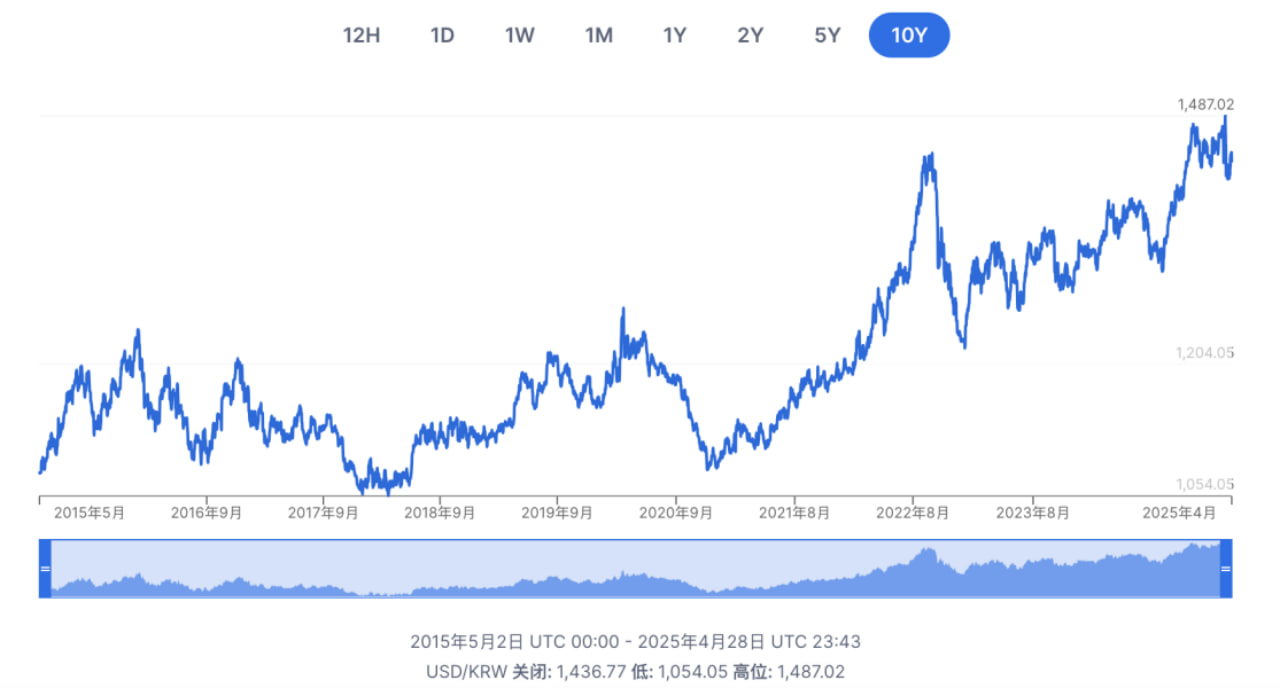
USD/KRW Chart (source: Xe)
In recent years, the Korean won has steadily depreciated, reaching 1,473.75 KRW per USD in April 2025—the lowest level since 2009. Combined with high oil prices and rising supply chain costs, this has fueled domestic inflation. Data shows Korea’s CPI rose 2.1% YoY in March 2025, with kimchi and coffee prices up 15.3% and 8.3% respectively, eroding household purchasing power and weighing on economic recovery.
Cryptocurrencies, being dollar-denominated, globally tradable, and decentralized, have emerged as a new avenue for hedging against local currency depreciation and preserving asset value.
2.2 Social Psychological Drivers
According to economist Paul Samuelson’s formula “Happiness = Utility / Desire,” happiness declines sharply when desires rise faster than utility can be fulfilled.
-
Long-standing social stratification, intense competition, and economic volatility have heightened wealth anxiety among youth, making “money” a dominant life goal. A 2024 Bank of Korea survey found that 72.4% of respondents view “economic status” as the primary determinant of happiness. Additionally, a 2025 report by Statistics Korea revealed that 69.1% of those aged 20–39 list “financial freedom” as their top life goal.
-
Amid this social mood, slogans like “Money is everything (돈이 최고야)” and “Reality sucks (현실이 개차반이야)” have gained popularity.
-
When traditional paths—employment, savings, or stock market returns—fail to meet financial aspirations, cryptocurrencies become a symbol of hope for young people seeking high utility and upward mobility, seen as a potential path to happiness and transformation.
Simultaneously, around the shared goal of “financial freedom,” young Koreans exhibit profound shifts in consumption mindset, shaping their investment preferences. According to reports from media outlets like *Asia Economy*, two distinct psychological trends are emerging among youth:
-
The “YOLO (You Only Live Once)” group, emphasizing instant gratification and high-risk tolerance;
-
The “YONO (You Only Need One)” group, favoring rational spending and prioritizing asset accumulation.
Among YOLO followers, facing real-life pressures and class anxiety, many see crypto markets as a “get-rich-quick” opportunity beyond traditional finance, enabling social advancement. Meanwhile, YONO adherents, motivated by wealth preservation and hedging against economic uncertainty, are gradually increasing savings and investments. A 2024 Gen Z consumer trend survey showed about 71.7% of young respondents prioritize saving and asset allocation. Cryptocurrencies, offering high returns, have become a compelling new option.
Despite differing consumption attitudes, both groups converge on the motivation to pursue high-return assets—cryptocurrencies perfectly align with their shared desire for returns and wealth growth.
2.3 Why South Korea, Not Japan?
2.3.1 Economic Angle: Weaker KRW Drives Demand for Alternatives
-
JPY: Due to ultra-low interest rates and massive foreign reserves, the yen is considered a global safe-haven currency. Even during fluctuations, its funding advantage persists, leading investors to hold JPY assets during geopolitical risks or financial turmoil to hedge against losses elsewhere.
-
KRW: Smaller market size, weaker liquidity, and sensitivity to global risk sentiment limit its role. With modest reserves and partial capital controls, the won cannot achieve the same status as the yen.
As a result, compared to Japanese investors, Koreans have less long-term trust and security in their domestic currency, making them more inclined to seek non-KRW-denominated, globally tradable assets—exactly where cryptocurrencies fit.
2.3.2 Economic Angle: Lower Returns Push Search for Higher Yields
-
Real Estate: Korean households allocate over 50% of assets to real estate, much higher than Japan’s 37%, yet actual returns are lower, compounded by stricter regulations:
Real Estate Yield Comparison: Japan vs. South Korea (source: Klein Labs)
-
Equities: South Korea’s stock market has lagged behind Japan’s in recent years—but the gap was especially pronounced in 2024:

Stock Market Comparison: Japan vs. South Korea (source: Klein Labs)
2.3.3 Policy Angle: Openness vs. Conservatism

Crypto Policy and Stance: Japan vs. South Korea (source: Klein Labs)
2.3.4 Cultural Angle: Fast Wealth vs. Steady Accumulation
-
Japan: Values “slow and steady accumulation.” Phrases like “一生懸命働いて、少しずつ貯める” (work hard, save gradually) and “家宝は寝て待て” (wait passively for family treasure) reflect a cultural preference for long-term, disciplined wealth building, emphasizing restraint, patience, and incremental growth.
-
South Korea: Emphasizes “quick success” and “keeping up with trends.” Concepts like “빨리빨리 (ppalli-ppalli)” dominate, encouraging short-term, high-return pursuits via stocks, crypto, or real estate for rapid enrichment.
The booming South Korean crypto market is essentially the optimal outcome of investor choices shaped by macroeconomics, traditional assets, government stance, and cultural mindset. While Japan shares similar East Asian foundations, it lags behind South Korea in the global crypto arena.
2.4 Global Implications of the Korean Model
As Asia’s crypto landscape quietly shifts, South Korea’s “middle path” is gaining strategic significance. Compared to Singapore tightening rules on local projects serving overseas users, and Hong Kong and Japan moving slowly on approvals and taxation, South Korea’s regulatory flexibility, cultural alignment, and capital environment are forming new comparative advantages.
The Monetary Authority of Singapore (MAS) recently mandated local projects to cease offering token services to overseas clients by end-June, removing transitional support—shattering its previous image of being “globally friendly.” This abrupt shift has prompted many crypto firms to reassess their Asian deployment strategies, turning attention toward countries with more flexible systems and room for growth. While Hong Kong is opening up, its complex tiered regulation and cautious pace make it difficult to absorb large-scale project migration in the short term.
Against this backdrop, South Korea is emerging as a strong contender in the next phase of Asia’s crypto hub race—leveraging domestic resource integration, fast tech adoption, and deep cultural engagement. For the global market, the key takeaway from the Korean model is: regulation can guide rather than loosen entirely; user education and cultural fit form the foundation of growth; infrastructure sovereignty and international collaboration are not mutually exclusive but dual engines for future development.
In the evolving Asian policy landscape, South Korea is no longer just an active consumer market—it may also become a regional technology origin point and asset management hub. For any global crypto industry player aiming to localize, South Korea offers a valuable real-world blueprint.
3. User Analysis of the Korean Market
3.1 User Profile of the Korean Market
Market and Account Types: Rapid Overall Growth
-
Investor Base Expansion: As of January 2025, the top five Korean exchanges (UPbit, Bithumb, Coinone, Korbit, Gopax) had approximately 25.25 million registered individual investors—a 37.6% increase from three years prior. This reflects rapid market expansion, attracting many new users and indicating accelerating crypto adoption and rising penetration.
-
Growth in Active Users: By February 2025, the number of crypto exchange accounts in Korea exceeded 25 million, with around 17.09 million classified as active traders. As market sentiment warmed in 2024, activity surged: after Trump’s re-election, inactive accounts dropped from ~8.57 million at the start of 2024 to 8.01 million by year-end, signaling recovering confidence and capital flowing back into the crypto market.
Age and Gender: Strong Growth Among Youth, Rising Female Participation

Source: Financial Services Commission (FSC)
-
The core user base consists of 30- to 40-somethings, collectively accounting for over 50%, indicating that mainstream users are financially capable and investment-savvy.
-
Young users under 20 show strong momentum, making up 18.6%. This signals rapid adoption among younger generations, positioning them as emerging market forces with significant future growth potential.
-
Gender gaps narrow with age, particularly among older women whose participation is rising. Although young women remain underrepresented, female involvement increases notably among economically stronger middle-aged and elderly groups.

Source: 금융위원회 (Financial Services Commission)
Age and Capital Size: Clear Generational Stratification
-
The market is dominated by small investors, most holding less than 500,000 KRW—especially prevalent among youth. Meanwhile, users holding over 10 million KRW account for 10%, down 0.2 percentage points from end-2023. Those holding over 100 million KRW decreased to 104,000, suggesting a shrinking share of high-net-worth individuals.
-
Correlating age and asset size reveals that younger users prefer micro-investments (<500,000 KRW), while older users (50+) tend toward larger allocations (>5 million KRW)—making this high-net-worth cohort the market’s value backbone.
-
Notably, investors over 60, though fewer in number, hold a total of 13.3795 trillion KRW in virtual assets. They adopt relatively conservative strategies, investing heavily in high-cap assets like Bitcoin to manage retirement funds.
The Korean crypto market displays a “two-tier structure”—young people drive user count and activity, while older generations control more assets and trading volume. This highlights clear generational segmentation in market composition.
3.2 User Behavior Patterns
3.2.1 Asset Preferences
Global vs. Domestic Assets: Localized Influences

Source: 금융위원회 (Financial Services Commission)
-
The domestic virtual asset market continues growing rapidly, with market cap reaching $2.12 billion—up 46% YoY.
-
Bitcoin dominates: BTC accounts for 37.2% of total trading volume, far outpacing other assets.
-
XRP remains highly attractive in Korea: Despite lower global rankings, XRP holds a $588 million market cap in Korea, placing second—indicating strong local popularity.
-
High concentration in major assets: Korea’s top ten virtual assets largely match the global top ten, reflecting strong local demand for mainstream assets like ETH, DOGE, and SOL.
3.2.2 General Behavioral Traits
Korean crypto users exhibit highly centralized behavior:
Exchange Preference Concentration: In 2024, UPbit alone captured 70–80% of the domestic market, demonstrating its dominant position.

Market Share of Top Four Korean Exchanges by Volume in 2024 (source: Klein Labs)
Investment Allocation Concentration: Local projects benefit from platform exclusivity and trust, drawing capital toward “Kimchi coins” (e.g., Steem Dollars, Moss Coin, Hippocrat). Trading activity in mainstream assets is relatively subdued compared to global markets. Local exchanges amplify the “Kimchi premium” through aggressive marketing partnerships, attracting continuous inflows.
3.2.3 On-Chain Usage

DEX vs. CEX Market Share (source: The Block)
As the global crypto ecosystem evolves, decentralized trading is rising fast. By December 2024, global DEX spot volume reached 13.76% of CEX volume, with daily turnover hitting $54.84 billion. In contrast, Korea remains heavily reliant on CEXs—about 68.9% of trading volume occurs on centralized platforms, while DEX and DeFi usage remains low, indicating users prefer stable, regulated environments.
However, Korea’s on-chain ecosystem is awakening. DEX volume share jumped from 8.57% in 2024 to nearly 17%; by early 2025, it reached 16.7%. Raydium and Phantom on Solana, with low entry barriers and fast listings, are popular among young Korean users. Platforms like Pump.fun have also sparked retail interest in DEXs, shifting trading behaviors.
Despite strong momentum, Korea’s DeFi market hasn’t fully exploded due to regulatory constraints and capital flow limitations. Unlocking its potential requires balancing “safety and innovation” in regulation to open pathways for on-chain finance growth.
4. Overview of Korean Crypto Exchanges
Domestic exchanges wield strong listing effects—especially UPbit. Projects listed often trigger significant market movements, making Korea a key barometer. This effect leads many projects to treat “securing a Korean exchange listing” as a strategic priority. Additionally, Korea Blockchain Week (KBW) has become a globally watched event, serving as a critical platform for exchanges to announce listings, projects to launch, and capital to connect. This year’s KBW (X: @kbwofficial) will take place September 22–28, 2025, hosted by FACTBLOCK (X: @FACTBLOCK), drawing global crypto professionals to Seoul.
The Korean crypto market is highly concentrated, led by five major spot exchanges: UPbit, Bithumb, Coinone, Korbit, and Gopax.

Market Share Comparison of Korea’s Top Four Domestic Exchanges (2022–2024) (source: Klein Labs)
Observing the past three years yields several insights:
-
The top two (UPbit and Bithumb) consistently command over 98% of total market share—showcasing severe head dominance.
-
Despite UPbit’s conservative listing policy, its market share grew from 78% to 86% last year.
-
Bithumb saw the largest YoY sales decline, likely due to its zero-commission policy launched in Q4 2023, which reduced revenue. However, this boosted trading activity and narrowed its gap with competitors, enhancing competitiveness.
-
Coinone and Korbit hold smaller shares but can leverage differentiation and long-tail strategies to gradually expand and strengthen their positions.
4.1 UPbit
Operated by Dunamu and backed by Kakao, UPbit boasts a broad user base and high compliance standards—one of Korea’s first platforms to obtain a Virtual Asset Service Provider (VASP) license. Since launching in 2017, it has rapidly grown into the market leader. It supports direct KRW deposits and trades, making it highly appealing to local users and ranking among the top five global exchanges by volume. UPbit offers KRW/BTC/USDT trading pairs, with most volume coming from KRW pairs. Its deep liquidity keeps it within the top five global spot exchanges.
4.2 Bithumb
Founded in 2014, once the market leader, now South Korea’s second-largest exchange by liquidity. Bithumb is actively pursuing growth and plans an IPO in 2025. Thanks to aggressive pricing, it has recently regained market share and remains influential.
4.3 Other Korean Exchanges
Coinone is renowned for exceptional security—no incidents in eight years. It was Korea’s first exchange to list Ethereum and is active in meme tokens.
Korbit, the earliest founded, launched the world’s first KRW-Bitcoin pair in April 2013. It’s the only Korean exchange that experienced the 2013 Bitcoin surge. Korbit YouTube and Korbit Research are known for high-quality information.
4.4 Overseas Exchanges in Korea
Binance, OKX, KuCoin, Kraken, Bybit, and Coinbase are gaining traction among Korean investors. FSC data shows fund transfers to offshore VASP wallets increased 2.3x YoY. This trend stems from weak stock returns and political instability. After Korea’s martial law incident in December 2024 disrupted local exchange services, trust in domestic platforms weakened—driving more investors toward overseas exchanges and DeFi platforms.
Advantages:

Bitcoin: Korea Premium Index (source: CryptoQuant)
Korea Premium Index = (Local Exchange Price – Global Average Price) / Global Average Price × 100%
A persistently positive index indicates sustained premiums in Korea, reflecting strong local demand or restricted capital flows.
-
Main advantage: The “Kimchi premium”—crypto prices on Korean exchanges often exceed global averages by up to 20%. Investors buy low overseas and sell high locally for profit.
-
Korean exchanges rely on trading fees and face regulatory limits on diversification. Lacking derivatives, investors turn to Binance, OKX, etc., for margin trading to boost returns.
Limitation: Government measures. Korea’s financial intelligence unit blocks access to 17 unregistered overseas crypto apps, restricting downloads and updates—including KuCoin, MEXC, Phemex.
5. Korean Market Investment Firms & Market Makers
Korean crypto investment firms share three main traits:
-
Firm types include pure crypto VCs, corporate venture capital (CVC), and multi-strategy hedge funds.
-
Investment stages range from seed to growth, focusing on DeFi, NFTs, Web3 gaming, infrastructure, and AI.
-
They differ significantly in geographic reach, ecosystem development, and incubation models, with successful cases spanning globally recognized protocols and startups.
Key players include:
Hashed
About: Founded in 2017, based in Seoul, focuses on early-stage Web3 project incubation in Asia, combining capital with ecosystem building. Hosts events like “Hashed Potato Club” and KBW to strengthen community ties.
Notable Successes: Axie Infinity, The Sandbox, Decentraland—leading game and metaverse projects.
(X:@hashed_official)
Nonce Classic
About: Launched in 2018, brands itself as a “social network-driven VC,” emphasizing team collaboration and information sharing, supporting portfolio companies via community mechanisms.
Notable Successes: Seed investments in Eisen, Pilgrim Protocol, Radius—mostly Layer1 and DeFi infrastructure projects. (X:@nonceclassic)
Blocore
About: Corporate VC arm of Gameberry, follows an “investment + incubation” model, specializing in Web3 gaming and IP projects, supporting them from seed to growth stages.
Notable Successes: Early bets on Animoca Brands, The Sandbox, Wemix—helping multiple game studios enter global markets. (X:@blocore_vc)
Samsung Next
About: Innovation investment arm of Samsung Group, covering Web3 infrastructure, AI hardware acceleration, security monitoring, and asset management—bridging enterprise and consumer applications.
Notable Successes: Participated in Sahara AI’s $43M Series A, invested in Yuga Labs, LayerZero, Berachain—global leaders. (X:@SamsungNext)
Tiger Research (타이거 리서치)
About: Specializes in on-chain data analytics and quantitative research. Uses proprietary price discovery algorithms and risk models to provide precise market-making for DeFi protocols and trading pairs. Its “dynamic order placement” strategy automatically adjusts order sizes based on market depth and trading tendencies. Serves major exchanges like UPbit and Coinone, and actively participates in local DeFi testnet incentive programs. (X:@TigerResearch)
Klein Labs (클라인 랩스)
About: A research-driven Web3 crypto service provider focused on delivering customized liquidity management, full-stack growth solutions, and capital strategy for ecosystem participants. Uses advanced data analytics and algorithmic strategies to optimize bid-ask spreads and minimize slippage. Beyond market-making, Klein Labs integrates marketing, listing, and fundraising support, offering one-stop solutions for projects in Korea, while also conducting early-stage VC and incubation. (X:@kleinlabsxyz)
6. Notable Projects in the Korean Market
A wave of protocols are gaining unexpected traction in Korea through product-market fit, community operations, and channel alignment.
Below are select projects with strong Korean market presence, active communities, and high trading engagement.
6.1 Infrastructure Ecosystems
6.1.1 Kaia
A pan-Asian Layer1 co-developed by Kakao and Naver, focused on distributed credentials and loyalty systems. Has generated over 38 million wallets, integrated with 80+ mini-apps, and achieved 1–1.5 million daily active addresses. (X: @KaiaChain)
6.1.2 Story Protocol
Positioned as a “programmable narrative engine,” enables on-chain IP creation and licensing. Now hosts 120+ DApps, partnering with Korea’s three major media outlets and top game developers. (X: @StoryProtocol)
6.1.3 Arbitrum
Established local community “Arbitrum Korea,” partnered with Delabs and Lotte Metaverse. Achieved +45% registration in first month, capturing 28% of Korea’s L2 trading volume. (X: @arbitrum)
6.1.4 Aptos
Hosted hackathons and developer salons in Seoul with Supervillain Labs; promoted Move language education. Community DApp MAU exceeds 5,000, developer onboarding up 75% YoY. (X: @Aptos)
6.1.5 Monad
Released Korean SDK and documentation, launched “Monad Analyst Certification” course with Seoul Digital Asset Institute. Official Discord Korean community exceeds 8,200 members. (X: @monad_xyz)
6.1.6 ICP
Established official Hub in Korea. Piggycell, an ICP ecosystem project, integrated with Korea’s largest shared charging network and joined Olympus accelerator. (X: @dfinity)
6.2 DeFi
6.2.1 Mitosis
Modular multi-chain asset management protocol supporting cross-chain lending and strategy configuration. Multiple pools live, with stable trading growth. (X: @MitosisOrg)
6.2.2 Keplr Wallet
Native Cosmos wallet, widely adopted in Korea. Formed “Korea Hub” with local validators; local staking accounts for over 40% of network-wide total. (X: @keplrwallet)
6.2.3 Exponents Fi
Focuses on automated yield and risk management, featuring dynamic strategy adjustments. TVL grew 20% in first month post-launch, popular among professional users. (X: @Exponents_Fi)
6.2.4 Xangle
Leading on-chain data service and solution provider helping enterprises thrive in dynamic Web3 environments.
(X: @Xangle_official)
6.3 GameFi
6.3.1 MapleStory N / Nexon
Nexon’s *MapleStory N* has become a breakout Web3 RPG hit, with token $NXPC surpassing $200 million market cap and listed on top exchanges. (X: @MaplestoryU)
6.3.2 Delabs
Sub-brand of 4:33 Games, *Rumble Racing Star* features on-chain track assets. Platform has over 400 million global players; airdrop campaigns attracted massive participation. (X: @DelabsOfficial)
6.3.3 Wemix
One of Korea’s strongest GameFi infrastructures, generating $20 million daily revenue. Supports DeFi/NFT/SoFi modules and hosts over 100 blockchain games globally. (X: @WemixNetwork)
6.3.4 BigTime
Time-travel MMORPG blending Warcraft and Diablo elements, attracting a large base of hardcore action gamers in Korea. (X: @playbigtime)
6.3.5 FLOKI
Evolving from a meme into a full-stack community ecosystem, earning massive fanbase in Korea through education, DeFi, and gaming. (X: @RealFlokiInu)
6.4 AI
6.4.1 FDN
Launched by a Korean AI team, focuses on Web3 data collection and model training. Deployed in KYC, AIGC, and metaverse use cases. Backed by Web3Labs and Kucoin Labs. (X: @project_fdn)
6.4.2 FLOCK
Decentralized AI privacy computing protocol introducing “federated learning blocks” to replace data centers via on-chain mechanisms. Emphasizes data sovereignty and composability. (X: @flock_io)
6.5 SocialFi
UXLINK
Though not native to Korea, UXLINK enjoys high community activity there. Integrates social asset management, content generation, and social trading via Telegram plugins, creating sticky community structures. (X: @UXLINKofficial)
7. Marketing and Promotion Landscape in Korea
7.1 Media Platforms
TokenPost
About: Founded in 2014, TokenPost has served as an official media partner for Korean government blockchain forums, Asian crypto summits, and tech workshops. Conducted exclusive interviews with Vitalik Buterin, CZ, and Korean chaebol families. Strategic alliances with Investing.com (20M users) and Nasdaq. Operates data and research divisions providing custom intelligence for institutions. Monthly traffic surpassed 7 million in 2025, building Korea’s “window to global Web3.” (X:@tokenpostkr)
CoinNess
About: Leading Korean crypto media, specializes in real-time translation and delivery of global news. Its Live Feed provides instant updates. Also Korea’s largest institutional crypto information provider. Partnered with national news agency Yonhap Infomax for exclusive real-time crypto feeds. (X:@CoinnessGL)
Blockmedia
Professional blockchain media focused on traditional finance trends, crypto developments, project updates, and regulatory dynamics. Quoted 1,080 times on Telegram in 2023 (68% coverage). Slightly slower than CoinNess but respected for quality. (X:@Blockmedia)
Cobak
Founded in 2018, Cobak is a leading Korean crypto platform offering global price tracking and ad-free communities. Over 500,000 users and 100,000 wallets. Hosted reward events totaling 10 billion KRW and successfully launched 47+ IDOs since 2019. (X: @CobakOfficial)
FACTBLOCK
Organizer of Korea Blockchain Week (KBW) since 2018, combines media and advisory roles, influencing global Web3 leaders. The 2024 event drew 61,700+ attendees, 870+ speakers, and 300+ sponsors—highlighting its integrated media and event strength. (X:@FACTBLOCK)
7.2 Marketing Agencies
Despread (디스프레드)
About: Consultancy and KoL agency offering GTM strategy for Korean market entry. (X:@DespreadTeam)
071 Labs
About: Top-tier marketing firm providing KoL networks for major projects like Particle Network, UXLink, Catizen in Korea. Also participates in early-stage investments. (X: @071_labs)
7.3 Key Opinion Leaders (KOLs)
WeCryptoTogether
About: One of Korea’s most influential KOLs. Core Telegram community nearing 50,000 subscribers, gathering active DeFi enthusiasts and investors with strong market influence. Preferred AMA host for local projects, having hosted over 10 major AMAs in 2024. Skilled in bilingual technical analysis and macro commentary, rapidly interpreting new listings and regulatory changes. (telegram:@WeCryptoTogether)
basixally
About: Telegram community “베이지컬리 비트코인 시황” has over 16,000 subscribers. Representative Bitcoin analyst in Korea, known for technical rigor and trend sensitivity. Focuses on swing trading and mid-term strategies, frequently publishing chart-based analyses using K-lines, volume, and macro cycles. Public BTC trade win rate reached 72% in Q1 2025—widely shared in private Telegram circles. (telegram:@basixally98)
Man Who Became Unemployed to Trade Crypto (코인하려고 백수 된 남자)
About: Highly influential Korean YouTube educator. Channel nearing 60,000 subscribers, covering blockchain fundamentals, investment logic, and market trends—catering to beginners and intermediate investors. Maintained high output in H1 2025, closely tracking Fed rate moves and ETF approvals with local context. One of the most representative Web3 creators on Korean YouTube. (YouTube:@cobacknam)
Additionally, non-local KOLs such as @delucinator (English), @Jinrong_web3 (Chinese), and @kodaiGrow (Japanese) consistently analyze and interpret the Korean market, offering high-value insights.
7.4 Community Channels
Top two Telegram channels: “WeCryptoTogether” and “취미생활방 (@enjoymyhobby)” stand out for high engagement and virality.
We interviewed @KimYoungTaek, operator of “enjoymyhobby,” yielding concise insights on “users–channels–market”:
-
Trading Volume Growth Driver: Regarding a 200% volume increase over three years, Mr. Kim attributes it primarily to “cultural factors,” reflecting Koreans’ high adaptability to mobile apps and digital finance, and strong interest from new investors.
-
Core User Profile: On the characteristics of 20–35-year-old users, Mr. Kim notes their “agile ‘just do it’ mindset,” “emotion-driven decisions, drawn to brands or cute aesthetics,” and “return-focused, quick in-and-out trading”—highlighting their flexible, experience-oriented investment style.
-
High-Leverage Trading Boom: On the popularity of high-leverage derivatives, Mr. Kim explains that when KOLs post proof of profits—like “200% gain with 5x leverage”—fans experience intense FOMO, underscoring how timely community sharing influences trading decisions.
-
KOL and Local Media Influence: On impact on user decisions, Mr. Kim says “KOLs bridge information gaps,” breaking down projects and shaping investment trends—playing a vital role in information delivery and trust-building.
7.5 Other Promotion Channels
Beyond global platforms like X, Discord, and Telegram, Korea has unique information and community channels:
-
KakaoTalk Open Chat Rooms: Korea’s most used messaging app, with 48 million MAUs at end-2023—near universal coverage. Rooms capped at 1,500, functionally simple, focused on price and market talk, low on-chain engagement.
-
Coinpan: Korea’s largest crypto community site, 5.3 million MAUs in 2023, peak daily posts of 8,636—centered on CEX coins and profit-sharing.
-
DCInside: Anonymous forum with Bitcoin, Altcoin, NFT galleries. Posts mostly short-term speculation; long-term technical discussions are rare.
7.6 Marketing Recommendations
(1) Accessibility and low product barriers are core competitive advantages:
-
Quick onboarding: Korean users are highly sensitive to usability and interface habits. Projects should design “beginner-friendly” guides, cheat sheets, and zero-barrier tools to reduce entry friction.
-
Traffic acquisition: Embed educational content into native mobile channels like KakaoTalk and mini-programs to overcome migration barriers and improve retention.
(2) Combine trust and aesthetics for instant gratification:
-
Build strong trust: Through systematic branding and authoritative endorsements—e.g., partnerships with UPbit, Bithumb, or local IPs—to create an immediate sense of “intuitive trust.”
-
Visual-first experience: Target millennials and Gen Z with strong UI/UX, IP collaborations, and personified packaging to deepen emotional connection and brand loyalty.
-
Instant satisfaction mechanics: Cater to the “just do it” mindset of 20–35-year-olds with one-click participation, time-limited airdrops, and blind box interactions to boost conversion and virality.
(3) Leverage local media and KOL matrix for market penetration:
-
Collaborate with media and local KOLs to ensure fast interpretation, wide dissemination, and trust endorsement—while avoiding excessive return hype to mitigate regulatory and reputational risks.
8. Regulatory Landscape in Korea

2017: First government intervention—banned foreign investors from opening accounts on local exchanges to curb international speculation.
2018: Full ICO ban introduced to prevent fraud and excessive speculation, prompting many Korean blockchain startups to relocate fundraising to Singapore.
2019: Amended the “Act on Reporting and Use of Specific Financial Transaction Information,” requiring Virtual Asset Service Providers (VASPs) to register and comply with AML and KYC rules.
2021: Announced plans to tax personal crypto gains, eventually implemented in 2024 to boost tax revenue.
2024:
-
Strengthened AML and stablecoin oversight: New rules require all VASPs to submit compliance reports and undergo AML audits.
-
Innovation support and blockchain ecosystem development: Established National Blockchain Innovation Center to promote blockchain applications.
-
Regulatory exploration of emerging fields: Released “DeFi Regulatory Guidelines” to enhance oversight of DeFi protocols.
-
Tax policy adjustments: Revised crypto tax legislation—raised tax exemption threshold and introduced tiered tax rates.
-
Green Blockchain Initiative: Promotes carbon neutrality in crypto, supporting mining farms powered by renewable energy.
9. Participation of Traditional Corporations in Korea
9.1 Kakao
Kakao has become a central force in advancing Korea’s crypto industry, deeply involved in exchange and public chain development, with active future planning.
UPbit Exchange: Via subsidiary Dunamu, Kakao launched UPbit in 2017, quickly becoming one of Korea’s largest crypto platforms.
Kaia: A Layer 1 blockchain formed in 2024 through the merger of Kakao’s Klaytn and LINE’s Finschia, aiming to build Asia’s leading Web3 infrastructure.
9.2 Samsung
As a Korean tech giant, Samsung is driving comprehensive penetration into the crypto ecosystem—from hardware to enterprise platforms and personal devices—building an integrated “on-chain and off-chain” value chain:
-
Blockchain R&D: Samsung SDS established a blockchain division, developing Nexledger—a high-performance, secure, multi-chain compatible enterprise platform. Supports smart contracts and various consensus mechanisms, widely used in finance, government, and manufacturing.
-
Crypto wallet: Integrated a crypto wallet into Galaxy S10 smartphones, supporting Bitcoin, Ethereum, and others. Uses secure private key management to enhance accessibility. Collaborates with blockchain projects to advance mobile adoption.
-
ASIC miner production: Manufactures ASIC miners through its semiconductor division, supplying hardware for crypto mining. In 2016, Samsung Semiconductor earned ~$50B; by 2017 (a bull market year), revenue rose to $65.3B—a ~30% increase driven largely by Bitcoin-specific ASIC chips.

Samsung SDS Blockchain Use Cases (source: Samsung)
9.3 Other Chaebols’ Involvement
Major Korean conglomerates are actively expanding into crypto and blockchain:
-
SK Group: Through investment arm SK Square, plans to issue its own cryptocurrency and became the second-largest shareholder in exchange Korbit.
-
Nexon (NXC): Acquired 65% stake in Korbit, actively expanding in blockchain and crypto. Its MapleStory game also issued a token.
-
Shinhan Financial Group: Subsidiary Shinhan Capital is considering investing in Korbit, broadening its blockchain and crypto footprint.
10. Future Outlook for the Korean Market
10.1 Investor Confidence and Market Sentiment
Overall sentiment is cautious, with clear divergence. 75% of investors are bullish on Bitcoin, yet 46% express concern or extreme concern, while only 24.7% feel optimistic—29.3% remain neutral—reflecting wariness toward high volatility.
For altcoins, 36.7% expect an “Altcoin Season” in Q3 2025, showing anticipation for a rebound in non-core assets. Overall, sentiment is characterized by “strong BTC outlook, selective altcoin recovery, and increasing polarization.”
10.2 Scale Growth and Mass Adoption
Market expansion: Grand View Research forecasts a 16.1% CAGR for Korea’s crypto market from 2025 to 2030, with revenue growing from $264.3M in 2024 to $635.4M by 2030.
User base milestone: Industry analysts predict 20 million users by end-2025—nearly 40% of the population.

Korean Crypto Market Forecast 2018–2030 (US$M) (source: Horizon)
10.3 Technological and Ecosystem Innovation
Korea’s crypto ecosystem is transitioning from foundational chains and trading toward diversification and compliance. Three sectors stand out:
-
DeFi and Layer2-driven
Amid rising self-custody demand due to political uncertainty and growing hedging needs from KRW depreciation, DeFi emerges as a rational choice for capital preservation and growth. Global DeFi TVL surged 211% in 2024 to $214 billion. Layer-2 solutions, with high throughput and low cost, now carry increasing DeFi liquidity.
-
AI and blockchain convergence
Korean telecom giants and research institutes have integrated AI, 5G, and blockchain into digital transformation. SK Telecom’s fusion projects in AI, 5G, DID, and NFT/DAO are piloted in Seoul and Busan, with user penetration expected to exceed 15% by 2025.
-
RWA (Real-World Asset) tokenization
To hedge against KRW and traditional asset volatility amid rising trade tensions and geopolitical risks, RWA tokenization and entertainment industries will be key drivers of Korea’s Web3 expansion. Stablecoin development is accelerating—Lee Jae-myung advocates “establishing a KRW-pegged stablecoin market as soon as possible.” Gold, copyrights, and real estate are already migrating on-chain.
10.4 Product and Institutional Evolution: ETFs and Financial Sector Entry
In 2025, the Korea Exchange announced plans to “explore crypto ETF issuance” to meet institutional demand and align with global trends. Shinhan Bank and KB Kookmin Bank have launched crypto custody and cross-border payment pilots. NH Investment Securities and Woori Bank are advancing STO and asset tokenization initiatives.
11. Crypto Policy Under the New Presidency
In June 2025, Lee Jae-myung officially assumed office as South Korea’s 21st president. His “crypto-friendly” stance quickly translated into policy action. Unlike his predecessor’s delayed reforms, Lee immediately pushed forward “Phase Two of Crypto Asset Legislation,” accelerating a balanced framework for compliance and innovation.
11.1 High-Level Consensus and Policy Direction
Lee and several major candidates previously agreed on a “cross-party crypto commitment,” supporting innovations like spot ETFs, KRW-pegged stablecoins, and STOs. The new administration prioritizes three directions:
-
Introduce a tiered licensing system to clarify boundaries across crypto businesses;
-
Launch blockchain special zones to accelerate pilot deployments;
-
Advance legislation for KRW-anchored stablecoins to strengthen financial sovereignty.
11.2 Dual Engine: ETFs and KRW Stablecoins
The government has begun negotiations with exchanges on Bitcoin spot ETF trading mechanisms, aiming to attract pension funds and lower barriers for retail investors. Simultaneously, aligned with “KRW internationalization,” Korea is advancing stablecoin legislation, encouraging banks and digital asset firms to jointly issue KRW-pegged stablecoins, integrating with CBDC infrastructure for cross-border settlement pilots.
This dual strategy aims to counter capital outflows from USD stablecoins and elevate the won’s role in Asia’s fintech ecosystem.
11.3 Tax Adjustments and Regulatory Upgrades
The planned 20% capital gains tax for 2025 has been postponed to 2027, with the tax-free
Join TechFlow official community to stay tuned
Telegram:https://t.me/TechFlowDaily
X (Twitter):https://x.com/TechFlowPost
X (Twitter) EN:https://x.com/BlockFlow_News
 @kleinlabsxyz