








Etherealize Research Report: Bullish on Ethereum, the New Oil of the Digital Era
TechFlow Selected TechFlow Selected
Etherealize Research Report: Bullish on Ethereum, the New Oil of the Digital Era
Digital oil, a store of value and the global reserve asset for the digital economy.
 Navigating Web3 tides with focused insights
Author: Etherealize
Translation: SNZ Capital
Executive Summary
The global financial system stands on the brink of a transformative shift, as assets worldwide are increasingly digitized and moved onto blockchains. The evolution from semi-digital, siloed financial systems to fully digital, composable ones requires a secure, neutral, and reliable global settlement layer to underpin global asset operations. Ethereum has already become this foundation.
Institutional adoption of Ethereum is accelerating rapidly, U.S. regulatory frameworks openly support blockchain innovation, and digital assets are becoming mainstream components of traditional investment portfolios.
Bitcoin took 15 years to be widely recognized as digital gold—a scarce monetary asset beyond sovereign control. Ethereum builds upon Bitcoin by not only storing value but also enabling seamless value transfer, trust formation, and global collaboration. ETH represents the next asymmetric investment opportunity and is poised to become the core holding in institutional digital asset portfolios.
Ethereum has emerged as the default platform for stablecoins, high-value tokenized assets, and institutional blockchain infrastructure. Over 80% of tokenized assets currently reside on Ethereum. With its robust architecture, Ethereum has earned the trust of leading global asset managers and infrastructure providers: it is the world’s most secure and decentralized blockchain, offering unparalleled reliability and zero downtime.
Yet ETH, the asset underpinning this transformative system, remains one of the most severely undervalued opportunities in global markets today. Despite Ethereum's clear market dominance and major technical upgrades, ETH currently trades far below its 2021 all-time highs. We believe this pricing discrepancy will not persist, and understanding ETH’s unique value proposition presents one of the largest upside opportunities in the current asset class.
ETH is more than just a token—it serves as collateral, computational fuel, and income-generating financial infrastructure within the on-chain economy. It is actively held, staked, burned, and used. While Bitcoin functions primarily as a commodity-like store of value, Ethereum is also a commodity with immense utility—effectively making it a productive reserve asset: digital oil powering the digital economy.
| Report Overview
This report aims to explain why ETH should be considered a core allocation in institutional strategies, especially those prioritizing long-term value creation, technological exposure, and future-oriented financial infrastructure. The report is divided into three core sections:
Understanding ETH: Digital Oil Powering the Digital Economy
This section explores the relationship between Ethereum and ETH, ETH’s utility and unique characteristics, appropriate valuation frameworks for assessing ETH as an asset, and the reasons why ETH remains undervalued and under-allocated in institutional investor portfolios seeking asymmetric opportunities and productive stores of value.
Ethereum: The Underlying Infrastructure Driving ETH’s Rise
This section covers the structural, technical, and economic drivers behind Ethereum’s growing momentum. It explains Ethereum’s potential establishment as the foundational layer of a global digital financial system and how this status will amplify ETH’s economic significance.
Ethereum and AI: The Economic Engine of Autonomous Economies
This section looks ahead to evaluate Ethereum—and by extension, ETH—in the potential role and value it may play within financial systems driven by autonomous agents.
| Key Takeaways
ETH is Digital Oil: ETH powers the Ethereum economy and accumulates value through its utility, scarcity, and yield generation.
ETH is Censorship-Resistant Value Storage: ETH serves as the settlement, security, and collateral asset for the digital economy. As the volume of externally controlled tokenized assets (stablecoins, real-world assets, and permissioned financial instruments) on Ethereum grows, demand for a globally neutral, censorship-resistant reserve asset at the base layer becomes essential.
ETH is Not a Tech Stock: Valuation frameworks must evolve; ETH cannot be valued like a tech stock based solely on fee revenue—Ethereum is a unique digital infrastructure encapsulated as a global reserve asset.
Programmable Issuance + Burning = Predictable Scarcity: The theoretical maximum annual issuance rate of ETH is capped at 1.51%1, but commodity burns generated by network usage typically result in lower net issuance. Since September 2022, ETH supply inflation has hovered around 0.09%2, lower than both fiat currencies and Bitcoin.
ETH Offers Native Yield: Validator staking enables staked ETH to function as a productive3, yield-bearing digital commodity.
ETH Is Already a Reserve Asset: ETH already serves as the reserve asset of the Ethereum digital economy and will soon become a reserve asset for institutions and sovereign nations.
ETH Is Undervalued: ETH’s underperformance relative to BTC is a temporary mispricing, not a structural weakness, creating a rare asymmetric investment opportunity.
ETH’s Role in Future AI Economies Is Not Priced In: As autonomous agents integrate into the financial world, a new type of economic infrastructure will be required. Ethereum is the best-positioned and most likely platform to support this future, serving as the operating layer for a human-machine hybrid economy—with ETH as its native currency and reserve asset.
ETH Has Trillion-Dollar Potential: Short-term target: $8,000 per ETH; long-term, conservative estimates suggest ETH could exceed $80,000 as a monetary reserve/commodity asset.
ETH: Digital Oil Powering the Digital Economy
ETH is the native asset of the Ethereum network and the economic engine that powers its operation.
It is digital oil—the asset that powers, secures, and reserves the internet’s new financial system.
The traditional financial system is at the beginning of a structural transition from analog infrastructure to digital-native architecture. Ethereum is positioned to become the foundational software layer—akin to an operating system like Microsoft Windows—upon which the world’s new financial system will be built.
When this vision is realized, ETH will serve as the foundational asset of a comprehensive global platform encompassing finance, tokenization, identity, computing, artificial intelligence, and more. This inherent complexity makes ETH harder to categorize, particularly compared to simpler value-storage assets like Bitcoin—but it also makes ETH strategically more valuable and endowed with greater long-term potential.
ETH is not merely a cryptocurrency; it is a multi-functional asset serving several key roles:
Computational Fuel: Every on-chain operation consumes (burns) ETH. It is the foundational asset driving computation, data storage, asset transfers, and value settlements on Ethereum, acting as fuel for:
- Every stablecoin transfer.
- Every issuance of a tokenized real-world asset.
- Every transaction executed on Ethereum.
- Every new application—DeFi, gaming, AI, identity—that operates by burning ETH.
Yield-Bearing Store of Value: Beyond simply holding ETH as a store of value, ETH can earn yield through staking. When someone stakes ETH, they commit their holdings to the system as a validator—a network participant functioning like a referee who checks and verifies transactions. The validation process is largely automated, so validators typically require no additional effort beyond staking their ETH. The network randomly selects validators to propose or confirm new blocks of transactions. If a validator performs correctly, they receive rewards in ETH.
Primary Settlement Collateral: ETH secures billions in stablecoins, RWAs (real-world assets), and financial applications. ETH is censorship-resistant, trustlessly neutral, and immune to devaluation, making it the foundational collateral of the Ethereum ecosystem. Currently, about 32.6%4 of the total ETH supply is used as collateral, with another 3.5%5 bridged to other blockchains. As the number of externally controlled tokenized assets (e.g., stablecoins, RWAs, permissioned financial tools) on Ethereum increases, the need for a neutral reserve asset as the base-layer value anchor becomes critical. Tokenized assets carry issuer, jurisdictional, and counterparty risks; in contrast, ETH anchors the entire system as a globally accessible, non-sovereign, neutral store of value, enabling settlement, collateralization, and liquidity routing without systemic reliance on any single party.
In a world increasingly filled with counterparty-dependent tokenized assets, the value of a truly neutral, native, and non-sovereign collateral asset grows significantly. ETH is the only primitive collateral in the smart contract economy—fully independent of external counterparty risk. ETH represents the highest form of trust on Earth, a factor that will increasingly contribute to its future monetary premium.
Deflationary Asset: As network activity increases, ETH becomes deflationary. Approximately 80.4%6 of transaction fees are permanently burned, reducing the total ETH supply. With a maximum issuance cap of 1.51%7 (only reached under the extreme scenario of 100% ETH staked and zero fee burning), ETH transforms into a deflationary commodity when demand for network resources is high. Unlike traditional commodities, increased demand for ETH does not trigger higher production, creating a dynamic where demand may consistently outpace supply over time.
Embodiment of Tokenized Economic Growth: Just as global oil demand rises with economic expansion, ETH captures value from the growth of the on-chain economy—but with much less supply elasticity due to its capped issuance:
- Total Value Secured on Ethereum: Ethereum currently secures over $767 billion8 in assets. This represents the highest Total Value Secured (TVS) across all blockchains, solidifying Ethereum’s position as the foundation of the tokenized economy.
- Exponential Growth: A paradigm shift is underway toward a more decentralized global economy. As commerce, trade, and asset ownership move on-chain, Ethereum’s economic throughput is expected to grow exponentially. This will dramatically increase demand for ETH, both as transaction fuel and as the core monetary reserve underpinning the new global financial system.
Reserve Trading Pair: ETH is the primary reserve trading pair on decentralized exchanges, with 70.6%9 of pairs on Ethereum priced in ETH. Similar to how most currencies trade against the U.S. dollar in traditional finance, most digital assets must trade against either ETH or a USD stablecoin for efficient exchange.
Strategic Reserve Asset: An increasing number of applications, DeFi protocols, and institutional fund managers are accumulating ETH as a strategic reserve asset. This trend is accelerating as more institutions and sovereign entities adopt Ethereum’s financial infrastructure10. Unlike inert reserve assets, ETH is fully programmable, enabling treasury automation and sophisticated financial management. Staked ETH can be programmatically deployed as collateral for lending, used in automated market makers (AMMs), or directly integrated into custody protocols, vesting schedules, payment systems, bridging mechanisms, and more. While BTC mainly sits idle as a treasury asset, ETH actively enhances treasury productivity and operational efficiency. As a neutral reserve asset, ETH is uniquely positioned to secure and drive the global tokenized financial system.
- This is not theoretical—the race to accumulate ETH has already begun. Strategic ETH reserves are expanding rapidly, with publicly disclosed institutional holdings nearing $2 billion. As institutions increasingly recognize ETH’s multifaceted value proposition, the first-mover opportunity becomes clear and compelling. ETH is not only becoming a strategic reserve asset but also an indispensable component of institutional treasury management.
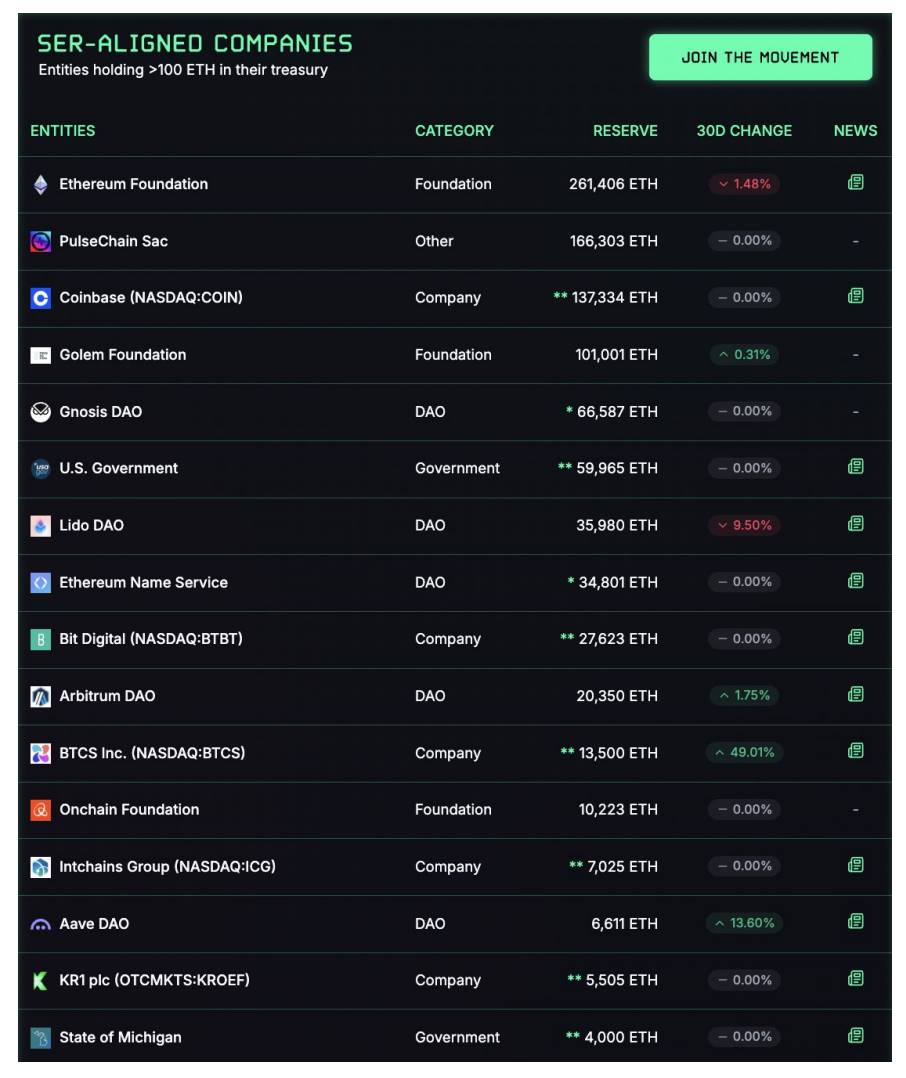
Source: strategicethreserve.xyz by Fabrice Cheng
Because of these unique features and capabilities, ETH cannot be evaluated like a technology stock. ETH is an entirely new category of asset.
Therefore, ETH cannot be accurately valued using discounted cash flow (DCF) models. Instead, ETH must be viewed through the lens of strategic value storage and utility-driven scarcity. This perspective captures ETH’s true upside potential, possibly even surpassing Bitcoin’s “digital gold” narrative.
Oil is a consumable commodity asset stored as reserves and burned as fuel. Oil has shaped nations, powered industries, and driven global trade. Its intrinsic utility, inherent scarcity, and strategic importance have made it one of history’s most valuable commodities—shaping nations, powering industries, and driving global trade. Thus, the total market capitalization of proven global oil reserves is approximately $85 trillion.
Given that ETH is on a similar developmental trajectory but oriented toward the digital realm, this provides a meaningful reference point:
- ETH powers the digital economy.
- ETH secures the digital economy.
- ETH captures value from the growth of the digital economy.
- Due to its supply dynamics and issuance cap, ETH has intrinsic scarcity.
As the global economy transitions toward tokenized infrastructure, ETH will become indispensable—not just as fuel, but as the native asset of the monetary and settlement layer of the future financial system.
| ETH’s Monetary Design: Simple, Transparent, Sustainable
ETH’s economics are elegant and simple, yet their importance is often overlooked. Unlike traditional commodities, Ethereum’s supply and demand dynamics are transparently coded into its protocol, enabling predictable issuance and sustainable network security. Ethereum has established an optimal issuance schedule that combines strong security (approximately $88 billion11 in staked ETH, compared to ~$10 billion12 in ASIC mining hardware securing Bitcoin) with extremely low inflation—averaging just 0.09%13 annually since the September 2022 Merge (the network’s transition from Proof-of-Work to Proof-of-Stake consensus). The more ETH that is staked, the more expensive and impractical it becomes to attack Ethereum, as an attacker would need to acquire at least 51% of existing ETH to successfully compromise or alter the network. This structure also protects against cartel-like, price-manipulating entities such as OPEC that have formed around traditional commodities.
Issuance
Issuance Mechanism
ETH issuance is programmatic and transparent. Like Bitcoin’s halving mechanism, newly minted ETH is distributed as rewards to validators (individuals or entities who stake ETH to help secure the network and validate transactions—this is the “yield” component mentioned earlier and discussed further below). However, unlike Bitcoin, Ethereum’s issuance adjusts dynamically based on network security needs rather than following a fixed schedule. The calculation is straightforward:
Maximum Annual ETH Issuance = 166.3 × Staked ETH
This formula creates a natural balance: as more ETH is staked to secure the network, issuance increases, but at a diminishing rate. This structure ensures a low inflation cap while incentivizing validators.
Critically, this mechanism establishes a clear upper limit on ETH issuance. Even under an extreme hypothetical scenario—where all circulating ETH supply (currently ~120.8 million14) is staked and no ETH is burned through network usage—the maximum possible inflation rate is capped at 1.51%15. In reality, ETH issuance will always remain below this theoretical ceiling. Currently, only about 28%16 of ETH is staked, meaning pre-burn inflation is approximately 0.8%17.
In practice, since Ethereum’s transition to Proof-of-Stake, ETH issuance has been far below this theoretical maximum. Since the Merge on September 15, 2022, average annual ETH issuance has been just 0.09%18, with current annualized issuance around 0.68%19. As network activity increases—especially driven by institutional adoption and tokenized asset deployment—ETH issuance may turn net deflationary, further strengthening ETH’s monetary dynamics. The impact of the improved issuance model post-Merge remains severely underestimated by mainstream investors.
Over the past decade, ETH issuance has consistently declined according to the “minimum viable issuance” principle. From 2015 to 2017, miners received an average of about 30,000 ETH per day. By 2019, this dropped to around 13,000 ETH daily. Since the 2022 Merge, daily issuance to validators now ranges from slightly negative to about 2,500 ETH per day.
How does this achieve sustainability? Unlike miners, validators have minimal operational overhead—no high electricity costs or significant hardware depreciation—allowing them to maintain network security with significantly lower token issuance. With much higher operating margins, validators have a lower marginal incentive to sell their staked tokens to cover expenses compared to Proof-of-Work miners, further enhancing ETH’s price stability and monetary soundness.
Burning
Beyond predictable issuance, Ethereum incorporates a unique and powerful monetary feature: a programmed fee-burning mechanism. This links ETH’s money supply directly to network activity, tightly aligning tokenomics with real economic demand.
On average, 80.4%20 of all transaction fees paid to validators are permanently burned, creating deflationary pressure on ETH’s circulating supply. As Ethereum’s economic activity grows, rising demand increases total fees, reinforcing this deflationary effect and reducing net ETH issuance.
This creates a self-regulating equilibrium:
- Issuance adjusts based on the amount of ETH staked to secure the network.
- Burning varies based on demand for Ethereum’s blockspace and transaction execution.
These forces together create a dynamic monetary framework where ETH’s net inflation fluctuates between slightly positive and fully deflationary—all driven by transparent, protocol-level rules. This is a monetary system designed not only for scarcity but also for sustainability, security, and alignment with real-world demand.
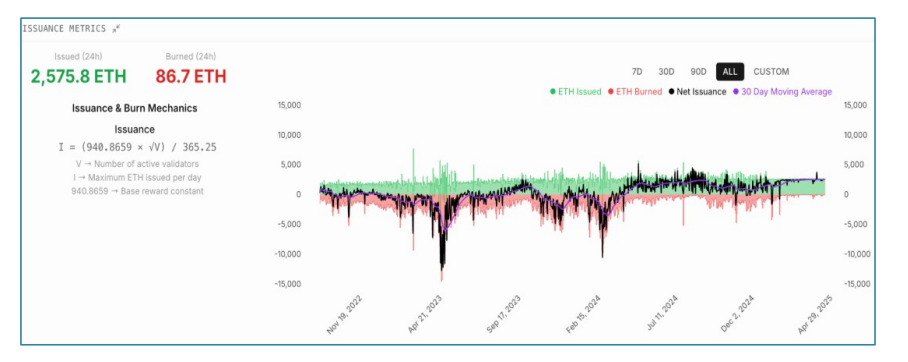
Source: dashboard.etherealize.com
Thus, modeling ETH’s net issuance boils down to two core variables:
- Amount of staked ETH determines the base issuance level for network security.
- Transaction fees denominated in ETH drive the programmed burn mechanism.
Together, these factors create a dynamic, self-regulating monetary balance. In the theoretical maximum case—if 100% of ETH were staked and no fees were generated—annual issuance would still be capped at 1.51%21. But in practice, activity on Ethereum offsets issuance through fee burning, often pushing net issuance toward zero or even negative values. As institutional adoption and demand for Ethereum’s blockspace continue to accelerate, ETH’s issuance dynamics may structurally shift toward sustained deflation.
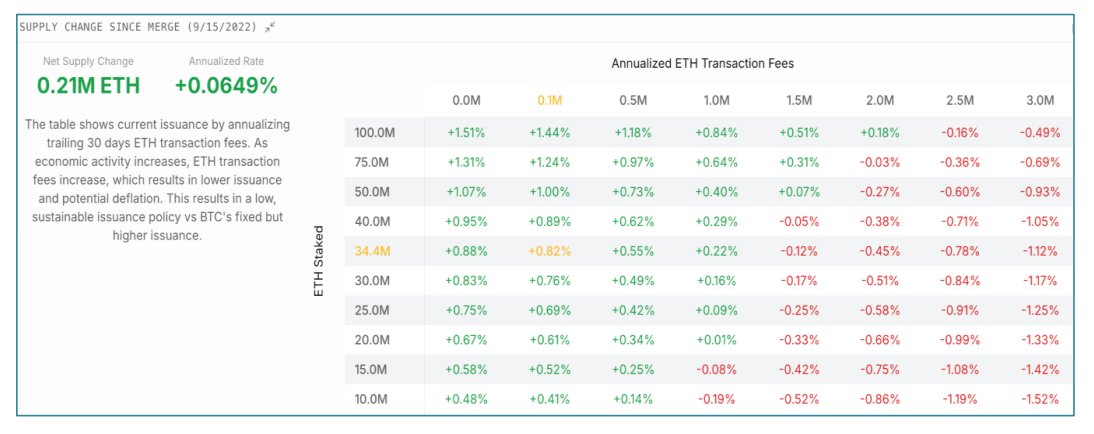
Source: dashboard.etherealize.com
ETH’s supply and demand dynamics are simple and sustainable: ETH is digital oil, featuring a predictable, programmatic issuance formula supplemented by a burn mechanism directly tied to actual Ethereum usage.
Supply
Unlike Bitcoin, ETH has no hard supply cap. Instead, Ethereum employs a predictable, formula-based issuance strategy aimed at long-term sustainability and security. While Bitcoin’s fixed 21 million cap is narratively appealing, it poses potential security risks. Entities securing Bitcoin’s network—miners—are compensated via newly minted Bitcoin and transaction fees. Once Bitcoin reaches its supply cap and stops issuing new coins as rewards, mining will become far less attractive, potentially causing miners to leave for more profitable activities, weakening Bitcoin’s security. Ethereum will not face this issue.
Current ETH supply is approximately 120.8 million22, with a theoretical maximum annual issuance cap of 1.51%23. In practice, increased network usage drives higher fee burns (as noted above), resulting in significantly lower net supply growth—or even deflation.
Bitcoin has a supply cap. ETH has an issuance cap.
Yield
As previously noted, ETH generates staking yield. Validators who stake ETH to secure Ethereum’s network are compensated with newly issued ETH. This yield directly incentivizes network security, similar to how Bitcoin miners are rewarded for investing in hardware and consuming energy to secure Bitcoin’s network.
A validator’s base yield is determined by Ethereum’s programmatic issuance (as detailed above) and supplemented by a portion of transaction fees generated by network activity. Therefore, as Ethereum’s economic activity expands, validator yields increase. ETH is a unique asset: increased economic usage leads to more fees, which simultaneously reduces net issuance below the cap (via fee burning) and increases validator rewards. No other asset combines these dynamics, making ETH a structurally attractive, yield-bearing digital asset.
Summary
ETH’s “digital oil” possesses economically superior characteristics compared to BTC’s “digital gold”—complementary yet more attractive across multiple dimensions: as blockchain ecosystems flourish, multiple institution-grade digital assets will emerge. Within a diversified crypto portfolio, ETH uniquely offers exposure to the growth of the entire digital economy.
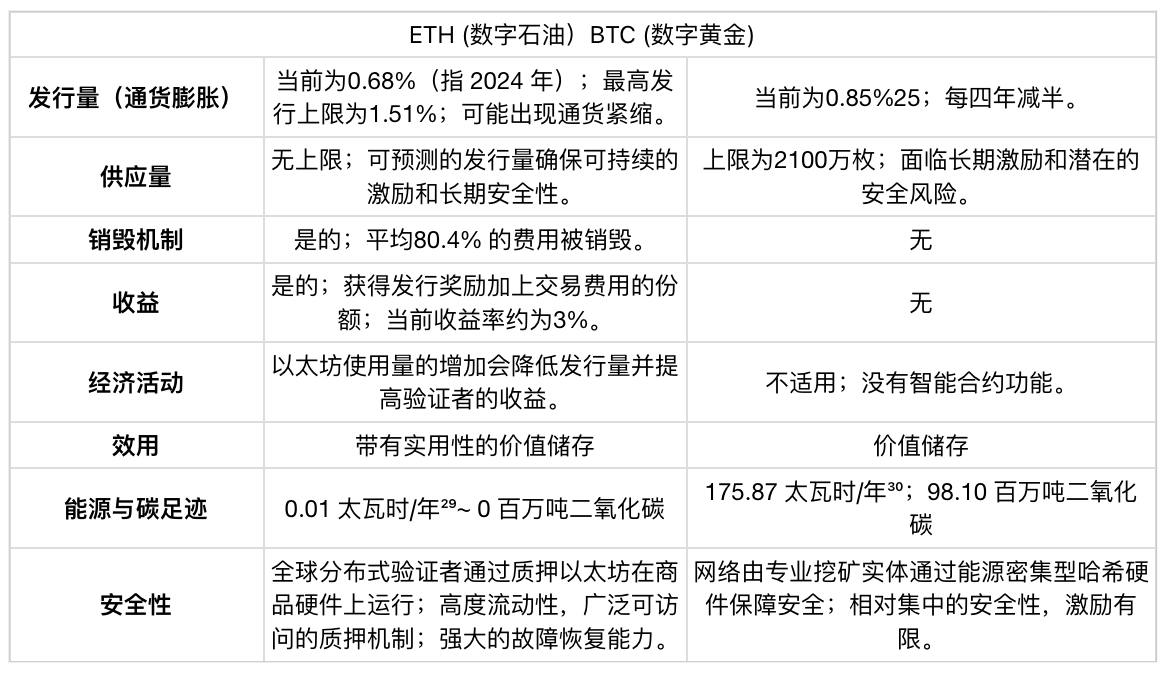
| Why Has ETH Underperformed BTC?
Since September 2022, the ETH/BTC ratio has declined from 0.085 to 0.024—a drop of over 70%. Measured in BTC, ETH is trading near 2018 lows—the same levels seen before DeFi emerged, stablecoins gained mass adoption, and many of Ethereum’s validated use cases existed. At those 2018 lows, many investors had completely abandoned Ethereum. Yet today, Ethereum dominates as the leading institutional smart contract blockchain. How can this disconnect be explained?
The answer is simple: Bitcoin’s narrative has been accepted by institutions, while Ethereum’s has not.
After 15 years in the market, Bitcoin has firmly established itself as an institutional-grade asset. Its narrative as digital gold—a scarce reserve currency resistant to fiat debasement—is now widely understood, mainstreamed, and investable. This narrative clarity has driven substantial revaluation and widespread adoption of Bitcoin.
In contrast, Ethereum’s value proposition is harder to define—not because it is weaker, but because it is broader. Bitcoin is a single-use value storage asset, whereas Ethereum is a programmable foundation supporting the entire tokenized economy.
Ethereum extends Bitcoin’s core innovation by adding smart contract functionality, unlocking use cases across finance, tokenization, identity, infrastructure, gaming, and artificial intelligence. Over the past decade, Ethereum has grown into the dominant global ledger, hosting the majority31 of tokenized assets, institutional activity, and on-chain value.
As previously noted, this makes ETH inherently more complex than BTC. This multidimensional utility makes ETH harder to categorize cleanly, leading to slower and less accurate market pricing. However, this complexity is a feature, not a flaw. ETH represents a new asset class, uniquely combining gold’s monetary premium, bonds’ productive yield, and oil’s strategic utility.
Ethereum followed Amazon’s playbook, self-disrupting through its Layer-2 (L2) roadmap during 2021–2022. Ethereum L1—the base, original Ethereum blockchain—hit a popularity bottleneck, with transaction speed limits causing network congestion and high fees during peak times. To improve scalability, L2 chains launched atop L1 to batch and process multiple transactions off-chain, then submit summaries back to L1 for final settlement. Think of L1 as the foundational highway layer, while L2s are express lanes or carpool lanes that help traffic flow faster without building an entirely new highway.
L2s greatly enhanced Ethereum’s throughput and customizability, albeit initially at the cost of fragmented liquidity and a more complex user experience (challenges now being rapidly resolved).
Critics narrowly applying discounted cash flow analysis to crypto assets argue that L2s have siphoned value away from ETH. However, this view fundamentally misunderstands the true nature of ETH’s value proposition.
| ETH: Valuation Framework
Before quantifying potential valuation scenarios for ETH, we must first correct a commonly misapplied valuation method: the Discounted Cash Flow (DCF) model, which fundamentally misrepresents ETH’s true nature and value drivers.
ETH is not a tech stock; it is a multi-functional commodity asset comparable to physical oil—but with less supply elasticity and programmatically controlled issuance caps. Oil, gold, and Bitcoin are not valued based on cash flows, therefore ETH should not be assessed solely on revenue multiples. While DCF models based on future Layer-1 and Layer-2 fees offer some insights, they miss the bigger picture—these fees are demand drivers for the ETH commodity itself. Because ETH’s issuance is designed with a cap, growing ecosystem usage makes its price highly sensitive to supply-demand dynamics. In other words, fees alone represent only a small fraction of ETH’s valuation and significantly underestimate its broader commodity and monetary characteristics.
Treating Ethereum’s fees as traditional “revenue” fundamentally mischaracterizes their role. Fees denominated in ETH are primarily a basic industrial input—fueling network transactions and incentivizing validators—not a USD-denominated profit stream. ETH’s true value stems from its unique productivity, robust value-storage economics, and its critical role as a neutral, primitive collateral within the Ethereum ecosystem.
This is not intended to diminish Ethereum’s fee decline during 2021–2022—though this decline matters for another reason. Despite record-high institutional adoption and tokenization, the revenue drop occurred precisely because Ethereum strategically self-disrupted to enable mass-scale adoption. Just as Amazon, Tesla, and Uber deliberately sacrificed short-term profits for global scale, Ethereum entered its own transformational growth phase, drastically lowering transaction fees via Layer-2 scaling. This strategy, while temporarily suppressing fee revenue, is structurally bullish: it ensures Ethereum’s long-term ubiquity, massively expands its total addressable market, and ultimately amplifies ETH’s fee burning and staking yields.
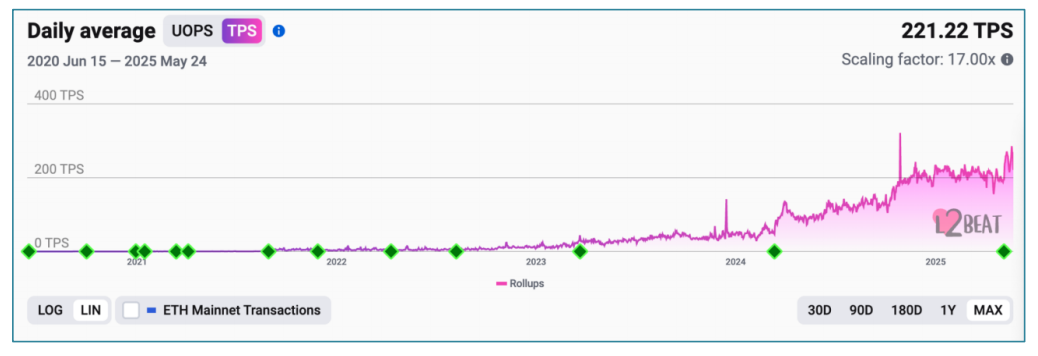
Source: https://l2beat.com/scaling/activity
Since the 2021 market peak, Ethereum’s throughput has increased by an order of magnitude while transaction costs have plummeted. The biggest scalability breakthroughs will arrive within the next year, with certain L2s projected to reach over 100,000 transactions per second.
If ETH were analyzed like a tech stock, these strategic scaling efforts would translate into exponentially higher projected revenues and thus significantly higher intrinsic valuations. Ethereum’s (and blockchain’s) adoption remains in early stages, historically constrained by regulatory uncertainty, limiting institutional and mass consumer participation. Today, these barriers are rapidly dissolving, paving the way for global acceleration.
However, ETH’s value extends far beyond fees and current or future revenue streams. ETH is digital oil, powering the world ledger of assets, money, and transactions. Like Bitcoin, ETH possesses significant value-storage qualities, with a monetary premium vastly exceeding income-based valuation multiples.
Instead of DCF models, we offer a comparative, holistic valuation framework for ETH’s long-term potential:
Petroleum Reserves Benchmark: Oil is a consumable commodity asset stored as reserves and burned as fuel. The total market capitalization of proven global oil reserves is approximately $85 trillion32—considering ETH’s scarcity, capped issuance dynamics, and critical utility in the digital economy, this provides a meaningful reference point.
Asset Tokenization Benchmark: Global wealth totals about $500 trillion33. Even conservatively assuming Ethereum tokenizes only 10% of global assets, it would host over $50 trillion in value. In this scenario, ETH—the critical asset securing network safety and settlement—would not remain valued at $300 billion.
Neutral, Primitive Collateral: ETH uniquely functions as a neutral, non-sovereign primitive collateral asset, independent of external counterparties. It is effectively the safest and “risk-free” asset within the Ethereum economy, analogous to U.S. Treasuries in the American economy—but with significantly greater upside potential.
Store-of-Value Economics: ETH reflects gold’s core monetary traits: low inflation, institutional-grade reserve status, and non-sovereign monetary premium.
| ETH Valuation Comparison: Against Other Global Reserve Assets
ETH represents a new asset class whose value drivers extend far beyond traditional equity-style cash flows. To accurately reflect ETH’s valuation potential as a global reserve asset, we must consider comparable global reserve assets as benchmarks.
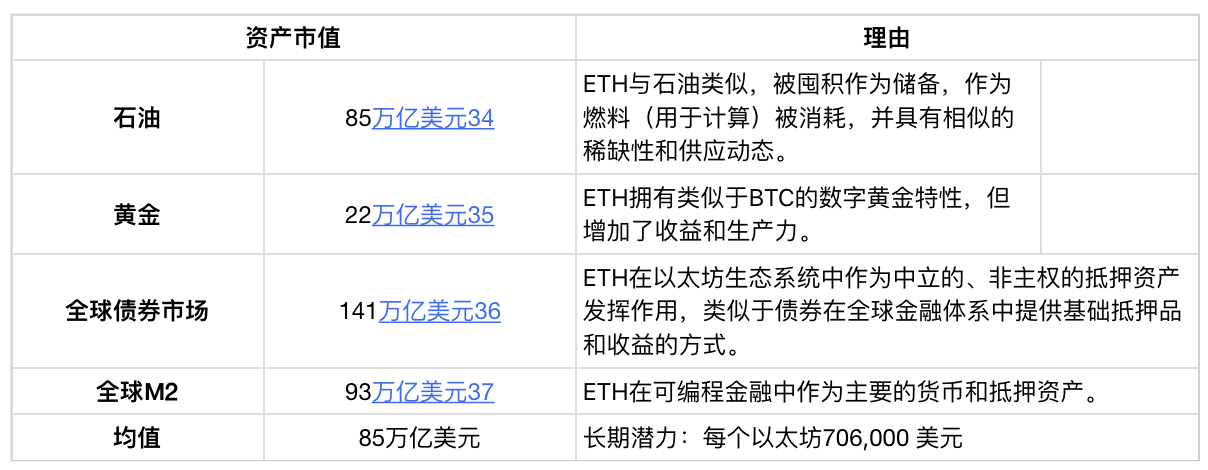
Ethereum is the most battle-tested and widely adopted ledger globally for tokenized assets, stablecoins, and digital economic activity. Among digital assets, ETH uniquely offers investors the highest upside opportunity to capture blockchain-driven growth in finance, tokenization, and global commerce.
As ETH re-prices as a global digital commodity and reserve asset, its valuation potential becomes nearly infinite. While a long-term valuation reaching $85 trillion (approximately $706,000 per ETH) is possible, some intermediate targets include:
- Short-term potential: $8,000 per ETH (~$1 trillion market cap)
- Mid-term potential: $80,000 per ETH (~$10 trillion market cap)
Catalysts for ETH Repricing
- Demand Surge: Institutional-scale rapid adoption and deployment of tokenized assets and financial infrastructure on Ethereum have begun.
- Accelerating Native Crypto Yield Demand: Upcoming staked ETH ETFs and institutional spot subscription/redemption models will significantly boost institutional interest in ETH staking yield.
- Strategic ETH Accumulation: A race is underway within the Ethereum ecosystem to hoard ETH as a monetarily premium store of value, evident in the growing strategic ETH reserves (publicly disclosed at ~$2.5 billion).
- ETH as Institutional Treasury Asset: ETH’s unique attributes—primitive collateral, neutrality, yield, and global utility—make it the preferred treasury reserve asset for institutions and globally.
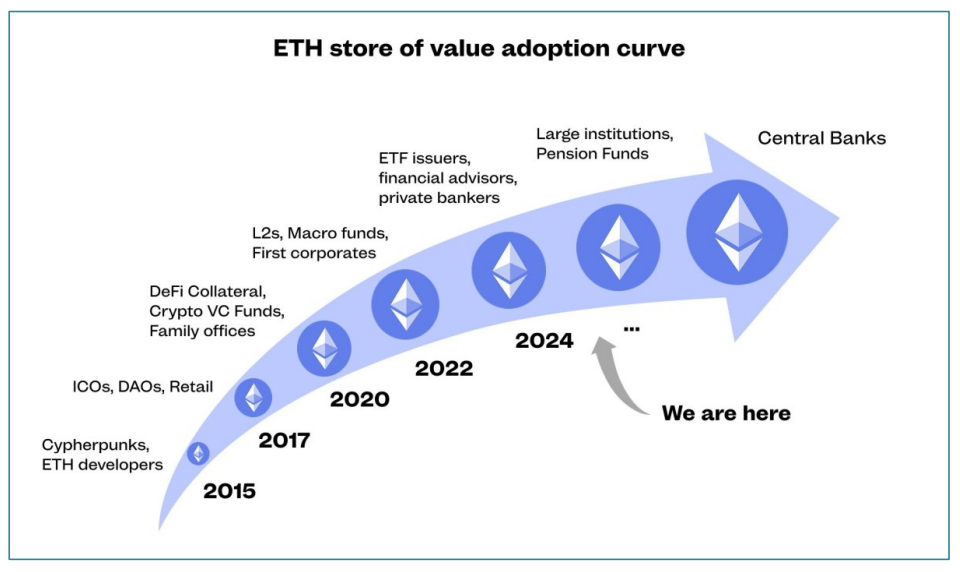
Ethereum: The Infrastructure Propelling ETH Higher
The first part of this report focused on ETH as a unique digital commodity (combining scarcity, utility, and yield), but its long-term value cannot be fully understood without examining the infrastructure it empowers. Ethereum is not just the backdrop for ETH; it is the foundational platform that makes ETH’s utility indispensable and its monetary design structurally sustainable.
Ethereum has become the most important infrastructure layer for the digital economy. It is where tokenized assets reside, where decentralized finance applications run, and where institutional settlement increasingly occurs. Ethereum has become the default platform for stablecoins, high-value tokenized assets, and institutional blockchain infrastructure. Today, over 81%38 of tokenized assets exist within the Ethereum ecosystem. Its resilience, credible neutrality, and programmability make it the only platform capable of supporting the future’s complex, programmable, globally scalable financial services and broad economic foundation.
This section explores why Ethereum is uniquely suited to underpin the next era of financial and digital economies. We examine its architectural advantages, recent scalability breakthroughs, improvements in user experience, and the accelerating migration of institutions to its Layer-2 ecosystem. We will also explore what we believe will be the next major catalyst for the Ethereum network—if realized, it will make Ethereum more than just a foundational layer for future finance: the convergence of Ethereum with AI-driven autonomous agents. In such a future, Ethereum will not merely be financial infrastructure, but the backbone of machine-native economic coordination.
In short, ETH’s value is a function of Ethereum’s growing centrality in the digital economy. As Ethereum adoption compounds, so too does demand for and strategic importance of its native asset. Therefore, understanding Ethereum’s trajectory is crucial to grasping the full scope of ETH’s investment potential.
| Why Ethereum Is Uniquely Advantageous as Financial Infrastructure
For ETH’s long-term success, Ethereum must be recognized by institutions as legitimate financial infrastructure and the undisputed leader among institution-grade blockchains.
As institutional investors increasingly recognize the limitations of existing financial infrastructure, Ethereum’s capabilities—its security, stability, scalability, programmability, decentralization, and credible neutrality—position it as the most likely platform to host the future global financial system.
- Proven Uptime and Resilience: Since its 2015 launch, Ethereum has never gone offline—even during major protocol upgrades like “The Merge.” More than 10 independent client implementations further enhance redundancy and robustness. All of this underscores its readiness as institution-grade infrastructure.
- Trustworthy Neutral Infrastructure: Ethereum is governed purely by transparent, auditable code—free from corporate interests, political pressures, or centralized figures. This credible neutrality ensures fairness, predictability, and eliminates counterparty risk.
- Massively Decentralized: Ethereum’s validator set is globally distributed, accessible to anyone with basic hardware and internet access. Its security stems from decentralization and diversity, not centralized data centers or privileged stakeholders.
- Unparalleled Market Share: The Ethereum ecosystem hosts 60%39 of all stablecoins and 82%40 of tokenized real-world assets (RWA), including tokenized treasuries and credit instruments. Most blockchain-based financial activity already exists on Ethereum41.
- High-Value Settlement Layer: Ethereum currently secures over $767 billion42 in Total Value Secured (TVS). As global finance increasingly moves on-chain, this figure is expected to grow significantly.
- Most Secure Developer Tools: The Ethereum Virtual Machine (EVM) enjoys popularity and adoption in the broader crypto ecosystem akin to JavaScript. It is well-understood and has been battle-tested over the past decade through countless high-value financial applications.
- Transparency: Fully open-source protocols and code, with publicly auditable data.
- Scalability: A clearly defined roadmap for performance enhancements and scaling solutions, enabling Ethereum to handle truly global-scale transactions and usage.
- Customizable Environment: Modular, isolated solutions designed specifically for institutions—including privacy, KYC compliance, custom gas models, data availability, and specialized execution environments.
- Security: A robust Proof-of-Stake consensus mechanism reinforced by economic slashing and diversified validator clients.
- Neutrality: No centralized foundation or privileged/subsidized validator set. Ethereum is both global and permissionless, eliminating counterparty risk at the infrastructure layer.
- Programmability: Native, highly composable smart contract functionality supported by the richest, most battle-tested ecosystem of developer and security tools.
- Regulatory Maturity: Ethereum is the most widely adopted and legally understood blockchain among global institutional entities and regulators.
- Minimal Environmental Footprint: ETH’s environmental footprint is nearly zero (~0.01 kg CO₂ per transaction)43.
Ethereum is more than just a decentralized ledger; it is a public infrastructure for institutions. With its credible neutrality, proven resilience, mature regulatory standing, and long-term roadmap, it is the only blockchain capable of serving as the foundational architecture for the global financial system.
| Why Ethereum Is Entering Its Renaissance
Ethereum’s fundamental strengths have long been underestimated, with its architecture, decentralization, and developer ecosystem quietly driving most meaningful innovation in crypto. Now, after years of quiet development and focused engineering, the ecosystem is experiencing a compounding series of tailwinds that together are poised to thrust Ethereum into the spotlight and drive rapid adoption.
For ETH, this renaissance is not just background—it is a catalyst. ETH’s value is directly tied to Ethereum’s strength, usage, and institutional trust. As Ethereum becomes faster, more intuitive, and more deeply embedded in the global financial system, demand for ETH as fuel, collateral, and strategic reserve asset will accelerate.
Below, we explore the structural improvements and ecosystem shifts defining Ethereum’s renaissance—and why they will lead to a dramatic repricing of ETH in the coming months and years.
- More Coordinated and Forward-Looking Ecosystem
Ethereum was born in an environment of regulatory uncertainty, where innovation often faced resistance and visibility came with risk. As one of the few truly decentralized blockchains alongside Bitcoin, Ethereum intentionally prioritized neutrality, security, and censorship resistance over speed or aggressive promotion. Consequently, for years, the Ethereum Foundation emphasized R&D over marketing and institutional partnerships.
This approach is now undergoing a significant shift. With increasing regulatory clarity, the Ethereum community has adopted a more proactive stance. Though no single entity governs Ethereum, the new leadership of the Ethereum Foundation—co-executive directors Tomasz Stanczak and Hsiao-Wei Wang—are clearly articulating and communicating the protocol’s technical roadmap. Around them, a diverse coalition of experienced builders, renowned funds, and key infrastructure providers is uniting to actively elevate Ethereum’s visibility and strategic relevance.
- Ethereum Layer 1 Is Scaling—Without Sacrificing Decentralization
Historically, Ethereum’s scaling strategy focused heavily on Layer-2 solutions. As noted earlier, L2s are independent chains designed to reduce traffic on Ethereum Layer 1, increase transaction throughput, and keep fees reasonable.
This approach was adopted because direct L1 scaling previously compromised Ethereum’s core principles—credible neutrality and decentralized security at the base layer. However, recent breakthroughs, such as production-grade zero-knowledge virtual machines (zkVMs) and innovative research projects like FOCIL, have opened new possibilities for significant L1 performance improvements without compromising decentralization or security.
Ethereum is now scaling in two directions simultaneously: vertical scaling of L1 and horizontal scaling via L2s. These advances have moved beyond theory; L1 enhancements are actively being developed, with deployment expected in 2025. The result will be a significantly higher-performance base layer serving as a central hub for economic activity, complemented by L2 networks that continue to expand Ethereum’s scalability and global reach.
- Ethereum L2s Are Faster, Cheaper, and More Interconnected Than Competing L1s
The Ethereum L2 ecosystem is expanding at an extraordinary pace, forming a vibrant, modular network of high-performance chains—all anchored to Ethereum’s security and economics. This flexible architecture has already attracted significant institutional adoption, with global heavyweights like Deutsche Bank (via zkSync and Memento), Sony (via Soneium), UBS, Coinbase (via the largest L2, Base), Kraken (via Ink), and World Chain (co-founded by OpenAI’s Sam Altman) actively deploying or developing customized L2 solutions.
Initial rapid growth led to fragmentation, as each L2 operated independently, introducing friction across the ecosystem. Now, this challenge is being decisively addressed. A new generation of interoperability standards is rolling out, reconnecting these Layer-2 chains into a cohesive Ethereum experience.
The outcome will be a unified, seamless ecosystem—one that retains Ethereum Layer 1’s robust security while delivering performance and cost advantages equal to or better than competing Layer-1 blockchains (since L2s leverage Ethereum for security instead of rebuilding it from scratch). With full deployment of interoperability protocols and abstracted wallet experiences, Ethereum will once again operate and feel like a single, unified chain.
- Ethereum’s User Experience Is Entering Its FinTech Era
One of Ethereum’s most significant transformations in recent years is not purely technical—it is experiential. For much of the past decade, interacting with Ethereum involved clunky interfaces, cumbersome 24-word recovery phrases, and uncomfortable trade-offs between friction and risk. That era is rapidly ending.
In May 2025, Ethereum introduced native Account Abstraction (AA), its most ambitious user experience overhaul to date. AA unlocks major enhancements, including biometric transactions (e.g., Face ID), seamless integration with secure hardware enclaves (e.g., those built into iPhones) for native key management, and advanced smart wallet features like social recovery. Ethereum is finally beginning to mirror the seamless experience of the modern internet—intuitive, secure, and nearly invisible to end users.
- Institutional Adoption Is No Longer Hypothetical—It’s Accelerating
Ethereum’s architecture—decentralized at the base layer, customizable at the application layer—is purpose-built for institutional adoption. This design has proven prescient. Today, Ethereum has become the primary destination for tokenized assets44, attracting the vast majority of institution-grade blockchain deployments on Ethereum Layer 2.
From asset managers tokenizing treasuries and credit markets to banks deploying settlement infrastructure, Ethereum has become the de facto standard. This adoption is not coincidental—it is structural. Ethereum uniquely delivers the regulatory neutrality, security assurances, and composability required by institutions operating globally. Leading tokenization initiatives have explicitly chosen Ethereum as their foundational infrastructure.45 Over **$10.2 billion46 (about 82%)** of all non-stablecoin tokenized assets—including treasuries, credit markets, and yield-bearing funds—have been issued on Ethereum by global leaders such as BlackRock, JPMorgan, Franklin Templeton, Fidelity, Apollo, Deutsche Bank, UBS, and Sony.47 Coinbase and other major exchanges are actively deploying custom L2 blockchains directly integrated into Ethereum’s security layer and economy.
Yet this institutional wave is still in its early stages. Ethereum’s infrastructure has finally matured, the regulatory environment is rapidly evolving, and institutional demand continues to accelerate. Ethereum is approaching its “ChatGPT moment”—a sudden, widespread realization among mainstream institutions that Ethereum is best suited to power the future of digital infrastructure.
- Regulatory Clarity Is Coming
For nearly a decade, Ethereum has operated under persistent regulatory uncertainty. In the U.S., the reputational, financial, and legal risks associated with developing on Ethereum were immense, stifling innovation and deterring institutional capital. The Ethereum token (ETH) itself remained in regulatory limbo, facing ongoing risk of classification as a security. As a result, despite its technical advantages, meaningful institutional adoption was delayed.
However, the regulatory landscape is shifting. The U.S. government confirmed in 201848 and reaffirmed in 202449 that Ethereum is a commodity, not a security. In May 2024, spot Ethereum ETFs were approved, granting ETH legitimacy in the eyes of traditional financial institutions. In 2025, the U.S. government signaled its intent to implement a clear legal framework for digital assets, likely further affirming Ethereum’s approved regulatory status and boosting institutional confidence in blockchain usage.
Institutional confidence is already rising rapidly, evidenced by increasing numbers of institutions publicly moving assets
Join TechFlow official community to stay tuned
Telegram:https://t.me/TechFlowDaily
X (Twitter):https://x.com/TechFlowPost
X (Twitter) EN:https://x.com/BlockFlow_News
 @Etherealize_io


