HTX Ventures: "On-chain Dollar" Reshapes Global Payment Order, Huobi HTX Actively Expands in Stablecoin Sector
TechFlow Selected TechFlow Selected
HTX Ventures: "On-chain Dollar" Reshapes Global Payment Order, Huobi HTX Actively Expands in Stablecoin Sector
As an active promoter of stablecoin development, HTX continues to expand its stablecoin ecosystem on the platform, further solidifying its core position in the global crypto landscape.
 Navigating Web3 tides with focused insights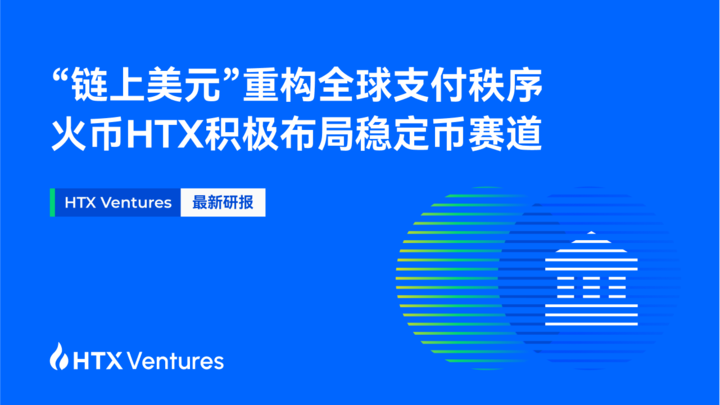
In today's global financial system, stablecoins are playing an increasingly important role as a critical component of payment infrastructure and have become a driving force behind the mainstream adoption of cryptocurrencies. Recently, HTX Ventures, the global investment arm of Huobi HTX, released a research report titled "The On-Chain Extension of the Dollar: Stablecoins, Shadow Banking, and the Restructuring of Global Payment Power", offering an in-depth analysis of the rise and strategic significance of stablecoins within the global financial landscape.
Building a "Parallel Dollar Network" to Reshape Payment Architecture
The U.S. dollar has long dominated global cross-border payments through fiat anchoring, trade denomination, and credit linkage, forming a robust moat. However, the dollar-centric payment system suffers from persistent issues such as low efficiency, high settlement costs, strict censorship, and widespread financial exclusion—challenges that severely limit financial inclusivity.
Against this backdrop, stablecoins offer a permissionless, highly liquid, and near-instant payment solution by combining blockchain technology with dollar-pegged mechanisms. Key advantages of stablecoins in payments include:
● Real-time settlement, clearing is settlement: The blockchain’s architecture inherently ensures consistency between clearing and settlement, eliminating traditional T+1 or T+2 processes;
● Borderless transferability: Users only need a wallet and internet access to participate in the dollar payment network;
● Integration with multi-chain ecosystems and payment APIs: USDT and USDC are now deployed across multiple blockchains including Ethereum, TRON, and Solana, enabling direct integration with Web3 merchants and financial APIs;
● Unification of settlement and store-of-value functions: As a single instrument serving as unit of account, medium of exchange, and store of value, stablecoins are ideal for replacing local currencies in high-inflation regions.
As a result, stablecoins are gradually building a more accessible, inclusive, and censorship-resistant on-chain dollar system—an increasingly viable alternative to traditional finance—with expanding use cases. In several Latin American countries, where local currencies suffer severe depreciation, residents heavily rely on USDT for daily transactions. Some platforms have already integrated stablecoin transfers with fiat on/off ramps, creating closed-loop exchange systems between "on-chain dollars" and local currencies. Additionally, stablecoins are being used for import/export settlements among SMEs globally, particularly in nations facing USD foreign exchange restrictions.
This parallel dollar network not only significantly improves transaction efficiency in cross-border remittances, international trade, and Web3 economies, but also enables over 1.3 billion unbanked individuals worldwide to access digital financial services—greatly amplifying the dollar’s global influence.
Challenges Facing Stablecoins and the "Shadow Bank" Dynamic
Despite their many advantages, stablecoins face significant challenges related to compliance, liquidity, privacy, and censorship. As an emerging payment solution, they threaten central banks and established cross-border payment giants, requiring careful navigation around regulatory compromise, collaboration with payment providers, and coexistence within the existing dollar hegemony.
Moreover, stablecoins are increasingly acting as "on-chain shadow banks," becoming a new channel for U.S. Treasury financing. Stablecoin issuers operate much like "on-chain money market funds," investing user-deposited dollars into short-term Treasuries and other assets while issuing tokenized forms of "credit money" on-chain. By merging faith in the dollar’s stability with on-chain liquidity, stablecoins transplant the logic of "the dollar as global sovereign currency" from traditional banking into the DeFi world. In this sense, stablecoins are not merely payment tools—they represent a cross-platform migration of monetary value systems. Yet this structure challenges central banks’ monopoly over money issuance and credit creation, while posing risks due to inadequate regulation, systemic liquidity concerns, security vulnerabilities, and trust dependencies.
Global Regulation Moves Toward Uniformity: The Institutionalization of Stablecoins
The widespread use of stablecoins in cross-border payments has drawn intense attention from governments and regulators worldwide. Mature markets such as those in Europe and North America have developed regulatory frameworks centered on compliance, capital requirements, and transparent reserves. Meanwhile, Asian jurisdictions are striving to balance innovation with oversight. Going forward, the mainstream adoption of stablecoins will depend increasingly on clear policy signals and cross-border regulatory coordination. The depth and flexibility of regulation will ultimately determine their legitimacy and longevity within the global payment ecosystem. HTX Ventures emphasizes that regulatory certainty and technological neutrality will be decisive factors in whether stablecoins can truly serve as the "dollar infrastructure of the digital age."
Huobi HTX Expands Stablecoin Ecosystem, Accelerating Global Payment Network Strategy
As a proactive supporter of stablecoin development, Huobi HTX continues to expand its platform’s stablecoin offerings, reinforcing its core position in the global crypto ecosystem. Since May, HTX has launched six new stablecoins: USD1, EURR, USDR, EURQ, USDQ, and AETHUSDT. Notably, USD1—issued by World Liberty Financial, a cryptocurrency project linked to the Trump family—is poised to become a standout player in the stablecoin space amid evolving U.S. regulatory clarity. As the first exchange to list USD1 globally, HTX added BTC/USD1 and ETH/USD1 trading pairs on June 17, further strengthening the USD1 ecosystem.
These newly listed stablecoins enhance users’ asset selection and transfer efficiency across multi-chain and multi-currency environments, providing more liquid and composable solutions for high-frequency trading, hedging, and on-chain payments.
Read the full report: https://square.htx.com/wp-content/uploads/2025/06/htx-ventures-zui-xin-yan-bao.pdf
About HTX Ventures
HTX Ventures is the global investment arm of Huobi HTX, integrating investment, incubation, and research to identify the most talented and innovative teams worldwide. As an industry pioneer with over 11 years of blockchain experience, HTX Ventures excels at identifying cutting-edge technologies and emerging business models. To drive growth across the blockchain ecosystem, we provide comprehensive support—including funding, resources, and strategic guidance—to portfolio projects.
HTX Ventures currently backs over 300 projects spanning various blockchain domains, with select high-quality projects already listed on Huobi HTX. Additionally, as one of the most active fund-of-funds (FOF), HTX Ventures invests in 30 leading global funds and collaborates with top-tier blockchain investors such as Polychain, Dragonfly, Bankless, Gitcoin, Figment, Nomad, Animoca, and Hack VC to build a robust blockchain ecosystem. Visit us.
For investment and partnership inquiries, please contact [email protected]
Join TechFlow official community to stay tuned
Telegram:https://t.me/TechFlowDaily
X (Twitter):https://x.com/TechFlowPost
X (Twitter) EN:https://x.com/BlockFlow_News
 @Ventures_HTX