The Rise of Stablecoins: A Platform Revolution from Payment Channels to Financial Infrastructure
TechFlow Selected TechFlow Selected
The Rise of Stablecoins: A Platform Revolution from Payment Channels to Financial Infrastructure
This article analyzes its transformative logic as new infrastructure and the industry reshaping trajectory over the next decade.
 Navigating Web3 tides with focused insights
Author: Simon Taylor
Translation: Block unicorn
Introduction
Every fintech company will become a stablecoin company.
Despite the immense hype, skepticism, hope, and concern surrounding stablecoins, I believe we’ve crossed a critical threshold—from the “Banking-as-a-Service” (BaaS) era to an age where stablecoins serve as foundational infrastructure. Companies centered on stablecoins for B2C, B2B, and infrastructure will shape the industry over the next decade.
This shift will be ten times more disruptive than the fintech boom of the past ten years.
We are moving toward a new layer of infrastructure. People still see stablecoins as just another payment channel, but when they recognize them as a platform that sits above all other layers, we will finally transition fully into a stablecoin-native world. Stablecoins are a platform.
Key points of this article:
-
The previous era: Banking-as-a-Service (BaaS) and its lessons for stablecoins
-
Why stablecoins are an infrastructure layer (not just a new channel)
-
The stablecoin gold rush and regulatory unlocking
-
Full-stack use cases
-
Strategic positioning and future outlook
1. Lessons from BaaS to Stablecoins
As the saying goes, fools rush in.
We’ve just witnessed this in BaaS.
The financial services era of the 2010s was defined by companies adopting mobile-first distribution and cloud-first infrastructure.
We saw a generation of new infrastructure providers built specifically for financial services. Every department and IT system within banks became accessible via APIs—customer onboarding, anti-fraud, anti-money laundering (AML), credit card services, and even customer support in some cases. This enabled new companies to launch mobile apps, wallets, and “accounts,” acquiring and serving customers at far lower costs than incumbents.
By combining APIs, mobile technology, and cloud infrastructure, fintech companies also benefited from a few "sponsor banks" that saw opportunities in providing banking rails, holding funds, and transferring money into this emerging space. Some banks succeeded greatly due to their "ease of collaboration."
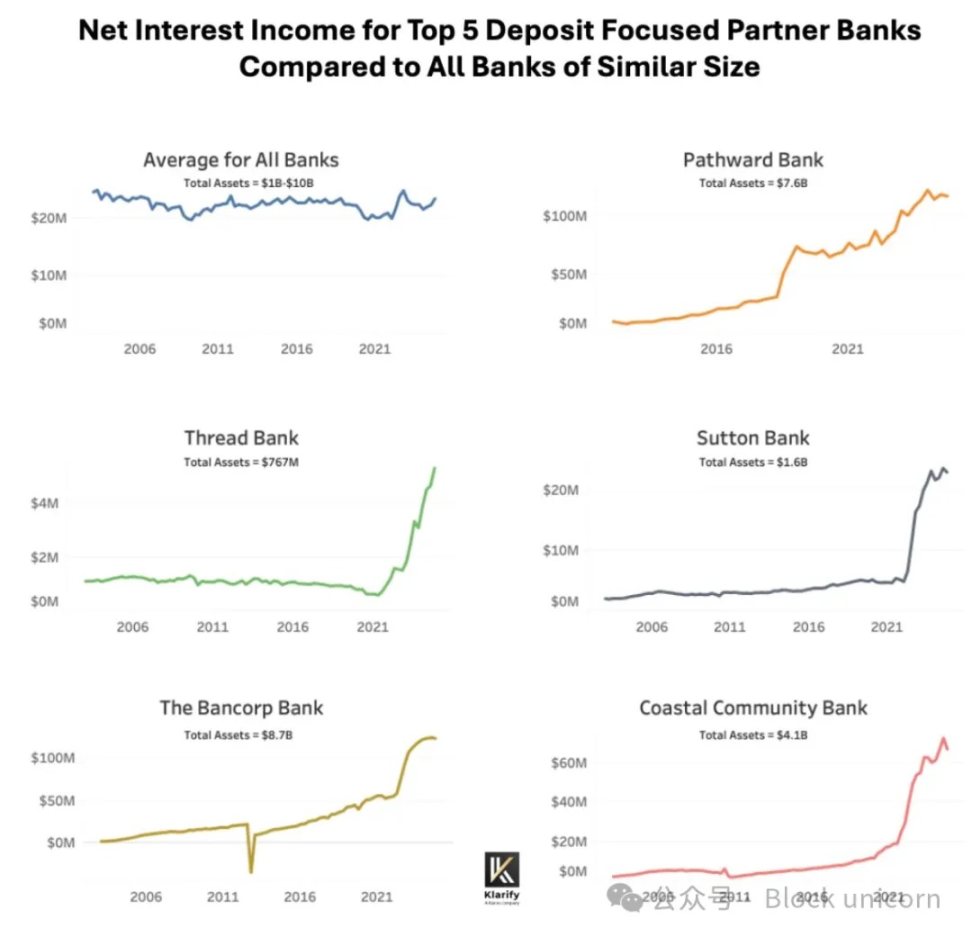
Source: Klaros Partners
For fintech companies, their initial business model was:
-
Revenue through interchange fees
-
Lower customer acquisition cost (CAC) via frictionless digital onboarding
There’s a saying: Show me the incentive, and I’ll show you the outcome?
Some (but not all) fintech companies optimized for conversion rates. When you do that, many norms in financial services start to look like friction. For example, requiring customers to submit multiple pages of documents for Know Your Customer (KYC) checks, or monitoring transactions for risks related to international terrorism when most customers are domestic.
When I wrote “BaaS is dead” in March 2023, warning signs were already visible.
Account opening is a crucial moment for catching bad actors. If you treat account opening as a checkbox process to be completed with minimal friction, then minimalist interpretations of Bank Secrecy Act / AML rules lead to high-conversion onboarding flows. Over the past two years, this has allowed fraud and money laundering to occur remotely at scale, attacking the system's weakest point.—Excerpt from “BaaS is Dead”
If you’re a criminal, attacking small new banks and neobanks is easy.
But the results weren’t good.
On April 22, 2024, BaaS provider Synapse went bankrupt, leaving tens of thousands of customers without access to their life savings. Fintech apps couldn’t reach these funds, and underlying banks couldn’t track or reconcile where the money had gone.
This incident triggered mainstream media headlines, prompting regulators to issue a series of consent orders identifying shortcomings in banks regarding:
-
Third-party risk management (i.e., API providers and fintech companies)
-
Anti-money laundering (i.e., inconsistent control measures across these firms)
-
Board governance (i.e., whether management was held accountable)
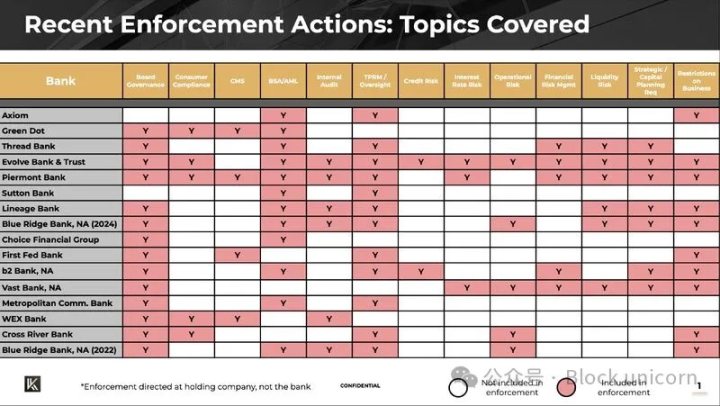
Source: Klaros Partners
The consequences of these failures were enormous.
If you can’t stop money from flowing to criminals, those criminals get paid—and fund human suffering.
However, the lesson here isn’t that BaaS or fintech is bad; quite the opposite.
Today we have:
-
The ability for immigrants and low-income individuals to open free accounts
-
The ability to underwrite loans based on cash flow (the money you actually have), meaning more people can avoid bankruptcy
-
Better consumer spending cards
-
Embedded lending for marketplaces, SMBs, and vertical SaaS platforms
Successful major financial brands have reshaped the industry. Cash App, Venmo, Chime, Affirm, Revolut, Monzo, Nubank, Stripe, Adyen, and your favorite brand have become household names in their markets and sectors. Fintech has fundamentally changed how finance is distributed and raised the bar for user experience.
We simply learned some hard lessons along the way.
The scale of investment in stablecoins and cross-border activity could make any collapse truly epic.
While I know it’s impossible to prevent bad things entirely, I hope companies building around stablecoins can learn from both the mistakes and successes of the BaaS era, and not lose their heads during the coming gold rush.
2. Regulatory Unlocking and Capital Surge
2.1 Regulatory Unlocking
The current draft of the GENIUS Act could change everything. Under the proposal, if you're an approved stablecoin issuer, you can treat stablecoins as cash equivalents on your balance sheet. This would be a big deal.
Take prepaid cards as an example. They require money transmission licenses, refund rules, and consumer protection requirements. Cash, like money in your pocket, is much simpler to hold and manage. Stablecoins could inherit that simplicity.
2.2 The Stablecoin Gold Rush
Investment in stablecoin-related businesses is expected to grow tenfold year-over-year.
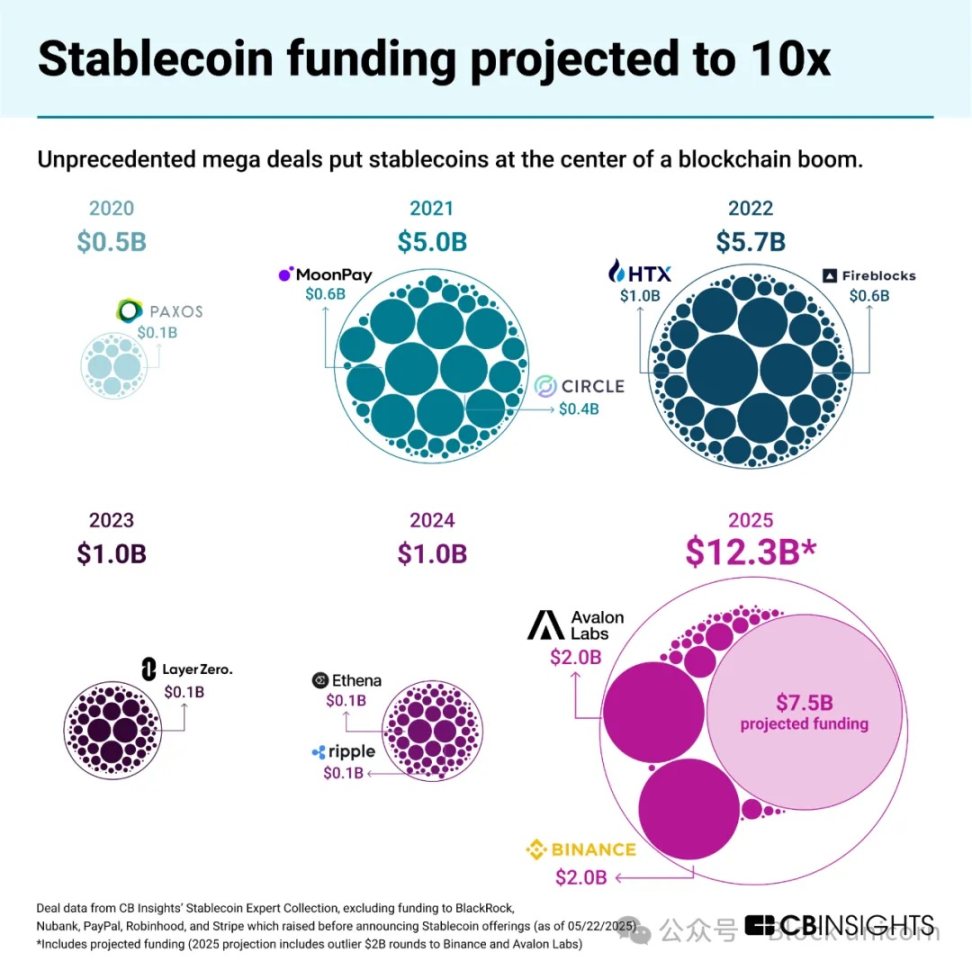
Funding in stablecoin-related businesses
If the GENIUS Act passes, a new regulated channel for stablecoins—and a new category of narrow banks called Permitted Payment Stablecoin Issuers (PPSIs)—will emerge.
This means every entrepreneur, venture capitalist, payments company, shadow bank, and even large banks will move to defend or seize this new opportunity.
3. The Argument: Stablecoins as a Platform
Today, stablecoins are used as alternative cross-border payment channels, and may eventually become domestic payment methods.
But if that’s all you see, you’re missing the bigger picture. Stablecoins are also a platform sitting atop channels like SWIFT, ACH, PIX, and UPI—connecting them all as foundational infrastructure. This unlocks new use cases and opportunities.
Ultimately, stablecoins will create an abstraction layer over existing payment networks, much like the internet did for telecom operators. Entire industries will become “stablecoin-native,” just as we’ve seen with video, messaging, and e-commerce. This network layer will ultimately eliminate intermediaries and reduce costs.—Excerpt from “Stablecoins aren't cheaper; they're better”
I envision it like this:
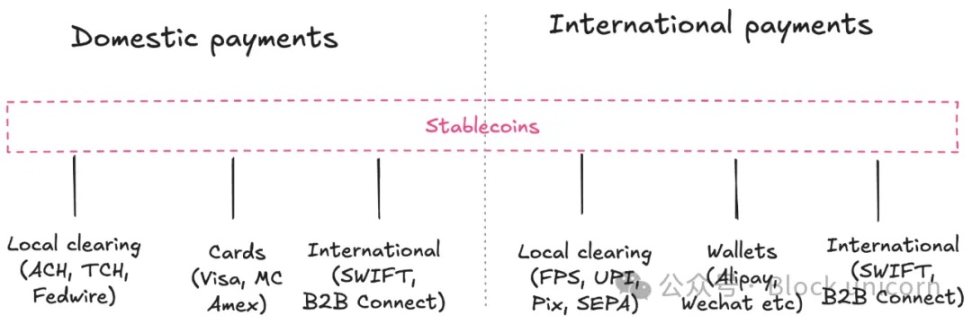
Stablecoins as a platform
This is what platform disruption looks like. Telecom traffic grew 60% YoY while revenue grew only 1%. Within 15 years, traffic growth outpaced revenue growth by over 1,000x.
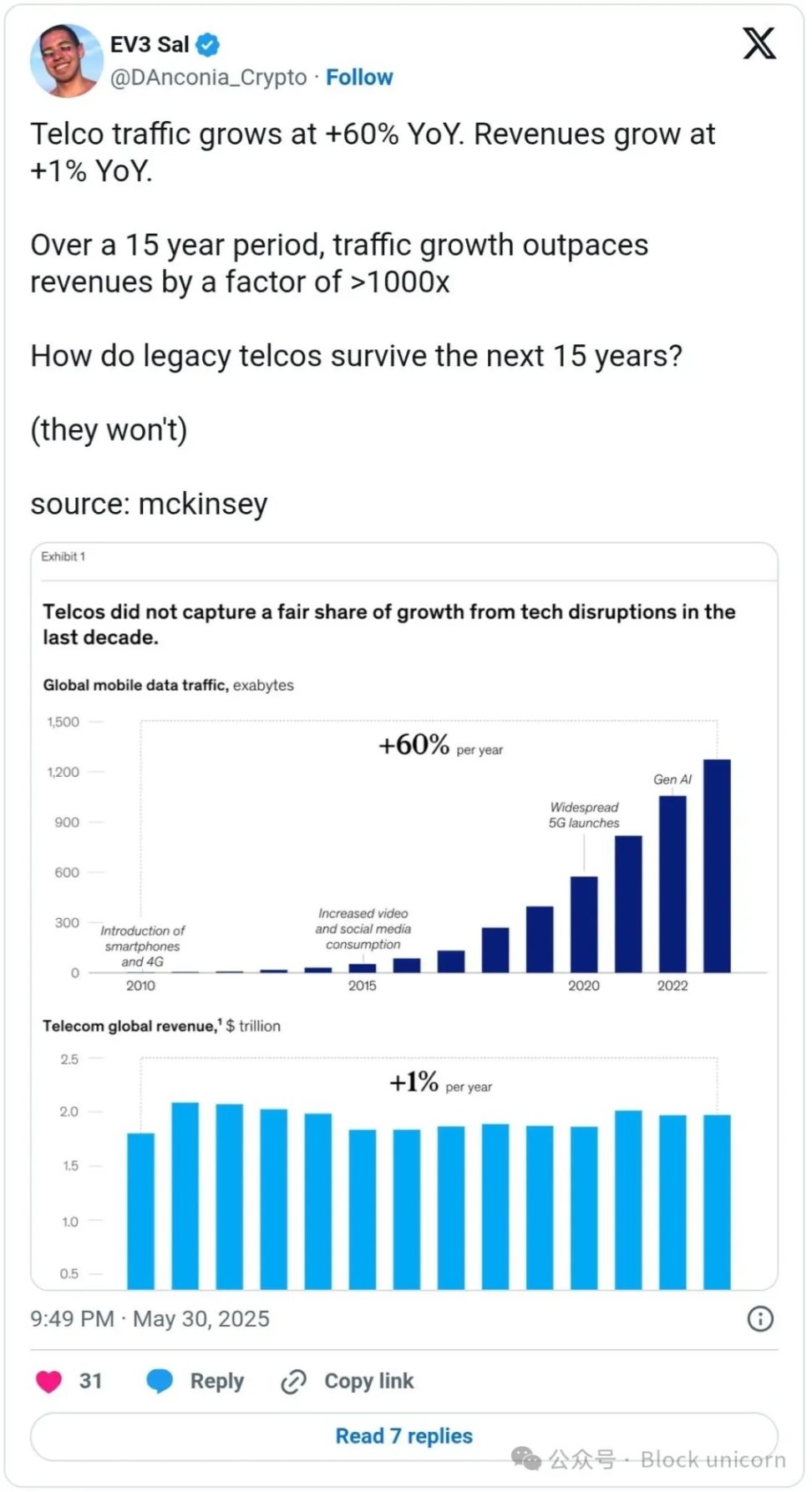
Incumbents unable to adapt to the new platform layer will be commoditized.
The impact of stablecoins on payments will mirror that of the internet on telecommunications—creating a platform layer that turns underlying infrastructure into commoditized pipes.
We can already see this infrastructure layer emerging across every payment flow and business model. Here’s how it works.
4. How Stablecoins Function Across the System
Yes, stablecoins currently operate as alternative payment channels. But that’s just the beginning. Most people view them merely as payment rails in the diagram below, rather than as a platform:
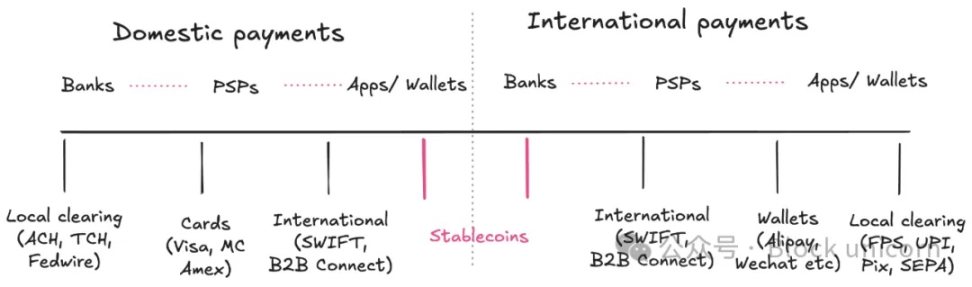
Stablecoins as payment channels—they are much more than that.
The real opportunity lies in what they enable as infrastructure.
4.1 Stablecoins for International Payments—The Starting Point
Undoubtedly, the primary use case for stablecoins is cross-border payments. Key currency corridors include Asian countries, followed by the U.S. to Latin American nations (Mexico, Brazil, Argentina).
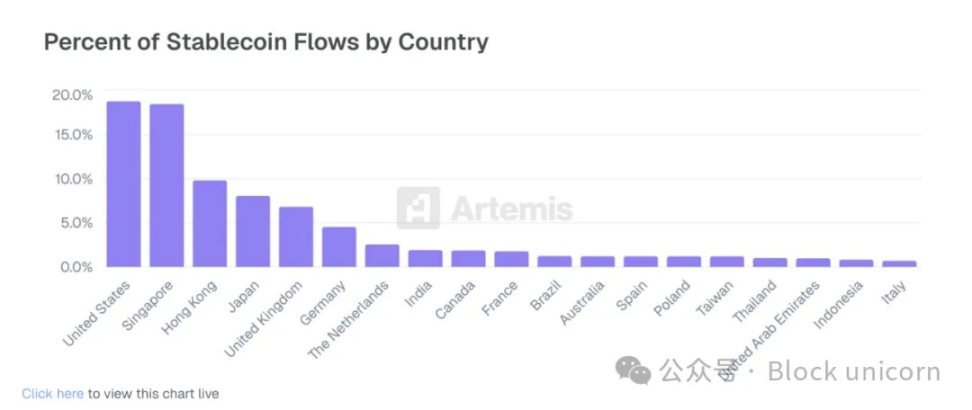
G20-led payment activities to Global South via Tron and Tether
There are various types of cross-border payments. Let’s dive deeper into each flow.
Early B2B use cases:
-
Scaling enterprises expanding into new markets (e.g., SpaceX): for treasury management, supplier payments, and intercompany transfers.
-
International payroll and payments (e.g., Deel, Remote): contractors and employer representatives receive payments directly into stablecoin wallets.
Artemis surveyed over 30 companies operating in the stablecoin space and found that B2B, as a category, grew 400% year-over-year (and accelerating), making it the fastest-growing segment. (Note: The chart below shows transaction volume representing only part of the overall market.)
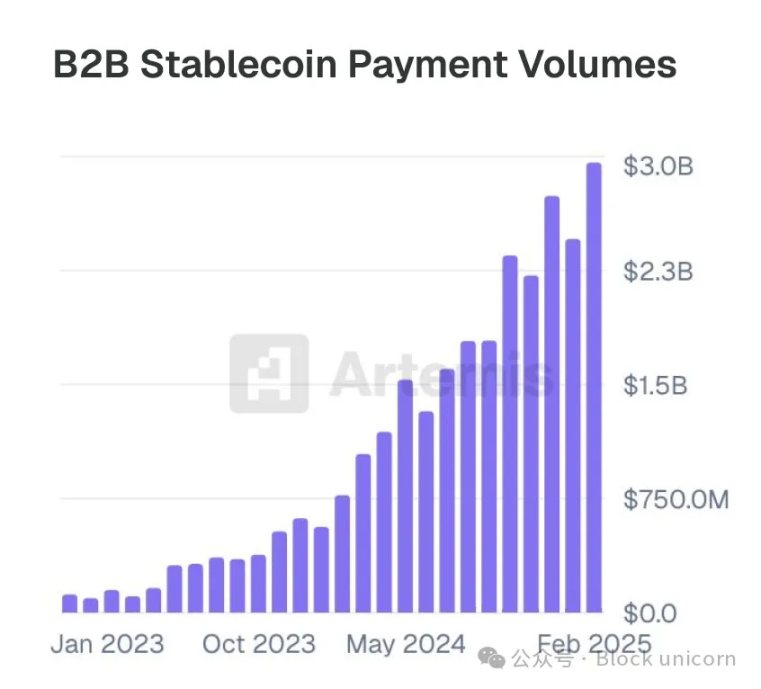
As the growth curve shows, this is significant momentum.
Currently, last-mile liquidity and foreign exchange spreads remain bottlenecks, but new companies like Stablesea, OpenFX, and Velocity are entering the market to address these issues.
Consumer use cases for cross-border stablecoins include:
-
Remittances and P2P (e.g., Sling Money): customers send money across borders using stablecoins—faster and often cheaper.
-
Stablecoin-linked cards: also known as “dollar cards,” enabling consumers in the Global South to purchase services like Netflix, ChatGPT, or Amazon.
Artemis’ survey also revealed that P2P and stablecoin-linked cards grew over 100% YoY, processing at least $1 billion in TPV (Transaction Payment Volume) within their sample.
Stablecoins are becoming a feature within neobanks like Revolut and Nubank. While current use cases remain narrow, they could expand significantly. Apps like Revolut, which started with remittances and P2P, are uniquely positioned to leverage this new channel.
Currently, FX spreads for local currency transactions tend to be high, and liquidity is low—but this is changing.
The landscape for domestic payments is still forming, yet fascinating.
4.2 Stablecoins for Domestic Payments (Future Direction)
Domestic B2B use cases include:
-
24/7 yield-bearing stablecoins (e.g., ONDO or BUIDL): Currently, crypto-native treasuries convert stablecoins into tokenized Treasuries to avoid converting back to fiat. If such 24/7 functionality becomes available within ERP systems, it could be highly attractive to corporate treasurers.
-
Stablecoins as an alternative to FBO structures (e.g., Modern Treasury): A quirk of U.S. regulation is that non-bank entities typically need a “For-Beneficiary-Only” (FBO) structure to transfer funds on behalf of clients. These accounts are complex to set up. Modern Treasury’s stablecoin product allows finance teams to establish payment flows for customers without needing an FBO structure.
-
Stablecoin-native B2B accounts (e.g., Altitude): “Borderless accounts” offered by Wise or Airwallex could be stablecoin-native. Denominated in USD, these accounts provide front-end tools to manage invoicing, expenses, and finances.
Domestic consumer use cases are still early-stage and include:
-
Stablecoin-native “checking” accounts (e.g., Fuse): Similar in user experience to Wise, Revolut, or remittance apps, but inherently global by default. These services are currently emerging in the Global South, but could represent a new, low-cost model for consumer fintech ventures.
-
Prepaid card programs: If stablecoins gain cash-equivalent status, CFOs can manage programmable digital money that sits on the balance sheet like cash but moves like digital payments—without dealing with complex prepaid liabilities.
-
P2P stablecoin transfers: Zelle, Venmo, Pix, and Faster Payments dominate domestically, but if stablecoins become an alternative paradigm, these apps might simply serve as front-ends supporting them.
4.3 Finance & Infrastructure (The Hidden Layer)
The hidden layer is infrastructure. Banking technology itself is becoming native to stablecoins.
-
Stablecoin issuance-as-a-service (e.g., Brale, M^0): Banks and non-bank institutions may want to launch their own stablecoins to attract deposits or avoid fees charged by other issuers.
-
Stablecoins as side-core (e.g., Stablecore): Banks may want to build record-keeping systems that interact with stablecoins independently of legacy platforms. A “side-core” enables this while still reconciling with the main core.
-
Stablecoins offering BaaS-like infrastructure (e.g., Squads Grid): Providing developers with simple APIs to quickly build consumer, B2B, or embedded finance products.
Most companies in the market severely underestimate how much developers love the convenience of stablecoins. For companies like Stripe, convenience has always been the secret to success.
You can imagine other possibilities. As a thought experiment, consider stablecoins as a global, programmable ledger system—visible and auditable by everyone.
Each wallet address could be linked to a known frontend or wallet creator, allowing immediate collaboration among companies when KYC or AML issues arise.
4.4 Strategic Positioning in the Stablecoin Landscape
The current market includes attackers, opportunists, and those still observing and formulating strategies.
Most activity today occurs on new platforms like crypto exchanges and wallets, but opportunists are positioning themselves to leverage stablecoins as a new payment channel:
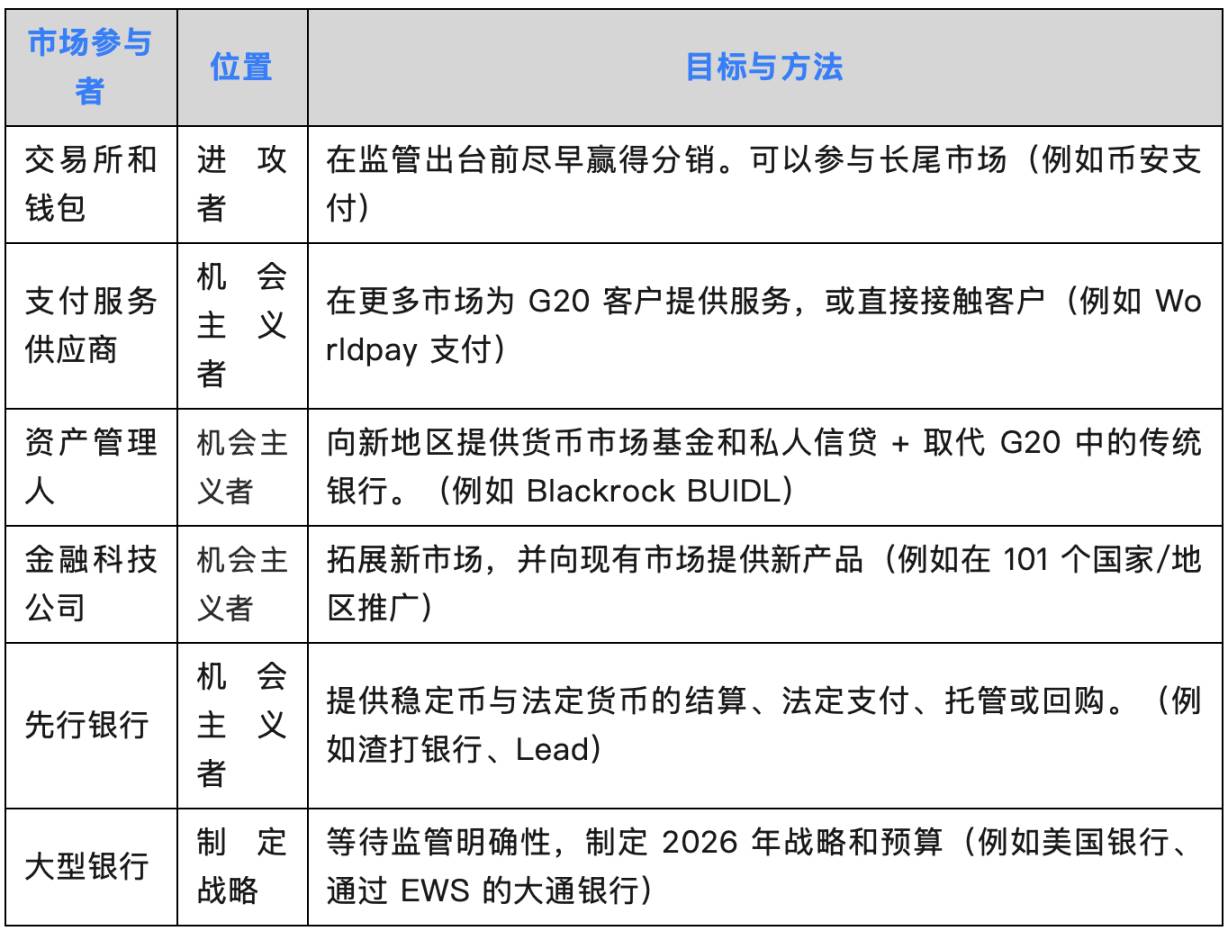
Here’s how I categorize them:
Attackers:
-
Asset managers: BlackRock, Franklin Templeton, Fidelity—firms reliant on banks for wire settlements. Since the financial crisis, they've taken market share from banks in credit and money market funds. Stablecoins connect it all with instant, 24/7 settlement.
-
Payment companies like Stripe, WorldPay, and Dlocal are expanding the number of markets they operate in and the types of payment flows they offer. “Financial accounts” erode the core business of large money-center banks, though typically targeting newer customer segments.
Defenders:
-
Large banks: JPMorgan, Bank of America, Citibank, and other U.S. banks previously discussed launching their own stablecoins. I believe this may be an attempt to capture market share in this new domestic and cross-border “channel”—just as banks dominated P2P payments via Zelle, they may “inevitably” dominate this new channel too.
-
Small banks: Have begun lobbying against stablecoins. Stablecoin issuers, asset managers, and large banks could siphon deposits from their low-yield checking accounts, so small banks stand to lose the most.
There will also be a wave of opportunistic banks—similar to what we saw in sponsored banking—who will seize huge opportunities amid this disruption.
The reality is that opportunities vary by use case. Startups are exploring new payment flows, while payment service providers (PSPs) expand market access through existing ones. In the future, asset managers and banks will find their place in the market, likely closer to their existing core businesses.
5. Criticisms, Concerns, and Why Most Are Overblown
I summarize the criticisms as follows:
Criticism: Stablecoins will trigger bank run scenarios. Rebuttal: This assumes Terra-style algorithmic stablecoins, not Treasury-backed, regulated Permitted Payment Stablecoin Issuers (PPSIs) under the GENIUS Act.
Criticism: Big Tech will form monetary oligopolies. Rebuttal: A valid concern, but the framework makes it unlikely for Big Tech to directly issue stablecoins—they’ll use them, not issue them. Becoming a PPSI presents high regulatory barriers for them.
Criticism: Will cause deposit flight from community banks. Rebuttal: Money market funds are already doing this. Community banks that adapt to offer stablecoin services will thrive.
Criticism: “It’s crypto,” implying crime and scams. Rebuttal: It’s time to move past this view. The future of finance is on-chain, and institutional capital is building the infrastructure. Real, novel risks exist—like key management, custody, liquidity, integration, and credit risk—and these deserve focus.
Criticism: “Stablecoins are just regulatory arbitrage because ‘holding USDC should be as hard as holding dollars.’” Rebuttal: Fintech itself achieved regulatory arbitrage via the Durbin Amendment. Building on stablecoins is easier, but there is now a full licensing regime.
I believe this debate will continue.
Stablecoins will drive the next era of finance, and our vision for the future has only just begun.
6. Finally, Why Every Company Needs a Stablecoin Strategy
Everything we do today can be made stablecoin-native, giving finance superpowers. We can build instant, global, 24/7 financial systems. We can reassemble financial Lego blocks in developer-friendly ways.
The BaaS era taught us that new infrastructure creates massive opportunities—and massive risks. Companies that learn from both the successes and failures of that era will win in the stablecoin-centric age.
Every company needs a stablecoin strategy. Every fintech firm, every bank, every finance team needs one. Because this isn’t just a new payment channel. It’s a platform layer upon which everything else will be built.
I urge every reader to build upon the lessons of the past.
Collapses are inevitable. Things will go wrong—that’s certain.
Part of your strategy must include how you’ll protect yourself when things inevitably break.
Build cool stuff.
And stay safe.
Join TechFlow official community to stay tuned
Telegram:https://t.me/TechFlowDaily
X (Twitter):https://x.com/TechFlowPost
X (Twitter) EN:https://x.com/BlockFlow_News
 @sytaylor