The role of cryptocurrency in the field of humanoid robots
TechFlow Selected TechFlow Selected
The role of cryptocurrency in the field of humanoid robots
The data required for humanoid robots needs to be cost-effective, scalable, and composable, and cryptocurrency token incentive models can fill the most urgent gap currently.
 Navigating Web3 tides with focused insights
Author: @brezshares
Translation: AididiaoJP, Foresight News
Background Summary
General-purpose humanoid robots are rapidly transitioning from science fiction to commercial reality. Thanks to declining hardware costs, surging capital investment, and advances in mobility and dexterity, the field of AI computing is on the verge of its next major transformation.
While AI cloud computing and hardware infrastructure have become increasingly accessible, providing a low-cost manufacturing environment for robotics, the field remains constrained by insufficient training data.
Reborn aims to leverage DePAI for decentralized high-fidelity motion and synthetic data generation, building foundational models for robotics. The team comprises members from UC Berkeley, Cornell University, Harvard University, and Apple.
Humanoid Robots: From Sci-Fi to Reality
Robot commercialization is not new—examples include the iRobot Roomba vacuum cleaner launched in 2002 or recent popular devices like Kasa pet cameras—but such products typically feature single-purpose designs. With advancements in artificial intelligence, robots are evolving from single-function machines into multi-purpose agents capable of operating in unstructured environments.
Over the next 5 to 15 years, humanoid robots will progress from basic tasks like cleaning and cooking to complex domains such as concierge services, firefighting, disaster rescue, and even surgical procedures. This vision is becoming reality through three key trends:
-
Rapid market expansion: Over 100 companies globally are now developing humanoid robots, including well-known names such as Tesla, Unitree, Figure, Clone, and Agile.
-
Hardware breakthroughs crossing the "uncanny valley": Next-generation humanoid robots exhibit fluid, natural movements and rich human interaction capabilities. For instance, the Unitree H1 walks at 3.3 meters per second, significantly faster than the average human walking speed of 1.4 meters per second.
-
A new paradigm in labor costs: By 2032, the operational cost of humanoid robots is expected to fall below the average wage level of human workers in the United States.
Bottleneck: Scarcity of Real-World Training Data
Despite the promising outlook for humanoid robots, large-scale deployment remains limited by the quality and scale of training data.
Other AI fields, such as autonomous driving, have solved their data challenges using vehicle-mounted cameras and sensors. For example, Tesla and Waymo train their self-driving systems on massive real-world driving datasets. Waymo vehicles can undergo real-time training with a robotic co-pilot seated beside them during operation.
However, consumers are generally unwilling to actively provide data when using robots—they are unlikely to tolerate the presence of a "robot nanny." As a result, robots must be highly capable right out of the factory, making pre-deployment data collection a critical challenge.
Although each training mode has its own scalability, robot training data lags behind other AI domains by orders of magnitude:
-
GPT-4: Trained on over 15 trillion text tokens.
-
Midjourney/Sora: Relies on billions of annotated video-text pairs.
-
Robotics datasets: The largest contain only about 2.4 million motion clips.
This gap explains why true foundation models have yet to emerge in robotics—the data simply cannot be collected at sufficient scale. Traditional data collection methods struggle to meet demand:
-
Simulation training: Low-cost but lacks rare real-world edge cases (the so-called "Sim2Real gap").
-
Web videos: Lack force feedback or proprioceptive data required for robot learning.
-
Real-world data collection: Requires manual teleoperation, with individual robot setups costing over $40,000 and difficult to scale.
Reborn attempts to solve the Sim2Real gap by acquiring real-world data efficiently and at low cost through a decentralized model.
Reborn: A Full-Stack Solution for DePAI
Reborn is building a vertically integrated physical AI software and data platform. Its core mission is to overcome the data bottleneck in humanoid robotics, but its ambitions extend further. Through proprietary hardware, multimodal simulation infrastructure, and foundation model development, Reborn aims to become a full-stack enabler in intelligent humanoid robotics.
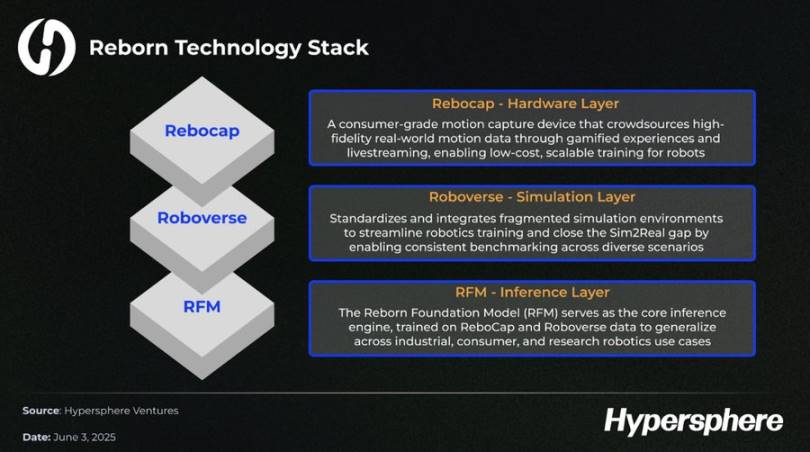
ReboCap: Crowdsourced High-Fidelity Motion Data
ReboCap is Reborn’s low-cost motion capture device, which has sold over 5,000 units and boasts 160,000 monthly active users (MAU).

Reborn achieves data acquisition with superior cost efficiency compared to alternative solutions.
Users generate high-fidelity motion data via AR/VR games and receive network incentives. This model attracts not only gamers but also digital streamers who use it for real-time digital avatars. This natural feedback loop enables scalable, low-cost, and high-fidelity data generation.
Roboverse: Unified Multimodal Simulation Platform
Roboverse is a multimodal simulation platform designed to unify fragmented simulation environments. Current robotics simulation tools (e.g., MuJoCo, NVIDIA Isaac Lab) vary in functionality and lack interoperability, severely hampering R&D efficiency. Roboverse establishes standardized simulation protocols, creating a shared virtual infrastructure for developing and evaluating robotic models. By offering a unified development and evaluation platform, it enhances model compatibility.
Reborn Foundation Model (RFM)
Reborn technology stack
The most critical component of Reborn’s full stack is the Reborn Foundation Model (RFM). One of the first foundation models specifically designed for robotics, RFM aims to serve as core infrastructure for DePAI—similar to traditional LLM foundation models like OpenAI’s o4 or Meta’s Llama, but tailored for robots.
ReboCap, Roboverse, and RFM together form Reborn’s strong moat. By combining real-world data from ReboCap with Roboverse’s simulation capabilities, RFM can train high-performance models adaptable to complex scenarios, supporting diverse applications across industrial, consumer, and research robots.
Reborn is advancing toward commercialization, currently running paid pilot programs with Galbot and Noematrix, and establishing strategic partnerships with Unitree Technology, Booster Robotics, Swiss Mile, and Agile Robots. China's humanoid robot market is growing rapidly, accounting for approximately 32.7% of the global share. Notably, Unitree Technology holds over 60% of the global simulated robot market and is among the Chinese manufacturers planning to produce more than 1,000 humanoid robots annually by 2025.
The Role of Cryptocurrency in DePAI
Cryptographic technologies are enabling complete vertical integration in DePAI.
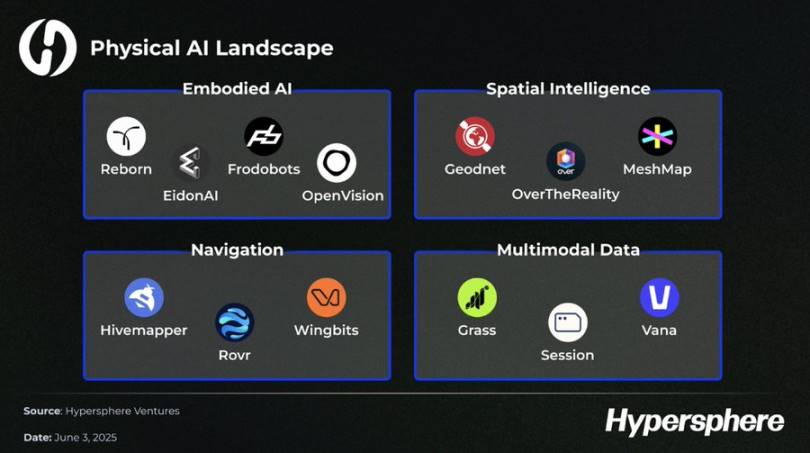
Reborn is a leading project in the DePAI space
DePAI projects utilize token incentives to ensure open, composable, and permissionless scaling, enabling efficient decentralized data collection and incentive alignment.
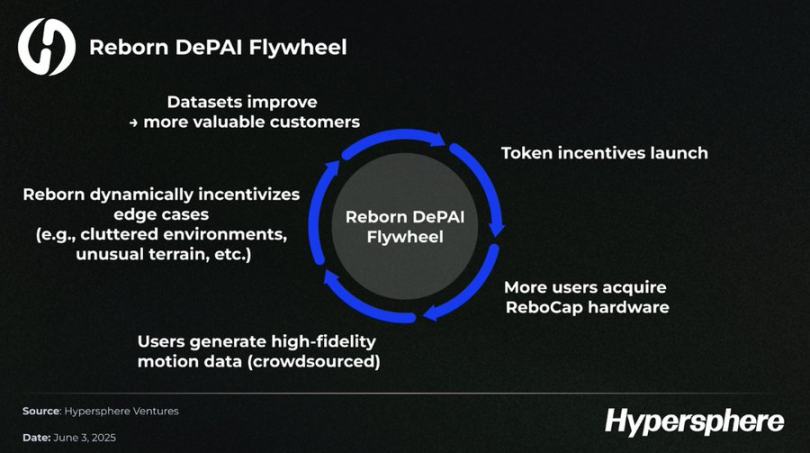
Reborn has not yet issued a token, but tokenomics could accelerate widespread adoption. Once live, the token incentive mechanism is expected to drive rapid growth in network participation:
-
Token rewards: Users earn tokens for purchasing and using ReboCap, while robotics companies pay for access to data, creating a positive feedback loop.
-
Edge case mining: Dynamic incentives encourage users to contribute high-value edge-case data, helping close the Sim2Real gap.
Reborn’s DePAI growth flywheel
Data Is the Key
The real competitive advantage in humanoid robotics lies in data and models—specifically, the scale, quality, and diversity of intelligent data used to train these machines.
The "ChatGPT moment" for humanoid robots will not be led by hardware companies, due to inherent challenges such as high costs and long deployment cycles. Viral diffusion in robotics is fundamentally constrained by cost, hardware availability, and logistical complexity—constraints that pure digital software like ChatGPT does not face.
Key Conclusion: Data Wins
The true inflection point will come from advantages in data and models once costs decline. The data needed for humanoid robots must be cost-effective, scalable, and composable—and cryptocurrency’s token incentive model can fill the most urgent gaps. Reborn turns ordinary people into “miners of motion data” through crypto token incentives.
Join TechFlow official community to stay tuned
Telegram:https://t.me/TechFlowDaily
X (Twitter):https://x.com/TechFlowPost
X (Twitter) EN:https://x.com/BlockFlow_News
 @hypersphere_