








Funds Arrive, but Compliance Lags Behind: Regulatory Gaps in Stablecoin Payment Processing and Merchant Selection
TechFlow Selected TechFlow Selected
Funds Arrive, but Compliance Lags Behind: Regulatory Gaps in Stablecoin Payment Processing and Merchant Selection
What drives merchants toward stablecoin payments has never been enthusiasm for new technology.
 Navigating Web3 tides with focused insights
By Will A Wang
Receiving payments in USDT—settled in ten seconds, chargebacks eliminated. This is the real first impression many digital entertainment merchants have when adopting stablecoin payment processing. But funds arriving is merely the simplest part of the story.
In traditional card-based payment processing, three parties—the issuing bank, acquiring bank, and card network—collectively handle all the invisible work: identity verification, risk screening, suspicious transaction reporting, and dispute resolution. Stablecoins dismantle every intermediary layer in this system. The moment an on-chain transfer completes, none of these four functions is being performed by anyone.
This article examines precisely that gap: Who fills it? How? And to what extent must it be filled to achieve regulatory compliance? For platforms building stablecoin payment processing services—and for merchants evaluating whether to integrate them—this isn’t a theoretical regulatory question. It’s a concrete compliance risk already embedded in your current business architecture.
I. Receiving Payments ≠ Payment Processing
At the end of 2023, a Southeast Asian digital entertainment merchant had its Stripe account permanently suspended after exceeding the chargeback threshold. Within three weeks, it integrated with a stablecoin payment platform registered in Saint Vincent and the Grenadines. USDT payments began flowing in; chargebacks disappeared. Yet two years later, a compliance audit revealed: Not a single one of those 24 months’ worth of transactions underwent on-chain risk screening.
Funds arrived. Compliance did not.
That is the core problem stablecoin payment processing must solve.
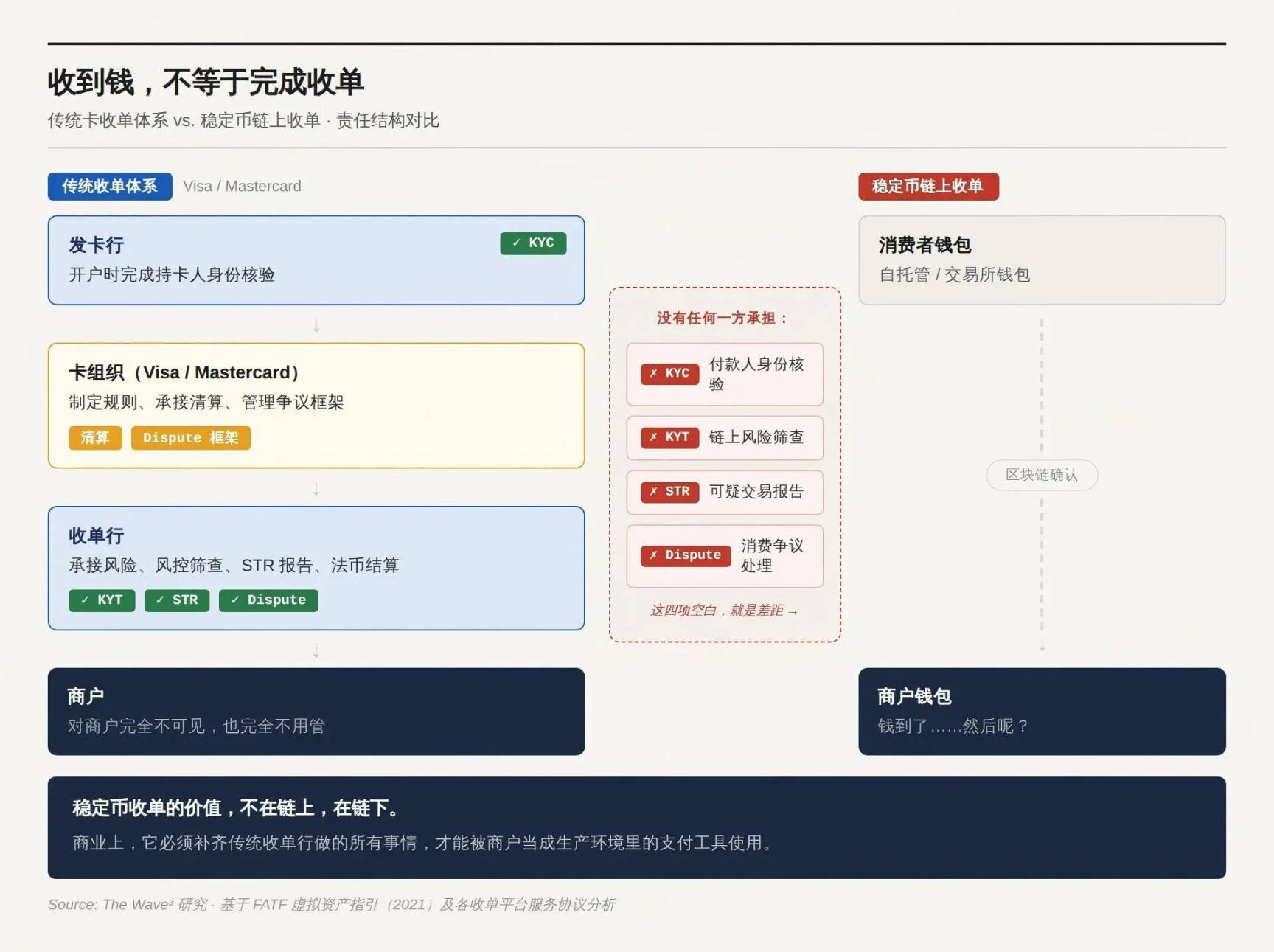
Stablecoins are inherently “payment receipt”—not “payment processing.” Money moves from wallet A to wallet B, confirmed on-chain, and that’s it. We borrow the term “payment processing” because it more accurately describes the underlying need: Merchants don’t just want to receive money—they require a full service infrastructure ensuring that money is legal, secure, and auditable.
In the traditional card network, this infrastructure is shared among three parties: the issuing bank verifies the cardholder’s identity; the acquiring bank accepts each transaction and bears the associated risk exposure; the card network handles clearing. Every time a merchant swipes a card, a complete framework of responsibility operates silently behind the scenes—KYC is handled, risk is borne, disputes are managed, reports are filed. None of this is visible or relevant to the merchant.
Stablecoins eliminate all intermediaries in this system. Funds arrive—but:
- No party performs payer identity verification (KYC)
- No party conducts risk screening on the transaction (KYT)
- No party reports suspicious fund flows to regulators (STR)
- No party handles mistaken payments or consumer disputes (Dispute)
These four missing elements constitute the entire gap between stablecoin payment receipt and true “payment processing.” Who fills them, how, and to what degree constitutes compliance—this is the sole subject of this article.
Technically, stablecoin payment processing is peer-to-peer on-chain transfer. Commercially, however, it must replicate everything traditional acquirers do. The value of stablecoin payment processing lies not on-chain—but off-chain.
II. Demand-Driven Adoption: Why Merchants Turn to Stablecoins
Merchants aren’t driven to stablecoin payments by enthusiasm for new technology. Three core business needs propel their adoption.
Need #1: Eliminating Chargebacks
Chargebacks aren’t incidental risks of online payments—they’re structural features. All online transactions lack physical card swiping, signatures, or face-to-face verification; the cost and difficulty of evidence collection in disputes fall entirely on the merchant.
Numbers reveal scale. According to Chargeflow, global e-commerce chargeback losses will reach $33.8 billion in 2025, rising to $41.7 billion by 2028. Sift’s Q4 2024 Digital Trust Index breaks this down further: At the macro level, average chargeback amounts surged 59% year-on-year to $374 in Q1 2024; at the sectoral level, chargeback rates spiked 816% for online travel & accommodation, 222% for e-commerce, and 59% for digital goods & services. Digital entertainment and financial services together account for 30% of all high-risk merchant disputes.
The root cause lies in the reversibility built into credit card systems. Friendly fraud—where users initiate chargebacks claiming “unauthorized transactions” after consuming services—is endemic to digital entertainment platforms. Worse still is account suspension: Exceeding chargeback thresholds triggers immediate freezes by Stripe or Adyen, halting payments for 2–4 weeks—causing existing users to abandon purchases upon seeing “Payment Failed.”
Blockchains lack a “dispute-and-reverse” mechanism. On-chain immutability severs this issue at its root.
NOWPayments’ data validates the magnitude of this demand: Its iGaming transaction volume grew 40% year-on-year, capturing ~15% market share in that sector. By 2025, stablecoins (USDT/USDC) accounted for over 50% of global crypto iGaming on-chain transaction volume. Note: iGaming’s shift toward stablecoins is multi-motivated—chargeback elimination is one driver; regulatory arbitrage and low entry barriers are others. But the migration has already occurred. Markets have moved.
Immutability eliminates chargebacks—but also removes consumers’ safety net. That issue returns in Chapter III.
Need #2: Reducing Online Payment Processing Costs
Online payment processing costs aren’t a single number—they’re a stack of layered fees.
Stripe charges U.S. merchants a standard rate of 2.9% + $0.30 per transaction, plus 1% for international cards and another 1% for currency conversion—meaning a $100 order from an overseas customer incurs nearly $5 just in payment processing fees. Adyen’s Interchange++ model offers greater transparency for large clients, but cross-border transactions layered with card network fees easily push total effective costs above 4%. High-risk industries face even higher surcharges and rolling reserves—Stripe outright refuses service to most digital entertainment and other high-risk categories.
A merchant processing $500,000 annually in online transactions pays $15,000–$20,000 solely in payment processing fees—not including chargeback losses, FX conversion, or platform monthly fees.
Stablecoin payment processing has a fundamentally different cost structure. Platforms like Triple-A typically charge 0.5%–1.5% overall, with no cross-border surcharges and no FX conversion middlemen—on-chain transfers inherently treat domestic and international transfers identically. More crucially, settlement speed shifts dramatically: Traditional processing takes T+2 to T+3 days; stablecoin settlement achieves T+0—or even real-time.
According to Eric Barbier, founder of Triple-A, working capital required for cross-border payments can be reduced to one-tenth using stablecoins versus traditional models. For startups, this isn’t about efficiency—it’s survival.
Need #3: Reaching Crypto-Holding Users & Global Internet Consumers
This is the fastest-growing—and most underestimated—of the three needs.
BVNK and YouGov surveyed over 4,600 stablecoin holders across 15 countries globally (note: respondents were active users who held or planned to acquire crypto within the past 12 months—not representative of general consumers). Three findings merit separate attention: 52% of holders deliberately chose to transact with merchants supporting stablecoins—payment methods aren’t just tools, they’re acquisition channels; stablecoin holders’ willingness to spend consistently outpaces actual spending across all tested categories—the bottleneck isn’t intent, but merchant integration; stablecoin users exhibit stronger international payment demand, with higher average order values and conversion rates than local credit card users.
On-chain data from Visa and Allium shows that in August 2025, total value of stablecoin micro-transfers under $250 reached $5.84 billion—the highest on record. This signals everyday spending—not speculation.
But stablecoin payment processing reaches beyond just “crypto holders.” For consumers in emerging markets with weak banking infrastructure, stablecoins provide a direct channel to participate in global e-commerce—bypassing traditional banks entirely. NOWPayments’ transaction data spanning 2023–2025 reveals starkly divergent drivers across regions: convenience in the U.S.; circumventing banking restrictions in India and Nigeria; fallback alternatives where traditional payment rails have failed in Russia and other emerging markets. A one-size-fits-all global payment strategy loses 15%–20% of potential conversions in these markets.
Razer Gold’s integration with Triple-A reflects precisely this logic: One payment interface reaching internet consumers in 130 countries—no need to build separate local payment integrations per market.
All three needs share one trait: Stablecoins solve genuine operational problems—not minor enhancements to payment UX. Stablecoin payment receipt has already scaled massively—even before comprehensive regulatory frameworks exist. Regulators’ real challenge isn’t “Should we allow it?” but rather, “How do we impose order on something that’s already happening?”
III. The Three-Layer Logic of Payment Processing Platforms
On-chain confirmation completed. Funds arrived at the address. Then what?
Order systems don’t recognize on-chain addresses. Accounting systems don’t book USDT. Balance sheets can’t hold crypto assets. Regulators demand suspicious transaction reporting. Consumers who send incorrect amounts need someone to assist. None of these issues is resolved by on-chain transfers alone.
The product logic of stablecoin payment processing platforms is to systematically absorb these problems—layer by layer. The more layers absorbed, the higher the service value—and the heavier the regulatory obligations.
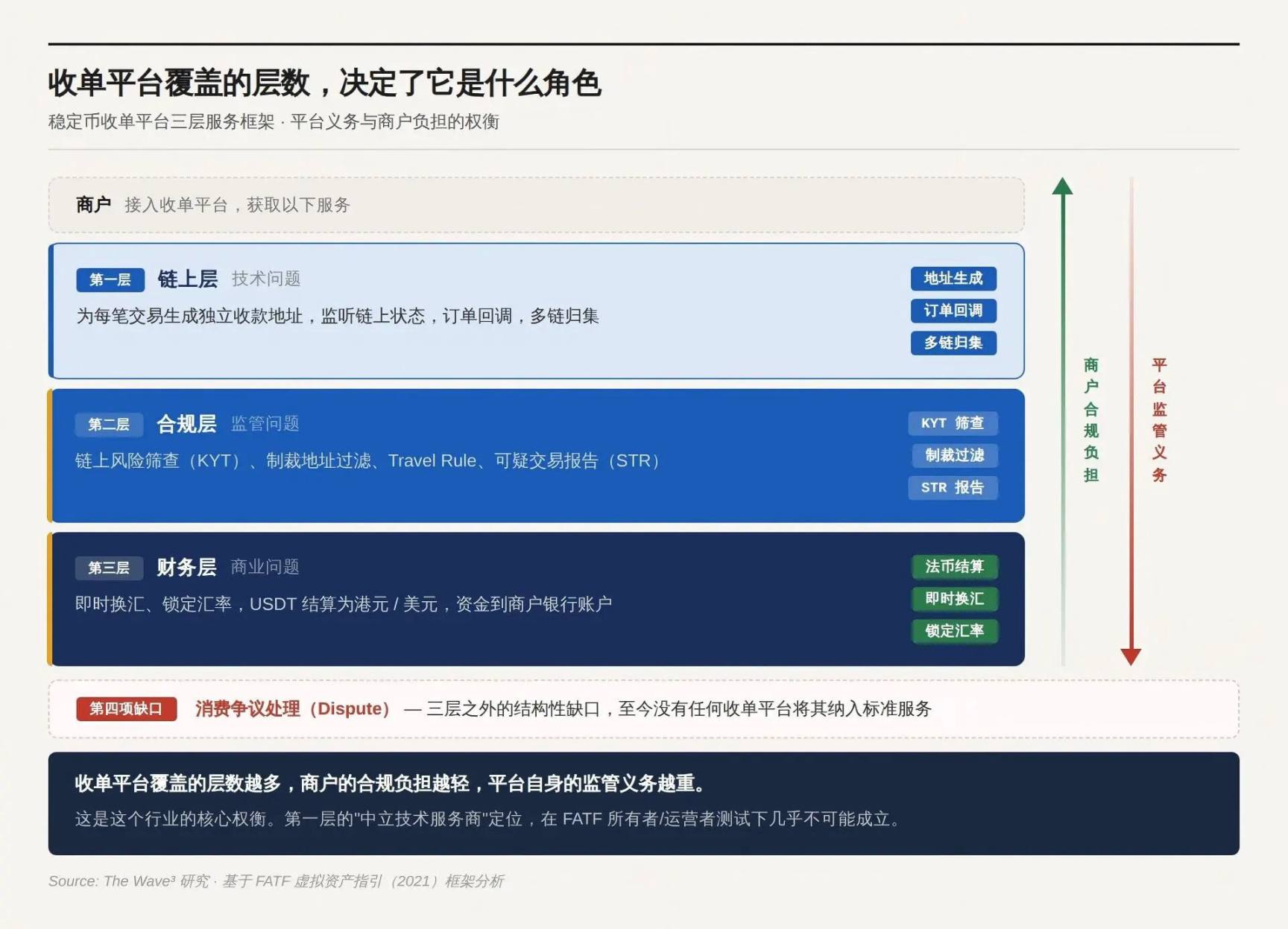
Layer 1: On-Chain Layer
Generate unique deposit addresses per transaction, monitor on-chain status, confirm receipt, and translate on-chain events into order callback signals recognizable by merchant systems. Mature platforms also offer multi-chain aggregation, smart-contract-based revenue splitting, and order state management (e.g., timeout closure, partial payment top-ups).
Without this layer, merchants cannot map on-chain transfers to specific orders. It’s also here that many platforms claim to be “neutral technology providers”—offering only technical tools, not intervening in fund flows, and thus asserting they shouldn’t be regulated as financial entities.
Whether this claim holds depends on the determination made at the next layer.
Layer 2: Compliance Layer
Every incoming fund requires on-chain risk screening (KYT): Is this wallet address on sanctions lists? Does it interact with mixers, darknet markets, or known fraudulent addresses? Transactions above threshold amounts trigger payer identity verification. The Travel Rule mandates transmission of payer and payee information between VASPs. Suspicious transactions must be reported to regulators (STR).
This layer is the core source of compliance obligations—and the central test regulators use to determine a platform’s classification.
The FATF’s October 2021 updated Virtual Assets Guidance established two principles: First, function-over-form—regulation focuses on business function, not technical form; non-custodial, decentralized, or smart-contract-based operations do not qualify for exemption. Second, the owner/operator test—even if superficial decentralization is claimed, “creators, owners, operators, or others retaining control or sufficient influence” may still fall under the VASP definition. Key indicators include: generating revenue from the service, possessing authority to set or modify parameters, and maintaining ongoing commercial relationships with users.
Who exercises substantive control over fund flows—regardless of whether they physically handle funds—is the regulated entity. Having a front-end interface, charging fees, and operating through an identifiable entity—meeting all three conditions invalidates the self-designation as a “neutral technology provider.” This test applies far more broadly than most platforms assume.
Layer 3: Financial Layer
Users pay in USDT; merchants need HKD or USD. Someone must perform instant FX conversion, lock exchange rates, and settle fiat into the merchant’s bank account. Merchants don’t want crypto assets on their balance sheets—not just preference, but a hard constraint under most corporate finance compliance standards.
Without fiat settlement, stablecoin payment receipt becomes a financial burden—not a payment tool—for most enterprises.
Beyond the Three Layers: The Structural Gap in Dispute Resolution
The first three gaps (KYC, KYT, STR) correspond directly to the above three-layer framework—and are now systematically addressed by multiple platforms. Only the fourth—consumer dispute resolution—remains unaddressed by any payment processor as a standard offering. This gap remains unresolved.
In the card system, consumers’ right to chargeback disputed transactions isn’t a customer support feature—it’s a legal obligation (U.S. Regulation E / Regulation Z; EU PSD2). Stablecoin immutability eliminates chargebacks—and simultaneously removes consumers’ recourse channels. What appears as a merchant “advantage” from a regulatory perspective is a “deficiency.”
Three remedial approaches are emerging: off-chain manual refunds at the platform layer (Triple-A model), smart-contract escrow with conditional release, and on-chain arbitration protocols like Kleros—but none has achieved scalable deployment in payment processing contexts. Consumer protection won’t be waived simply because underlying technology changes. This issue remains open.
The more layers a payment processing platform covers, the lighter the merchant’s compliance burden—and the heavier the platform’s own regulatory obligations. This trade-off defines the industry’s core dynamic.
IV. Choosing Which Layer to Cover Defines Your Role
The three-layer framework presents a strategic choice. Which layer(s) you cover determines your role—and which regulations apply. Three dominant architectures in the market reflect distinct choices—and outcomes.
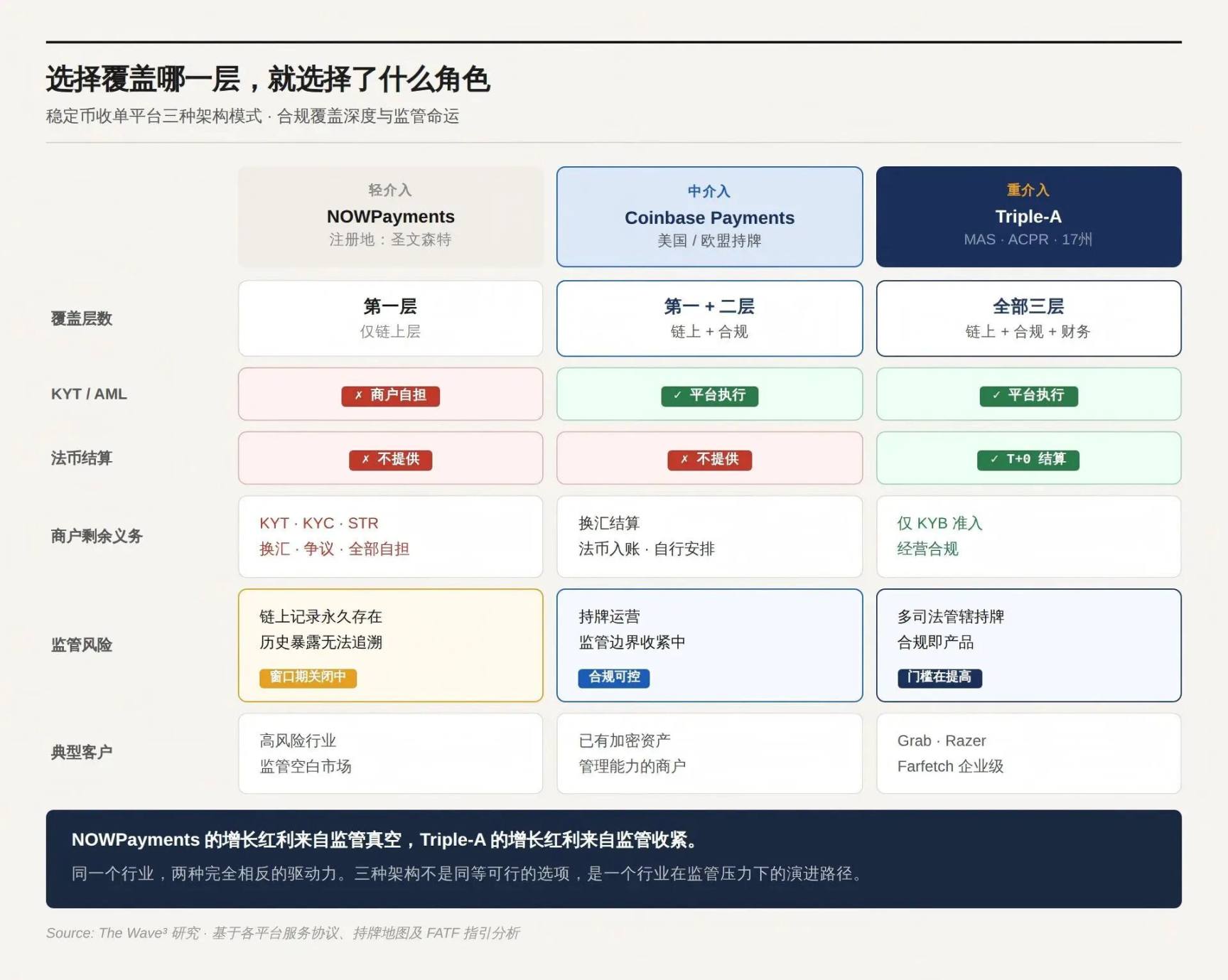
Light Touch: The Regulatory Arbitrage Window
Platforms operate only at Layer 1: generate addresses, monitor receipts, and route funds directly to merchant wallets. NOWPayments exemplifies this model—registered in Saint Vincent and the Grenadines, where virtual asset activities face virtually no substantive regulation. Their approach to compliance obligations is explicitly stated in service agreements: FD Transfers LLC declares the platform “assumes no responsibility for KYC, KYB, or AML compliance of merchants or end users,” and that “merchants and end users bear full responsibility for transactions they execute.”
CoinPayments (a non-custodial gateway supporting 100+ cryptocurrencies) and PayRam (focused on self-hosted node deployment) follow the same path: platforms provide only technical tools; compliance responsibilities rest entirely with merchants and users.
This model operated efficiently during regulatory gray zones—serving precisely the sectors traditional processors refused. But on-chain records are permanent. All historical transactions conducted without licenses remain fully traceable at any time. Today’s compliance decisions shape not only tomorrow’s risk exposure—but also legal liability for the past two years.
The problem with the NOWPayments model isn’t “Will something go wrong now?” but rather, “When something does go wrong, the window for correction will already be closed.”
Medium Touch: Not Handling Funds ≠ No License Required
Platforms operate at Layers 1 + 2: conduct KYT screening and sanctions filtering before releasing funds—but avoid FX conversion and fiat settlement. Coinbase Commerce (now rebranded Coinbase Payments) is the most widely misinterpreted example of this model.
The appeal of direct on-chain architecture is intuitive: If funds move straight from user wallet to merchant wallet—and the platform never touches them—why should it be classified as a financial services provider? Coinbase’s practice directly refutes this logic. Coinbase Payments’ terms explicitly state it does not hold merchant assets—but simultaneously reserve the right to modify, suspend, or terminate service. Front-end interface, fee collection, identifiable operator, ability to disable service—all criteria of the owner/operator test are met.
Coinbase holds FinCEN MSB registration in the U.S., money transmitter licenses across multiple states, New York BitLicense, and a CASP license via its Luxembourg entity covering the EU. This is the correct way to handle medium-touch architecture: Acknowledge regulatory status once Layer 2 is implemented—don’t attempt to evade classification by claiming “we only do risk controls.”
Heavy Touch: Embedding Compliance Into Product
Platforms cover all three layers—receipt, screening, FX conversion, and settlement—so merchants see normal fiat deposits without ever touching crypto. Triple-A represents the mature implementation of this model.
Triple-A’s terms clearly reflect this positioning: It’s not a technology vendor but a full-fledged payment processing and settlement provider—executing FX conversion, deducting fees, and settling net fiat amounts to merchants. Merchant KYB checks and ongoing compliance obligations are contractually mandated. Licensing footprint includes Singapore’s MAS Major Payment Institution (MPI) license; France’s ACPR Payment Institution license (covering all 27 EU member states via passporting); FinCEN MSB registration; money transmitter licenses in 17 U.S. states; Canada’s FMSB registration; and South Africa’s FSCA registration.
Grab, Razer, and Farfetch chose Triple-A—not because it offers the lowest fees—but because Triple-A absorbs all three layers, enabling enterprises to access previously unreachable markets via a single API—without handling any crypto assets themselves. Other players in this space include Stripe (acquiring Bridge to support USDC settlement at 1.5% fee, no additional fixed fee) and traditional payment giant Shift4 (launching stablecoin settlement options by end-2025). Traditional payment companies entering this space signal market maturity.
Compliance itself has become a product. Its value rises as regulation tightens.
The light-touch window is closing. Medium-touch regulatory boundaries are tightening. Heavy-touch entry barriers are rising. NOWPayments’ growth红利 came from regulatory vacuums; Triple-A’s growth红利 comes from regulatory tightening. Same industry—two diametrically opposed drivers.
V. The Online Merchant’s Choice
Most merchants ask: “Is integrating stablecoin payment processing compliant for our platform?”
There is no binary answer—because the question is flawed. Compliance isn’t a yes/no judgment; it’s the intersection of two variables:
Where are your customers located? How much compliance responsibility does your chosen platform assume?
Only by intersecting these two variables can merchants assess their remaining obligations.
Variable #1: Where Are Your Customers Located?
Regulatory obligations follow the jurisdiction where business activity occurs—not where the platform is incorporated. A Cayman-registered payment processor facilitating payments from Hong Kong users to Hong Kong merchants falls fully under Hong Kong regulators’ jurisdiction—regardless of the platform’s registration location. Offshore incorporation avoids tax—but not regulation.
Major jurisdictions still disagree on stablecoin classification (virtual asset vs. payment instrument), triggering different licensing requirements—but regardless of classification, licensing obligations remain equally binding.
Tether remains unauthorized under MiCA, creating explicit uncertainty around USDT’s compliance status in the EU; some EU exchanges have already delisted USDT. Payment processors serving EU consumers must proactively plan stablecoin selection strategies.
Variable #2: How Much Compliance Responsibility Does Your Platform Assume?
The more compliance responsibility assumed by the platform, the fewer residual obligations remain for the merchant—but the higher the service fee premium.

KYC Divergence for On-Chain Consumers
Stablecoin receipt introduces a structural problem absent in traditional payment processing: On-chain payments carry zero identity information by design. A user scans a QR code—USDT moves from one wallet address to another. This transaction exposes only a string of on-chain addresses—no names, no ID numbers, no bank accounts. In traditional processing, KYC is performed by the issuing bank; the acquirer trusts that result. Stablecoins have no issuing banks—the KYC chain doesn’t exist from the outset.
This doesn’t exempt anonymous wallets from compliance. Regulators mandate “risk-proportionate measures”: KYT is the baseline; sanctions list filtering is the red line; identity verification triggers above threshold amounts; behavioral anomalies trigger deep-dive investigations. The Travel Rule requires VASPs to transmit payer/payee information—but when consumers pay via self-custodial wallets, that information simply doesn’t exist.
Regulatory texts haven’t yet provided unified answers to these questions—but regulators’ letters won’t wait for consensus.
Holding a license proves regulators permit your operation. Real compliance means executing KYT screening on every transaction, completing KYB reviews for every onboarded merchant, and producing complete transaction records upon regulator request. Missing either license or execution creates vulnerabilities—only differing in which gets discovered first.
VI. What Happens Next
Rules are crystallizing—but whether that’s good or bad news depends entirely on who you are.
Regulatory Clarity = Market Entry Ticket
2024–2025 marks the watershed for stablecoin regulation. The three most influential global financial regulators completed foundational legislation within two years—but legislation ≠ clarity. The GENIUS Act governs issuance; its transmission path to payment processing remains contested among U.S. state regulators. MiCA’s CASP license faces materially divergent approval standards across EU member states. Hong Kong’s Stablecoin Ordinance regulates issuers—but enforcement precedent defining coverage of payment processors remains absent. Fireblocks’ March 2025 survey of 295 financial institutions and payment providers found the share citing “regulation as a barrier” dropped from ~80% to under 20%—but lower barriers don’t mean smooth roads.
Compliance Credentials Are Supplanting Product Features as Primary Acquisition Drivers
Triple-A’s significant enterprise client expansion over the past two years stems not from superior product features—but from its compliance credentials enabling Grab, Razer, and Farfetch to integrate with confidence. Stripe launching stablecoin settlement and Shift4 offering stablecoin options to its hundreds of thousands of merchants—traditional payment giants entering signals that stablecoin payment processing has evolved from “gray-market alternative” to “mainstream payment infrastructure.”
Implication: Compliance advisors serving stablecoin processors, on-chain analytics tools (Chainalysis, TRM Labs), and cross-jurisdictional legal services will see their market value rise in tandem with regulatory intensity. Compliance isn’t a cost center—it’s the business itself.
Cost Solutions Lie Not in Technology—but in Competitive Dynamics
Who ultimately bears compliance costs? Platforms pass them to merchants—who churn if prices exceed tolerance. Platforms absorb them internally—requiring premium pricing to recoup costs—prompting merchants to revert to price-comparison logic: “Why not use cheaper unlicensed platforms?”
Traditional payment industry experience shows: Once regulation becomes standardized, competition doesn’t vanish—but shifts from “compliant vs. non-compliant” to “who delivers lowest cost within the compliant framework.”
Stablecoin payment processing will follow the same trajectory—when unlicensed platforms exit systematically, compliance cost becomes the universal floor for all participants. Competition then centers on maximizing efficiency atop that floor. Triple-A and BVNK’s current scale advantages are essentially strategic positioning for that race.
Which players will go the distance? No guesswork needed.
Join TechFlow official community to stay tuned
Telegram:https://t.me/TechFlowDaily
X (Twitter):https://x.com/TechFlowPost
X (Twitter) EN:https://x.com/BlockFlow_News
 0xWillmfer


