An Overview of the Stablecoin Market Landscape and Global Regulatory Developments
TechFlow Selected TechFlow Selected
An Overview of the Stablecoin Market Landscape and Global Regulatory Developments
The next 12 months will determine whether the stablecoin market consolidates around a small number of regulated “super issuers.”
 Navigating Web3 tides with focused insights
By: Eli5DeFi
Translated by: AididiaoJP, Foresight News
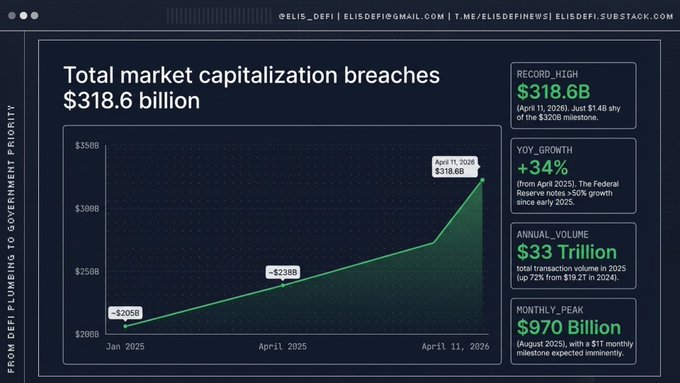
The stablecoin market reached an all-time high on April 11, 2026, with a total market capitalization of $318.6 billion—up approximately 34% year-on-year from ~$238 billion in April 2025.
This surge coincides with an unprecedented wave of global regulatory action: the GENIUS Act has officially become law; four federal agencies are actively drafting implementing rules; Hong Kong issued its first stablecoin licenses just days ago; and MiCA’s enforcement is reshaping the European market.
Let’s examine how stablecoins have become a top government priority.
Stablecoin Market Data
According to DefiLlama, the stablecoin market cap hit $318.6 billion on April 11, 2026—a figure corroborated by the Federal Reserve’s FEDS Note published on April 6, citing $317 billion.
The market is only $1.4 billion away from breaching $320 billion. Year-on-year growth stands at ~34% from ~$238 billion in April 2025; the Fed, using ~$20.5 billion in January 2025 as its baseline, reports growth exceeding 50%.
Total stablecoin transaction volume for 2025 reached $33 trillion—up 72% from $19.2 trillion in 2024. Monthly volume peaked at $97 billion in August 2025; a monthly $100 billion milestone is expected in 2026.
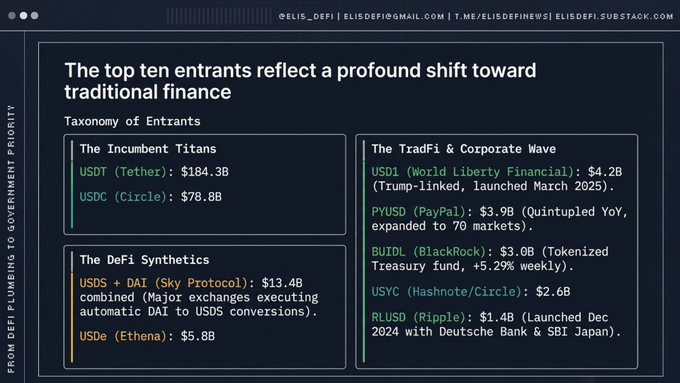
Major new entrants since mid-2025:
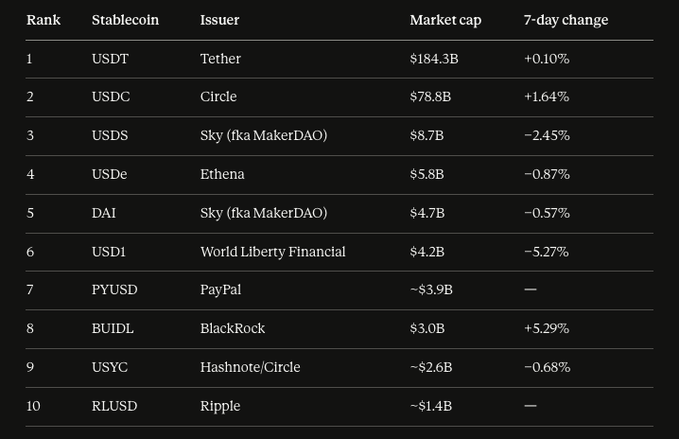
- USD1 (World Liberty Financial), launched in March 2025, briefly reached $5 billion in January 2026 and currently holds a $4.2 billion market cap—ranking sixth globally (amid significant controversy).
- BlackRock’s tokenized Treasury fund BUIDL reached $3 billion, posting a 5.29% weekly gain—the strongest performer this week.
- Ripple’s RLUSD, launched in December 2024, grew from zero to $1.4 billion in under one year, with partners including Deutsche Bank, Japan’s SBI, and LMAX Group.
- PayPal’s PYUSD grew fivefold year-on-year to ~$3.9 billion and expanded to 70 markets globally in March 2026.
USDS and DAI, both under Sky Protocol, collectively reached $13.4 billion. Major exchanges—including Binance and BitMart—executed automatic DAI→USDS conversions in April 2026.
Tether: The $184B Giant Faces Its Largest-Ever Audit
Tether’s USDT market cap reached $184.3 billion (as of April 11, 2026), with ~18.43 billion tokens in circulation.
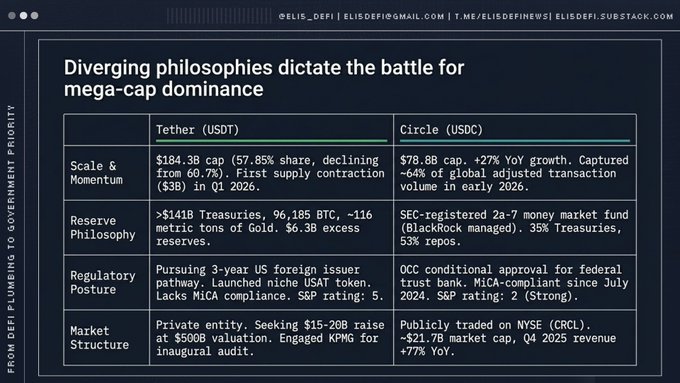
Its market share declined from ~60.7% at the start of January 2026 to 57.85%—the first quarterly supply contraction since the Terra/LUNA collapse. USDT supply shrank by ~$3 billion in Q1 2026, driven primarily by MiCA-mandated delistings in Europe and broader market weakness.
Nonetheless, USDT remains the third-largest crypto asset by market cap—behind Bitcoin and Ethereum.
Q4 2025 attestation report (BDO, released January 30, 2026): Tether reported total assets exceeding $192.9 billion against liabilities of $186.5 billion—resulting in $6.3 billion in excess reserves. Full-year 2025 net profit exceeded $10 billion; $5 billion in new USDT was issued; and its independent investment portfolio surpassed $2 billion. The Q1 2026 attestation report has not yet been published and is expected by end-April.
Reserve composition (as of December 31, 2025):
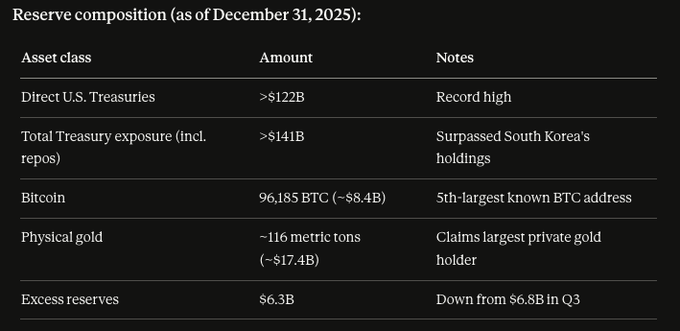
In 2025, Tether allocated up to 15% of its quarterly realized profits toward Bitcoin purchases—three times totaling exactly 8,888.8888 BTC. The company is also a major shareholder of Twenty One Capital (NYSE: XXI), which holds an additional 43,514 BTC.
The KPMG audit is the standout development. On March 24, 2026, Tether announced it had engaged one of the Big Four accounting firms for its first full financial statement audit. Three days later, the Financial Times confirmed KPMG as the auditor, while PwC is handling internal systems and controls preparation. CEO Paolo Ardoino called it “the largest inaugural audit in financial market history.”
The audit is underway, but no completion timeline has been disclosed; results are not expected soon. In the interim, quarterly BDO attestations (limited assurance—not full audits) will continue to be published.
Other key Q1 2026 developments for Tether: S&P Global downgraded USDT’s stability rating to “5 (Weak)” in November 2025—the lowest possible score—citing increased exposure to higher-risk assets. Since 2023, Tether has frozen $4.2 billion worth of tokens linked to illicit activity. Reports indicate the company is seeking $15–20 billion in funding at a $500 billion valuation—and participating in U.S. political activities via a pro-crypto super PAC.
Circle Goes Public; USDC Advances Steadily
USDC’s market cap reached $78.8 billion (as of April 11, 2026), with ~7.88 billion tokens in circulation—up 27% year-on-year. Net inflows totaled $1.27 billion this week. Full-year 2025 growth stood at 73%. S&P rates USDC’s stability at “2 (Strong)”—the highest among major stablecoins.
Circle completed its IPO on June 5, 2025, on the NYSE under ticker CRCL, pricing shares at $31 each and raising ~$1.1 billion, valuing the company at ~$6.9 billion. Shares surged to $100 on the first trading day and hit a record high of $298.99 on June 23, 2025, before experiencing volatile pullbacks.
As of April 10–11, 2026, CRCL traded at ~$88 per share, with a market cap of ~$21.7 billion. Its 52-week range is $49.90–$298.99. Q4 2025 earnings beat expectations: revenue reached $770.2 million (+77% YoY); EPS was $0.43. Analysts’ average target price is $123.71, with a consensus “Buy” rating.
Reserve structure: USDC reserves are held primarily in the Circle Reserve Fund (USDXX)—an SEC-registered Rule 2a-7 government money market fund managed by BlackRock, with BNY Mellon as custodian. As of October 2025, composition was ~35% U.S. Treasuries, ~53% repurchase agreements, and ~12% cash deposited at globally systemically important banks. Monthly attestations are conducted by Deloitte & Touche LLP.
Regulatory positioning: Circle received conditional approval from the Office of the Comptroller of the Currency (OCC) on December 12, 2025, to establish First National Digital Currency Bank, N.A.—a federally regulated trust bank. Circle already holds an EMI license in France (compliant with MiCA since July 2024), and maintains licenses in the UK (FCA), Singapore, Abu Dhabi, Bermuda, and Canada. Key competitive advantage: According to Mizuho Securities, USDC accounted for ~64% of global adjusted stablecoin transaction volume in early 2026—the first time since 2019 it has surpassed USDT.
On April 8, 2026, Circle partnered with Thunes and Worldline to launch CPN Managed Payments—a full-stack stablecoin settlement platform. Other 2026 partners include Intuit (TurboTax, QuickBooks), FIS, Nubank, and Polymarket.
The draft CLARITY Act (March 2026), which would prohibit stablecoin issuers from paying passive yield to holders, caused CRCL shares to drop ~20% on March 24. This provision remains in draft form.
GENIUS Act Implementation Accelerates Across Four Agencies
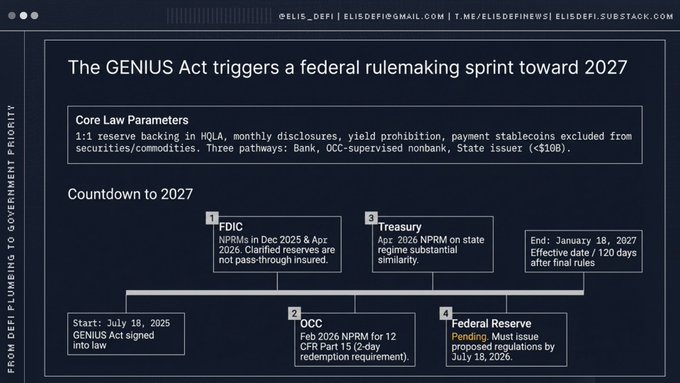
The GENIUS Act was signed into law on July 18, 2025, passing the Senate 68–30 and the House 308–122. It is the U.S.’s first comprehensive federal stablecoin law, mandating 1:1 backing by high-quality liquid assets, monthly public disclosures, AML/KYC compliance, and three licensing pathways: bank subsidiary, federally qualified nonbank entity (OCC-supervised), or state-qualified issuer (with a $10 billion cap).
Payment stablecoins are explicitly excluded from definitions of securities and commodities. Issuers are prohibited from paying interest or yield to holders. The law takes effect on January 18, 2027—or 120 days after final implementing rules are published, whichever comes first.
Rulemaking status (all remain in proposed/NPRM stage—no final rules yet):
- OCC (February 25, 2026): Most comprehensive NPRM, creating new 12 CFR Part 15 covering licensing, permitted activities, reserve standards, 2-business-day redemption requirements, capital requirements, and foreign issuer registration. Comment period ends May 1, 2026.
- FDIC (two NPRMs): First (December 16, 2025) establishes application procedures for bank subsidiaries; second (April 7, 2026) sets prudential standards—including reserve requirements, redemption obligations—and clarifies that deposits held as stablecoin reserves do not qualify for pass-through insurance.
- Treasury (April 3, 2026): NPRM establishes principles for assessing “substantial similarity” of state regulatory regimes. Comments due by June 2, 2026.
- Federal Reserve: Has not yet issued an independent NPRM but must propose regulations by July 18, 2026. Fed Governor Michael Barr delivered a cautious speech on March 31, 2026, warning of money laundering risks, bank-run vulnerabilities, and potential loopholes—e.g., El Salvador’s Bitcoin legal tender status potentially enabling BTC repos as qualifying reserves.
Tether’s dual-track U.S. strategy: On January 27, 2026, Tether launched USAT—a separate U.S.-regulated stablecoin issued via Anchorage Digital Bank (OCC-supervised), custodied by Cantor Fitzgerald, and led by former White House Crypto Council Chair Bo Hines. USAT’s market cap currently stands at ~$28 million. For USDT itself, Tether is applying via the foreign issuer pathway, benefiting from a three-year compliance window extending through mid-2028. No formal registration or approval has been announced.
MiCA Reshapes Europe; Hong Kong Opens Its Market
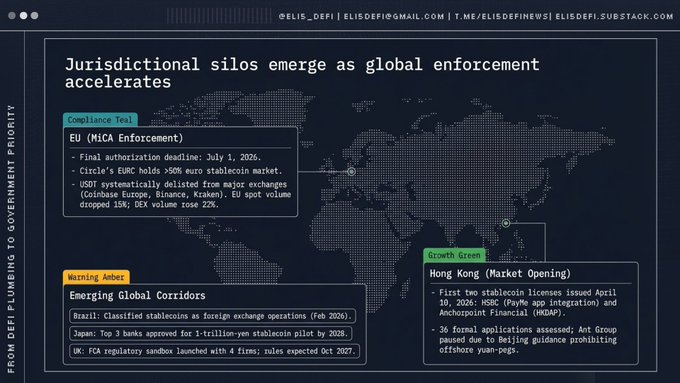
EU MiCA: Approximately 19 electronic money token (EMT) issuers across 11 EU member states have obtained MiCA authorization, issuing ~29 compliant stablecoin tokens. Over 40 crypto-asset service provider (CASP) licenses have been granted. Circle became the first global issuer to achieve MiCA compliance (July 2024); its euro stablecoin EURC has grown over eightfold since then and now commands >50% of the euro stablecoin market. No asset-referenced token (ART) issuers have yet been authorized. Final authorization deadline is July 1, 2026.
Tether remains MiCA-noncompliant; CEO Ardoino has publicly criticized the EU’s 60% bank deposit reserve requirement. This has triggered clear shifts: EU-regulated spot trading volume dropped ~15% in early 2026, while EU user DEX trading volume rose 22%.
A consortium of nine major European banks—including ING, UniCredit, CaixaBank, Danske Bank, and SEB—has announced plans to launch a MiCA-compliant euro stablecoin in H2 2026.
Industry analysis estimates cumulative MiCA enforcement fines exceed €540 million, with over 50 licenses revoked (note: these figures derive from industry analysis—not direct ESMA disclosures—and should be treated with caution). The EU’s newly established Anti-Money Laundering Authority (AMLA) launches in 2026 and will directly supervise the largest cross-border crypto firms.
Hong Kong: The Hong Kong Monetary Authority (HKMA) confirmed on April 10, 2026, granting the first two stablecoin licenses—to HSBC (License FRS02) and Anchorpoint Financial (License FRS01), a joint venture among Standard Chartered, HKT, and Animoca Brands. Both plan to issue HKD-pegged stablecoins: HSBC intends to launch via its PayMe app in H2 2026; Anchorpoint (“HKDAP”) aims for Q2 2026.
HKMA reviewed 36 formal applications drawn from an initial pool of 77 letters of intent—approving only these two in Round One, without publicly announcing any rejections.
JD.com’s subsidiary JD Blockchain completed sandbox testing but did not make the first license round; reports suggest the firm has “largely abandoned” its application due to regulatory friction—though it has not formally withdrawn.
Ant Group fully suspended its Hong Kong stablecoin initiative following direct guidance from Beijing—the People’s Bank of China and eight other Chinese regulators jointly reaffirmed in early 2026 that no entity may issue RMB-pegged stablecoins overseas.
New Launches, Depegs, and Fed Stability Warnings
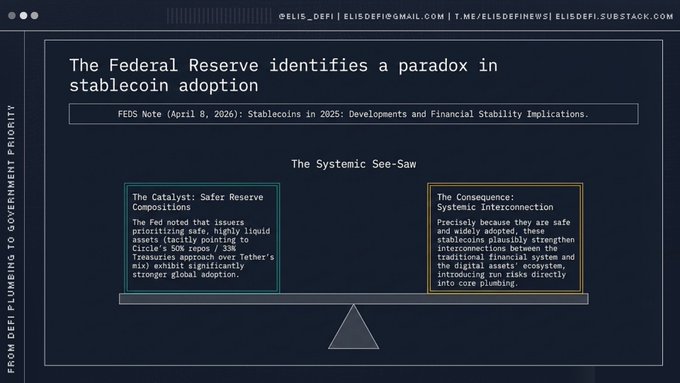
Federal Reserve FEDS Note (April 8, 2026): Titled “Stablecoins in 2025: Developments and Financial Stability Implications,” the report finds that stablecoins with safer, more liquid reserves demonstrate relatively stronger adoption—a tacit endorsement of the USDC model versus USDT. Yet it warns that precisely these safer stablecoins “may strengthen interlinkages between the traditional financial system and the digital asset ecosystem”; deeper integration of stablecoin payments introduces systemic risk. The report details reserve compositions: Tether holds 64.15% U.S. Treasuries and 13.91% money market funds; Circle holds 50.79% repos and 33.59% Treasuries.
Notable 2026 events:
- Resolv Labs USR vulnerability (March 22, 2026): Attackers exploited a smart contract flaw to mint ~80 million unsupported USR tokens, causing the token to crash from $1.00 to $0.025 in 17 minutes within certain Curve pools. ~$23–25 million was extracted from the protocol, which had >$500 million TVL. USR now trades at ~$0.87.
- Synthetix sUSD depeg (late January 2026): sUSD briefly fell to ~$0.75 before partially recovering.
- STASIS EURS anomaly (April 3, 2026): This euro-backed stablecoin spiked 47.3% above its peg to $1.21—raising questions about its redemption mechanism.
Notable new stablecoin launches: Western Union announced USDPT, set for launch on Solana in H1 2026 via Anchorage Digital Bank—the first major remittance firm to issue its own stablecoin.
Pakistan signed an agreement with SC Financial Technologies (World Liberty Financial) to explore cross-border payments using USD1. Nine European banks are building a consortium euro stablecoin targeting H2 2026 launch.
Other international regulatory developments: Brazil classified all stablecoin activities as foreign exchange operations effective February 2, 2026, requiring services to be provided only by institutions authorized by the Central Bank of Brazil (BCB)—stablecoins account for ~90% of Brazil’s crypto transaction volume.
The UK’s FCA launched a stablecoin regulatory sandbox in February 2026 for Revolut, Monee Financial Technologies, ReStabilise, and VVTX; final rules are expected in October 2027. Japan’s three largest banks—MUFG, SMBC, and Mizuho—received FSA approval to jointly pilot stablecoins, targeting ¥1 trillion issuance by 2028. Singapore is preparing legislative drafts to grant full legal force to its SCS framework by mid-2026.
Conclusion
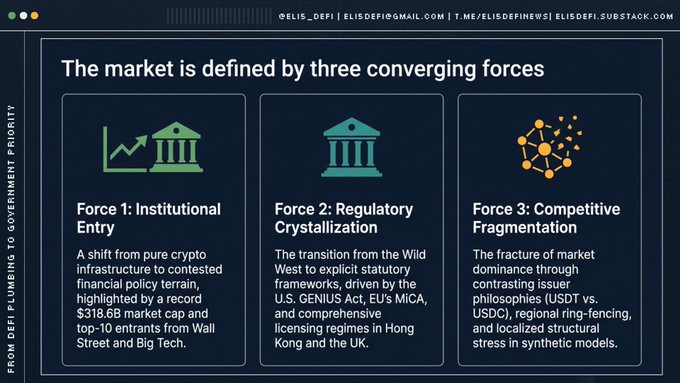
The stablecoin market in April 2026 is shaped by three converging forces: regulatory normalization, institutional entry, and competitive fragmentation. The GENIUS Act’s implementation timeline—final rules expected in July 2026, effective January 2027—is compressing decision windows for all issuers.
Tether’s KPMG audit and USAT launch signal genuine compliance intent—but its $184 billion USDT business faces structural headwinds from MiCA exclusion and S&P’s “Weak” rating. By contrast, Circle has emerged as the regulatory winner—publicly listed, MiCA-compliant, OCC-chartered, and now processing more adjusted transaction volume than USDT.
The most striking development may be the composition of the top 10 stablecoins. One year ago, the leaderboard consisted mainly of USDT, USDC, and a few DeFi protocols.
Today’s list features BlackRock, PayPal, the Trump family project, and Ripple—reflecting stablecoins’ evolution from crypto infrastructure into a contested domain of financial policy. The Fed’s April 8 report crystallizes this tension: safer stablecoins grow faster—but also deepen the very linkages between traditional finance and crypto ecosystems that regulators fear most.
With Hong Kong, Brazil, Japan, and the UK simultaneously establishing licensing regimes, the next 12 months will determine whether the stablecoin market consolidates around a handful of heavily regulated super-issuers—or fragments into jurisdictional silos.
Join TechFlow official community to stay tuned
Telegram:https://t.me/TechFlowDaily
X (Twitter):https://x.com/TechFlowPost
X (Twitter) EN:https://x.com/BlockFlow_News
 @eli5_defi