Machines’ Time: When Agents Consume Stablecoins
TechFlow Selected TechFlow Selected
Machines’ Time: When Agents Consume Stablecoins
The significance of agents for consumption and finance is entering the post-experimental implementation phase, while stablecoins carry all of crypto’s hopes.
 Navigating Web3 tides with focused insights
Author: Zuoye Yeboshan
We live amid vast disparities; the passage of time often leaves us disoriented.
In 2023, Elon Musk called for micro-payments to block bot intrusions and preserve human-centered community discourse. Yet within just two or three years, bots—supercharged by AI—are poised to become the primary actors in micro-payment ecosystems, even exhibiting an apparent “aversion” toward humans.
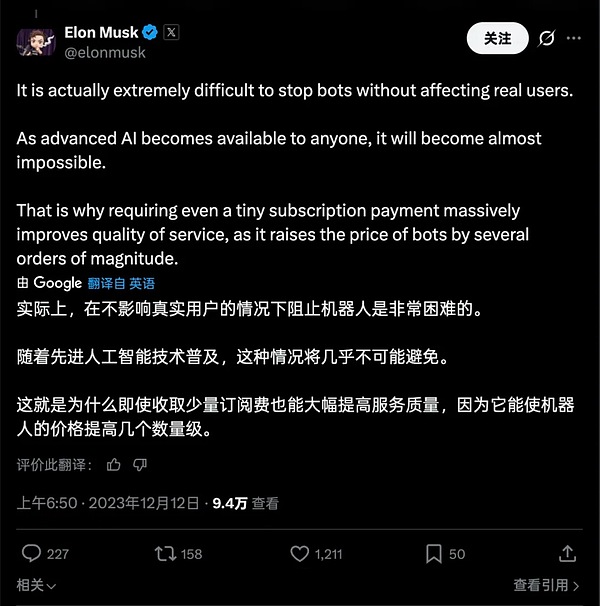
Caption: Musk’s proposal to use micropayments to block bots
Source: @elonmusk
Those feeling abandoned are not only ordinary white-collar workers but also members of the crypto community—overwhelmed by a sense of falling behind. You can feel this despair repeatedly: Vitalik’s mantra-like insistence on ZK’s importance for trustworthy AI; decentralized agents like Virtuals seeking LLMs via decentralization; and most recently, the claim that agents should consume stablecoins.
This time, crypto must prove its value to AI—in the name of stablecoins.
AI Enters Productivity; Crypto Remains Stuck in Finance
The moment you pursue freedom, you’ve already lost it.
The canonical narrative framing AI and crypto—“AI handles productivity; crypto handles production relations”—has never materialized.
Production relations refer to patterns of human collaboration, whereas the defining feature of this wave of AI is its capacity to *replace* humans.
AI agents are emerging from screens to assume white-collar roles—and increasingly encroaching upon physically repetitive labor. True, as Jensen Huang notes, AI remains constrained by physical hardware such as power infrastructure, tethered firmly to the geometric spaces humans have built.
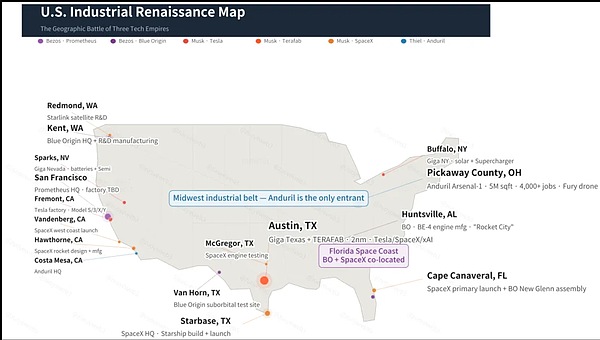
Caption: AI entering the production domain
Source: @zuoyeweb3
If humans exist solely to serve AI’s production and consumption, can they retain agency over their own labor?
Meanwhile, crypto’s vision has narrowed progressively—from early decentralized storage projects like IPFS/Filecoin, to compute- and storage-focused initiatives during the 2024–2025 cycle, and most recently to USDAI’s GPU-lending model. It would be unfair to say crypto isn’t trying—but each wave has failed to capture genuine AI use cases.
“AI handles both productivity *and* production relations” may prove more realistic. Even if the agent narrative isn’t pure hype, the stablecoins used may not be those backed by BTC/ETH assets and running on Ethereum.
I’m not indulging in alarmism or pessimism. The Genius Act has effectively granted the Office of the Comptroller of the Currency (OCC) authority over the definition of “compliant stablecoins.” Sky’s USDS is merely a U.S. Treasury-backed instrument operating on Ethereum. In the upcoming RWA era, will more assets choose Goldman Sachs-endorsed Canton—or Solana, aggressively pursuing business development?
Ethereum’s L1 has re-emerged as a high-performance blockchain—at the cost of explosive node growth. First, compliant stablecoins replace “YBS”; then Canton supplants ETH/SOL; finally, Vitalik is co-opted as an institutionalized maverick.
Liangshan succeeded precisely because it surrendered; crypto fails because it’s financialized.
But Liangshan had military strength enabling surrender; crypto possesses all the tooling of financialization—and regardless of how thoroughly agents supplant human consumption capacity, they still act only according to human intent.
In other words: agents are the acting subjects; humans remain the intentional subjects. Agent consumption is merely the infinite extension of human will.
In March 2026, Stripe launched the MPP protocol (Machine Payments Protocol). Superficially aimed at bypassing humans, it’s actually a reboot after failing to integrate machines into existing financial infrastructure.
As early as last September, Stripe partnered with OpenAI to launch ACP (Agentic Commerce Protocol), aiming to replace the traditional “Google search + Amazon shopping” flow via OpenAI’s chat interface. Unfortunately, agents couldn’t overcome the entrenched, non-standard legacy systems accumulated by incumbents over two decades—complexity doomed conversion rates to near-zero.
Many similar protocols are rushing to market—including those from Visa and banks—all urgently rolling out their own “machine payment” standards. Ultimately, however, these boil down to adding stablecoins on the acquiring side. You’ll hardly find merchants voluntarily integrating stablecoins.
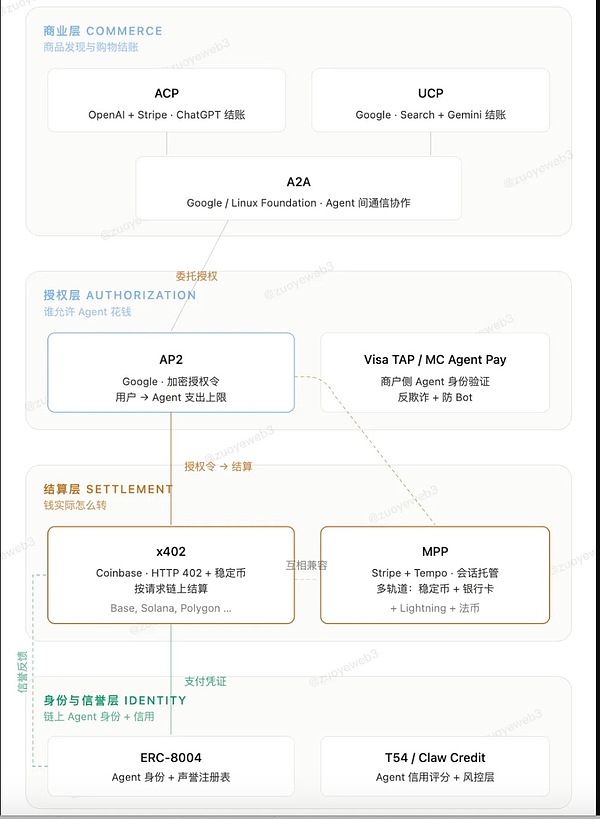
This isn’t denying the trend of combining stablecoins with agents. As @Shoal Research puts it: “Over the past fifty years, every attempt—from PayPal to Apple Pay—to displace card networks has ultimately failed.”
If bank-issued stablecoins operating on Visa’s private chain defeat crypto’s efforts—just as they previously vanquished fintech—that story offers little comfort to us.
Here, crypto must learn from AI: from Prompt Engineering, to Context Engineering, to today’s Harness Engineering—the survival form of agents keeps evolving.
Initially, humans optimized prompts within chat interfaces; then, humans refined their phrasing within AI-generated responses, distilled them into skills, and frenetically purchased APIs and hardware like Mac Minis; finally, they trained agents to replace themselves ever more efficiently.
The stablecoin-agent consumption narrative is a desperate move born solely of financial utility—selling cheapness and speed to AI and the public, akin to tightening your own noose at fire-sale prices.
Crypto Token ⇄ AI Token ⇄ Crypto Token
Stay far from gunfire—observe the battlefield from a safe distance.
If you’re caught in the fray, create your own new battlefield.
Providing liquidity to the AI industry is a dead end (no capital, and crypto gets relegated backstage). Acting as SaaS or distribution channel invites absorption and profit capture. Only volatility triggers human FOMO—and thus sparks miraculous asset price surges.
The most compelling agent narrative positions them as dual agents of *production* and *consumption*. Letting agents consume vastly exceeds human biological limits:
- Human numbers are finite—stablecoin consumers capped at ~8 billion. But agent count is infinite, recursively scalable: one person’s agent invokes another agent; “my vassal’s vassal is not my vassal.”
- Agents require no sleep—the first “tool” to demonstrate physiological superiority over humans, revealing a biological advantage in labor endurance—not greater intelligence, but greater durability, scaling across time.
- Agents excel at fuzzy tasks—or at least always deliver *an* answer. Under multi-agent architectures, AI achieves true 24/7 operational capability for the first time.
Agents aren’t an evolution of Fordist assembly lines—they represent Taylorism’s theoretical optimum. Humans fluctuate; agents continuously self-optimize, ultimately fulfilling capitalism’s ultimate dream: capital appreciation.
This isn’t sensationalism. Across both Chinese and English contexts, “token” now points to AI throughput—not PoW competition.
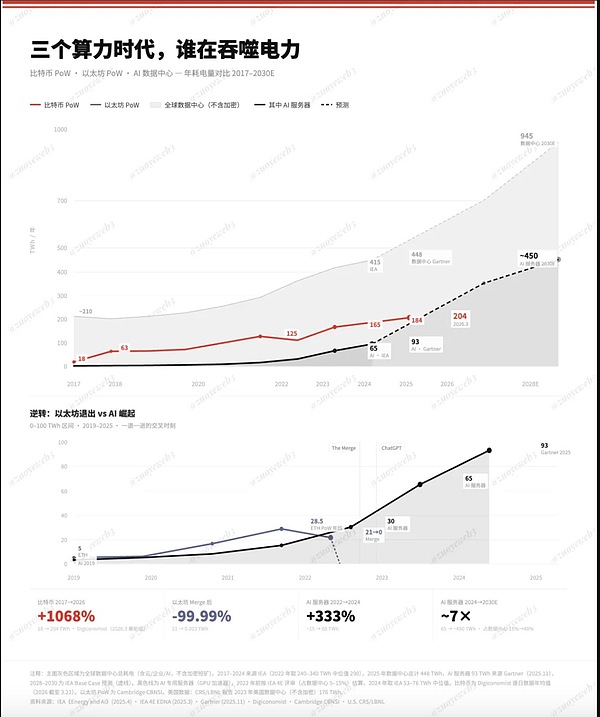
Caption: Evolution of the compute era
Data source: @DigiEconomist @IEA
Ethereum abandoned PoW in 2022; ChatGPT ignited the AI compute race the same year. Fate loves irony: as tokens in crypto devolved into pure emission games, more people gravitated toward AI—backed by tangible compute consumption.
Transitioning from Crypto Tokens to AI Tokens isn’t hard—stablecoins are already attempting it. But reversing that flow—converting AI Tokens back into Crypto Tokens with real liquidity—has become an intractable challenge.
Having lost ground in compute, inference, and storage, how can the stablecoin story hold up?
Perhaps AI offers guidance: agents displaced chat interfaces because chat models couldn’t sustain viable business models. ChatGPT shows no signs of replacing Google or Amazon; Claude specializes in deterministic domains like coding.
Now we must ask: Will crypto decline slowly and painfully like Binance—or collapse rapidly like FTX?
We must reverse-engineer AI’s playbook: build volatility *on top of stability*—crypto’s native domain. Traditional finance adopts AI to boost accuracy and reduce manual labor; yet its adoption of crypto focuses on “tokenization” to reduce friction.
This isn’t crypto’s own narrative. Volatility has always rested on stable foundations—e.g., RWAs shifting from Treasuries to corporate bonds; lending moving from floating to fixed rates.
What crypto needs is this: given agents *do* use stablecoins, how do we manufacture volatility—or asset-price inflation?
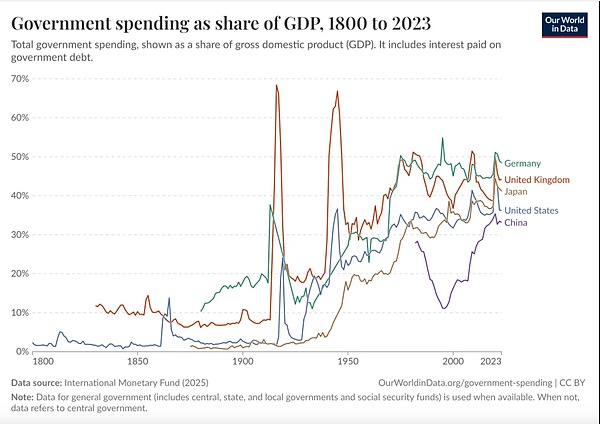
Caption: Government as consumer
Source: @OurWorldInData
It’s not as difficult as imagined. Since the Industrial Revolution, the state has been central to economic activity—even under neoliberal narratives launched in the 1980s, its share has continued rising steadily.
QE liquidity, strict banking regulation—these culminated in the 2026 asset-management giant withdrawal surge. This market never lacks AUM; it perpetually lacks demand-side traction.
That’s stablecoins’ significance for retail markets: whether branded as agents’ “chosen currency” or post-human essentials, initial buying momentum still hinges on human emotion.
AI narratives work the same way; crypto narratives do too—both ultimately target narrow demand pools.
Only technological progress generates wealth surplus, gradually lifting per-capita income—and thereby boosting consumption. That’s AI’s story. But token-driven wealth effects are fading; growth is absent. That’s crypto’s greatest crisis.
This isn’t about productivity vs. production relations—it’s about consumption and finance, a fruitful marriage. AI can become a consumption subject; governments drive consumption—but only humans can execute the financial explosion needed to complete the cycle.
The leap from AI Token to Crypto Token requires tokens to escape quantitative constraints and re-enter the realm of imagination.
Conclusion
Circle’s true brilliance lies in letting agents surpass human limits in scale and consumption capacity—fabricating for capital markets a dream of infinite users.
Yet a regulated Circle could plunge sharply if clear legislation “bans” passive yield—a reminder that markets crave ambiguity: room to operate even when compliance becomes burdensome.
That’s crypto’s essence: forever the frontline financial lab.
Today’s AI methodology is maturing steadily. Its sole remaining frontier is Li Fei-Fei and Yann LeCun’s world models—but even that isn’t a fundamental algorithmic revolution, merely an expansion of data dimensions.
The implications of agents for consumption and finance have entered the post-experiment deployment phase—and stablecoins carry crypto’s entire hope.
Join TechFlow official community to stay tuned
Telegram:https://t.me/TechFlowDaily
X (Twitter):https://x.com/TechFlowPost
X (Twitter) EN:https://x.com/BlockFlow_News
 @zuoyeweb3