








Crypto Morning Brief: Drift Hacked for ~$285M; Uniswap Discloses 2025 Financial Data
TechFlow Selected TechFlow Selected
Crypto Morning Brief: Drift Hacked for ~$285M; Uniswap Discloses 2025 Financial Data
SpaceX has secretly filed for an IPO, with a valuation potentially exceeding $1.75 trillion.
 Navigating Web3 tides with focused insights
Author: TechFlow
Yesterday’s Market Updates
U.S. President Trump: Iran Has Requested a Ceasefire from the U.S.
According to JINSHI Data, U.S. President Trump stated: “The new Iranian regime’s president is less radical and more intelligent than his predecessors—and he has just requested a ceasefire from the United States! We will consider this request only when the Strait of Hormuz is open, free, and unobstructed. Until then, we will bomb Iran into oblivion—or, as they say, back into the Stone Age.”
Iranian Foreign Minister: We Do Not Accept a Ceasefire; We Seek an End to the War
According to JINSHI Data, Iranian Foreign Minister Hossein Amir-Abdollahian stated: “We do not accept a ceasefire; what we seek is an end to the war—and guarantees that similar aggression will not be repeated.” He added that Trump’s claim regarding Iran’s alleged ceasefire request is false and baseless.
U.S. March ADP Employment Change: 62,000 vs. Expected 40,000, Prior 63,000
According to JINSHI Data, U.S. March ADP employment change stood at 62,000, versus an expected 40,000 and a prior reading of 63,000.
U.S. Treasury Issues Proposed Rule on “Substantial Similarity” Criteria for State-Level Stablecoin Regulation under the GENIUS Act
Per the Notice of Proposed Rulemaking (NPRM) issued by the U.S. Department of the Treasury, the Treasury proposes establishing broad principles to clarify when state-level stablecoin regulatory regimes may be deemed “substantially similar” to the federal regulatory framework—fulfilling the requirement under Section 4(c) of the Generative Artificial Intelligence and National Innovation for Stablecoins Act (GENIUS Act).
Key provisions include:
1. State-level regulatory regimes must meet or exceed the federal standards set forth in Section 4(a) of the GENIUS Act, with core prudential requirements—including reserve assets, redemption, capital, liquidity management, and risk management—not falling below the federal regulatory floor;
2. The term “federal regulatory framework” encompasses both the statutory text of the Act and interpretive guidance and regulations issued by the Office of the Comptroller of the Currency (OCC) in the Federal Register; Bank Secrecy Act (BSA)/sanctions compliance provisions are governed by Treasury rules, while anti-tying provisions follow Federal Reserve rules;
3. Regulatory requirements are divided into two categories: “uniform requirements,” which mandate full substantive alignment between state regimes and the federal framework, and “state-determined requirements,” which allow states discretion—but require outcomes no less stringent than federal standards;
4. State-level regimes must incorporate supporting frameworks covering transition to federal oversight, licensing applications, supervision and enforcement, custody arrangements, and insolvency proceedings—and may impose additional requirements, provided they do not conflict with federal law.
Fortune: Paradigm Is Developing a Prediction Market Trading Terminal
According to Fortune, crypto venture firm Paradigm is developing a prediction market trading terminal tailored for professional traders and market makers, led by Partner Arjun Balaji. The project launched in late 2025.
Paradigm is also evaluating whether to launch an internal prediction market market-making business and is collaborating with researchers to explore feasibility of creating a prediction market index—i.e., bundling multiple prediction markets into a tradable product, analogous to the S&P 500 index structure. The firm has begun aggregating prediction market data into a public data dashboard.
On the investment front, Paradigm is a key backer of prediction market platform Kalshi, having participated in all three of its 2025 funding rounds—including leading the December round that valued Kalshi at $11 billion. Kalshi’s most recent funding round raised at least $1 billion, lifting its valuation to $22 billion.
Uniswap Discloses 2025 Financials: Foundation’s Total Assets Reach $85.8 Million, Sufficient to Support Operations Through January 2027
According to The Block, the Uniswap Foundation released an unaudited financial summary showing total assets of $85.8 million as of December 31, 2025—including $49.9 million in cash and stablecoins, 15.1 million UNI tokens, and 240 ETH. Current reserves are projected to sustain operations through January 2027.
Regarding fund allocation, the Foundation has earmarked approximately $106.2 million for ecosystem grants and incentive programs, and $26.3 million for operational costs and employee token rewards. Full-year 2025 operating expenses totaled $9.7 million (excluding token-based compensation), while interest income amounted to $1.7 million.
The Foundation notes that these financial projections may be adjusted following governance changes triggered by the recently approved “UNIfication” proposal.
In 2025, the Uniswap ecosystem continued expanding, with major milestones including the launch of Uniswap v4, mainnet deployment of Unichain, and activation of the UNIfication fee switch. Additionally, Uniswap proposed enabling protocol fees on v3 liquidity pools and extending deployments across more blockchains. On the institutional front, BlackRock and Securitize have recently integrated Uniswap to enable on-chain direct trading for their BUIDL tokenized fund.
Franklin Templeton to Launch Crypto Division “Franklin Crypto,” Targeting Pension Funds and Sovereign Wealth Funds
According to CoinDesk, Franklin Templeton will launch a dedicated crypto division named “Franklin Crypto,” specifically serving pension funds and sovereign wealth funds.
Earlier reports indicated that Franklin Templeton today disclosed plans to acquire 250 Capital—a spin-off from CoinFund—to accelerate its digital asset strategy.
SBI’s B2C2 Designates Solana as Primary Settlement Network for Institutional Stablecoin Transactions
According to The Block, B2C2—a market maker owned by Japan’s SBI Holdings—announced Solana as its core network for routing and settling large-scale stablecoin transactions for institutional clients.
B2C2 serves as a primary market maker for institutions including Robinhood, Standard Chartered, Anchorage Digital, and Bitget. Thomas Restout, Group CEO of B2C2, stated that Solana’s speed, stability, and scalability have made it essential financial infrastructure for its clients.
B2C2 will support multiple stablecoins issued on Solana, including USDC, USDT, PYUSD, USDG, USD1, EURC, and FDUSD.
Cango Announces $65 Million Strategic Financing and $10 Million Convertible Note Financing & Strategic Partnership with DL Holdings
According to PR Newswire, Cango Inc. (NYSE: CANG), a Bitcoin mining company listed on the New York Stock Exchange, announced completion of two significant financing transactions.
First, the company completed a $65 million strategic investment, issuing a total of 49,242,424 Class A common shares to two entities wholly controlled by Chairman Xin Jin and Director Chang-Wei Chiu, respectively. The transaction closed on March 31, with proceeds settled in USDT.
Second, the company signed a securities purchase agreement with DL Holdings Group Limited (HKEX: 1709), a financial services group listed on the Hong Kong Stock Exchange, issuing a $10 million convertible note and warrants exercisable for up to 370,370 Class A common shares at an exercise price of $2.70 per share. Proceeds will fund upstream acquisitions and expansion of AI and compute infrastructure. Concurrently, both parties signed a memorandum of understanding under which DL Holdings expressed intent to jointly pursue strategic investments totaling up to $10 million—with focus areas including cryptocurrency mining facilities and artificial intelligence—subject to due diligence and formal agreement execution.
Bithumb’s IPO Plan Further Delayed; Earliest Listing Now Expected in 2028
According to The Block, South Korea’s cryptocurrency exchange Bithumb confirmed at its annual general meeting that its IPO timeline has been pushed beyond 2028—significantly later than the previously anticipated second half of 2025.
Bithumb CFO Jeong Sang-gyun stated the company remains in preparation mode, focusing on strengthening accounting policies, enhancing internal controls, and conducting comprehensive internal audits. It has extended its IPO advisory agreement with Samjong KPMG through year-end 2027.
Multiple internal issues underlie the delay. Earlier this year, Bithumb mistakenly distributed approximately 620,000 BTC (valued at roughly $43 billion at the time) as promotional rewards to users. Though most funds were recovered and a dedicated task force established, the incident triggered a special investigation by Korea’s Financial Supervisory Service (FSS) into Bithumb’s internal controls and risk management. Meanwhile, the Korea Financial Intelligence Unit (KoFIU) imposed a fine of approximately ₩36 billion (~$27 million) and suspended certain business operations; Bithumb is currently assessing whether to appeal.
Market Report: SpaceX Has Secretly Filed for IPO, Valuation May Exceed $1.75 Trillion
According to foreign media reports, informed sources revealed that SpaceX has secretly filed for an initial public offering (IPO), bringing it closer to executing history’s largest IPO. Sources said the company has submitted its IPO registration statement to the U.S. Securities and Exchange Commission (SEC) and could list as early as June—potentially becoming the first of three anticipated “mega-IPOs,” ahead of OpenAI and Anthropic. Sources indicated SpaceX may seek a valuation exceeding $1.75 trillion in the IPO. Following its acquisition of Elon Musk’s AI startup xAI, the combined entity was valued at $1.25 trillion. Specific listing details—including number of shares offered and pricing range—are expected to be disclosed in subsequent filings. Reports estimate SpaceX’s IPO fundraising could reach as high as $75 billion—far surpassing the current record holder, Saudi Aramco’s $29 billion IPO in 2019. Sources noted that Bank of America, Citigroup, Goldman Sachs, JPMorgan Chase, and Morgan Stanley will serve as lead underwriters.
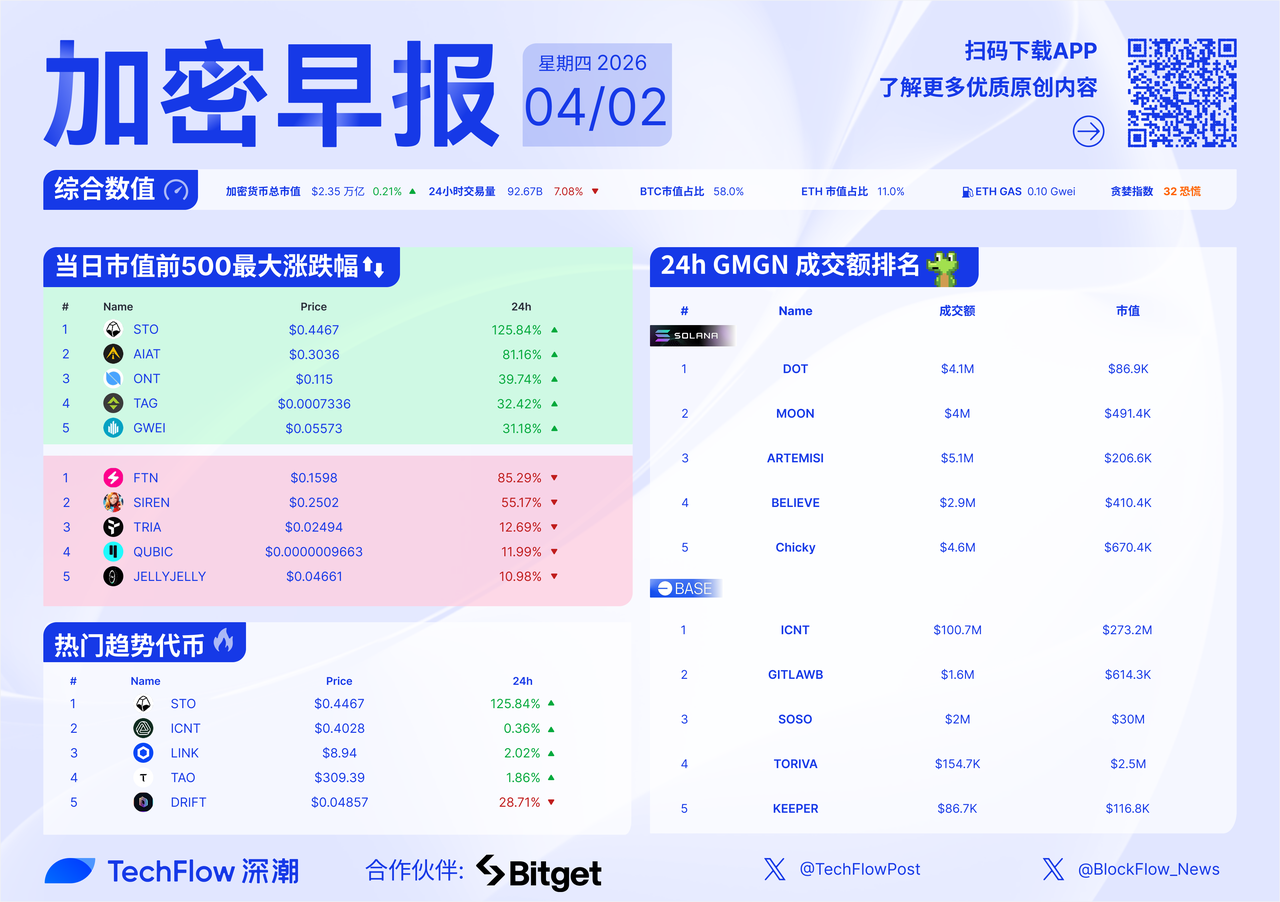
Market Data
Recommended Reading
EthCC Cannes Recap: When Bankers Took Seats in Developers’ Conference Halls
https://www.techflowpost.com/zh-CN/article/30937
This article covers the annual Ethereum conference EthCC, focusing on Ethereum’s ecosystem transformation, institutional adoption trends, and regulatory framework maturation. The ecosystem’s dominant narrative has shifted from “What are we building?” to “Who is using it, how are they using it, and under what compliant frameworks?” Side events—including the Stablecoin Summit and hackathons—signal Ethereum’s entry into a new phase centered on real-world application and regulatory compliance.
The World Is a Giant Improv Troupe: The Full Story Behind the Public Exposure of Claude Code’s Source Code
https://www.techflowpost.com/zh-CN/article/30938
This article provides a detailed analysis of Anthropic’s 2026 source code leak—including leaked content, root causes, competitive impact, and deeper systemic issues exposed. It also highlights some intriguing peripheral details related to the incident and explores broader challenges facing the AI industry.
95-Year-Old Buffett Shares 7 Key Insights: Now Is Not Yet the Time to Buy the Dip; Nuclear Weapons Will Be Used Eventually
https://www.techflowpost.com/zh-CN/article/30940
This article documents Warren Buffett’s CNBC interview, where he shared insights on life post-retirement, investment philosophy, market outlook, and global affairs. Though he has stepped down as CEO of Berkshire Hathaway, he remains deeply involved in daily operations and offered perspectives on Apple investments, market volatility, inflation targets, philanthropy, and the global nuclear weapons landscape.
Microsoft’s Stock Plunges 25% in Q1—Its Worst Quarter Since 2008—as AI “Burn Rate Anxiety” Crushes Valuation of This Trillion-Dollar Giant
https://www.techflowpost.com/zh-CN/article/30944
This article details Microsoft’s 25% stock decline in Q1 2026—the worst quarterly performance since 2008. Key drivers include the widening gap between massive AI capital expenditures and tangible returns, as well as disputes over its exclusive agreement with OpenAI. Moreover, sluggish adoption and declining market share of its Copilot product have further heightened investor concerns. Despite this, Wall Street analysts maintain predominantly “buy” ratings—though some institutions have lowered price targets. To respond, Microsoft is restructuring its organization, launching new products, and accelerating development of proprietary AI technologies to reduce reliance on single suppliers.
A Roundtable with Seven Co-Founders: How Was Anthropic Born?
https://www.techflowpost.com/zh-CN/article/30945
This article chronicles Anthropic’s founding background, core philosophy, developmental trajectory, and explorations in AI safety, interpretability research, and Responsible Scaling Policy (RSP). Through dialogue with its founding team, the piece reveals the company’s vision, challenges, and future aspirations—and examines AI’s potential and responsibilities across society, science, and democracy.
Join TechFlow official community to stay tuned
Telegram:https://t.me/TechFlowDaily
X (Twitter):https://x.com/TechFlowPost
X (Twitter) EN:https://x.com/BlockFlow_News
 深潮TechFlow










