Why Do AI Companies’ Logos All Look Like Anuses?
TechFlow Selected TechFlow Selected
Why Do AI Companies’ Logos All Look Like Anuses?
Congratulations—you haven’t been fully tamed by algorithms yet—if you find yourself unable to look directly at these logos. You still retain humanity’s most primal—and most precious—spirit of defiance.
 Navigating Web3 tides with focused insights
Original author: Highway Store WeChat Official Account
If you lined up the logos of dozens of current AI companies—each valued at over $1 billion—without any accompanying text, you’d experience a strangely uncanny sensation, as if you’d stumbled into a proctology expert consultation room. No neural networks. No computing matrices. Just a dense grid of screens filled with oddly shaped, actively contracting “back gardens.”
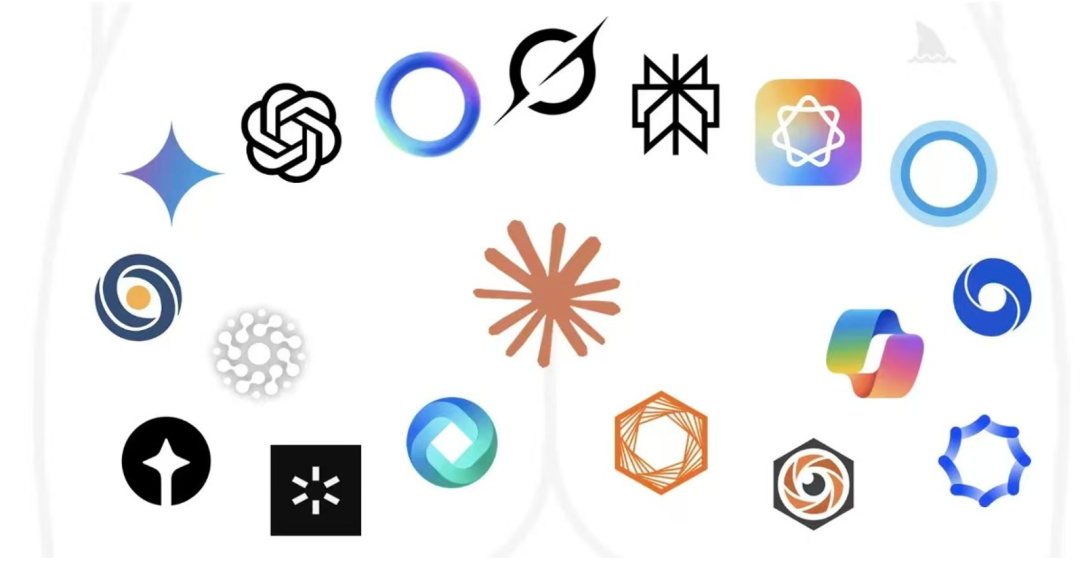
Claude-led proliferation across the board
Zoom in and examine closely: these logos share an astonishingly stable genetic structure—a central hole, surrounded by a ring, plus a touch of gradient. To designers, this shape may be dubbed the “data core,” “neural network,” “intelligence vortex,” or “information hub.” But to ordinary eyes? It’s unmistakably a high-tech chrysanthemum.
And not just any chrysanthemum—it’s a gradient-colored one, with softly glowing edges, performing quantum computation in the future.
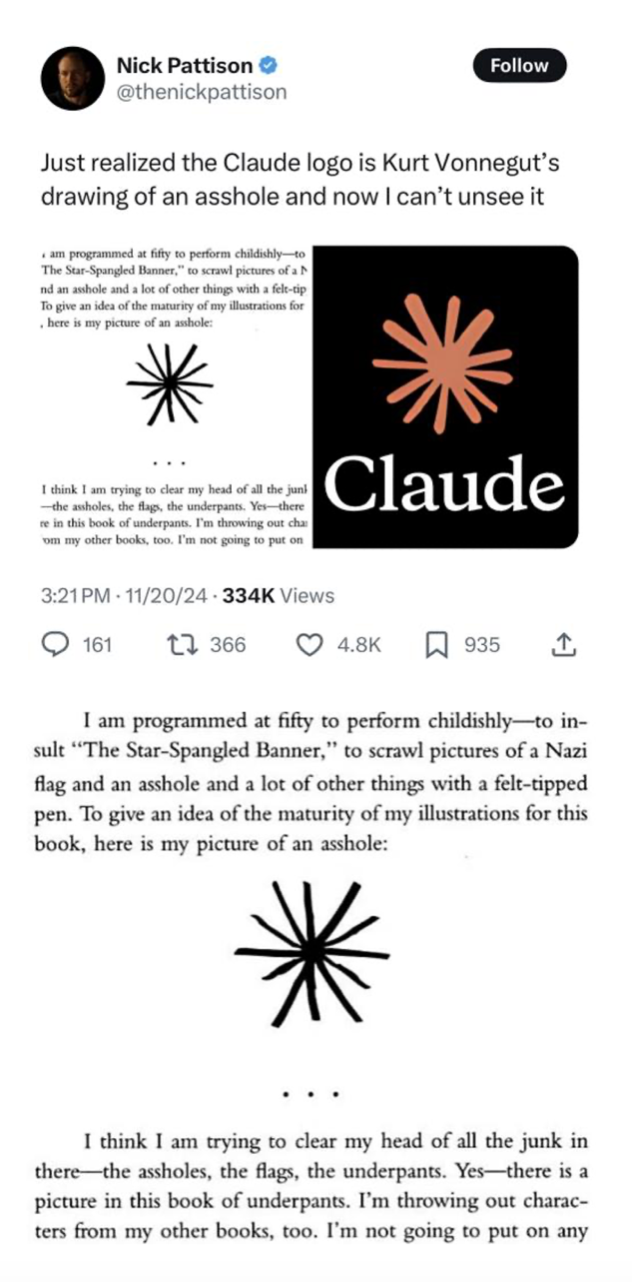
This person discovered the inspiration behind Claude’s logo
May trace back to the “butt-eye” drawn by Vonnegut
Decades ago, literary giant Kurt Vonnegut casually sketched this symbol with a felt-tip pen in his book Breakfast of Champions, labeling it plainly: “This is an asshole.”
No metaphor. No sublimation. Pure literalism.
He said he kept drawing such things even at age fifty—to clear his mind. Fifty years’ accumulation of profound truths and correct ideas needed an outlet for release. The anus is the last uncolonized organ in the human body: it performs no acts of nobility; it feigns no elegance. It simply returns, unchanged, whatever has been swallowed—back to the world.
Vonnegut drew assholes because he believed they were the only honest organ. Decades later, that same shape appeared on tech company launch stages—rebranded as the “core nexus of humanity and intelligence.”
No matter how grand the narrative built around this shape, the human retina retains an utterly ruthless and irreversible “shape persistence” mechanism.
The internet obeys a remarkably stable law: once something is pointed out to resemble a particular body part, its fate is sealed.
Take, for instance, that famous building in Nanning, which went viral nationwide due solely to its viewing angle. Initially, it was merely a forward-looking urban landmark—its designer perhaps aiming to express power, futurism, or some modernist sculptural sensibility. But the moment someone quietly remarked on its resemblance, the brain completed the match instantly. From then on, you could never look at that building the same way again. No amount of designer explanation—about energy fields or information centers—could undo it. To passersby, it had become nothing more than a colossal physiological suggestion standing defiantly in the city center.

A certain new media center
This visual curse is now descending, unaltered, upon today’s AI giants. Yet if you ask the designers who’ve burned the midnight oil—and their hair—in front of their screens, they’ll surely protest: “This isn’t some crude anatomical joke. It’s the universe’s ultimate logic made visible—a visual inevitability.”
There’s a famous joke in mathematics: to a topologist, a coffee cup and a donut are essentially the same object—even humans and trousers share no fundamental distinction.
Topology doesn’t care what an object looks like. It cares about only one thing: how many holes it has. If two objects can be continuously deformed into each other, they belong to the same topological class.

An adult human is topologically messy, with multiple holes.
The handle of a coffee cup is one hole; the center of a donut is another—so topologically, they’re identical. Thus, they share the same distinguished identity: a torus of genus 1. Extending this logic further, humans and trousers seem hardly different: the human body features a single贯通 digestive tract plus two interconnected nostrils, while trousers happen to be a two-hole structure.

From this perspective, AI companies’ obsession with drawing a single hole may simply reflect an unconscious adherence to an ancient mathematical tradition.
Designers in Silicon Valley spent hours sketching and calculating—only to realize that to accommodate trillion-scale data flows, the optimal container isn’t a closed sphere, but a perforated torus.
A single hole signals that the system isn’t sealed: it both consumes everything and endlessly produces everything—an unceasing circular conduit. This was originally a tribute to mathematics. But as designers immersed themselves in this grand narrative, they clearly forgot where, on the human body, lies the most famous, self-consistent, and likewise genus-1 toroidal structure.
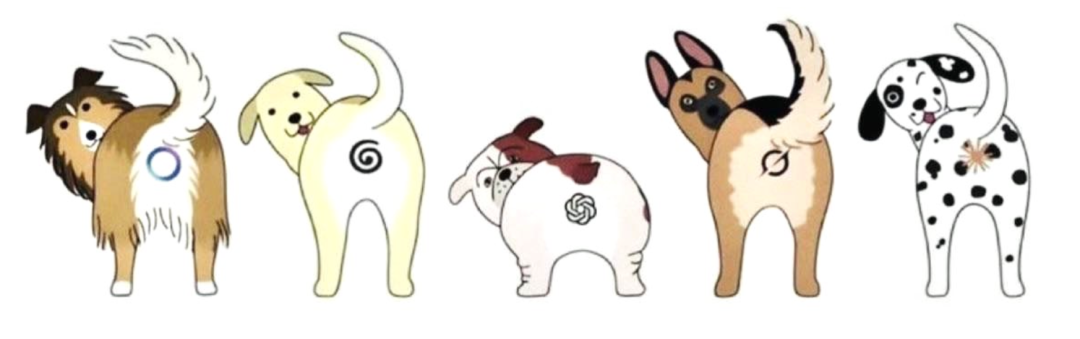
AI = Artificial Intelligence ✗
AI = Anal Intelligence ✓
Perhaps decades from now, design historians will seriously debate this question: Why did the most advanced technological industry of the 21st century collectively adopt such a highly uniform visual language? They may convene extensive academic discussions: “Circular Structures and Visual Symbols in AI,” “Topological Metaphors in Tech Branding,” “Visual Expressions of Data Circulation and Open Systems…”
But the internet offered a far more direct explanation long ago: Because it looks like an asshole.

Stop obsessing over what these logos represent for the future. Since AI is voraciously consuming humanity’s millennia of accumulated data, it’s perfectly logical that—after passing through the black box’s digestion—the output emerging from this very orifice would be a reality indistinguishable from truth or fiction. And if you find yourself unable to look at these logos without discomfort, congratulations: you haven’t yet been fully tamed by algorithms.
You still retain humanity’s most primal—and most precious—spirit of irreverence.
Join TechFlow official community to stay tuned
Telegram:https://t.me/TechFlowDaily
X (Twitter):https://x.com/TechFlowPost
X (Twitter) EN:https://x.com/BlockFlow_News