








SEC "Innovation Exemption" Ignites DeFi Engine: Top DeFi Players See TVL and Token Prices Enact a Tale of Fire and Ice
TechFlow Selected TechFlow Selected
SEC "Innovation Exemption" Ignites DeFi Engine: Top DeFi Players See TVL and Token Prices Enact a Tale of Fire and Ice
The harsh winter of U.S. regulation seems to be quietly receding, as a glimmer of "innovation exemption" dawns upon the DeFi sector.
 Navigating Web3 tides with focused insights
Author: Frank, PANews
The harsh winter of U.S. regulation appears to be quietly receding, as a glimmer of "innovation exemption" shines into the DeFi sector. On June 9, positive signals from senior SEC officials suggested that DeFi platforms might soon enjoy a more favorable development environment.
Yet beneath this regulatory thaw, the DeFi market presents a paradoxical picture: on one hand, leading protocols like Aave are hitting record highs in total value locked (TVL), with strong fundamental data; on the other, many top-tier DeFi protocols show stagnant TVL growth and token prices still below their January levels. The path toward true "value discovery" in the market remains long. Although DeFi tokens have seen a sharp rebound in the past two days, is this merely a short-term emotional swing or driven by deeper value dynamics? PANews examines the latest developments and data trends among top DeFi players to unpack the opportunities and challenges ahead.
SEC Sends Positive Signals: DeFi Regulation Gains an "Innovation Exemption" Framework
The U.S. Securities and Exchange Commission (SEC) has recently sent markedly positive signals regarding DeFi regulation. At the “DeFi and the American Spirit” crypto roundtable on June 9, SEC Chair Paul Atkins stated that DeFi’s core principles align with key American values such as economic freedom and private property rights, and expressed support for self-custody of digital assets. He emphasized that blockchain enables financial transactions without intermediaries, and the SEC should not stifle such innovation.
Moreover, Chair Atkins revealed for the first time that he had directed staff to explore developing an “innovation exemption” policy framework specifically for DeFi platforms. This framework aims to “quickly allow both SEC-regulated and non-regulated entities to bring on-chain products and services to market.” He also clarified that developers building self-custody or privacy-focused software should not be held liable under federal securities laws solely for publishing code, and noted that the SEC’s Division of Corporation Finance has already clarified that Proof-of-Work mining and Proof-of-Stake staking, in themselves, do not constitute securities transactions.
Commissioner Hester Peirce, head of the SEC’s Crypto Task Force, echoed this sentiment, stressing that developers should not be held accountable simply because others use their code. However, she cautioned that centralized entities cannot evade regulation by labeling themselves as “decentralized.”
Against the backdrop of Republican commissioners pushing for more crypto-friendly policies, these statements were widely interpreted as major bullish news, triggering a surge in DeFi token prices. If implemented, the “innovation exemption” could create a clearer, more permissive regulatory landscape for U.S.-based DeFi projects.
Data Review: Stagnant TVL Growth Amid Strong Token Rebound
Following the regulatory optimism from the meeting, dormant DeFi tokens experienced broad gains. Leading projects such as Aave, LDO, UNI, and COMP saw significant price increases of 20%–40%. But was this just a fleeting reaction to news, or a reflection of organic industry growth? PANews reviewed the past six months of data across the top 20 DeFi protocols.
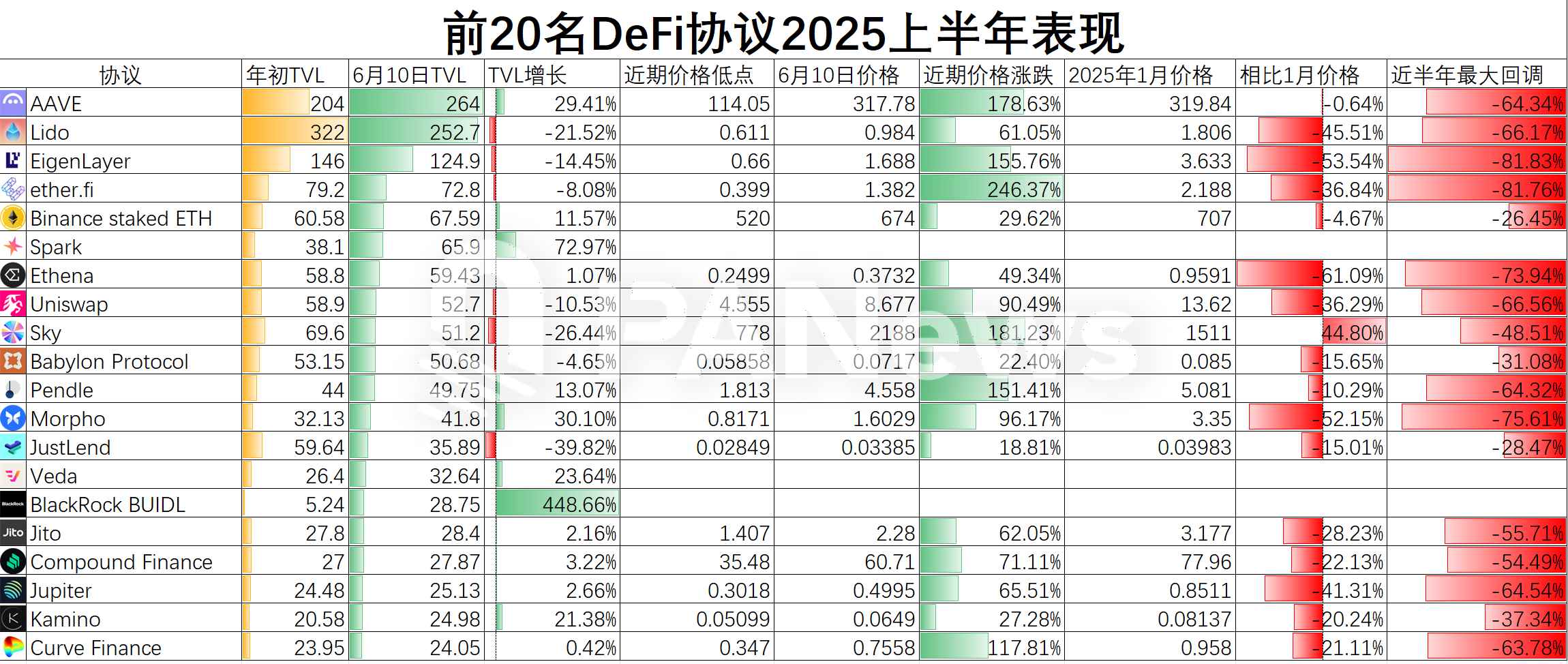
Overall, the TVL growth of these leading DeFi protocols during the first half of 2025 has been negligible—seven protocols even saw declines. Among those that grew, five showed less than 5% growth, essentially treading water. The fastest-growing protocol was BUIDL, launched by BlackRock, though it differs significantly from traditional DeFi models and falls strictly within the RWA (real-world assets) category. Other notable gainers include Aave, whose TVL surpassed $26 billion, reaching an all-time high with over $6 billion added in the first half. Spark from the Sky ecosystem achieved 72.97% growth.
Despite steady stablecoin growth in the Tron ecosystem this year, its leading DeFi protocol JustLend saw a 39.82% decline in TVL—the largest drop among top protocols. Additionally, high-profile protocols such as Sky, Lido, EigenLayer, and Uniswap experienced varying degrees of decline during the same period.
Token prices appear to amplify this downward trend. The average peak-to-trough drawdown for the top 20 DeFi tokens exceeded 57% in the first half of 2025. Even after recent market recovery and strong rebounds, most tokens remain below their January 1 price levels. Only MKR, Sky’s governance token, rose 44.8% compared to January 1, while AAVE barely returned to its starting point. Overall, these tokens averaged a 24% decline from their January 1 prices.
However, there has been a substantial rebound across the board—on average, tokens recovered about 95.59% from their lows. Tokens including ether.fi, Sky, Aave, EigenLayer, and Pendle rebounded more than 150%. Their lowest points generally clustered around April 7, mirroring broader crypto market trends, but the strength of their recovery outpaced other token categories. Nevertheless, whether viewed through price rebound or overall performance over the past six months, there appears to be no direct correlation between token price movements and the underlying TVL performance of these DeFi protocols.
Aave Advances Steadily, Uni Upgrades, Sky Transforms, EigenLayer Resurges
Among these projects, several stand out for particularly noteworthy performance.
Aave: As the flagship DeFi protocol, Aave delivered strong data throughout the first half, repeatedly breaking historical records. It expanded to multiple blockchains including Aptos and Soneium, now supporting 18 chains. To boost AAVE token value, the community proposed “Aavenomics,” which includes a $1 million weekly token buyback program and revenue redistribution for Aave and its native stablecoin GHO. Under the proposal, 80% of Anti-GHO rewards will go to Aave stakers.
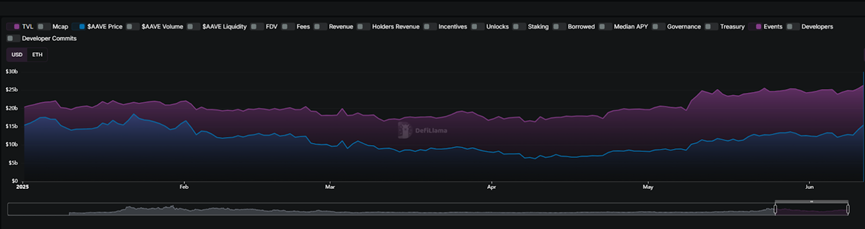
While Aave’s lending rates are not particularly high, it offers deeper liquidity, attracting large-scale users. On June 10, World Liberty Financial—a firm backed by the Trump family—borrowed $7.5 million worth of USDT from Aave. Overall, Aave demonstrated consistent growth in both fundamentals (TVL and related metrics) and market performance in early 2025, continuing to serve as a benchmark model for DeFi protocol development.
Uniswap: In 2025, Uniswap officially launched its V4 version, introducing technical innovations such as hooks and singleton architecture, enabling greater customization and significantly reducing gas fees. Furthermore, the launch of Unichain has enhanced Uniswap’s competitiveness within the broader DeFi ecosystem.
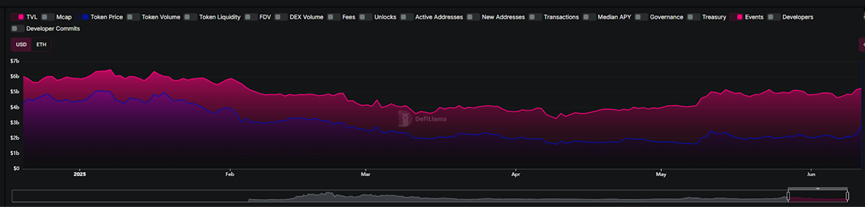
Although Uniswap’s TVL declined slightly in the first half, closer analysis reveals this was largely due to falling ETH prices. In terms of ETH-denominated deposits, volumes actually increased compared to January. Moreover, following its launch, Unichain rapidly captured market share and became the second-largest chain by TVL on Uniswap, with approximately $546 million in TVL as of June 11.
Sky: Since rebranding from MakerDAO to Sky in 2024, the project has undergone a comprehensive brand transformation. While Sky’s standalone TVL declined post-upgrade, its sister protocol Spark unlocked new potential in the RWA space. Combined, the two protocols exceed $11 billion in TVL—ranking among the top three. Additionally, its MKR token performed strongly in 2025, rising from around $800 to $2,100—an increase of over 170%. However, MakerDAO’s “Endgame” upgrade plan involved complex restructuring across governance, tokenomics, and product offerings, making it difficult for the market to grasp quickly and hindering effective communication.
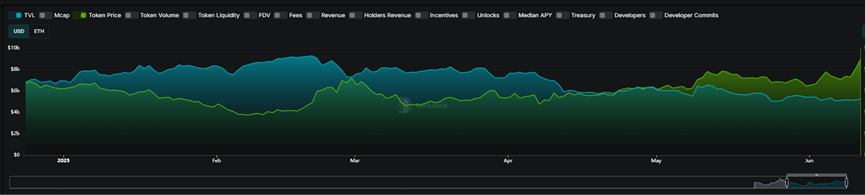
EigenLayer: Pioneering the concept of “restaking,” EigenLayer experienced explosive TVL growth, reaching $12.4 billion and ranking third among DeFi protocols. After a cooling-off period following the initial restaking hype in 2024, EigenLayer entered a new growth phase starting in April, increasing TVL from $7 billion to $12.4 billion in under two months—a 77% rise. Beyond the buzzword, the real utility of restaking may now be gaining renewed recognition.
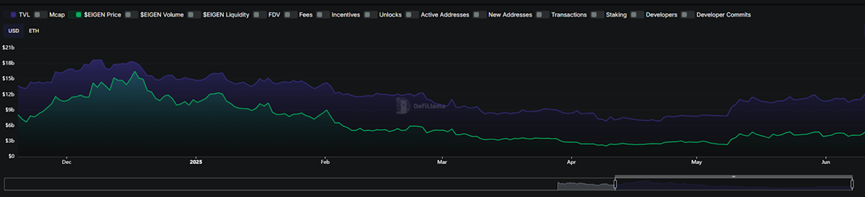
Lido: As the leader in liquid staking, Lido once dominated the market with stETH, achieving nearly $40 billion in TVL in 2024. However, since late 2024, as Ethereum Layer 2s gained momentum, Lido—over 99% concentrated on the Ethereum mainnet—began to lose ground, with TVL steadily declining. Its token rebound has also been muted, rising only 61% from its low to June 10, far below the average for the top 20 DeFi tokens. Despite this, Lido remains second in total TVL after Aave, benefiting from scale effects. The key challenge going forward will be accelerating diversification to stay competitive across multiple ecosystems.
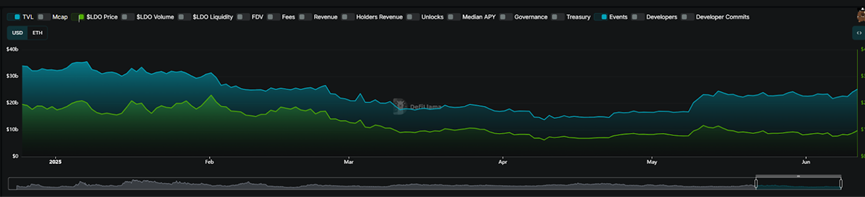
The SEC’s regulatory shift undoubtedly serves as a strong confidence booster for the U.S. DeFi market. Long-standing regulatory uncertainty may finally ease, potentially allowing stalled innovations—such as Uniswap’s fee switch—to become reality. The data trends also offer valuable insights: while Ethereum remains the primary home for TVL, DeFi’s growth momentum is increasingly independent, even beginning to reinforce the value of underlying blockchains. As Bitwise analyst Danny Nelson put it, “The DeFi ecosystem is becoming the engine behind ETH’s price appreciation.” Going forward, clearer regulations could attract traditional finance capital with lower risk tolerance into DeFi, injecting fresh liquidity. Meanwhile, initiatives by giants like BlackRock to launch unique DeFi products signal broader convergence possibilities—but also foreshadow fiercer competition for incremental market share. This new chapter, sparked by regulatory loosening, may mark the beginning of DeFi’s maturation and deep integration with traditional finance.
Join TechFlow official community to stay tuned
Telegram:https://t.me/TechFlowDaily
X (Twitter):https://x.com/TechFlowPost
X (Twitter) EN:https://x.com/BlockFlow_News
 PANews






