After the on-chain treasury net TVL halved to $120 billion, these 3 types of treasuries are booming
TechFlow Selected TechFlow Selected
After the on-chain treasury net TVL halved to $120 billion, these 3 types of treasuries are booming
The Wave of DeFi Treasuryization: A Comprehensive Breakdown of 8 Major DeFi Treasuries
 Navigating Web3 tides with focused insights
Author: Castle Labs
Translated by: AididiaoJP, Foresight News
Treasury Categorization
This section presents a quantitative analysis of the treasury ecosystem, aiming to deliver a comprehensive overview of the sector and its evolution. We analyze the ecosystem by category, tracking TVL changes across treasuries and curators. We break down manager concentration and provide insights into major capital flows, contextualized against structural shifts that have defined treasuries this year.
Treasures should not be viewed as a single, monolithic market; rather, they must be evaluated according to their distinct implementations—each with unique parameters, risk vectors, and responses to stress testing. Aggregated statistics offer only a partial picture; significant nuance is required.
Before diving into the analysis, clarifying the definition of “treasury” forms the foundation of our methodology.
Our definition is based on deployment pathway. A treasury is defined as “a tool through which users access actively managed yield-generating strategies.” Any asset that functions purely as an off-chain wrapper is excluded from our analysis.
- Maple’s syrupUSDC qualifies as a treasury: users deposit stablecoins into the protocol, which lends them to institutional borrowers and accrues APY via credit activity represented by issued tokens.
- Lido’s stETH qualifies as a treasury: users deposit ETH, the protocol earns staking rewards, and distributes them via rebasing tokens.
- Centrifuge’s JAAA qualifies as a treasury: users access AAA-rated CLO yields through a tokenized wrapper that generates returns via its credit positions.
- BlackRock’s BUIDL does not qualify as a treasury: it is a 1:1 tokenized claim directly representing an off-chain U.S. Treasury fund.
From this perspective, we define eight structural categories:
- Lending vaults
- Liquid staking
- Restaking
- Risk-Curated vaults
- Vault Infrastructure Providers and Yield Optimisers
- RWA credit vaults
- Perpetual LP vaults
- Options vaults
To better understand their dynamics and growth, we treat Risk-Curated vaults as a standalone category.
Before analyzing each category individually, we first highlight the overall performance of the treasury ecosystem.
Current State of the Treasury Ecosystem
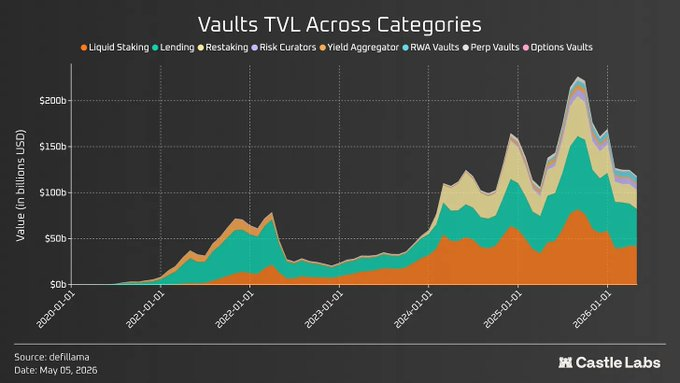
The aggregate net TVL across all defined treasury categories stands at $120.4 billion—approximately 50% lower than the peak of $24.1 billion reached around October last year. This post-October decline was driven by an October liquidation event that triggered cascading liquidations across DeFi chains.
Treasury TVL figures exceed current DeFi TVL (roughly $86 billion) due to overlap. For example, liquid staking protocols such as @LidoFinance issue stETH—a rebasing asset representing staking yield on deposited ETH—which can serve as collateral in lending protocols like @Aave and @Morpho.
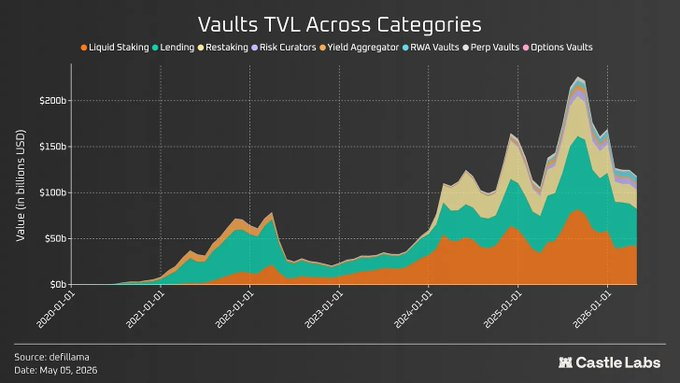
Zooming into category-level analysis reveals a dramatically different picture. Recent events have triggered TVL outflows and prompted broader reality checks across the industry—ideally shifting toward safety-first approaches centered on security and risk management.
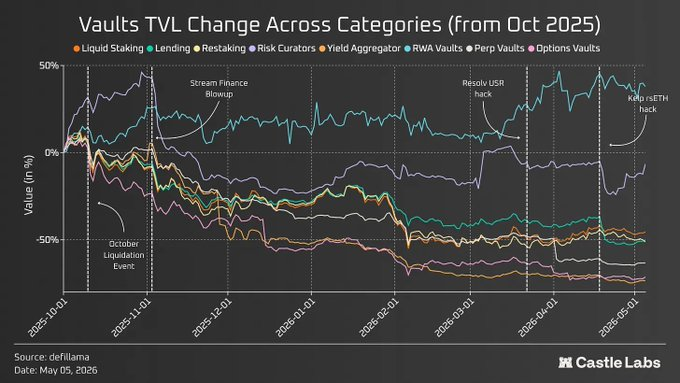
Categories most exposed to on-chain assets—and underpinning the on-chain economy—such as Lending, Liquid Staking, and Restaking were hit hardest. Meanwhile, RWA vaults—exposed to non-crypto assets—continued exhibiting uncorrelated growth. Options vaults peaked in April 2022 and have struggled since. Risk-Curated vaults suffered similarly severe drawdowns as other major categories, peaking at the end of October before declining following the Stream Finance incident.
Three incidents between October 2025 and May 2026—Stream Finance, Resolv, and the Kelp hack—constitute a robust stress-test window. These blowups/attacks had cascading effects across DeFi. In the chart below, we highlight historical TVL trends for each category during this period. As noted above, only RWA vaults grew—by 37.8%—while all others experienced sharp retracements.
Next, we analyze growth across treasury categories, highlighting recent trends and structural shifts.
Lending Vaults
Lending is the largest treasury category, accounting for the majority of DeFi TVL. Last year marked a broad shift toward manager-led vaults, accelerated by products like Morpho. On Morpho, curators can create their own vaults—exposed to multiple markets and generating yield for depositors. These vaults can ultimately be managed by any provider, including TradFi institutions. Morpho’s recent Vaults V2 upgrade equips managers with enhanced capabilities—including embedded, pre-approved adapters to access multi-source yields, fine-grained risk controls (e.g., setting absolute or relative exposure caps per vault), and built-in KYC controls.
In parallel, Aave launched V4, introducing dedicated spokes and a unified liquidity hub. Spokes enable greater customization—including custom risk parameters, isolated collateral types, and per-market oracle configurations. Unlike Morpho’s permissionless, curator-led model, Aave’s governance retains oversight and approval authority over spoke implementation. This represents Aave’s shift from monolithic to modular lending.
The manager model has propelled Morpho to over $7.5 billion in TVL on Ethereum Mainnet and Base. Base contributed significantly to Morpho’s growth—TVL surged from $604 million to over $2.8 billion. This demonstrates the power of Morpho’s distribution partnerships, such as its collaboration with Coinbase: roughly 40% of Morpho’s dollar-denominated TVL is now cbBTC, helping Coinbase users facilitate over $1 billion in loans.
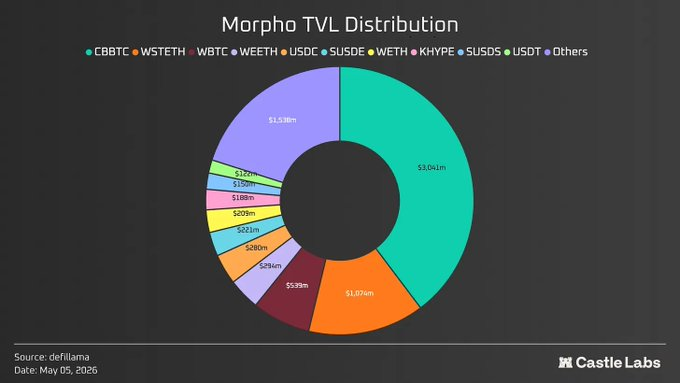
Targeting institutional adoption of the manager model, Aave launched Horizon—an institutional track that has accumulated over $350 million in TVL since launch.
Additionally, Aave underwent several changes over recent months—including service providers BGD and ACI departing Aave Labs, and the announcement and approval of the “Aave will Win” framework, which routes revenue from all Aave products to token holders.
These developments had minimal direct impact on Aave users. The sole notable effect was on Aave token price performance—until the recent KelpDAO hack changed the landscape: Aave lost over $12 billion in TVL, bringing its TVL closer to competitor Morpho. Previously, Aave’s TVL stood at 5–6x Morpho’s; it has now fallen to under 2x.
@sparkdotfi, Sky’s lending protocol, was among the biggest beneficiaries of post-hack inflows. The chart below shows its TVL trajectory:
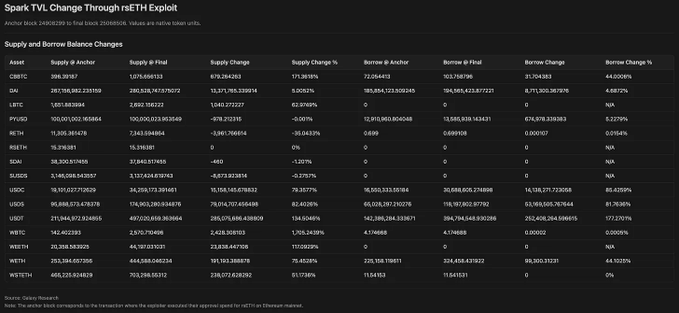
Most notably, Bitcoin supply nearly tripled; stablecoin borrowing rose 78% to $752 million, with utilization remaining manageable; and WETH borrowing increased 44.1% to 325,000 WETH.
@0xfluid’s unified liquidity layer introduces an alternative liquidity design: lending, borrowing, and DEX share the same capital pool. User collateral earns trading fees as LPs on Fluid DEX, while borrowed funds are deployed as Smart Debt into DEX pools—earning fees to offset borrowing costs.
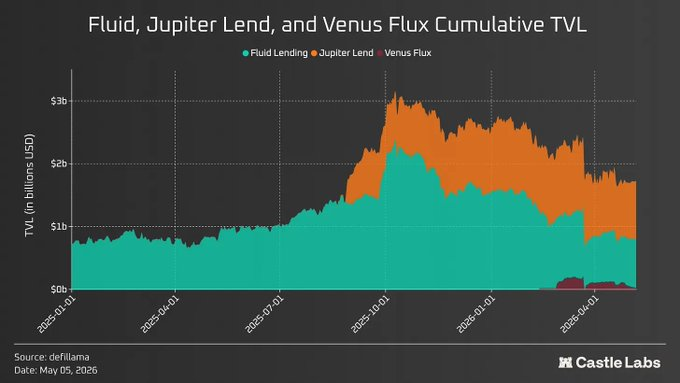
Fluid’s other distinctive approach involves partnering with protocols like @JupiterExchange and @VenusProtocol to launch white-label products—e.g., JupLend (Solana, $926 million TVL) and Venus Flux (BSC, $21 million TVL). This fits Fluid’s broader positioning: collaborating with top players across chains to expand market share—and sharing fee revenue with partners.
Worth noting is Solana’s leading lending stack, @kamino vaults, with over $1.6 billion TVL. Its growth stems largely from the K-Lend model—the Solana equivalent of Morpho—enabling Kamino to partner with established curators like Gauntlet and target institutional integrations.
The platform’s largest vault is @SentoraHQ’s PYUSD, with over $219 million TVL; second is RockawayX’s RWA USDC vault at just $33 million—indicating ample room for growth for both Kamino and Solana overall.
Liquid Staking and Restaking
Liquid staking and restaking represent substantial shares of treasury TVL—$42.4 billion and $20.6 billion respectively.
Major liquid staking players include Lido ($21.8 billion), Binance Staked ETH ($8.9 billion), @Rocket_Pool ($1.2 billion), and @Coinbase’s cbETH ($320 million).
Lido maintains long-standing dominance, with stETH highly composable across DeFi. Yet this dominance also reflects concentration risk. Lido expanded its offerings with Earn—a yield-aggregation product that deposits user funds into DeFi to generate yield. However, after the recent Kelp DAO hack, Earn suffered losses due to its exposure to rsETH.
Binance Staked ETH grew 121.8% year-on-year, fueled by Binance’s massive user base.
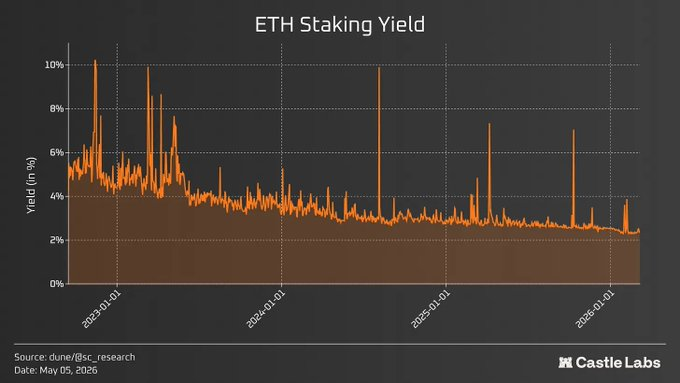
Growth for other protocols—and the category overall—has been sluggish, achieved partly at the expense of diluting staking yields, which currently hover near 2.5%.
Conversely, restaking and liquid staking—as categories—grew by enhancing liquid staking yields. @KelpDAO, a liquid staking protocol, saw its hack—and the ensuing DeFi-wide cascade—highlight the composability risks of these assets: widely accepted as collateral across DeFi, they functioned more as vulnerabilities than features in this incident.
Top restaking players include @EigenCloud ($7.8 billion), @ether_fi ($5.7 billion), Kelp DAO ($1.6 billion), and Renzo ($167 million).
Restaking products like EigenCloud and EtherFi have expanded into additional services over time.
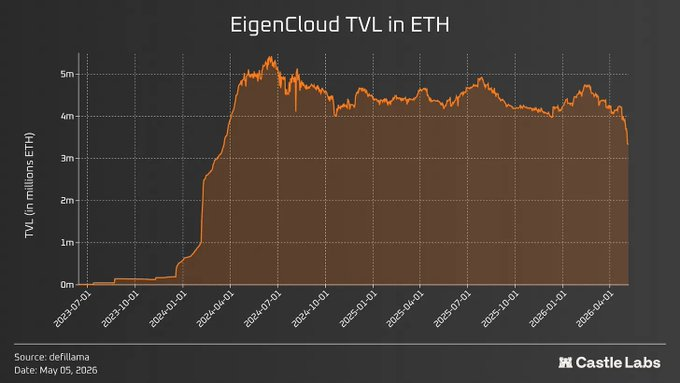
EigenCloud’s 2025 rebrand positioned it within the AWS-like category, emphasizing verifiable execution. Its data availability layer, EigenDA, is used by multiple L2s—including @megaeth, @Mantle_Official, and @Celo. Over 1.8 TB of data has been published on EigenDA, generating ~$90,000 in total fees. EigenCloud’s TVL—denominated in ETH—remained stable for years but recently declined post-Kelp hack, as users withdrew amid uncertainty.
Similarly, EtherFi expanded into neobanking—with thousands of active cardholders spending ~$440 million cumulatively via its products. It also launched a Liquid product (remember, EtherFi launched originally as a liquid staking protocol), supporting multiple strategies to boost DeFi yields. Its top-performing ETH yield vault holds $177.5 million TVL.
Risk-Curated Vaults
Risk-Curated Vaults rank among the fastest-growing categories—reflecting the broader shift from monolithic to modular lending. Manager-run vaults on platforms like Morpho earn performance and management fees, operating similarly to TradFi funds—deploying user capital across diverse strategies to generate returns.
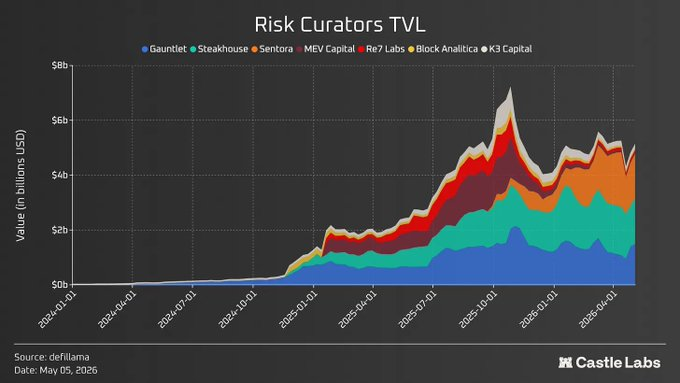
This category currently holds ~$6.5 billion TVL, with 75% held by just three curators: Sentora ($1.85 billion), @SteakhouseFi ($1.63 billion), and @gauntlet_xyz ($1.5 billion)—suggesting limited competition.
Fees charged by these risk curators fall well below those of TradFi hedge funds and venture funds—typically charging ~1–2% AUM management fees plus ~10–20% performance fees on interest income. For instance, top revenue-generating manager Steakhouse Financial earned $3 million annually on $2.13 billion AUM—just 0.14% of AUM. Most charge only performance fees; some add management fees—but rates remain markedly low, reflecting competitive pressure as managers vie for TVL with lowest possible fees.
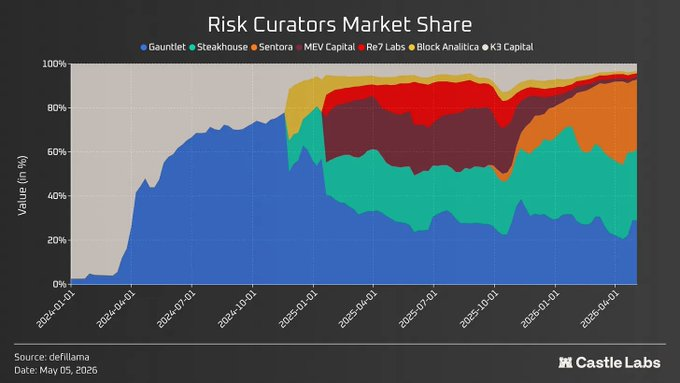
Nonetheless, concentration remains pronounced at the top—dominated by three providers. This is healthier than Lido’s overwhelming dominance in liquid staking.
What does this concentration imply? Steakhouse’s team notes: “Concentration likely follows the power law observed in traditional asset management—e.g., ETFs—where most AUM concentrates among top-tier managers. This isn’t necessarily negative; it reflects compounding scale and trust toward larger managers competing on performance, product breadth, and fee efficiency. DeFi’s advantage is an open arena—anyone can enter and compete. We expect top-tier concentration to persist alongside healthy edge competition and specialization opportunities.”
Concentration dynamics shifted recently post-Stream Finance, following strong prior performances by MEV Capital and Re7—peaking at $1.49 billion and $830 million respectively—before contracting, allowing Sentora to rise as the #2 curator.
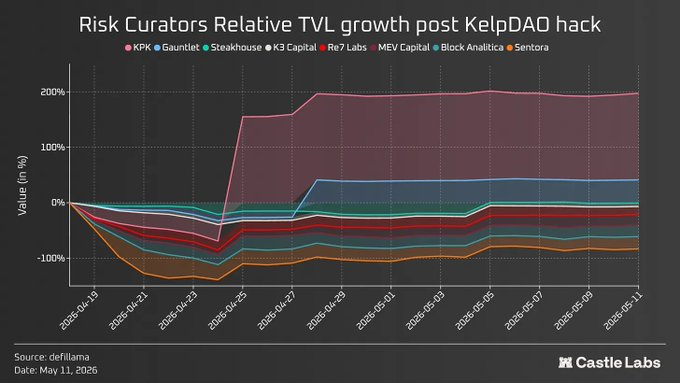
Moreover, the KelpDAO hack clearly impacted risk curators—but select winners emerged, including @kpk_io (+159.6%) and Gauntlet (+42.7%), achieving net positive inflows. For KPK, growth stemmed from its recent Morpho V2 vault launch—drawing deposits from ensdomains, CoWSwap, and NexusMutual. It integrated agent-driven automation for rebalancing and vault exits, enhancing risk management. For Gauntlet, growth came from its BSC chain expansion and partnership with Lista DAO’s lending protocol—driving new inflows.
As Sentora’s Juan Pellicer observes: “DeFi insurance is also becoming a real part of the institutional landscape. Offering affordable insurance fundamentally changes the calculus for treasuries or asset managers accountable to investment committees—a structural unlock.”
Vault Infrastructure Providers and Yield Optimisers
Yield optimisers as a category are maturing—and seeing significant new entrants. As on-chain yield sources proliferate, optimization or aggregation models are emerging as superior treasury architectures—delivering best-in-market yields to depositors.
Protocols like @Veda_labs ($1 billion), @upshift_fi ($380 million), and Fluid Lite Vault ($164 million) lead this category. Each serves distinct models—but the shared goal is seamless integration of optimized-yield vaults delivering best-available DeFi yields. All remain far below peaks due to ongoing market drawdowns and the stress period since last October.
It helps to view providers like Veda and Upshift as infrastructure for creating isolated yield products—not aggregators. Upshift enforces vault authorization via its proprietary strategy engine—and ensures self-custody by restricting deployments to whitelisted chains/protocols/tokens/smart contract calls. Moreover, Upshift fits better as a multi-strategy vault: its vaults offer exposures across DeFi—including lending, basis trading, carry trading, LP, and RWA.
Veda employs a modular architecture—separating operations into “boring” vaults (sole purpose: holding assets), with specialized tasks delegated to external modules. It uses Merkle trees to enforce permissions for specific vault operations via whitelisting.
Infrastructure providers make it trivial for institutions to begin with a single integration—allocating to one lending protocol—and progressively layer on more sophisticated strategies as product offerings expand—unlocking higher yields and deeper liquidity.
Other products—including @ipor_io’s Fusion ($30 million) and @GearboxProtocol ($29 million)—also operate as yield-optimization layers. Fusion primarily targets on-chain vault infrastructure—enabling independent entities (e.g., curators and asset managers) to build and operate yield strategies like leveraged loops.
Each Fusion vault is unique in curation, strategy, and allocation. Automation operates at the strategy level—with triggers for optimization, leverage maintenance, liquidation risk management, routing, etc. Examples include swapping during negative basis, cross-market migration of leveraged positions using flash loans, or exiting during risk events. As the Fusion team notes: “This automation proved critical during the recent rsETH/Aave crisis—where IPOR DAO’s mainnet stETH loop vault was among the earliest to fully sever core exposure to Aave v3. Automation and execution typically empower curators to rapidly manage risk precisely when speed matters most.”
Leveraged loops represent the highest protocol-managed value so far—~$80 million. This figure exceeds TVL because TVL is an inadequate metric for yield optimisers. Instead, these providers should be assessed by Assets Under Management (AUM)—since they allocate capital across other protocols, meaning TVL fails to capture true growth.
Gearbox introduced a vault architecture tailored for passive lenders and active borrowers.
Its core enables access to leveraged or delta-neutral exposures to farming or liquidity provision strategies. While most vault mechanisms center on curator-managed asset allocation, Gearbox focuses on lender risk-management infrastructure.
Borrowers can open Credit Accounts to interact with external protocols—while funds remain non-custodial. V3 introduced strategy-level firewalls—protecting the protocol if a Credit Account or strategy fails. During such events, they cannot drain beyond their allocated share of the pooled liquidity—shielding passive lenders from contagion.
Recently, the protocol announced a focus on RWA loop vaults.
RWA Vaults
RWA vaults have posted consistent growth over the past five years—achieving a 231.3% CAGR—reflecting rising retail and institutional interest in RWA yield exposure. Even after recent attacks on @ResolvLabs and Kelp, RWA vaults remained sticky—with minimal movement due to limited exposure to on-chain assets.
Top players include @maplefinance ($2.1 billion), @centrifuge ($1.6 billion), @anemoycapital ($1.1 billion), and @re ($263 million).
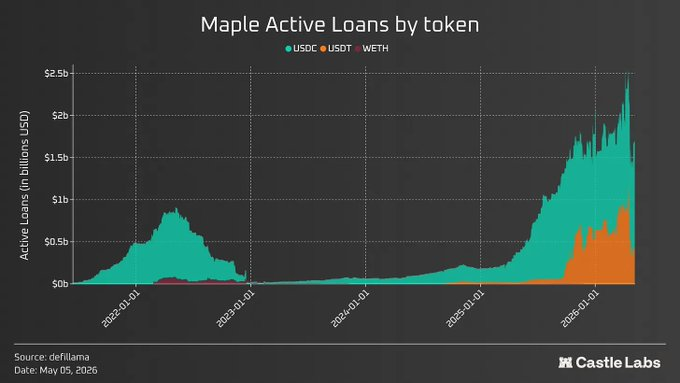
Maple Finance grew rapidly over the past year—TVL increasing nearly tenfold since early 2025. This growth stems from multiple factors—including launching Syrup, part of its transition from an institution-only model. Syrup opened the door to retail traffic via highly composable DeFi products like syrupUSDC and syrupUSDT. DeFi composability and deep liquidity allow assets to be recycled through lending protocols and integrated with products like @pendle_fi—fueling a growth flywheel. Reflecting product demand, the platform’s current active loan volume stands at ~$1.7 billion—predominantly in USDC (~75% of active loans), followed by USDT.
Other products also witnessed massive growth. Centrifuge positions itself as private credit infrastructure. Its collaboration with Anemoy launched an $1.1 billion T-bill pool running atop Centrifuge’s infrastructure. Centrifuge was also recently selected by Coinbase as a tokenization partner.
Products like Re bring reinsurance underwriting risk on-chain—broadening user exposure to real-world yields. Separately, Upshift’s USDC vault lends to overcollateralized institutional funds—providing depositors with institutional lending exposure.
Although RWAs have captured all growth in DeFi, they still represent only a small fraction of on-chain tokenized value—currently ~1/10 of total RWA value. This gap arises because RWAs belong to distinct categories—falling outside standard asset considerations—including redemption periods, compliance requirements, and, in some cases, liquidity constraints.
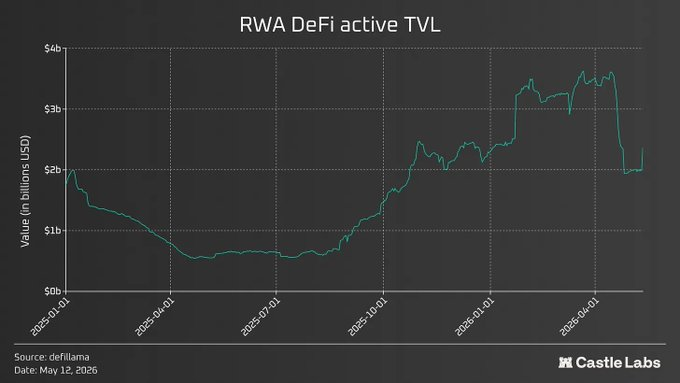
For any asset to scale in DeFi, active redemptions and secondary liquidity are essential—because users may need to sell assets to regain liquidity, or liquidators must repay loans and sell assets near mark price for profit. Yet RWA-specific complexities make this far harder to implement.
Additionally, yield-bearing assets like RWAs feature another key growth flywheel component: looping. RWA looping involves borrowing stablecoins against tokenized Treasuries—and repeatedly redeploying proceeds into yield-generating vaults. With a 4–5% base Treasury yield, 2–3x leverage can produce 7–12% returns—provided borrowing costs stay low (~1%). But on-chain stablecoin rates fluctuate wildly—potentially squeezing this spread. Leverage amplifies liquidation and oracle risks—and the strategy depends critically on stable RWA collateral valuations.
Toward this end, several solutions exist today:
- ERC-7540: Introduces asynchronous ERC-4626 vaults—allowing users to use redemption claims as liquidity while underlying assets settle off-chain. Centrifuge is a key production-environment example of ERC-7540—using synchronous deposits and asynchronous redemptions—to resolve tension between DeFi and TradFi T+ settlement. These hybrid vaults are becoming templates for any vault touching off-chain assets.
- Securitize Vault Registrar: This ERC maps each investor to their identity when using RWAs in DeFi—ensuring protocols comply with all regulatory and compliance requirements tied to the asset.
- Redstone Liquidation Flow: They conduct RWA liquidations via auction-based mechanisms—connecting positions to KYC-verified solvers who take on off-chain underlying assets and close positions on-chain.
- Upshift Clear: Upshift is launching a new product with Superstate—enabling instant RWA redemptions—letting users swap RWAs for USDC at the current reported price, charging a 5 bps redemption fee.
Another protocol in this category is 3F—a platform for leveraged RWAs on-chain (@3f_xyz). It currently holds $7 million TVL and tackles RWA asset challenges in DeFi differently than other solutions. It externalizes distinct roles—including Bridge Facilitators and Liquidity Integrators. Bridge Facilitators provide pre-funded liquidity to complete users’ targeted exposures based on underlying capital. For example, a user targeting $3M exposure with $1M deposit can obtain the remaining $2M liquidity from a Bridge Facilitator—achieving 3x leverage on the full position. Similarly, Bridge Facilitators supply needed liquidity when users unwind positions—solving redemption delays. Liquidity Integrators provide instant liquidity when users want immediate exit—because even with Bridge Facilitators, the user’s $1M deposit still requires full redemption processing. These integrators supply urgently needed liquidity.
Both methods borrow efficiency from markets—like liquidations in lending—where incentivized on-chain participants fill gaps in RWA looping to profit. Over time, such systems scale more easily—because every participant benefits: loopers gain smooth exits; facilitators profit by providing liquidity and enabling faster redemptions.
As noted earlier, Gearbox also plans to launch “Retokenisation”: a feature enabling infrastructure-native leveraged minting and redemption of non-atomic tokenized assets—without requiring secondary liquidity or incurring redemption delays. Effectively, Gearbox’s contracts will operate jointly with RWA issuers’ contracts—creating a seamless, composable system for RWA leverage directly at the issuer level—making Gearbox the only EVM protocol offering native RWA leverage.
Perpetual LP Vaults
Perpetual LP vaults are represented by Jupiter Perps ($715 million), @HyperliquidX HLP ($396 million), @DriftProtocol ($256 million, post-hack decline), @GMX_IO ($242 million), and @Ostium ($51 million).
Jupiter’s JLP remains the largest perpetual vault by TVL—but has lost over half its value since last October due to the liquidation event.
HLP fared better on value preservation—down 30% from its $600 million peak in September last year. Hyperliquid’s vaults experience persistent volatility—often driven by floating HLP yields shaped by its structure and market conditions. Thus, high-yield cycles attract capital—while low-yield or loss periods drive it away.
One major loss event occurred in March 2025—when a trader opened a massive short on Jelly tokens, then withdrew margin—triggering forced liquidation and causing HLP to absorb the position. Such losses create structural bias against HLP for depositors—leading many to classify it as higher-risk. Yet Hyperliquid reduced allowed leverage on such high-risk tokens to prevent recurrence—ironically amplifying losses when they occur.
Products like Ostium’s OLP offer RWA perpetual exposure—with differentiated yield configurations—but its TVL dropped ~50% from peak. This drawdown reflects broader market movements and Ostium’s yield cycle.
Additionally, Ostium recently introduced architectural changes—making OLP an upper tranche and intraday settlement layer—never bearing first-loss risk. This contrasts sharply with HLP: previously, depositors seeking directional OLP exposure may have departed—but now OLP becomes a risk-reduced passive yield source suitable for depositors under the new model.
Options Vaults
DeFi Options Vaults (DOVs) as a category have gradually faded—peaking in 2022. DOVs offered exposures to strategies like covered calls and cash-secured puts—but suffered from low capital efficiency, high risk, and shrinking appeal as crypto users favored perpetuals. Yet options vaults have recently improved and solidified their use cases—at least for more sophisticated users.
Options vaults no longer exist in their prior form. Instead, they’re architecturally distinct and more user-friendly—delivered via products like @DeriveXYZ and @ryskfinance. Today, options vaults execute via Request-for-Quote (RFQ) systems—with market makers handling execution behind the scenes.
Derive is an options and perpetuals exchange—its V2 launch in March 2025 drove accelerated growth via feature expansion—including a central limit order book (CLOB) and institutional-grade features like OTC custody and multi-collateral support—processing $12 billion in perpetuals and $16 billion in options volume. Derive V1 vaults remain active—offering diverse options strategy exposures and constructing delta-neutral positions for depositors to maximize APY. These vaults currently hold ~$2.4 million TVL.
Meanwhile, products like Rysk offer options exposure to retail—via covered calls and cash-secured puts—launched on Hyperliquid and focused on HYPE-covered calls. It currently holds ~$56 million TVL and has processed $975 million in options notional. Additionally, it offers Rysk Premium—a flagship product functioning as a vault for sophisticated allocators—deploying capital across diverse options strategies to generate consistent returns for depositors.
New vault implementations focus on solving key issues of prior incumbents—including poor strategy design (timeframes as short as 7 days), fixed-interval trade execution (creating front-running opportunities), and rigid structures—limiting user alignment on size, strike, or expiry. Options vault providers are now more attuned to market pulse—selecting which assets to list to capture new yield opportunities.
Join TechFlow official community to stay tuned
Telegram:https://t.me/TechFlowDaily
X (Twitter):https://x.com/TechFlowPost
X (Twitter) EN:https://x.com/BlockFlow_News
 @castle_labs