Kelp DAO Vulnerability Triggers $10B Exodus, Two Major DeFi Lending Approaches Clash Head-On
TechFlow Selected TechFlow Selected
Kelp DAO Vulnerability Triggers $10B Exodus, Two Major DeFi Lending Approaches Clash Head-On
Shared-pool models reveal shortcomings—why are institutions collectively shifting to Morpho’s isolated markets?
 Navigating Web3 tides with focused insights
By Vaidik Mandloi
Translated by Saoirse, Foresight News
The underlying mechanics of all DeFi lending protocols are broadly similar: users deposit stablecoins or ETH into shared liquidity pools; borrowers post collateral to draw funds from those pools; and a decentralized autonomous organization (DAO) votes on which assets may serve as collateral and their respective loan-to-value (LTV) ratios. Aave built its $5 billion deposit base precisely on this model. For most of DeFi’s history, this has been the industry’s sole prevailing paradigm—and its validity has never faced serious challenge.
But on April 18, 2026, a hacker exploited a vulnerability in Kelp DAO’s LayerZero cross-chain bridge to mint $292 million worth of counterfeit rsETH tokens. The attacker deposited these fake tokens as collateral on Aave and borrowed real ETH. Within hours, utilization rates across Aave’s major lending markets spiked to 100%, meaning every available dollar of liquidity had been borrowed. Over the next three and a half days, Aave lost $1.5 billion in deposits. Ultimately, Aave was forced to coordinate an emergency rescue with ecosystem partners, raising $160 million to cover losses.
Although the vulnerability originated in Kelp DAO’s code, the scale of the damage stemmed directly from Aave’s governance design. As early as January this year, the community voted to raise rsETH’s LTV ratio to 93%, leaving only a 7% risk buffer—precisely the decision that triggered one of the largest bank runs in DeFi lending history.
On the same day, some of the forged rsETH also flowed into Morpho—the second-largest DeFi lending protocol—but exposure remained limited to just $1 million, spread across two small, isolated markets, avoiding any systemic contagion.
I conducted an in-depth investigation into this incident and found it involved far more than a simple security breach.
Core Differences Between the Two Models
To understand why Aave hemorrhaged billions while Morpho remained virtually unscathed, we must first examine how each protocol structures and manages capital.
When you deposit USDC into Aave, your funds flow into a single, unified pool supporting lending for all community-approved assets—including ETH and staked tokens. Depositors have no control over which underlying collateral backs their deposits; all parameters are set exclusively via DAO voting. So when rsETH collapsed, even users who had only ever deposited USDC—and never touched rsETH—found their assets frozen. All funds reside in a single risk pool: everyone shares the downside.
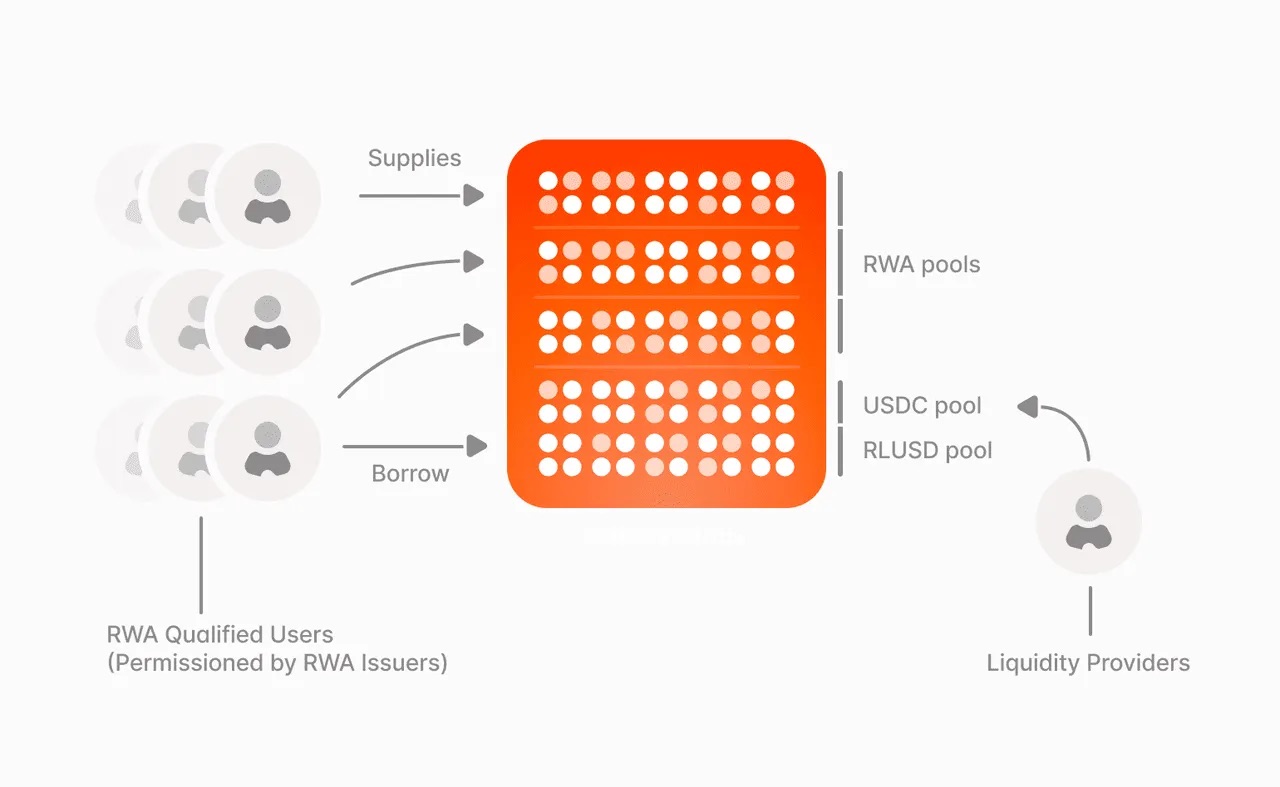
Source: BingX
Even more troubling: amid market paralysis and inability to withdraw, Aave’s governance slashed borrowing rates in the frozen ETH market—specifically to protect leveraged rsETH borrowers. Since deposit rates are mechanically tied to borrowing rates, the safest depositors—those bearing minimal risk and holding fully secured principal—saw their yields further eroded.
In traditional credit systems, lenders with the lowest risk enjoy priority repayment rights. Aave flips this principle entirely. Why? Because the very borrowers engaged in rsETH leverage trades are also the most active voters in governance. When risk materializes, high-risk participants—who hold decisive governance power—naturally prioritize protecting themselves.
Aave launched an insurance mechanism called Umbrella in late 2025 to mitigate such bad debt risks. Users could stake ETH; if bad debt occurred, staked assets would be used to cover losses. Yet during the Kelp DAO crisis, of 23,507 aWETH stakes, 18,922 entered withdrawal queues—nearly 80% of the insurance pool withdrew en masse.
The mechanism failed entirely. Onchain insurance relies on voluntary participation, and capital providers inevitably exit when risk crystallizes—because only then do their assets face actual loss. Such insurance thus exists robustly in calm times but vanishes precisely when needed most.
Morpho operates on a fundamentally different model. It abandons the unified liquidity pool entirely. Anyone can create independent, isolated lending markets, predefining supported assets, collateral types, price oracles, and interest rate models—all immutable once deployed. To adjust risk parameters, users must launch an entirely new market.
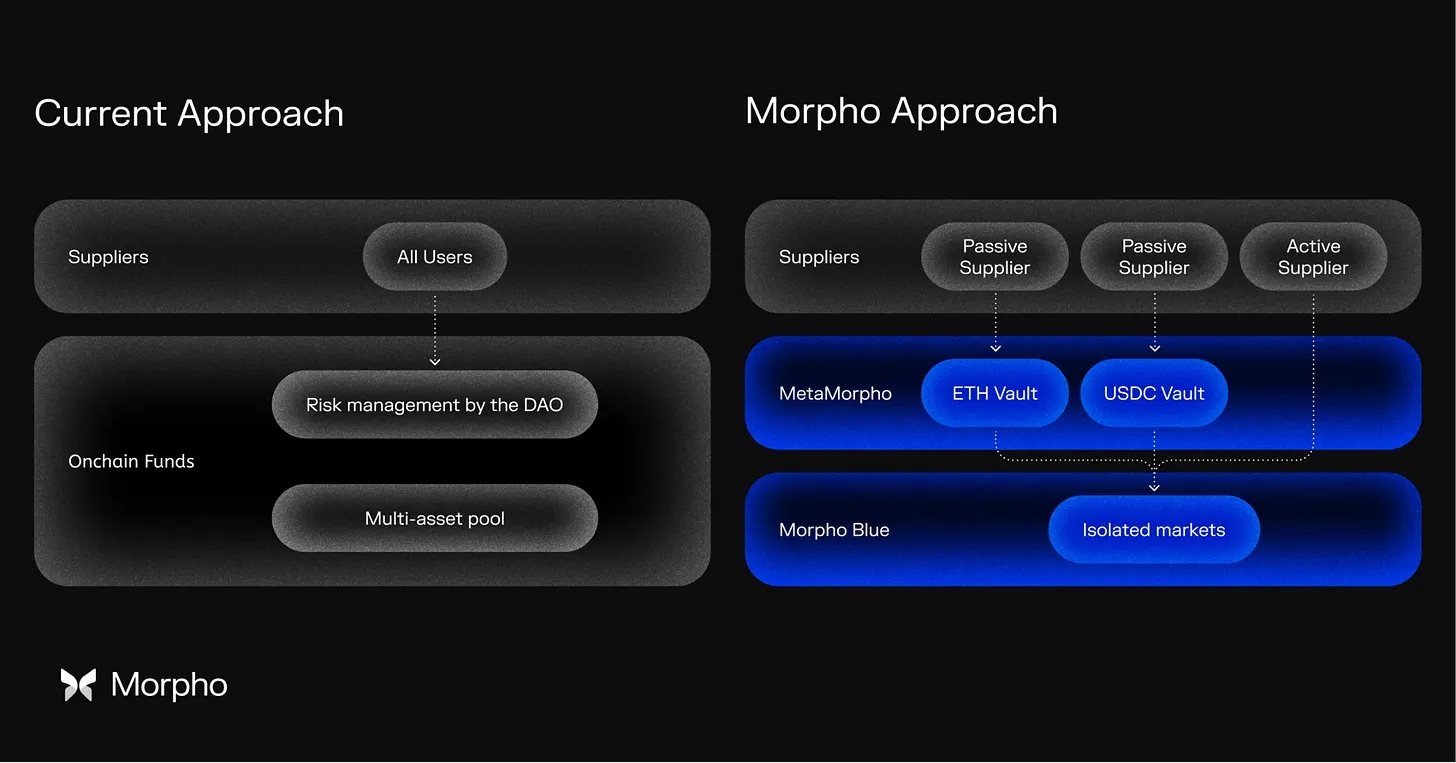
Architectural differences between traditional DeFi lending (exemplified by Aave) and Morpho’s “morphological” model
Moreover, Morpho introduces independent risk managers (“curators”), such as Gauntlet and Steakhouse Financial. These entities maintain dedicated treasuries, allocate capital across markets based on proprietary risk assessments, and earn performance fees. Losses affect only their own treasury. Gauntlet previously advised Aave on risk management—but its expert recommendations were routinely overruled by token holders chasing higher yields. Morpho eliminates this dynamic at the architectural level.
The Overlooked Hidden Cost
Aave and Morpho represent the two most widely adopted lending paradigms in crypto today: Aave uses a shared-pool model—where all deposits merge into one pool and risk rules are set by community vote—while Morpho champions isolated markets, where each lending pair operates independently under professional risk oversight.
The Kelp DAO exploit laid bare the vulnerabilities inherent in the shared-pool model. But even in tranquil periods—absent any security incidents—this model carries a long-overlooked hidden cost. Aave’s three core Ethereum markets (ETH, USDT, USDC) account for 89% of its total lending volume. Across these markets, deposit rates consistently trail borrowing rates by 25–35%. That gap represents idle capital sitting dormant in the pool—capital depositors cannot earn yield on, yet borrowers still pay full interest on.
Interest rate mechanisms tied to utilization can raise rates as risk rises—but they cannot reactivate idle capital when demand falls. Vast sums remain inert, generating zero yield. Just these three markets alone incur $52 million annually in value erosion due to idle capital—nearly one-quarter of Aave’s quarterly annualized revenue. Even eliminating reserve ratios or platform fees cannot resolve this: it is an intrinsic architectural limitation of shared pools.
Morpho’s interest rate model targets a 90% utilization rate—significantly higher than Aave’s typical 60–80% range. This elevated utilization is sustainable because deposits within Morpho are never reused as collateral for other loans—eliminating cascading liquidation risk at the source and removing the need for large risk buffers. When demand surges and capital is heavily borrowed, rates automatically rise to attract more depositors; when demand cools, rates fall to incentivize borrowing. The entire system achieves dynamic equilibrium without requiring DAO votes.
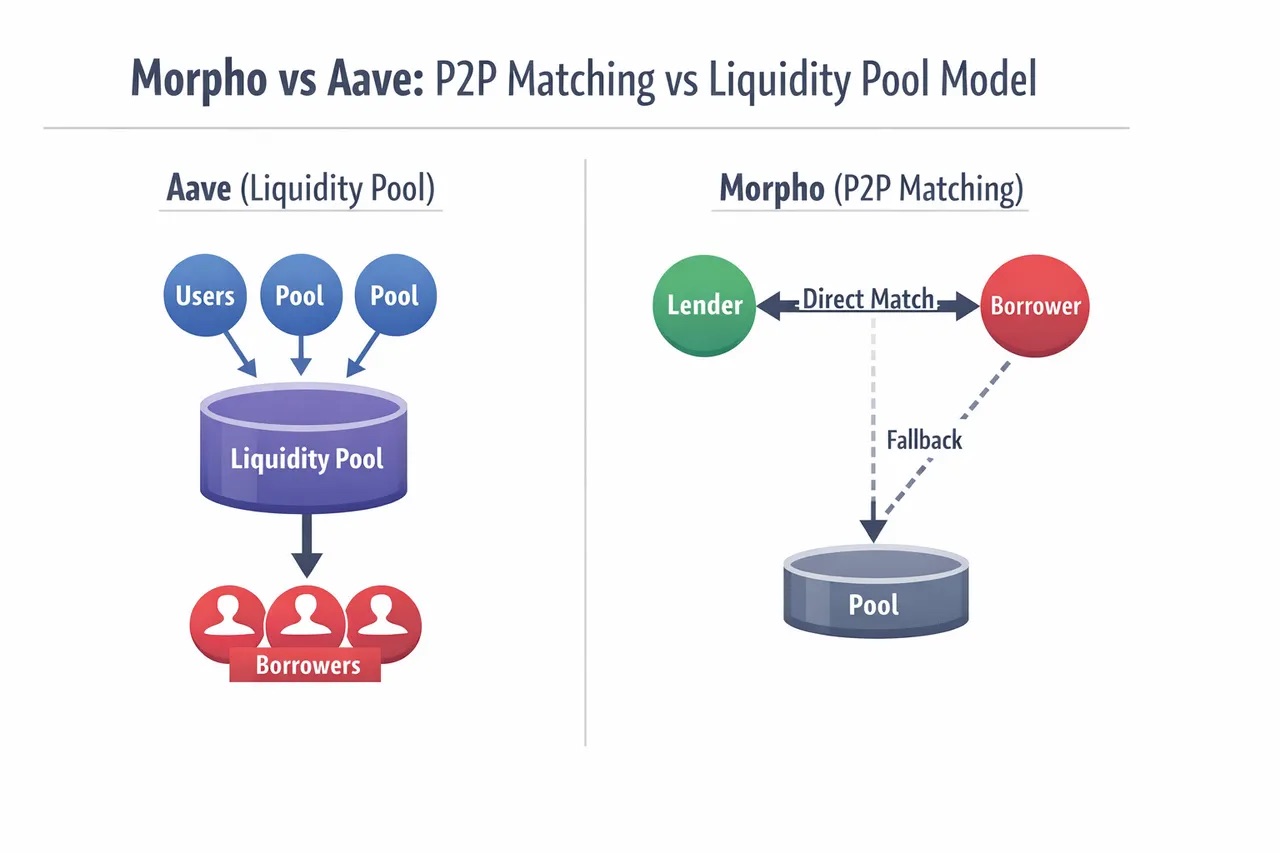
Source: Gate.com
Real-world data confirms the advantage: even after deducting curator fees, Morpho’s top USDC vault delivers higher yields to depositors than both Aave and Compound. Morpho’s current deposit-to-loan ratio stands at 41%, versus Aave’s 39%; and with Morpho’s vaults now managing billions in assets, this yield advantage compounds daily for all depositors.
Institutional Choice: Who Is More Trustworthy?
Surprisingly, all cryptocurrency lending services offered by Coinbase run atop Morpho. Related loan volumes now exceed $2 billion, and over 100 million Coinbase users indirectly benefit from Morpho’s yield-generating infrastructure.
Most users don’t even realize they’re interacting with DeFi. Coinbase neither built its own lending stack nor opted for another protocol—its core reason being Morpho’s architecture allows platforms to set custom risk parameters, select vetted risk curators, and retain full end-to-end control over product experience.
Apollo Global Management—a global asset manager with over $1 trillion in assets under management and 30 years of private credit expertise—recently signed a four-year agreement to acquire up to 90 million MORPHO tokens, representing 9% of total supply. Apollo will pledge tokenized fund assets as collateral on Morpho, with Gauntlet managing the treasury and conducting stress tests.
Beyond that, Anchorage Digital—the first native crypto bank chartered federally in the U.S.—has integrated Morpho vaults for its institutional clients managing over $10 billion. SG-FORGE—the regulated arm of French banking giant Société Générale—is the first licensed bank to deploy DeFi lending via Morpho.
These rigorously regulated traditional financial institutions collectively chose Morpho for one consistent, core reason: the isolated-market model enables them to meet compliance and risk requirements without relying on DAO governance. By contrast, Aave’s market rules are inseparable from community voting—making it wholly incompatible with institutional demands for autonomous risk control.
Evolving regulatory frameworks amplify this trend. The U.S. GENIUS Act prohibits stablecoin issuers from directly distributing yield, meaning stablecoin firms require neutral, underlying infrastructure to activate massive dormant asset balances. U.S. forecasts project that stablecoin reserves invested in U.S. Treasuries will surge from $120 billion today to over $1 trillion by 2028. This colossal capital pool urgently needs a lending infrastructure that empowers asset owners to govern risk autonomously—and Morpho is currently the best-fit solution.
Join TechFlow official community to stay tuned
Telegram:https://t.me/TechFlowDaily
X (Twitter):https://x.com/TechFlowPost
X (Twitter) EN:https://x.com/BlockFlow_News