








Why Isn’t Anyone Buying DeFi Insurance?
TechFlow Selected TechFlow Selected
Why Isn’t Anyone Buying DeFi Insurance?
Revenue is drained by premiums; underwriting capital is severely insufficient; and systemic risk remains unresolved.
 Navigating Web3 tides with focused insights
By: Thejaswini M A
Translated by: Luffy, Foresight News
“Insurance is pure fraud”—this is virtually the consensus across the market.
This perception isn’t entirely unfounded. Cigna, a U.S. insurer, developed an algorithm that denies claims without even reviewing medical records. UnitedHealthcare automatically stops reimbursing care costs once its algorithm-determined time window expires—completely disregarding physicians’ clinical judgments. The traditional insurance business model has always been: collect premiums from customers first, skim off hefty margins, then erect layered barriers to obstruct claims.
While bank deposits are protected by the Federal Deposit Insurance Corporation (FDIC), coverage caps at just $250,000—a limit set in 1934 and rarely adjusted since. Brokerage accounts fall under Securities Investor Protection Corporation (SIPC) protection, capped at $500,000; once account assets exceed this threshold, protection effectively vanishes. Public perception of safety vastly overestimates reality—the payout ceiling is unilaterally set by insurers.
DeFi insurance was poised to solve this pain point decisively: eliminating intermediaries, payouts execute automatically via smart contracts once pre-defined conditions trigger—fully removing human discretion and malicious claim denials.
Yet in practice, almost no one buys it. Premiums severely erode investment returns; after deducting premiums, net yields fail to justify the risk investors bear.
This article explains the current market reality—and why, despite universal desire to fix this problem, its core root causes remain stubbornly resistant to change.
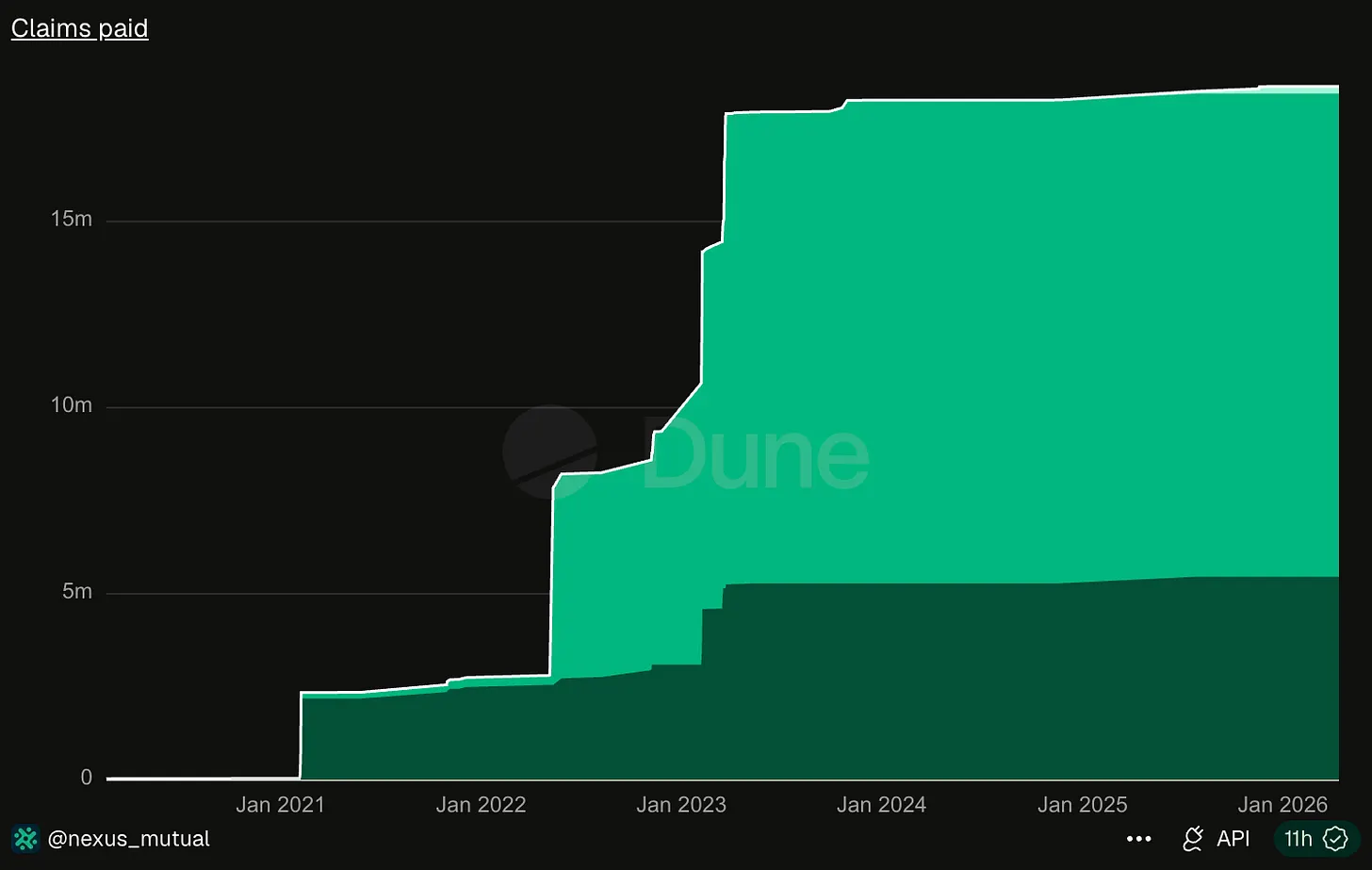
Nexus Mutual is currently the largest DeFi insurance provider. Since launching in 2019, its cumulative payouts total just over $18 million.
Source: Dune Analytics
In April 2026, Kelp DAO suffered a hack resulting in losses of $292 million—more than 16 times Nexus Mutual’s total payouts over seven years.
This stands in stark contrast to traditional insurance’s aggressive claim denials: charging high premiums while actively obstructing payouts. Meanwhile, DeFi insurance generates meager premium revenue precisely because almost no investors choose to buy coverage.
Traditional insurance remains viable primarily because risks are uncorrelated: if one household’s house burns down, it won’t trigger fires elsewhere. An insurer can sell policies to one million users; a single fire claim is easily covered by pooled premiums. DeFi lacks such risk isolation: oracle failures, cross-chain bridge vulnerabilities, and other security incidents cascade across all protocols and liquidity pools built atop the same underlying assets. During the March 2023 USDC depeg event, every protocol using USDC as collateral was simultaneously impacted. For DeFi insurance pools, risks are highly correlated—underwriters can only gamble that security incidents cause manageable losses and that pool capital suffices to absorb them.
In March 2023, Euler Finance lost $197 million to a hack; the contagion spread rapidly: Angle Protocol lost $17 million holding Euler liquidity tokens; Yield Protocol urgently suspended operations; Inverse Finance and several other platforms were also affected.
Once a protocol suffers a security flaw, multiple projects often get swept up—extreme single-day incidents can exhaust an insurance pool’s entire reserve.
I’ve compiled current premium rates for Nexus Mutual and InsurAce, comparing them against native annualized yields of their insured protocols: Aave V3’s USDC deposit yield sits around 3.14%, with premiums ranging 1.5%–2.5%; net yield after premiums drops to just 0.6%–1.6%. Investors bearing on-chain security risk end up with returns barely exceeding ordinary bank savings.
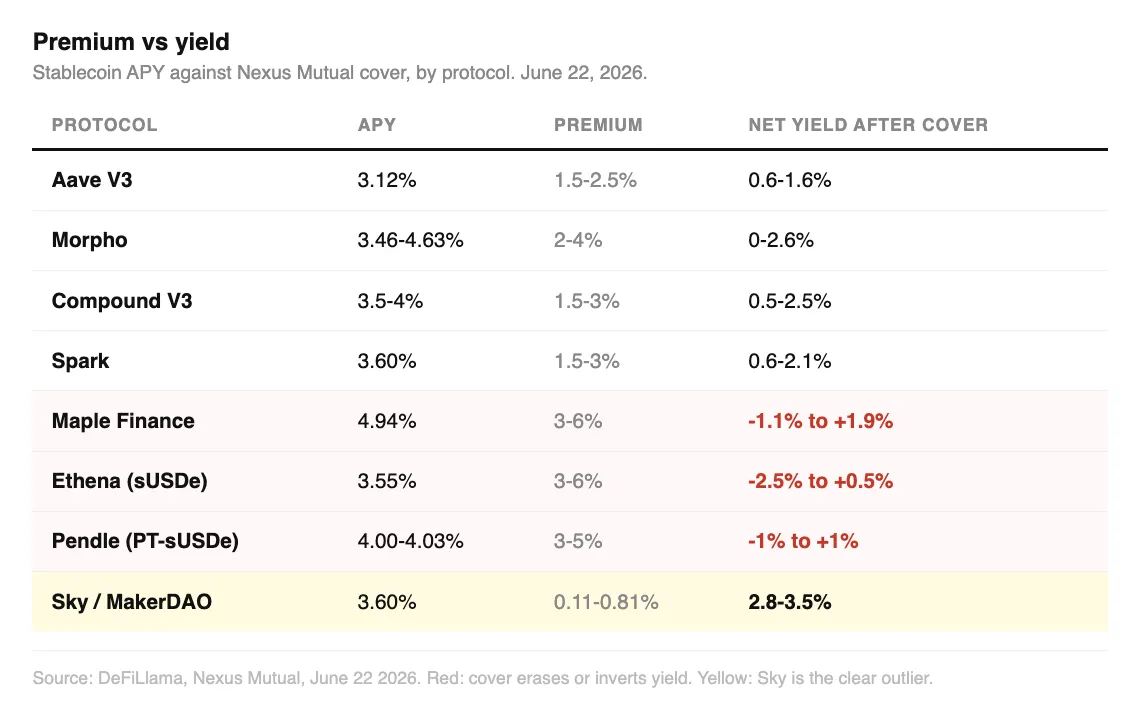
Morpho, Compound, and Spark show similar dynamics: native yields of 3.5%–4%, with premiums consuming one-third to half of returns—leaving only marginal profit, but extremely poor cost-benefit value.
Maple Finance’s institutional lending pools yield 4.77%–4.90%, yet insurance premiums hit 3%–6%, leaving net yields between -1.1% and 1.9%. Ethena’s staking yield ranges 3.6%–4%, with identical 3%–6% premiums, yielding net returns of -2.4% to 1%. Purchasing insurance on these platforms could—even in extreme cases—result in principal loss.
Only MakerDAO (Sky) stands out. Its savings product yields 3.6%, with insurance premiums as low as 0.11%—widely regarded as DeFi’s lowest-risk asset. Post-insurance net yields hold steady at 2.8%–3.5%, preserving most of the original return.
Premium pricing strictly reflects risk tiers—but for emerging platforms, premiums are so high they directly erase the very high yields investors seek.
Crypto investors opt out of insurance not out of laziness or recklessness—they know purchasing coverage often amounts to zeroing out returns. Even if every DeFi depositor bought full coverage tomorrow, the industry couldn’t meet demand: Nexus Mutual’s total pool size stands at ~$81.56 million; effective industry-wide coverage capacity maxes out at a few hundred million dollars, while locked assets across major protocols total hundreds of billions—supply-demand imbalance is astronomical.
A single Kelp DAO-scale incident would instantly drain most of the industry’s insurance reserves.
The $18 million historical payout total starkly exposes the fragility of insurance pools—the market has never faced a catastrophic risk event large enough to breach coverage reserves.
When users file claims with Nexus Mutual, payouts require voting approval from all platform token holders. Members voting “yes” face direct asset losses if claims ultimately fail to pay out. This mechanism inherently incentivizes claim denial. Traditional insurers employ dedicated underwriters and claims adjusters to balance competing interests—DeFi insurance collapses ownership, underwriting, and claims adjudication into a single group.
Before the 2008 financial crisis, risk-rating agencies widely deemed a nationwide U.S. housing collapse impossible—simply because they’d never witnessed one. Insurance giant AIG sold massive volumes of risk-protection contracts, yet proved utterly incapable of honoring them when crisis struck.
Prior to the U.S. government establishing FDIC bank deposit insurance, ordinary depositors had zero asset safeguards. The Great Depression forced policymakers to mandate bank insurance, making coverage a non-negotiable operational cost for banks.
In DeFi, no entity can compel protocols like Aave or Morpho to purchase insurance—smart contract deployment is permissionless, and no authority exists to enforce risk mitigation requirements. This leaves the industry without any systemic backstop against extreme market events.
Nexus Mutual’s three largest historical payouts were: ~$7.3 million split across two batches for the FTX collapse, $5 million for the TribeDAO hack, and $3.4 million for the Euler Finance attack—combined, nearly matching its seven-year cumulative payout total of $18.6 million.
Now, this mutual insurance platform is pivoting toward proactive risk prevention—partnering with security audit firms Immunefi, Cantina, and Sherlock to launch bug-bounty-backed coverage products. Protocol teams cover just 20% of critical-bug bounties; Nexus Mutual absorbs the remainder, front-funding rewards for white-hat hackers to identify vulnerabilities early and prevent breaches. Simultaneously, Nexus Mutual is pursuing compliant reinsurance arrangements—seeking to channel crypto risks into larger external reinsurance pools to bolster underwriting capacity.
In March 2025, Cantina went further, launching a standalone native-protocol coverage product: users receive payouts even if vulnerabilities go undetected by bounty hunters prior to a hack.
Both initiatives acknowledge one fundamental reality: on-chain capital alone cannot cover on-chain risk. Tiny pool sizes, highly correlated risks, and the conflation of claim adjudicators with capital providers represent three structural flaws that cannot be eliminated.
Per DeFiLlama, Nexus Mutual’s TVL stands at $81.56 million—accounting for 85% of the entire DeFi insurance sector’s market share. Competitors continue shrinking: InsurAce peaked at $150 million TVL but now holds just $132,000—completing only one major payout after the 2022 UST depeg; Sherlock’s pool shrank from $60 million to $505,000 within a year; Unslashed Finance’s multi-million-dollar funds remain trapped in outdated code last updated in late 2024. Other insurance projects have either shut down entirely or pivoted away from insurance.
A lighthouse warns ships of hidden reefs—but cannot charge passing vessels for its use. Thus, few voluntarily fund lighthouse construction: benefits accrue to all, while costs burden the builder alone.
The true value of DeFi insurance lies in halting cascading liquidation panic. Crypto assets are deeply interconnected; only universal coverage can sustain overall market stability. Yet if everyone expects others to shoulder insurance costs while refusing to pay themselves, no one will deploy coverage—and the risk-mitigation system collapses entirely. A safeguard no one voluntarily underwrites ultimately protects nothing.
Join TechFlow official community to stay tuned
Telegram:https://t.me/TechFlowDaily
X (Twitter):https://x.com/TechFlowPost
X (Twitter) EN:https://x.com/BlockFlow_News


