








With channel-based growth opportunities exhausted, what can DeFi protocols rely on to fend off encroachment by tech giants?
TechFlow Selected TechFlow Selected
With channel-based growth opportunities exhausted, what can DeFi protocols rely on to fend off encroachment by tech giants?
When giants move downward to harvest, DeFi can only break out laterally.
 Navigating Web3 tides with focused insights
By Thejaswini M A
Translated by Saoirse, Foresight News
In Goodfellas, Ray Liotta delivers a line: “Shut up and pay me.” This brutally strips away the romanticized moral veneer that films like The Godfather cast over organized crime—revealing its cold, parasitic, profit-obsessed essence. I’ll apply a similar logic to discuss Big Tech.
Control profits, and you control value. To achieve this, you don’t even need to build a public blockchain protocol or launch a project. It’s a rule-free battle for profit. Yet we can’t fault Coinbase, Stripe, or Kraken for making such choices.
At their core, their strategy mirrors shrewd real estate development: seize distribution channels first. Today, they hold sway over those channels—and from their elevated position, ask bluntly: “Who really holds the pricing power?”
Coinbase built its own blockchain; Stripe spent $1.1 billion acquiring infrastructure it could have rented; Kraken acquired a derivatives exchange for $1.5 billion; Apple built the App Store. The underlying logic is clear: let others pioneer markets and shoulder early-stage risks—then, once profitability becomes sufficiently attractive, absorb the foundational infrastructure yourself. The central question explored here is: where does the industry go when distribution channels cease to hold core value?
Coinbase commands 110 million verified users. For years, its user-facing lending products relied on the open-source protocol Morpho—with all protocol fees flowing directly to Morpho. Later, Coinbase launched its own Layer 2 blockchain, Base. Morpho chose to deploy on Base solely because of Coinbase’s massive user base and resulting transaction volume. Now, every transaction fee (known as “ordering fees”) generated on Base flows entirely to Coinbase—not Morpho.
Base generated $76 million in net ordering fee revenue in 2024 and $74 million in 2025. Prior to February 2026, Coinbase was contractually obligated to share part of this revenue with Optimism under its licensing agreement. But ultimately, Coinbase severed ties and switched to its own custom-built underlying architecture—retaining the full $64 million in revenue today. Meanwhile, Morpho remains deeply embedded on Base and continues thriving, with $2.5 billion in total value locked (TVL). However, Morpho must now share revenue from every transaction it processes with Coinbase.
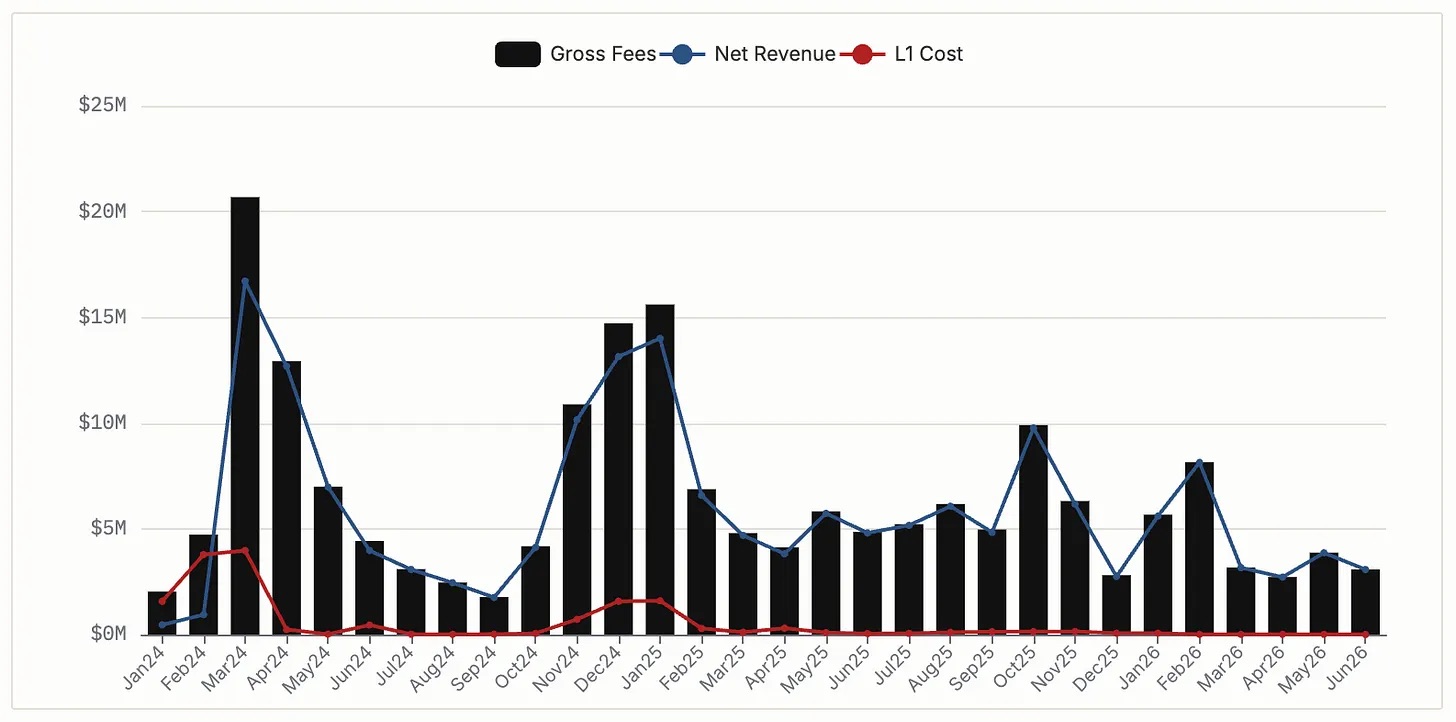
Base monthly ordering fee revenue. Source: DeFiLlama
Coinbase leveraged Morpho’s underlying architecture to launch a $300 million Bitcoin-backed lending product. Its wrapped Bitcoin token, cbBTC, is Morpho’s largest collateral asset—accounting for 38% of the protocol’s total TVL. This creates a mutual dependency: Morpho provides the core infrastructure powering Coinbase’s credit products, while Coinbase captures revenue shares from all of Morpho’s operations. Neither side can easily sever the relationship.
Now consider Stripe’s case: In early 2025, it acquired Bridge for $1.1 billion. Before that, Stripe’s stablecoin business relied entirely on Circle’s infrastructure. Circle retained the authority to issue stablecoins and earned floating interest income from reserve collateral. At the time, all revenue generated from Stripe’s trillion-dollar stablecoin transaction volume flowed straight to Circle. The Bridge acquisition completely reversed this dynamic. Bridge issues its own stablecoin, USDB, backed by BlackRock’s money market fund. After switching to USDB, the substantial interest yield from these reserves stays entirely within Stripe’s ecosystem. With annual payment processing volume reaching $1.4 trillion, Stripe had been losing hundreds of millions of dollars annually by leasing infrastructure from competitors.
Patrick Collison once dubbed stablecoins “room-temperature superconductors of finance.” Spending $1.1 billion to fully acquire this foundational infrastructure is far more economical than paying ongoing tolls to rivals.
Pure spot exchanges face inherent growth ceilings—users can only trade a few hundred tokens. But Kraken aims to attract institutional investors and sophisticated retail traders, who primarily engage via futures, options, and other derivatives. Launching derivatives services requires registration with the U.S. Commodity Futures Trading Commission (CFTC), membership in the National Futures Association (NFA), and a broker-dealer license—the entire compliance framework takes years to build. Even if Kraken attempted to build it from scratch, regulators could reject applications for any number of uncontrollable reasons.
That’s why Kraken targeted NinjaTrader. Its $1.5 billion acquisition in January 2025 brought not just 1.7 million funded trading accounts—but crucially, also delivered the full suite of broker-dealer licenses Kraken couldn’t rapidly develop in-house.
By acquiring pre-existing compliance credentials, Kraken eliminated dependence on external partners. It now owns both the full technical stack and regulatory licenses outright—no reliance on third parties, no multi-year wait for regulatory approvals.
Some may argue: “Don’t big corporations always absorb small protocols? What’s new here?”
Morpho’s total TVL stands at $6.4 billion—$3.308 billion deployed on Ethereum and $2.488 billion on Base. If Coinbase were to delist Morpho and replace it with an in-house lending protocol, Morpho would immediately lose 39% of its TVL. Yet it would retain 52% on Ethereum—and continues expanding across multiple chains including Hyperliquid L1, Monad, and Arbitrum, ensuring overall operational stability.
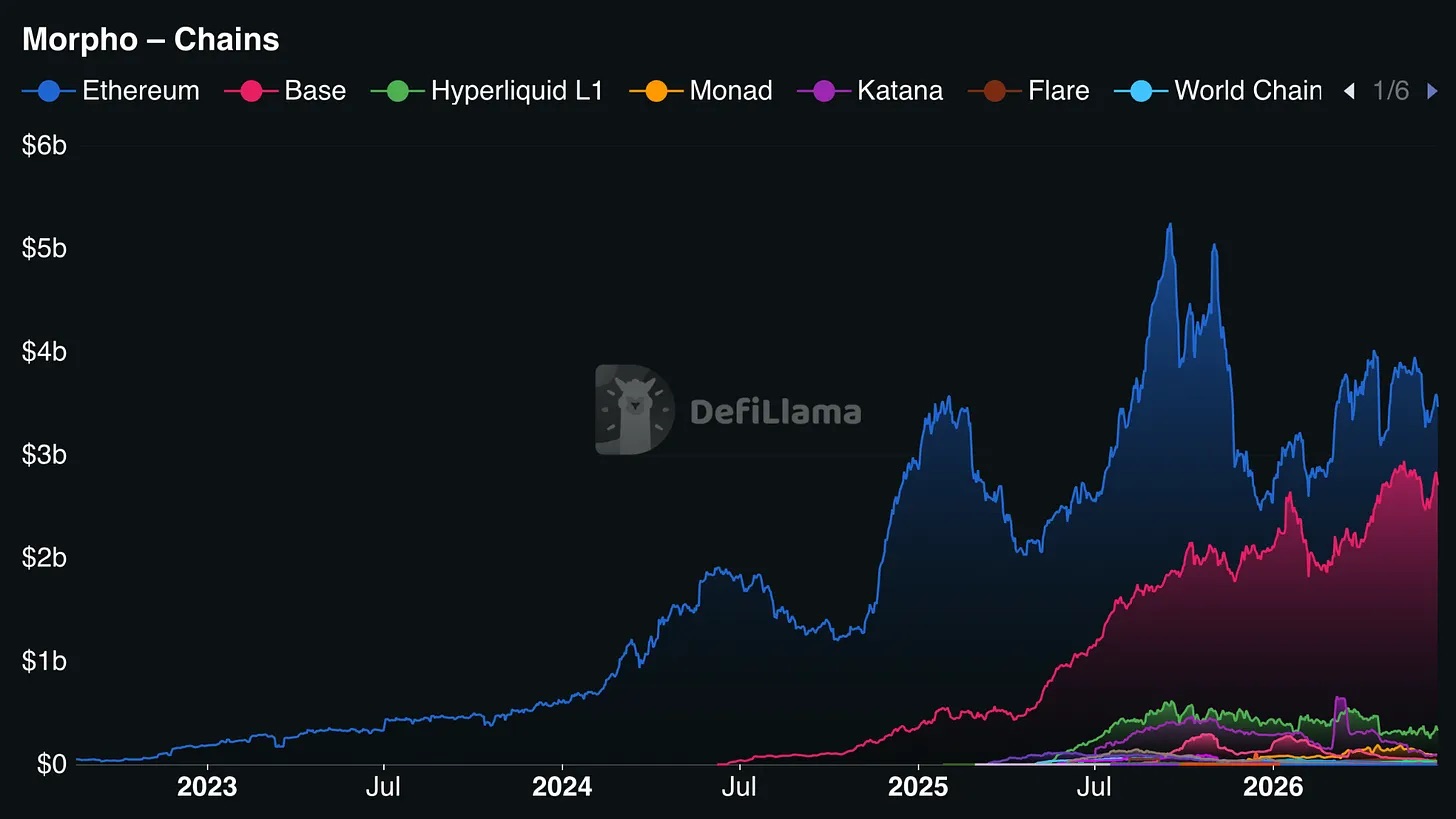
Morpho’s TVL distribution across blockchains. Source: DeFiLlama
The Aerodrome case on Base vividly illustrates how chain operators’ promotion of native competitors reshapes the industry. Aerodrome is Base’s native decentralized exchange (DEX), architected specifically for Base. Coinbase Ventures holds approximately $20 million worth of AERO tokens—the largest liquidity token investment in its portfolio. Meanwhile, project contributors lock AERO tokens to vote on directing liquidity toward Coinbase-owned products—including the cbBTC pool. Aerodrome handles roughly 51% of Base’s DEX trading volume, peaking at 77% in September 2024. Uniswap—the cross-chain DEX deployed across 44 blockchains—is Base’s second-largest DEX, commanding 30% of trading volume. Even after losing its dominant position on Base, Uniswap hasn’t vanished: in 2025, it processed $212 billion in trading volume on Base alone, with estimated monthly cross-chain volume around $73 billion.
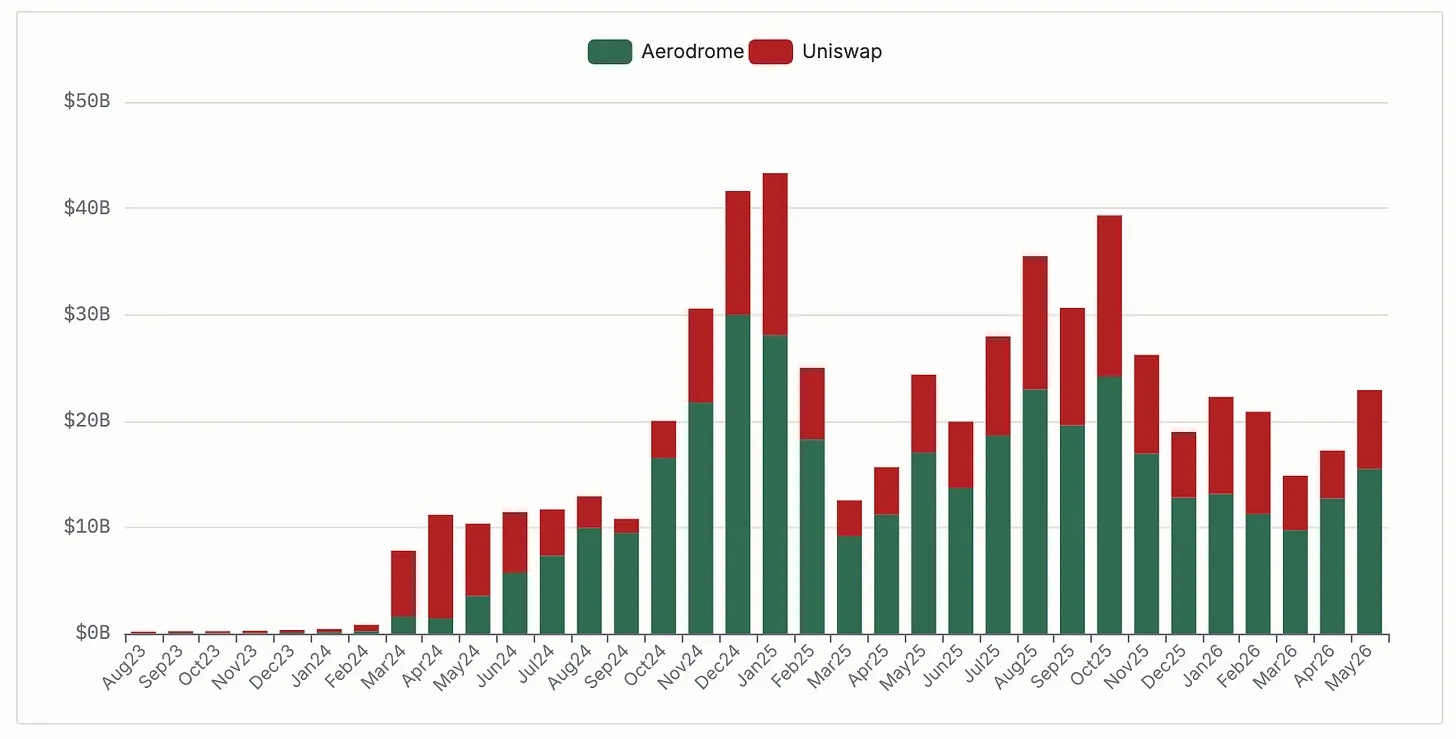
DEX trading volume share on Base. Source: DeFiLlama
This case confirms: multi-chain deployment is a protocol’s natural moat. Projects deployed exclusively on a single chain are entirely at the mercy of the chain operator—who can unilaterally promote competing products to squeeze out your market share. By contrast, multi-chain protocols can sustain operations even if they lose ground on one chain. Observing Uniswap’s traffic erosion on Base due to Aerodrome, Morpho rapidly expanded across multiple chains. Large traffic platforms can vertically integrate downward into infrastructure; open-source protocols counter by horizontally diversifying risk across chains.
If you rely on infrastructure you don’t own, you don’t truly control your business. The party controlling the infrastructure holds overwhelming pricing power—it defines your product experience and ultimately dictates your operational stability. For enterprises of this scale, such dependency erodes profits daily. This commercial logic isn’t unique to crypto: Amazon built its moat on AWS; Apple, once constrained by Intel’s chip roadmap, invested years developing its own custom silicon to break free.
Everyone can instantly verify exactly how much Coinbase earns from Base’s ordering fees—and clearly track Morpho’s TVL across chains. This value capture is fully transparent, unlike internal infrastructure profits at traditional internet giants like Amazon.
A potential industry trajectory looms: future markets become fully dominated by a handful of giants—Coinbase, Stripe, Kraken, and a few banks—controlling the entire stack from base-layer protocols to payment cards. Open-source protocols would serve merely as stopgap solutions filling narrow niches not yet addressed by these giants. This is a perfectly plausible path for fintech. Open-source technology would no longer be fertile ground for unfettered innovation—but rather function as duct tape applied to tiny cracks where giants haven’t yet decided how to monetize. As one quip goes: “Look at this high-quality open-source protocol—we’ll just build a commercial layer on top and harvest its traffic.”
Yet I lean optimistic: analyzing recent acquisitions, full monopolization seems less probable than it appears. Base-layer protocols are difficult for giants to monopolize like traffic channels. Morpho can deploy on a new chain in weeks; a battle-tested, institutionally embedded lending protocol carries prohibitively high replacement costs—costs outsiders rarely grasp. Coinbase’s $300 million Bitcoin lending product still relies on Morpho because replicating Morpho’s security architecture from scratch would take years—and introduce unacceptable security risks.
Protocols surviving this wave of corporate consolidation share one critical trait: achieving comprehensive multi-chain deployment *before* traffic giants build their own ecosystems—and embedding deeply into enterprise backend systems so deeply that replacing them becomes economically untenable. Even Robinhood—a traffic giant with massive user reach—chose to integrate Lighter, a third-party zero-knowledge perpetuals exchange, as its trading infrastructure. Robinhood Ventures participated in Lighter’s $68 million funding round, and founder Vlad Tenev maintains close communication with the team.
Had only traffic channels conferred competitive advantage, Robinhood could have followed Coinbase’s path and built everything in-house. It didn’t—because combining centralized-exchange speed with zero-knowledge verifiability of matching logic is an extremely specialized technical challenge. Lighter’s team spent over a year solving it. Robinhood determined that licensing proven technology was significantly more cost-effective than building from scratch.
Currently, Morpho occupies this advantageous position of mutual leverage; Uniswap pioneered this path. The pace of institutional expansion versus the speed of open-source protocols’ horizontal, multi-chain scaling will ultimately determine the industry’s structural outcome.
Stripe, Coinbase, and similar giants still rely on open-source technology for their foundational layers. In the short term, open-source protocols remain secure—but two years from now, the landscape may look very different. We’ll reassess then.
Join TechFlow official community to stay tuned
Telegram:https://t.me/TechFlowDaily
X (Twitter):https://x.com/TechFlowPost
X (Twitter) EN:https://x.com/BlockFlow_News


