








Singapore Releases New Crypto Regulations, Drawing a Line Between Compliance and Survival for Web3
TechFlow Selected TechFlow Selected
Singapore Releases New Crypto Regulations, Drawing a Line Between Compliance and Survival for Web3
Is it a retreat or a defense?
 Navigating Web3 tides with focused insights
By陀螺财经
With strong support from the United States, global regulators appear to be relaxing oversight of cryptocurrency markets—yet one country is moving in the opposite direction.
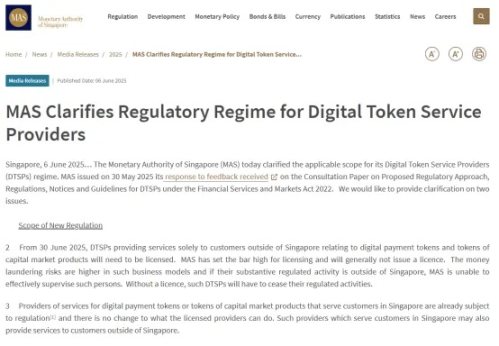
On May 30, the Monetary Authority of Singapore (MAS) released its final policy guidelines for Digital Token Service Providers (DTSP), announcing that new DTSP regulations will officially take effect on June 30. Under the new rules, all crypto service providers registered or operating in Singapore must cease offering services to overseas clients by June 30, 2025, if they have not obtained a DTSP license.
The move caught the crypto market off guard. Local industry players are voicing concerns, and talk of a "Web3 exodus" from Singapore has begun circulating. Is this a retreat or a defensive stance? A well-planned strategy or an authoritarian crackdown? The abrupt regulatory shift has stirred market turmoil, as compliance becomes a global imperative and the industry inevitably follows suit.
01 Regulatory Advantage Fuels Singapore’s Rise as a Web3 Hub
Four years ago, during China’s sweeping crypto industry purge and before Hong Kong issued its virtual asset policy declaration, Western dominance in the crypto sphere was on the rise. Chinese Web3 entrepreneurs flocked to Singapore as their next safe haven.
The reasons were straightforward. Singapore served as an ideal gateway to Western markets, combining economic prosperity with political stability. For Chinese entrepreneurs, the cultural environment was also more familiar. As a result, talent, projects, investment firms, and supporting institutions converged in Singapore, making it a hotspot for Chinese Web3 investments. At the time, over 47 cryptocurrency exchanges were based in Singapore, with major platforms like Coinbase, Binance, and FTX establishing their Asia-Pacific headquarters or R&D centers there. Industry leaders even treated Singapore as a personal refuge: CZ once held long-term residency, while Wu Jihan became a permanent resident.
At the heart of this growth was Singapore’s open regulatory framework. In 2019, Singapore introduced the Payment Services Act, clearly defining licensing requirements for digital tokens. Companies providing crypto exchange and related services were required to apply for licenses—either as a “Money-Changing” licensee, a “Standard Payment Institution,” or a “Major Payment Institution”—depending on the nature and scale of their operations. In 2020, Singapore published its Crypto Offerings Guidelines and proposed the Financial Services and Markets Bill, laying the foundation for clear licensing and accountability in the crypto space. At that time, while China had imposed outright bans, U.S. regulators were embroiled in jurisdictional disputes, and Europe struggled with fragmented regulations, Singapore stood out as the only jurisdiction offering a relatively open, clear, and stable regulatory environment—including temporary exemptions allowing certain payment services.
Yet this very Singapore—the beacon of crypto-friendly regulation—on May 30 released the final DTSP policy guidelines, followed by a final response document to the consultation on DTSP regulation under Part 9 of the Financial Services and Markets Act 2022. The message was unequivocal: no license, no service—and with no transitional period offered, industry participants were thrown into panic.
02 A Regulatory Cliff? Singapore Enacts Its Toughest Rules Yet
First, the claims of a “mass exodus” or “cliff-like regulation” are somewhat exaggerated. Signs of tighter crypto regulation in Singapore have been evident for some time. In 2022, MAS introduced the Financial Services and Markets Act, with Part 9 establishing the DTSP licensing regime—the first such framework in Singaporean law. That June, Singapore’s fintech policy chief stated the country would take “ruthless and relentless action” against bad actors in the crypto industry.
The collapse of FTX at the end of 2022 was a pivotal moment. The fallout exposed a chain of implicated investors, including Temasek Holdings, Singapore’s sovereign wealth fund. Due to its FTX exposure, Temasek was forced to write off a $275 million investment. In response, the Singapore government acknowledged reputational damage and even imposed salary cuts on the investment team and senior executives involved.
In May 2023, the Financial Services and Markets (Amendment) Act was passed, enhancing customer information sharing among financial institutions to combat money laundering and terrorist financing. By August of the same year, stablecoins were formally brought under regulatory oversight.
In 2024, MAS launched a consultation paper outlining its regulatory approach, rules, notices, and guidelines for digital tokens. The language was telling: “Given the internet-based and cross-border nature of digital token services, Digital Token Service Providers (DTSPs) are more susceptible to money laundering/terrorist financing (ML/TF) risks… The primary risk DTSPs pose to Singapore is reputational risk—that is, the potential harm to Singapore’s reputation if they are involved in or misused for illicit purposes.”
Finally, on June 30 this year, the DTSP regulations officially took effect. Looking back at this regulatory evolution, there was in fact a three-year preparation window, with clear and progressive signals from the government—hardly a sudden or “cliff-like” enforcement.
Globally, licensing frameworks are central to crypto regulation, as seen in the U.S., Hong Kong, and Europe. Singapore’s earlier Payment Services Act similarly used licensing as a core control mechanism. So why has this seemingly routine license requirement caused such upheaval? The answer lies in regulatory arbitrage.
The crypto industry operates globally, but regulations are typically territorial—creating opportunities for arbitrage. Obtaining a license in a jurisdiction with lenient oversight and then serving global clients became standard practice. Under Singapore’s previous rules, while domestic operations faced strict requirements, overseas services were loosely regulated. Registered Singapore entities could freely serve international clients—a perfect fit for crypto’s borderless nature. This flexibility was precisely why so many exchanges chose Singapore.
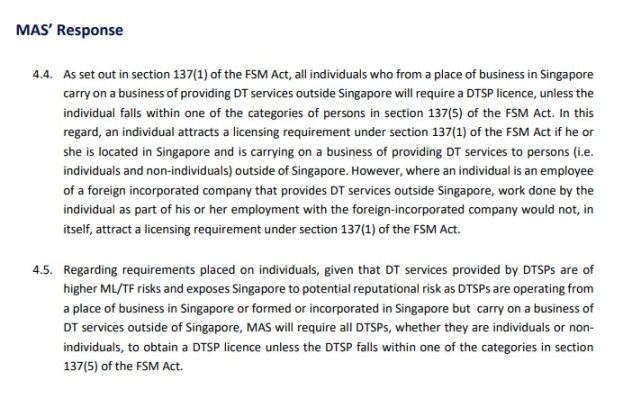
This loophole, however, ends with the new rules. The DTSP framework is exceptionally stringent. First, the scope is broad and inclusive: any individual or entity operating in Singapore with a physical presence, regardless of where services are delivered, must obtain a DTSP license if engaged in digital token activities. Second, the definition of “place of business” is expansive—officially defined as any location used for conducting business, including temporary or mobile setups like street stalls. This provision specifically targets remote and home-based crypto operations. Third, regulated activities cover nearly the entire value chain: from token issuance, custody, brokerage, trading, settlement, payment transfer, governance validation, to custodial technology development—excluding only technical consulting and marketing. In practice, no part of the industry is left unregulated.
Beyond the scope, the licensing bar is set extremely high. MAS has made it clear that DTSP licenses will be granted only in “exceptionally limited circumstances.” Applicants must demonstrate a sound business model, operational practices that avoid regulatory conflicts—meaning they must also be licensed in their operating jurisdictions—and meet organizational standards, including governance frameworks and capital adequacy. The difficulty is evident in the numbers: during Singapore’s 2021 crypto boom, over 500 firms applied for licenses. Four years later, only 33—such as BitGo, Circle, Coinbase, GSR, Hashkey, and OKX SG—are listed on MAS’s official website as licensed DTSPs, reflecting a success rate below 10%.
Notably, some exemptions exist. Entities already licensed under Singapore’s Securities and Futures Act, Financial Advisers Act, or Payment Services Act do not need to reapply for a DTSP license but must comply with new audit and risk management requirements. This benefits firms that secured licenses during earlier, more lenient periods. According to the MAS website, companies like COBO, ANTALPHA, CEFFU, and MATRIXPORT are on this exempt list. Additionally, individuals working remotely for overseas-registered entities and serving only foreign clients do not require a license—unless they operate locally in Singapore, in which case they fall under the new rules.
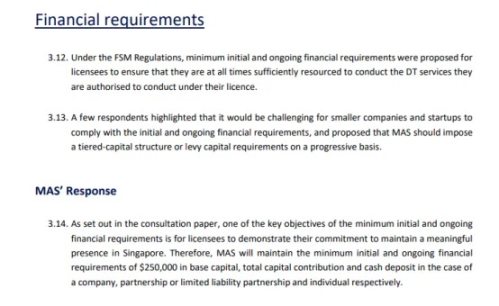
In short, any unlicensed entity within the regulatory scope that fails to act swiftly faces shutdown by June 30. As shown above, this affects nearly the entire industry chain. For startups, the burden is especially heavy: a minimum paid-up capital of 250,000 SGD and annual licensing fees of 10,000 SGD. Such high costs mean another wave of migration is inevitable. Not only individual professionals but also some crypto exchanges are considering relocation. “Compared to other regions, Singapore never had a cost advantage. With tightening compliance, some exchanges may move to Hong Kong for strategic reasons. Individuals have more options—lower-cost Southeast Asian countries, Dubai, or Japan. Even without these new rules, the number of professionals leaving Singapore has been rising in recent years,” said a crypto employee at a Singapore-based exchange.
Hong Kong has seized the opportunity to launch its own talent recruitment campaign. Recently, Hong Kong legislator Wilson Ng posted on social media: “Since Hong Kong issued its virtual asset declaration in 2022, we’ve actively welcomed industry players to develop here. Informal estimates show over a thousand Web3 companies have already established in Hong Kong. If you’re currently in Singapore and considering relocating your headquarters and team to Hong Kong, I’m happy to assist. Welcome to Hong Kong!” What appears to be a single regulatory update could thus have far-reaching implications for the global crypto landscape.
03 Small Players Exit, Large Institutions Take Center Stage
From a policy standpoint, Singapore’s move is resolute. It accepts the imminent loss of projects due to strict regulations, clearly signaling zero tolerance for regulatory arbitrage. The policy serves as a wake-up call for Singapore’s local Web3 ecosystem: the era of leniency is over; tightening is the new norm. Through high compliance costs, Singapore aims to eliminate small-scale and gray-market projects, explicitly encouraging well-backed, financially robust, and reputable enterprises to settle in. Sustainable and healthy industrial development is Singapore’s ultimate goal.
Why, then, is Singapore so determined to tighten regulation? Beyond its legalistic governance philosophy, the key reason is that negative externalities now outweigh industrial benefits. From a national perspective, while the crypto sector appears to grow, its decentralized nature and global operations yield significantly lower tax revenue compared to traditional industries. Meanwhile, crypto-related fraud and illicit activities continue to rise. According to data from the Singapore Police Force, cryptocurrency scams surged from about 6.8% of fraud cases in 2023 to approximately 24.3% in 2024—a worsening trend. Notably, cryptocurrencies played a significant role in Singapore’s recent billion-dollar money laundering case. Low taxes, high crime rates, and competition for domestic resources leading to internal tensions—all these factors make Singapore’s tough regulatory stance both understandable and justified.
In fact, this mirrors China’s regulatory rationale. Compared to Singapore, China faces greater population size and regulatory complexity, with even higher levels of policy arbitrage. As a result, China adopted a stricter, blanket ban. Singapore, by contrast, retained limited market access to balance regulation and innovation.
Singapore’s shift reflects a broader global trend. For the crypto industry, the compliance wave is unstoppable—compliance is no longer optional but mandatory. In the past, global crypto firms pursued strategies centered on finding regulatory havens, clustering in gray zones. But today, with clear regulatory frameworks now established in the U.S., Europe, Hong Kong, and Singapore, only those embracing compliance and stepping into the light can achieve sustainable, long-term growth. Compliance increasingly defines the industry’s character: large institutions will dominate in bargaining power and competitiveness, while startups face immense pressure. From mainland China to Hong Kong, then to Singapore, and now possibly onward again—constant migration isn’t necessarily alarming for startups. The real challenge lies in identifying the most suitable ecosystem aligned with their business models.
Join TechFlow official community to stay tuned
Telegram:https://t.me/TechFlowDaily
X (Twitter):https://x.com/TechFlowPost
X (Twitter) EN:https://x.com/BlockFlow_News






