








Beijing officially announces a new compliant solution for handling virtual currencies in cases
TechFlow Selected TechFlow Selected
Beijing officially announces a new compliant solution for handling virtual currencies in cases
Rarely made official.
 Navigating Web3 tides with focused insights
Author: Liu Honglin
On June 5, the Beijing Municipal Public Security Bureau's legal affairs public account "Fa Qing Yuan" published an article detailing the bureau's innovative "Beijing Model"—disposing of seized virtual currencies through compliant, licensed exchanges in Hong Kong. This approach achieves a closed-loop transition from on-chain to off-chain, ensuring both legal compliance and operational efficiency and security.
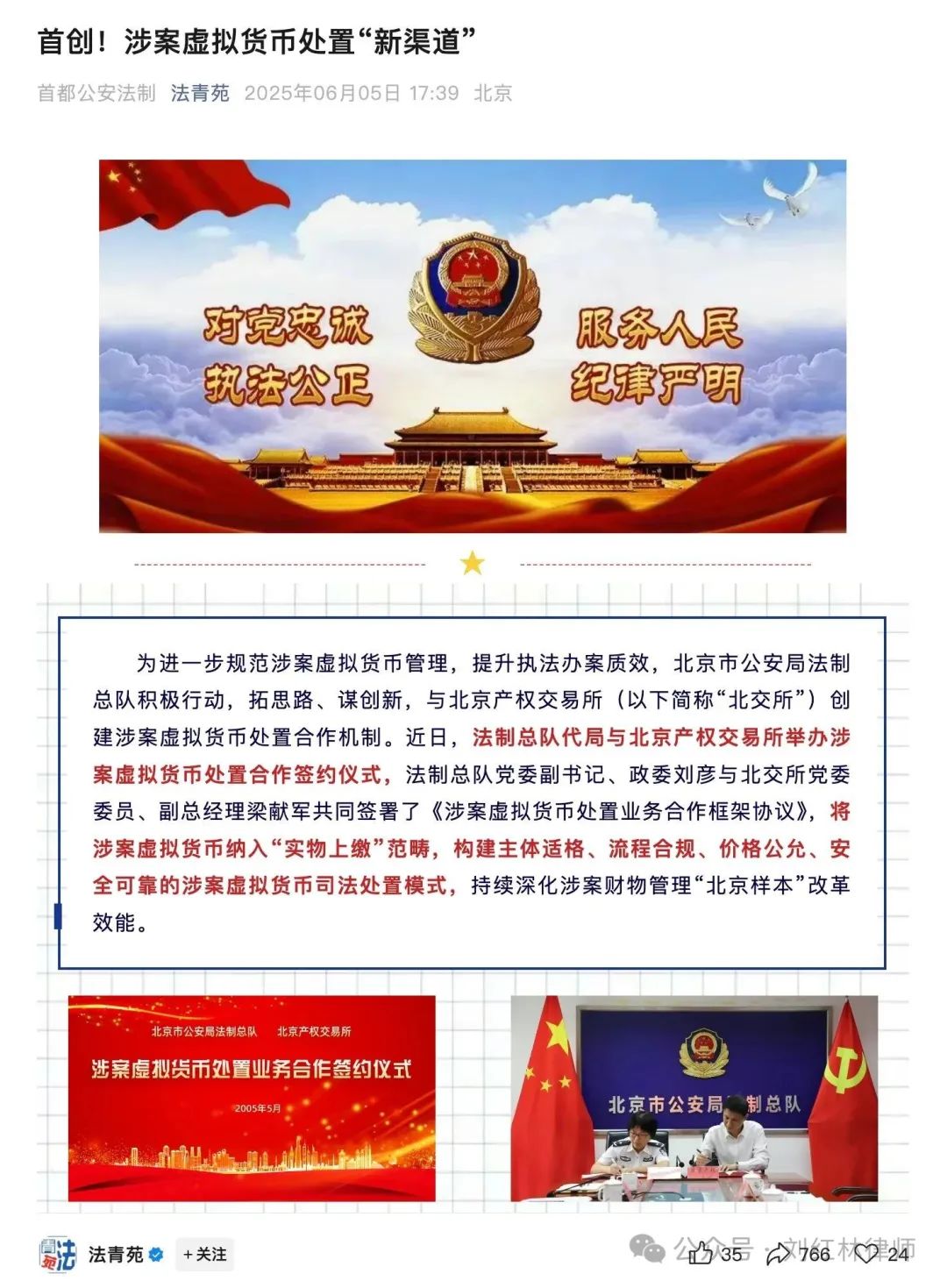
According to the article from "Fa Qing Yuan," the Legal Affairs Brigade of the Beijing Municipal Public Security Bureau, in collaboration with the Beijing Property Rights Exchange, has pioneered a new channel: law enforcement first entrusts seized virtual currency assets to the Beijing Property Rights Exchange for inspection, receipt, and transfer. The assets are then publicly sold via licensed virtual asset exchanges in Hong Kong—such as OSL Exchange and HashKey Pro. After the transaction is completed, funds go through state foreign exchange management approval procedures before being converted into RMB and deposited into the police force’s special account for seized assets, ultimately remitted to the national treasury. To date, the Beijing Property Rights Exchange has handled a cumulative total of 5.468 million seized items.
Based on information shared by Liu Yang, a Beijing-based lawyer (WeChat official account: Zhongben Law. Highly recommended!), several key details underpin this process:
First, full technical support is provided by the First Research Institute of the Ministry of Public Security, with the entire disposal procedure recorded via audio and video to ensure safety and compliance. This work is specifically carried out by Beijing Zhongtianfeng Security Protection Technology Co., Ltd., a wholly-owned subsidiary of the institute.
Second, Zhongtianfeng collaborates with institutions within the CITIC Bank system—including CITIC Bank Beijing Branch, its Hong Kong branch, Hong Kong trust entities, and other non-banking financial institutions. Non-bank institutions such as trusts are required because banks can only conduct interbank business and cannot directly open institutional accounts at Hong Kong exchanges for disposal operations. Zhongtianfeng and CITIC Bank jointly developed a "Virtual Currency Disposal and Fund Repatriation Clearing System," which has already been deployed on the internal police network and officially registered with and approved by the People's Bank of China and the State Administration of Foreign Exchange.
Third, the cooperation between the Beijing Municipal Public Security Bureau and the Beijing Property Rights Exchange is not unique. For example, the Suzhou Municipal Public Security Bureau works with Suzhou Bidai Digital Asset Service Center, a local state-owned enterprise. This indicates that the model is highly replicable.
The "Beijing Model" resolves the longstanding issue of being unable to directly liquidate seized virtual currencies within mainland China, while also addressing the risks and challenges associated with cross-border handling in judicial practice. By leveraging compliant, licensed exchanges in Hong Kong for monetization, coupled with strict regulatory oversight and approvals, it enables seized virtual assets to return "cleanly" from blockchain to fiat and smoothly enter the national treasury—a commendable achievement both legally and regulatorily.
However, upon closer examination of the operational chain of the "Beijing Model," one critical component stands out: the licensed virtual asset exchanges in Hong Kong, which serve as the pivotal link and the most trusted venue in this entire process.
This raises an important question: Why has Hong Kong become the ideal destination for such cross-border disposal?
Liu Honglin previously explored this topic in depth in his article "ManQin Law | The Biggest Demand for Hong Kong Cryptocurrency Exchanges Actually Comes from Mainland China". Interested readers are encouraged to read further.
Overall, Hong Kong’s domestic user base for virtual assets is actually quite limited. Although Hong Kong regulators established a licensing regime for virtual asset trading early on and allow compliant platforms to serve both professional and retail investors, the local market has struggled to sustain a complete trading ecosystem due to difficulties in bank account access, low public awareness, and limited user scale.
Theoretically, Hong Kong-licensed exchanges can serve global users, but in reality, international users are largely locked into dominant platforms like Coinbase and Binance. Competing globally would be extremely difficult. Rather than fighting for market share abroad, a smarter strategy for Hong Kong exchanges is to leverage their advantage as a “regulatory interface” and focus on serving “non-traditional markets”—especially mainland China.
The opportunity stems from mainland China’s firm stance on cryptocurrencies: there will be no comprehensive opening of cryptocurrency investment or public trading markets for retail investors, now or in the future.
The core reason behind this goes beyond concerns about “high risk” or “immature technology.” It lies in a higher-level institutional framework—the country’s foreign exchange control system. As long as China’s capital account remains non-convertible, tools inherently capable of facilitating cross-border capital flows, such as crypto assets, cannot be freely permitted. This isn’t a decision any single department can make; it’s a hard institutional red line.
Therefore, rather than chasing retail users, forward-thinking Hong Kong exchanges should explore opportunities within institutional gaps—such as judicial asset disposal and Cross-boundary Wealth Management Connect (WMC). These represent the most promising use cases.
And these, precisely, constitute the biggest market opportunities for Hong Kong’s cryptocurrency exchanges.
In recent years, virtual currencies have increasingly appeared in criminal cases and civil disputes. Whether it's court-ordered asset division or virtual currencies seized by police, there is growing demand for a compliant exchange capable of completing a verifiable, end-to-end "on-chain to off-chain" process—and Hong Kong is uniquely positioned to fulfill this role. It is close to China’s judicial system, possesses a mature licensing regime, ensures compliance, and solves real-world problems.
Due to my professional involvement, Attorney Honglin has participated in numerous judicial disposal projects involving seized virtual currencies. Without disclosing sensitive information, he can share a few examples from pilot documents issued by provincial public security departments to help illustrate the sophistication and complexity of this mechanism.
For instance, when managing seized virtual currencies, law enforcement must immediately disconnect the suspect wallet from the internet using signal jamming or similar methods to prevent asset transfers. Seized virtual currencies must be transferred to qualified custodians to prevent unauthorized access via private keys or seed phrases.
During the disposal phase, authorities require that non-stablecoins first be exchanged into stablecoins before being converted into foreign fiat currency. Complete transaction records and documentation must be preserved to ensure fair pricing, traceability, and auditability.
For virtual currencies located overseas, law enforcement must engage overseas qualified custodians or disposal agents who hold local financial licenses and meet mainland China’s compliance standards. These partners must be verified and approved by the cyber security department of the Ministry of Public Security before cooperation can begin.
After monetization, similar to the Beijing Model described earlier, international balance of payments reporting and fund repatriation declarations must be completed with the central bank and SAFE before the funds can be credited to domestic accounts for settlement and final disposition.
This end-to-end regulatory framework ensures the legality and compliance of judicial disposal while providing sufficient safeguards and traceability for future audits.
The existence of such detailed internal guidelines not only reflects the judiciary’s high level of attention to virtual currency disposal but also underscores the dual defense lines of national financial security and data security. It further confirms that cryptocurrency disposal is far more than just a niche concern for crypto enthusiasts—it is a national-level systemic project.
And at the heart of this project lies Hong Kong.
To some extent, whether Hong Kong can become a global crypto finance hub depends not on technological prowess or user numbers, but on its ability to consistently play the role of a “compliant intermediary” at the edge of China’s institutional boundaries. After all, the Beijing Model makes one thing clear: within a lawful and compliant framework for judicial disposal and fund repatriation, Hong Kong’s role is indispensable.
Join TechFlow official community to stay tuned
Telegram:https://t.me/TechFlowDaily
X (Twitter):https://x.com/TechFlowPost
X (Twitter) EN:https://x.com/BlockFlow_News






