Compliance is the coming-of-age ceremony for the underground economy.
TechFlow Selected TechFlow Selected
Compliance is the coming-of-age ceremony for the underground economy.
Looking for the Next Arbitrage King
 Navigating Web3 tides with focused insights
By: Zuo Ye
In 2017, Binance rapidly rose to become the world’s largest exchange through regulatory arbitrage. Yet by 2025, the far more permissionless Hyperliquid captures only 15% of Binance’s market share. Does tokenized real-world assets (RWA) as the foundational asset source for DeFi offer any viable space—or scalable future—for regulatory arbitrage?
Compliance has become the dominant theme of 2026. Offshore exchange Binance has officially gone onshore under the Abu Dhabi Global Market (ADGM) regulatory framework; Coinbase has secured both the GENIUS Act and the Clarity for Digital Assets Act; even the Eastern superpower has begun “principled” experimentation with RWA regulation.
We stand at a definitive inflection point. Blockchain will not replace the internet; Web3 is merely an arrogant illusion. The “listing effect”—whereby listing a token automatically drives its price—ended when Binance purchased Bitcoin. Yet Hyperliquid is gaining traction in precious metals and prediction markets, while RWAs—including stablecoins (“coins”), U.S. equities (“stocks”), U.S. Treasuries and subordinated debt (“bonds”), and hedge/actively managed funds (“funds”)—are now being tokenized at the right moment.
Against this backdrop, compliance transcends the ceremonial function of “holding a small-country license to exploit large-country advantages.” It evolves into a genuine structural framework separating trading, clearing, and custody. When the industry breaks past scale constraints, regulatory compliance becomes profitable.
Amidst silence, compliance signals not only the end of the previous era of frenzied growth—but also heralds thunderous opportunities: certain sectors still harbor arbitrage potential for scaling up.
Let us begin with exchanges to explore the economic considerations beyond compliance.
Wall Street Civilization, Barbarian Frenzy
Barbarian conquerors, following an eternal historical law, are themselves conquered by the higher civilization of the peoples they subjugate.
In 2022, FTX collapsed in dramatic fashion. Wall Street briefly entertained ambitions of capturing the exchange sector: Castle Securities, Fidelity, and Charles Schwab jointly launched EDX Markets in Singapore, operating under the Monetary Authority of Singapore (MAS)’s compliant framework—and adhering strictly to the principle of separating trading and custody.
As Gary Gensler-led SEC intensified its crackdown on Binance, Coinbase and Kraken retreated into the U.S. spot market, remaining unable to enter sophisticated markets such as derivatives and options. At that time, EDX Markets drew high expectations from the market.
Absent unforeseen developments, we should have witnessed Binance’s demise—akin to BitMEX after March 12, 2020. But history never repeats itself. Hyperliquid emerged as the true winner; the degraded Binance and the perpetually hunkered-down Coinbase failed to claim center stage in the next act.
To understand the winners’ success, we must first grasp the losers’ failures.
After its founding in 2017, Binance got at least two things right:
- While actively embracing globalization, it continued serving users from mainland China—creating a seesaw dynamic between trading volume and user scale;
- In 2019, it launched IEOs (Initial Exchange Offerings), generating tangible wealth effects well before the DeFi Summer.
Following China’s September 4, 2017 ban, providing trading services to mainland Chinese users entered a “gray zone.” A third regulation—specifically targeting crypto exchanges—prohibited them from offering quotation, order matching, and clearing services. As seen in He Yi’s response to Cathie Wood, Binance would likely respond with “we do not serve users from mainland China.”
From 2017 to 2019, Binance solidified its position as the world’s leading offshore exchange. From 2020 to 2022, it filled the derivatives market void left by BitMEX. From 2022 to 2024, it dominated the global altcoin market—where “listing” effectively meant “listing on Binance.”
Entering 2025, Binance formally adopted ADGM’s regulatory framework, splitting itself into three distinct entities: trading, clearing, and OTC. Yet this structure retains Binance’s signature arbitrage flavor.
Notably, compliance did not prevent Binance’s listing team from adding meme coins. Moreover, neither ADGM nor the broader UAE financial system possesses the capacity to regulate a behemoth like Binance—just as The Bahamas proved powerless against FTX’s global operations.
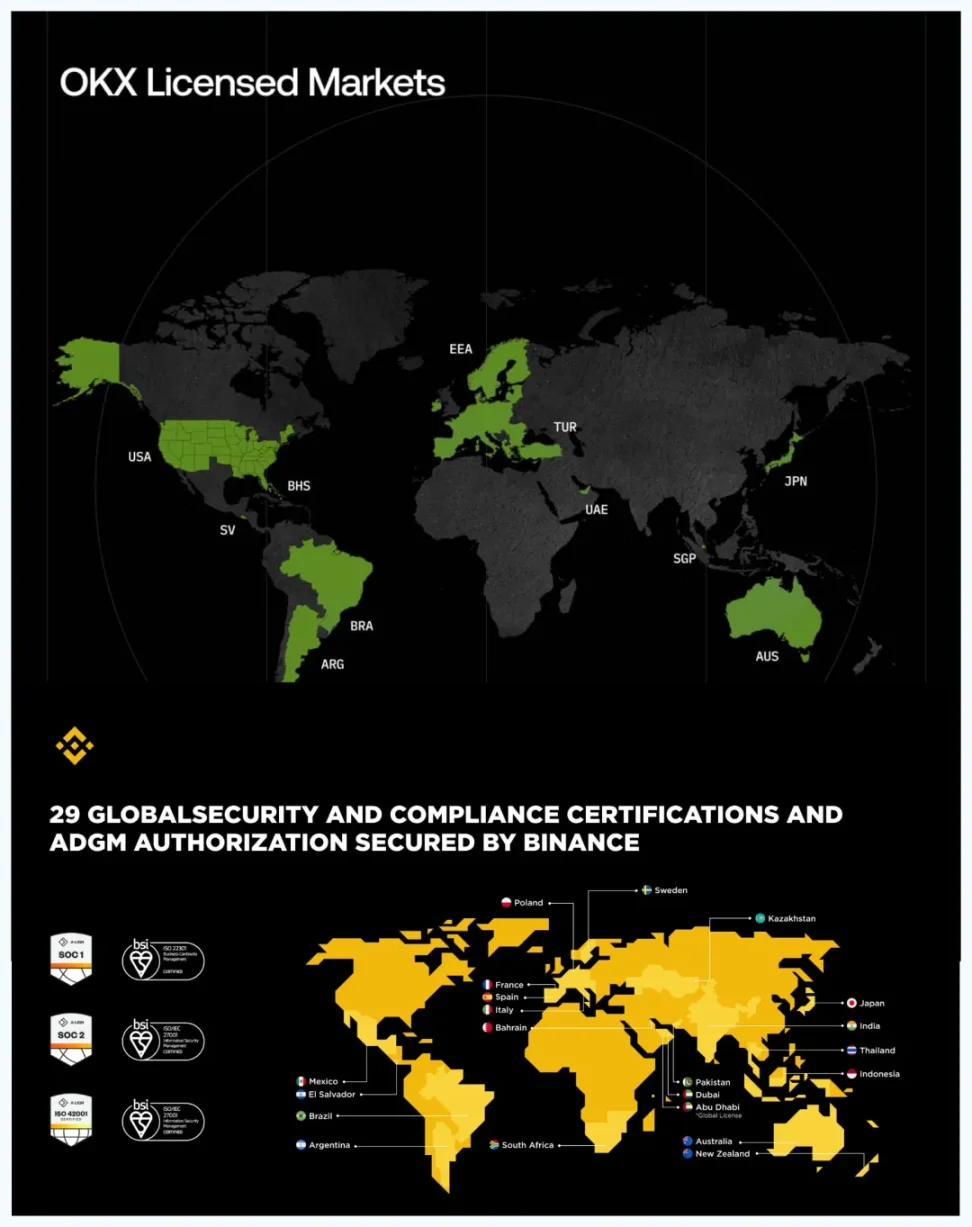
Caption: “Passing the civil service exam” is the only way to go onshore. Source: @binance @okx
After FTX’s collapse, Coinbase became the most compliant exchange—but this compliance stems from Trump-era reforms to the SEC, CFTC, and OCC, pushing them toward crypto-friendly regulation.
Broadly speaking, the SEC determines whether a given token qualifies as a security; the CFTC oversees derivatives trading; the OCC issues bank charters enabling custodial services. The U.S. lacks an ADGM-style “crypto exchange license,” instead regulating by business type.
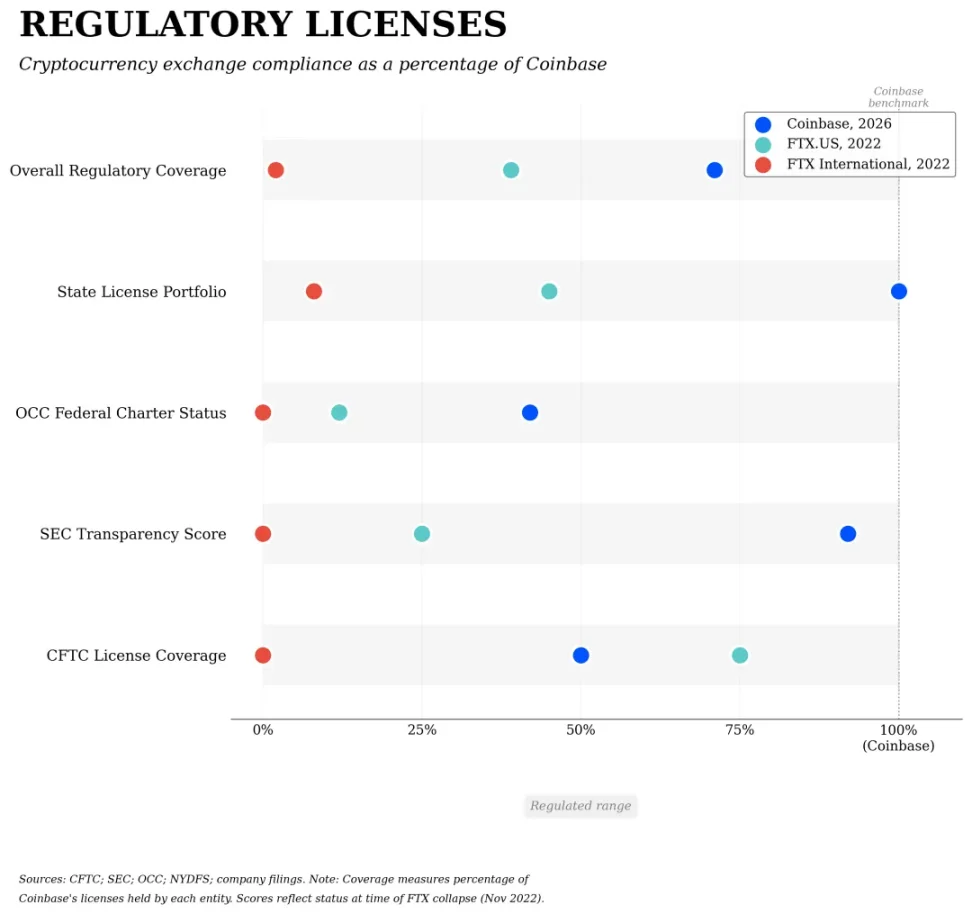
Caption: Regulatory progress. Source: @zuoyeweb3
This regulatory architecture remains under construction—but it is certain that Coinbase will shape the U.S. compliance framework, covering listings (spot and derivatives), trading (spot and derivatives), custody (retail and institutional), clearing/settlement (fiat and crypto), auditing (technical and asset), and insurance (fiat and crypto).
Binance’s ADGM licensing and Coinbase’s U.S. licensing are fundamentally different concepts—the latter places Coinbase squarely within regulators’ supervisory scope.
Regulation serves to clarify rules—not protect retail investors. For instance, institutional clients using Coinbase’s custody services enjoy bankruptcy-remote protection via Coinbase Custody Trust Company.
But retail deposits held at Coinbase fall under Coinbase Inc. If fiat, those deposits may be covered by FDIC insurance through partner banks; crypto assets, however, risk suffering the same fate as FTX’s collapse.
For example, FTX Token (FTT) buyers were deemed equity holders and received minimal legal protection during claims—a situation mirrored at Coinbase. The sole silver lining is that Coinbase has avoided a bank run.
Hyperliquid Enters the RWA Space “Unlicensed”
Human progress will no longer resemble that terrifying pagan deity who could drink sweet wine only from cups made of murdered victims’ skulls.
Regulatory arbitrage persists. In crypto trading, EDX’s U.S.-based peer Hyperliquid also launched in Singapore—and is steadily eroding Binance’s global market share and Coinbase’s U.S. dominance.
This can be termed “second-order arbitrage”: Binance arbitrages global regulations; Hyperliquid arbitrages Binance.
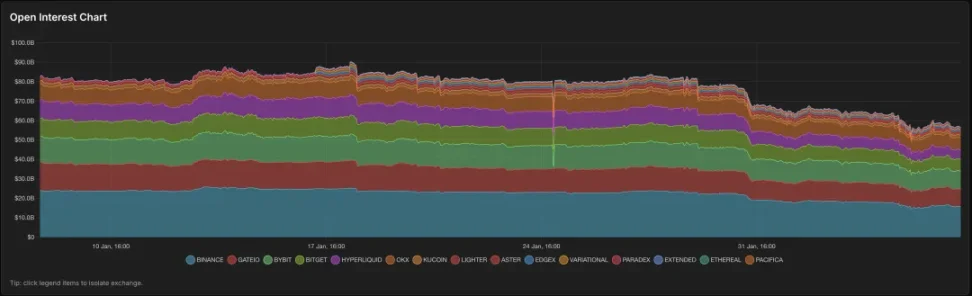
Caption: CEXs and DEXs remain neck-and-neck. Source: @LorisTools
Hyperliquid blocks U.S. IP addresses—but this restriction is largely ineffective. Compare: U.S. users cannot realistically open accounts on Binance’s global platform—they’re confined to Binance.US.
Coinbase initially permitted U.S. users to trade derivatives, but its derivatives volume was virtually non-existent. Thus, in this peculiar gray zone, Hyperliquid captured a segment of European and North American users outside both Binance and Coinbase—offering derivatives services.
Crucially, Hyperliquid’s arbitrage cannot replicate Binance’s growth miracle or mimic Coinbase’s capture of the U.S. compliant market—it likely caps out at ~15% of Binance’s market share.
As Hyperliquid expands into non-traditional areas—precious metals, prediction markets—its impact on global financial markets intensifies. If the U.S. can regulate Binance and Tornado Cash, Singapore won’t resist action against Hyperliquid.
Ultimately, most “underground economy” models cannot achieve scale. Take USDT: its reserve transparency and circulation restrictions have tightened markedly. Evidence includes hackers sparing USDT during the Bybit breach—and freezing “black USDT” post-Huiwang case.
- Huiwang underpins Cambodia’s—and much of Southeast Asia’s—underground economy, yet Cambodia cannot bear the cost of FATF’s “gray list” designation for money laundering.
- Binance supports a BNB Chain ecosystem dominated by altcoins—but geopolitical pressure between China and the U.S. prevents Binance from accessing higher-quality financial assets.
This reflects America’s low-regulatory-cost advantage. U.S. economic sanctions hinge less on the dollar or the military than on its status as the world’s largest single consumer market and primary financial hub. Severing Cambodia or Binance from U.S. ties risks turning them into another North Korea.
Hence Binance pays dearly for compliance—and Hyperliquid’s compliance is merely a matter of time.
This raises an extended question: Can RWA replicate crypto trading’s trajectory—preserving itself through regulatory arbitrage while scaling into fully compliant frameworks?
This hinges on two premises: Hyperliquid is unlikely to surpass Binance in crypto trading, and equally unlikely to match Coinbase’s level of compliance.
If we’d stood in 2017, even CZ might not have believed CEXs were the future. Looking backward: stamp-collecting platforms, P2P lending, O2O, and ofo were all fleeting fads. Looking forward: DeFi yield farming, NFTs, GameFi, and SocialFi all fizzled out.
Thus, Binance and BNB should be viewed as project-based ventures—their luster sustained solely by recurring wealth effects, destined for premature termination like successive financial bubbles.
Yet network effects liberated trading from crypto’s confines—extending across all financial domains—and thus converged with broad-based RWAs. Stablecoin yield challenges CBDCs; asset-backed securitization inevitably moves toward tokenization.
For instance, the Eastern superpower’s new regulatory guidelines represent spillover from U.S. financial influence—rewriting onchain finance in unexpected ways.
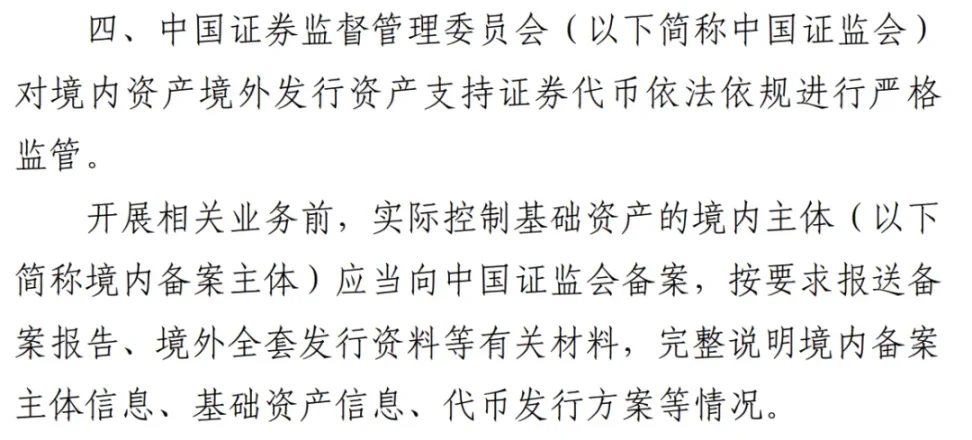
Caption: “Flowers bloom outside the wall.”
Caixin interprets the Eastern superpower’s new regulatory measures as covering four categories: foreign debt, equity, asset securitization, and others. Yet in my view, only the securities tokenization pathway holds real significance—aligning with the reform goal of “securitizing all assets.” Specifically:
- The lead regulator is the CSRC (China Securities Regulatory Commission);
- Issuance requires prior CSRC approval;
- Only cross-border issuance—from domestic issuers to overseas investors—is permitted.
Moreover, this securities tokenization guidance explicitly mandates compliance for both rights and returns—mirroring the SEC’s evolving push for native “stock tokenization.” Offshore RMB stablecoins, foreign debt, and fund tokenization present unique circumstances:
- Offshore RMB stablecoins exist (e.g., Tether’s involvement), but lack practical utility and generate negligible volume;
- Tokenized foreign debt and funds are already live—fully isolated from domestic assets and issued exclusively to overseas clients—rendering them outside the scope of this guideline.
The current regulation targets cross-border issuance of domestic assets—emphasizing strict separation: “Overseas stays overseas; domestic stays domestic.” Regulatory oversight applies only where the two intersect.
In today’s RWA landscape, China and the U.S. are already engaged in de facto “land-grabbing.” This liquidity overflow onto blockchains is sufficient to reshape the global financial order.
Conclusion
An industry’s destiny depends not only on self-effort—but also on the course of history.
CZ himself may not have believed CEXs were the future—even Bitcoin, he might argue, is just one phase of a new pyramid scheme, destined to vanish like P2P lending or high-interest loan apps.
Yet no one anticipated CEXs surviving until 2026—or Hyperliquid storming into precious metals and prediction markets—while still failing to overtake Binance.
If Hyperliquid adds RWA to its arsenal, can it finally reach the other shore?
Join TechFlow official community to stay tuned
Telegram:https://t.me/TechFlowDaily
X (Twitter):https://x.com/TechFlowPost
X (Twitter) EN:https://x.com/BlockFlow_News
 @zuoyeweb3