Meme Coin Sell-Off Sparks Risk Aversion Amid Pump.fun Token Launch Rumors – Is It Deserving of the Title "Solana's Number One Toxic Element"?
TechFlow Selected TechFlow Selected
Meme Coin Sell-Off Sparks Risk Aversion Amid Pump.fun Token Launch Rumors – Is It Deserving of the Title "Solana's Number One Toxic Element"?
As news of Pump.fun launching a token spread once again, Solana's already fragile liquidity defense on-chain was breached, shattering the market confidence still in recovery and quickly escalating risk-averse sentiment across the chain.
 Navigating Web3 tides with focused insights
Author: Nancy, PANews
With renewed rumors of a token launch by Pump.fun, Solana's already fragile liquidity defenses have been breached, shattering market confidence still in recovery and rapidly intensifying on-chain risk-averse sentiment.
The On-Chain Slot Machine: Only 3.6% of Users Have Profited Over $500
Recently, speculation about Pump.fun’s imminent token issuance has stirred the market once again. According to Blockworks, citing multiple insiders, Pump.fun plans to raise $1 billion through a token sale at a $4 billion valuation, with tokens offered to both public and private investors. Although the official launch date remains unconfirmed, hints from the platform’s social media accounts suggest it could go live within two weeks.
This is not the first time such rumors have surfaced. As early as February this year, Wu Talk Blockchain reported that Pump.fun intended to conduct a Dutch auction-style token launch via centralized exchanges (CEX), having already provided detailed preparation documents to these platforms. However, at that time, market liquidity was heavily drained by meme coins launched by Trump and his wife Melania, causing the plan to ultimately fall through. Now, with slightly improved market conditions, Pump.fun’s token issuance appears back on the agenda.
Yet, this so-called on-chain "money printer" now faces a significant decline in market enthusiasm.
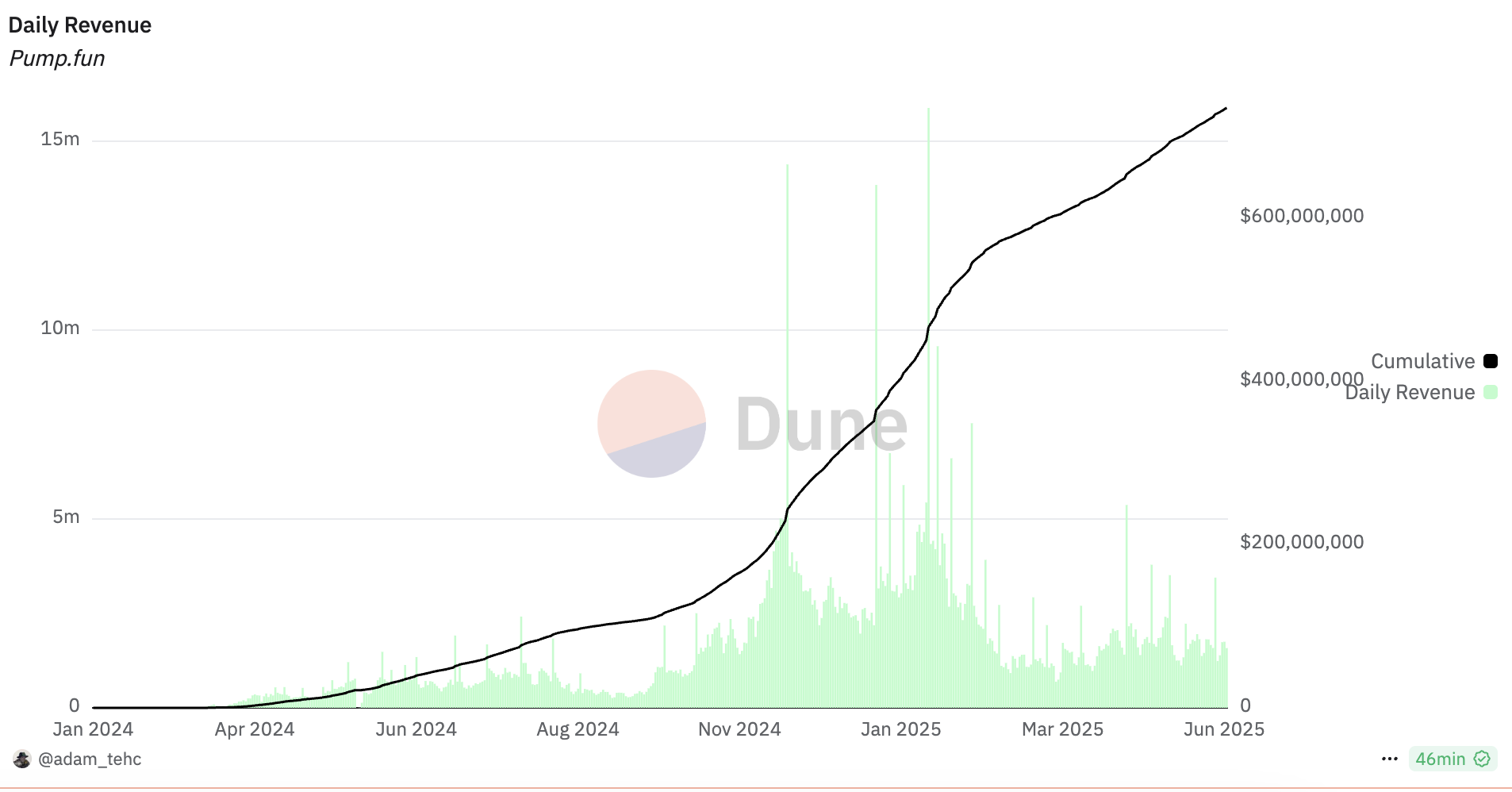
Data from Dune shows that as of June 4, the platform has generated over $730 million in cumulative revenue, with daily income peaking near $15 million. However, since February 2025, revenue growth has noticeably slowed, with current daily earnings mostly stabilizing in the multi-million dollar range.
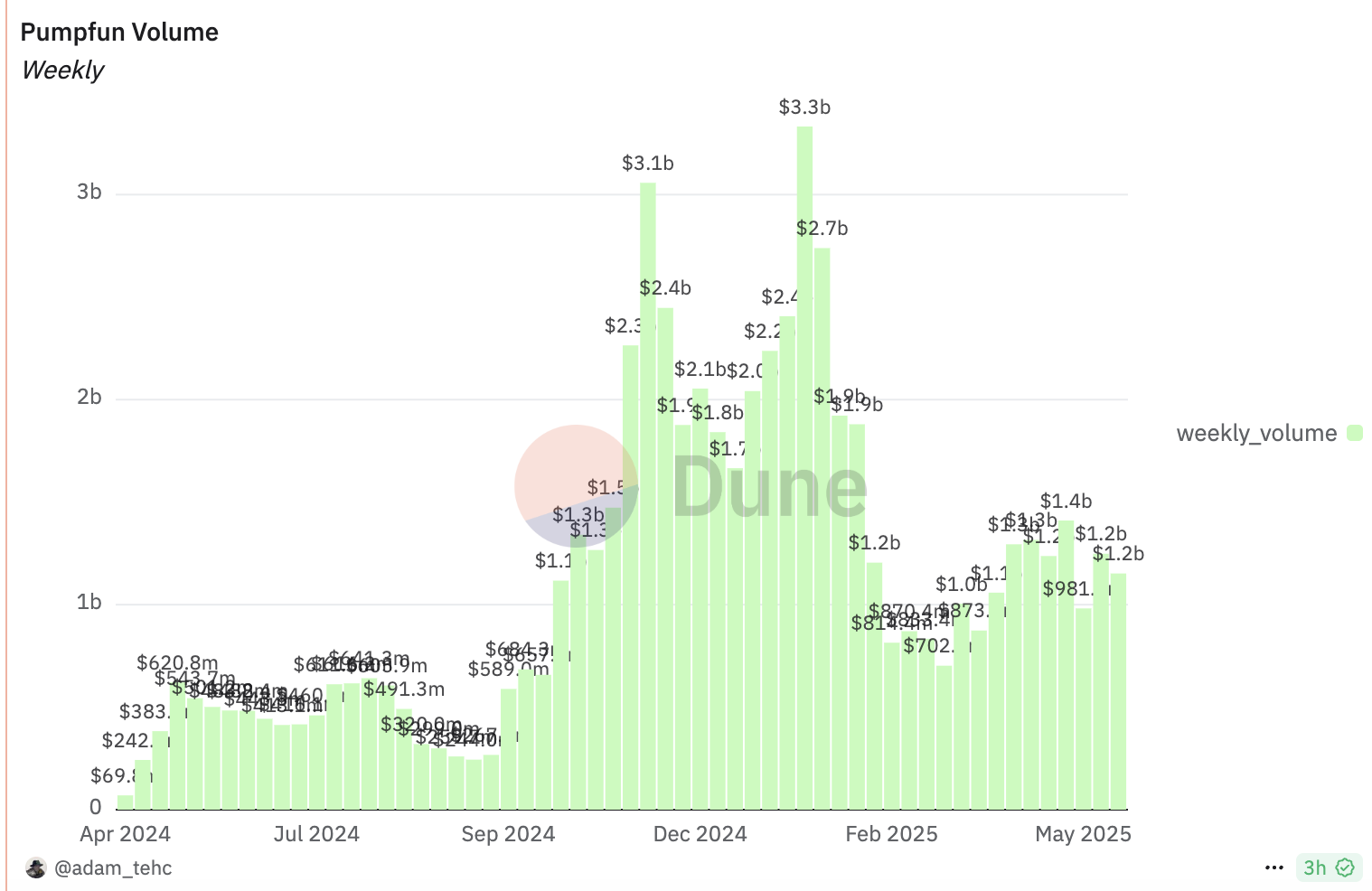
In terms of trading volume, Pump.fun hit a record weekly high of $3.3 billion at the end of 2024. While there were several rebounds into the $1 billion range afterward, it has struggled to regain its former peak. This weakening liquidity trend has undermined platform热度 and user engagement to some extent.
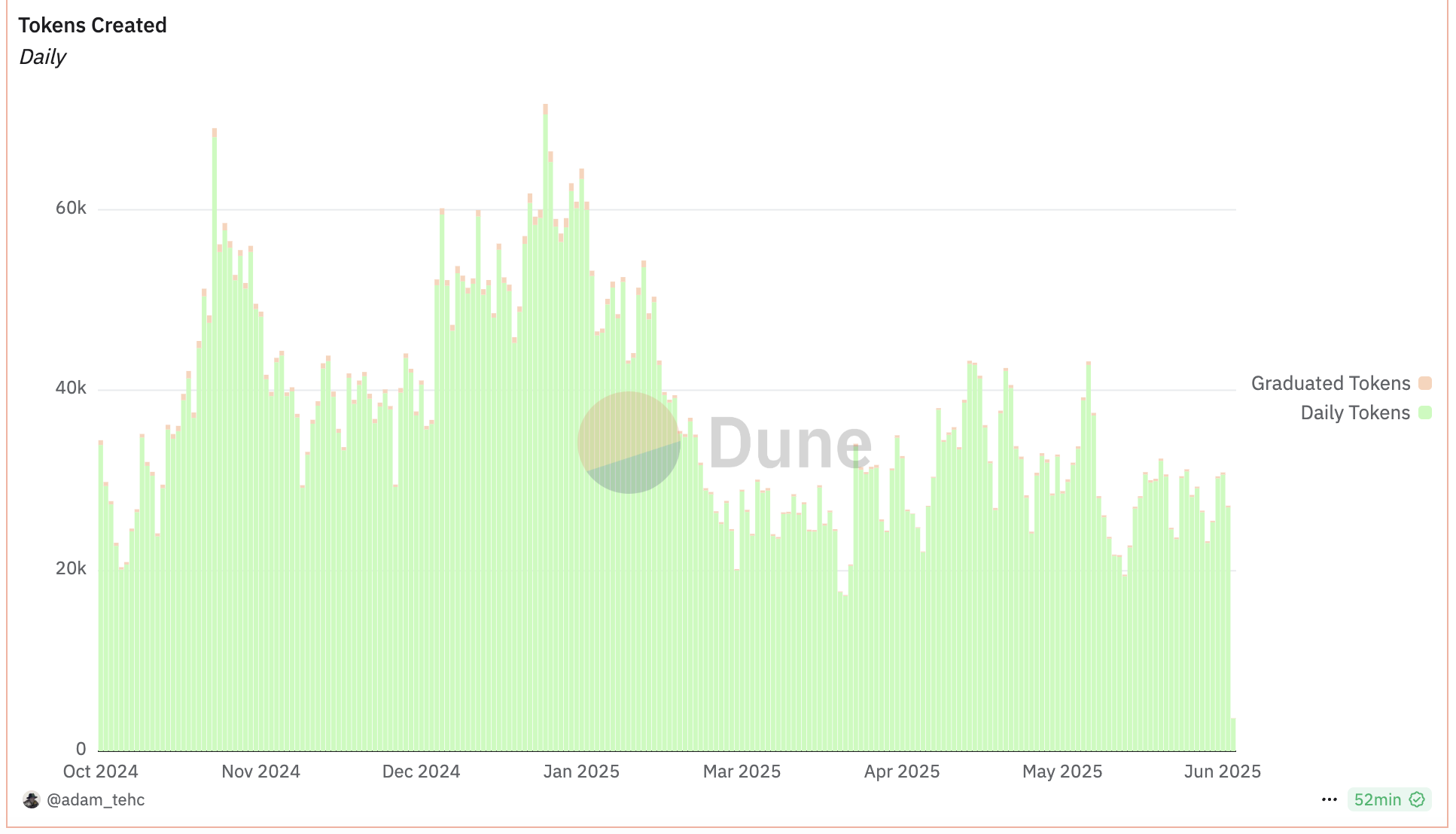
Regarding token creation, Pump.fun has created over 11.02 million tokens to date, with a single-day peak of 70,000 tokens in January 2025. The figure has since dropped to around 30,000 per day, indicating waning user interest.
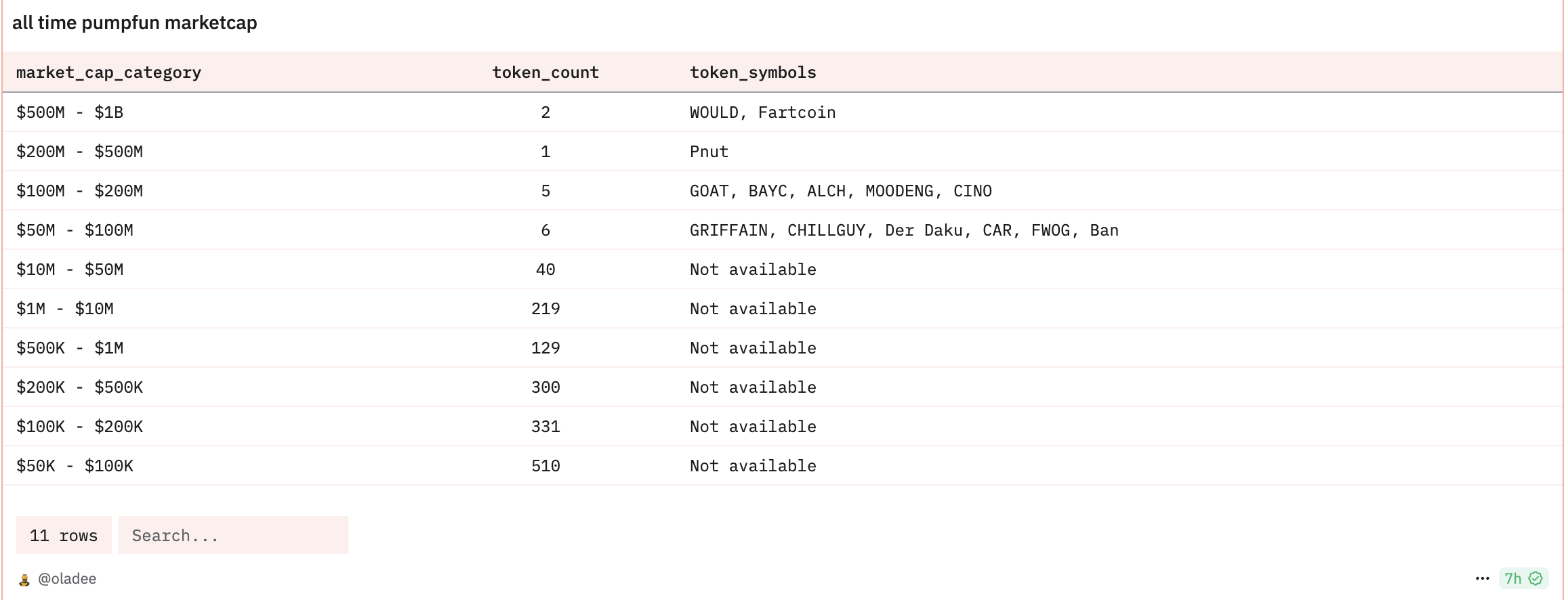
Notably, despite the massive number of meme coins, very few have achieved meaningful market capitalization. According to Dune, only 14 tokens currently exceed $50 million in market cap, and just 259 fall between $1 million and $50 million. The remaining approximately 1.4 million tokens remain in the micro-cap stage. This indicates that most tokens are stuck in self-referential loops without external capital support.
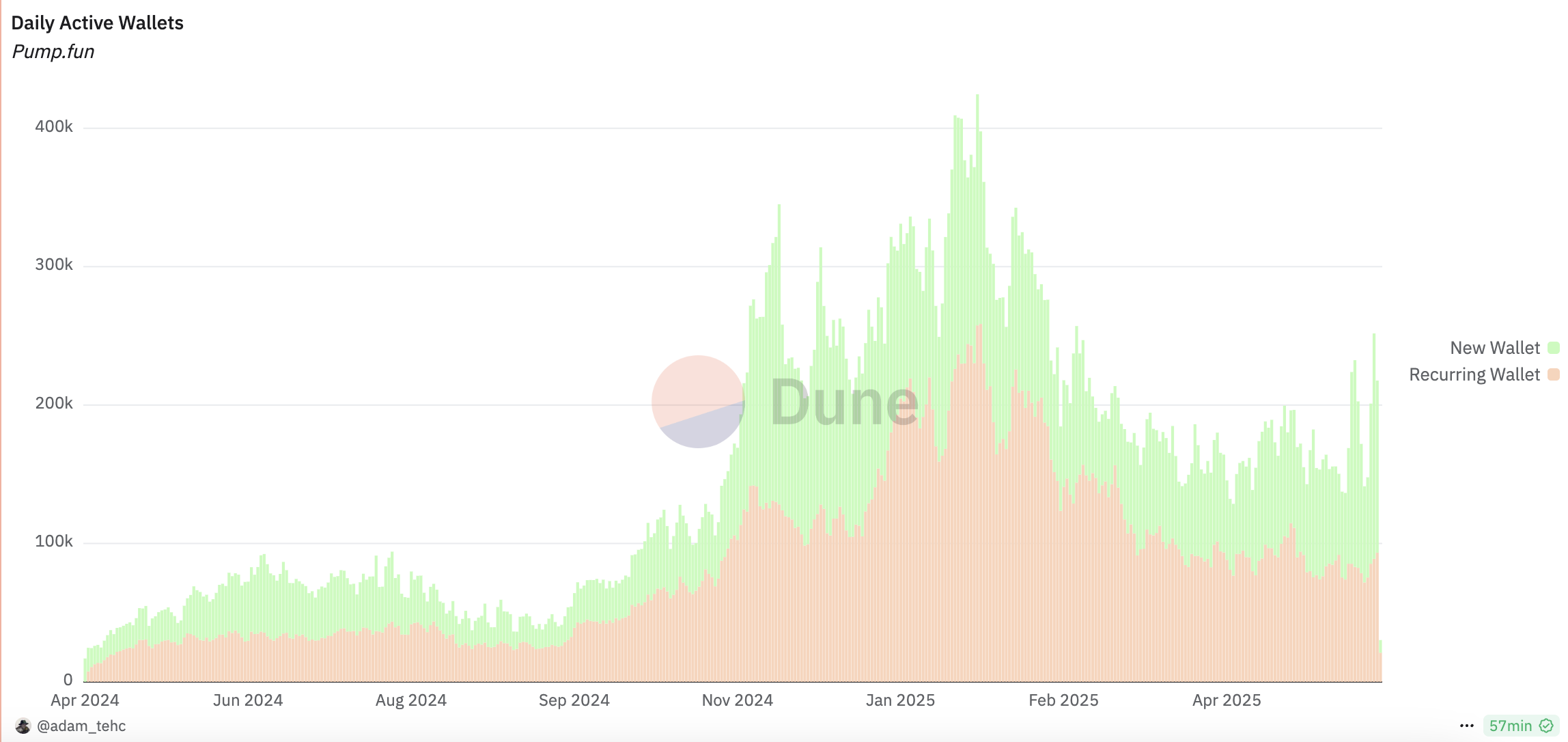
On the user side, Pump.fun is also facing a cliff in new traffic while relying on long-time users to sustain activity. Dune data reveals that Pump.fun reached its peak in late January 2025, with daily active wallets surpassing 400,000—driven largely by an influx of new users. But as market sentiment cooled, active wallet numbers declined, with platform activity now primarily maintained through reuse by existing users. New user contributions have sharply decreased. This trend confirms that while many users frequently create and speculate on meme coins, very few projects achieve lasting value, resulting in short user cycles and weak retention.
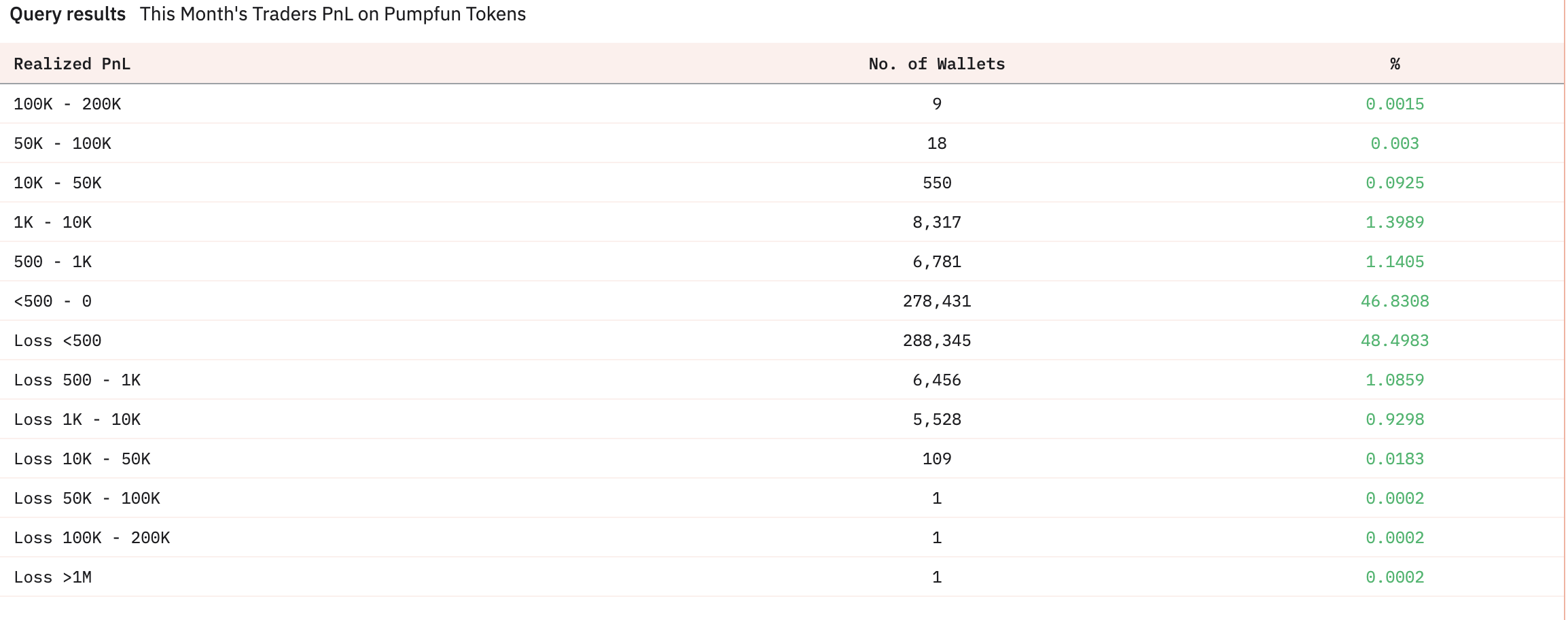
Moreover, behind Pump.fun’s get-rich-quick narrative lies stark survivorship bias. Dune data shows that approximately 594,000 wallets participated in trades this month, but only 3.6% achieved real profits exceeding $500. Even more strikingly, only 27 wallets earned over $100,000—just 0.0045% of all traders—while 577 wallets made over $10,000, representing merely 0.1%. In contrast, the proportion of losing traders is significantly higher, reaching 52.5%, including extreme cases of million-dollar losses. These figures clearly show that a tiny minority of large players capture the vast majority of profits, while most retail users serve merely as liquidity fuel.
At a time when user growth has plateaued, token quality is questionable, and liquidity is depleted, whether Pump.fun’s token launch can revive market sentiment and justify a lofty $4 billion valuation remains highly uncertain.
Rising Risk Aversion on Solana: High-Valuation Token Launch Sparks Controversy
The news of Pump.fun’s high-valuation token launch has raised concerns among investors about a repeat of APE’s final bull-market frenzy.
"The last major project valued at $4 billion was Yuga Labs when they launched APE—the so-called last glory of that bull run, after which all altcoins halved. Now Pump.fun is similarly valued at $4 billion, but raising more than twice the capital APE did. The recent acceleration in listing speeds across exchanges likely reflects intentional efforts to avoid PUMP’s massive liquidity drain in two weeks," commented crypto KOL @AB.
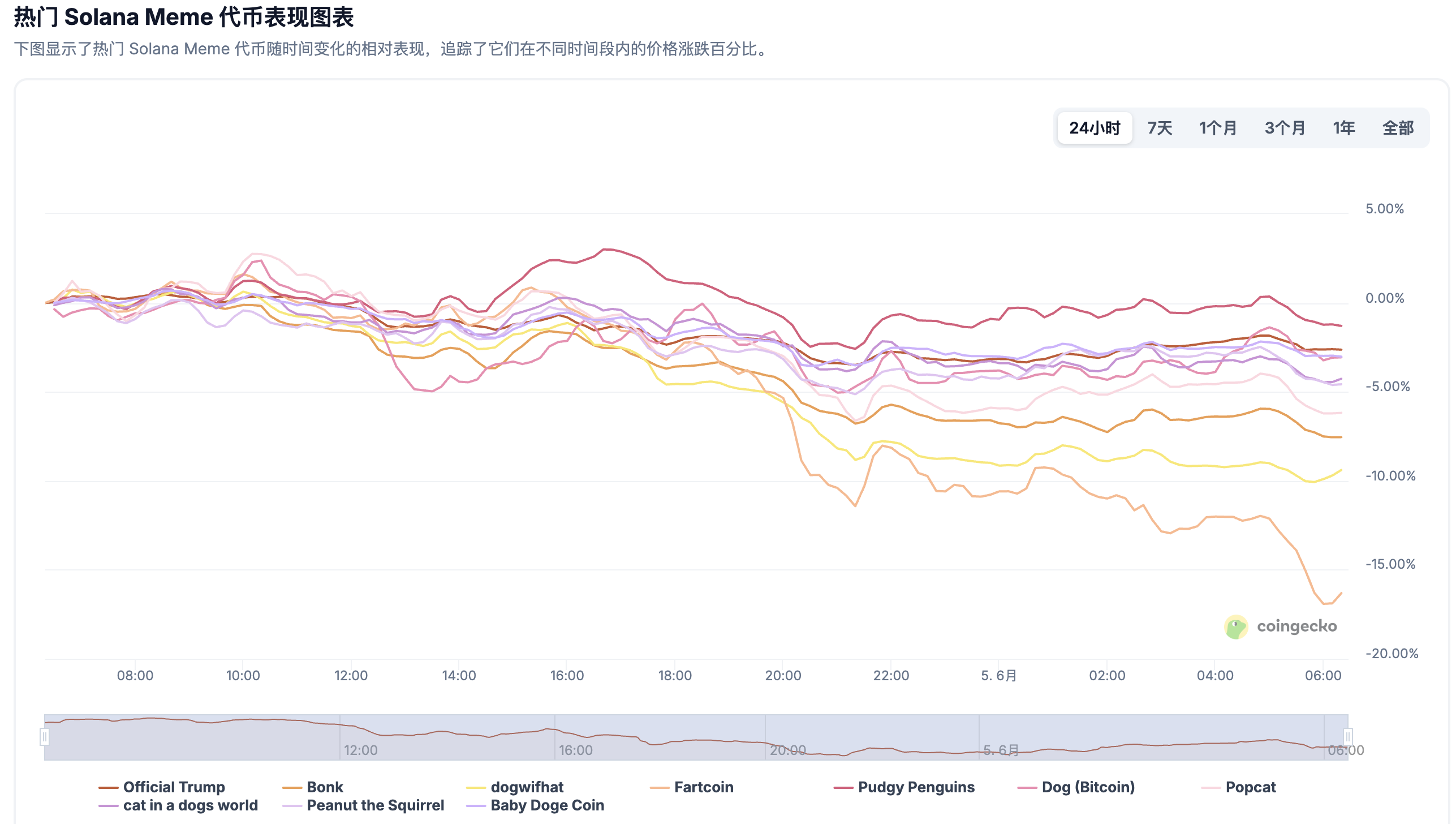
From Solana’s on-chain fund flows, risk-averse sentiment is clearly rising, with meme coins collectively declining. According to CoinGecko, popular Solana-based meme coins saw varying degrees of pullback over the past 24 hours. Meanwhile, Artemis data shows Solana ranked third in net outflows among blockchain networks during the same period.
Independent researcher @Haotian bluntly labeled Pump.fun’s current valuation as “extremely bubbly,” noting that a meme launchpad now commands a market cap exceeding most DeFi blue-chip protocols. He offered four key criticisms: (1) The inflated, bubble-like valuation is fundamentally unjustified: Pump.fun’s business model relies entirely on the irrational, short-term FOMO surrounding meme coins—a pure monetization of gambling-driven attention. This means its revenue potential stems solely from temporary spotlight effects rather than sustainable,常态化 profitability; (2) Its fragile competitive moat is easily overtaken: Pump.fun capitalized on Solana’s high performance and low costs, along with the cultural shift of memes going mainstream. But building atop others’ infrastructure makes it inherently vulnerable—if Solana’s ecosystem shifts, Pump.fun’s business model would be exposed; (3) As a launchpad tool, it struggles to evolve into a self-sustaining ecosystem: No matter how profitable it becomes, it remains just a “token launching tool.” Attempting to transform into a complex meme economy contradicts the core of meme culture—simplicity, directness, and viral spread. Adding too many features risks eroding the platform’s original rawness; (4) The sky-high valuation distorts the value innovation framework: Pump.fun’s valuation sends a dangerous signal to the industry—that “traffic aggregation + speculative monetization” may now outweigh “technical innovation + infrastructure building.” The critical question, he argues, is whether Pump.fun can use its massive capital to build real, lasting defensibility. Otherwise, this distorted valuation could trigger a major innovation crisis, heralding a more utilitarian, short-term, and tech-detached future for crypto.
KOL @xingpt added a valuation perspective: Pump.fun’s annualized revenue over the past 30 days stands at $77.98 million. At a fully diluted valuation (FDV) of $5 billion, its FDV/annualized revenue ratio reaches 64—relatively high. In the long term, Pump is certainly not worth this valuation, given its lower earnings certainty compared to DeFi leaders like Raydium or PancakeSwap. However, in a strong market, the team could generate FOMO and potentially double the price. Given current X (formerly Twitter) sentiment, he sees no need to aggressively short at launch. Holding cash and waiting may be the wisest move.
Nonetheless, crypto KOL @加密韋馱 argued that judging success without context is flawed. Solana’s current status as the primary on-chain battleground owes directly to Pump.fun—it solved the full liquidity pipeline from zero liquidity to AMM and then CEX listings, standardized on-chain safety (e.g., pool draining, contract poisoning), established a PVP (player-versus-player) on-chain culture, and drove substantial SOL staking. Pump.fun’s emergence was akin to the iPhone moment for on-chain apps—the first to recognize that younger generations have extremely short attention spans, reject traditional values, and embrace PVP dynamics. From a value investing standpoint, Pump is the largest consumer application on the internet, yet trades at a mere P/E of 5, making it a genuine value play. He believes crypto now has only two true moats: liquidity and screen time.
“Stop dreaming about a Pump.fun airdrop,” said sleepy, founder of Weirdo Ghost Gang, addressing market fantasies. Pump.fun has already achieved product-led growth and has no incentive to issue an airdrop. Today, airdrops are increasingly becoming short-term tools for capturing attention—ostensibly “rewarding users,” but rarely cultivating genuine loyalty. Airdrop ≠ user loyalty. An airdrop is merely a traffic amplifier used to briefly boost visibility. But Pump.fun already enjoys a stable and massive user base—it neither needs airdrops to attract attention nor to generate buzz.
In summary, while Pump.fun’s token launch has reignited heated debate, beneath the surface lies a fragile structural liquidity, fading user engagement, and the enormous bubble surrounding meme narratives.
Join TechFlow official community to stay tuned
Telegram:https://t.me/TechFlowDaily
X (Twitter):https://x.com/TechFlowPost
X (Twitter) EN:https://x.com/BlockFlow_News
 PANews