Singapore Cracks Down on Web3, Ending the Era of Regulatory Arbitrage
TechFlow Selected TechFlow Selected
Singapore Cracks Down on Web3, Ending the Era of Regulatory Arbitrage
A Web3 "great retreat" is coming....
 Navigating Web3 tides with focused insights
Author: Bobo Bobo
The Monetary Authority of Singapore (MAS) released its response document on new regulations for Digital Token Service Providers (DTSP) on May 30, 2025—an update that many have yet to realize will reshape the entire Asian Web3 landscape.
The new rules take effect officially on June 30, 2025, with MAS making it clear: there will be no grace period. A large-scale "Web3 exodus from Singapore" may already be quietly underway.
"We will be extremely cautious." When MAS openly expresses such a stance in this sharply worded consultation paper, the Singapore once hailed by global Web3 practitioners as the "crypto-friendly haven of Asia" is now bidding farewell to its past in an unexpected way—not through gradual policy adjustments, but via an almost "cliff-like" regulatory crackdown.
For projects and institutions still hesitating, the question is no longer whether to leave—but when, and where to go instead.
Past Glory: The Golden Age of Regulatory Arbitrage
Remember Singapore in 2021? While China imposed a blanket ban on cryptocurrency trading and the U.S. SEC swung its regulatory hammer everywhere, this small island nation opened its arms to Web3 entrepreneurs. Three Arrows Capital, Alameda Research, FTX’s Asia headquarters—each chose to set up shop here, drawn not only by the 0% capital gains tax, but also by MAS's then-innovative, welcoming posture.
Singapore was then the ultimate "regulatory arbitrage sanctuary" for the Web3 industry. Registering a company here allowed firms to legally provide digital asset services globally (excluding Singapore itself), while benefiting from the credibility of being based in a major financial hub. This "based in Singapore, serving the world" business model attracted countless Web3 players.
Today, however, Singapore’s new DTSP regulations signal a definitive end to that era of regulatory openness. The message is blunt: kick all unlicensed Web3 actors out of Singapore.
What Is DTSP? A Definition That Sends Chills
DTSP stands for Digital Token Service Provider. Under Section 137 of the Financial Services and Markets Act (FSM Act) and paragraph 3.10 of the document, DTSP includes two categories:
1. Individuals or partnerships operating from a business premises in Singapore;
2. Singapore-registered companies conducting digital token services outside Singapore (regardless of where the company originates).
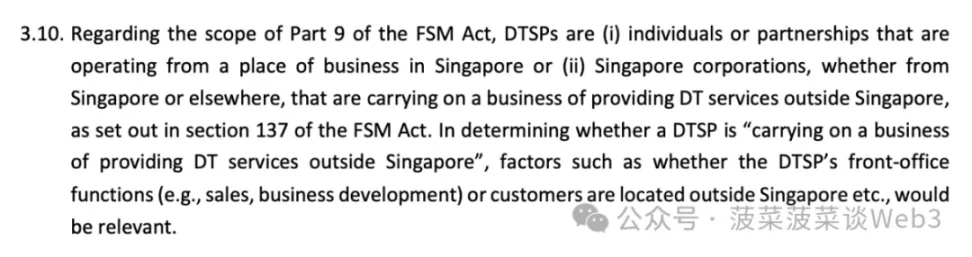
This definition appears simple, but hides serious implications.
First, what exactly constitutes a “business premises” in Singapore? MAS defines it as “any location in Singapore used by a licensee to carry out business activities (including stalls that can be moved from one location to another).”
Note several key points in this definition:
-
“Any location”: not limited to formal commercial offices
-
“Including stalls”: even mobile setups are included, indicating broad regulatory reach
-
“Used to carry out business”: hinges on whether business activity occurs at the site
In short, if you're operating any digital asset-related business from any location in Singapore without a license, you risk breaking the law—regardless of whether you're a local or foreign entity, and regardless of whether your clients are in Singapore or abroad.
So, does working from home constitute illegal activity?
On this issue, Baker McKenzie submitted specific feedback to MAS:
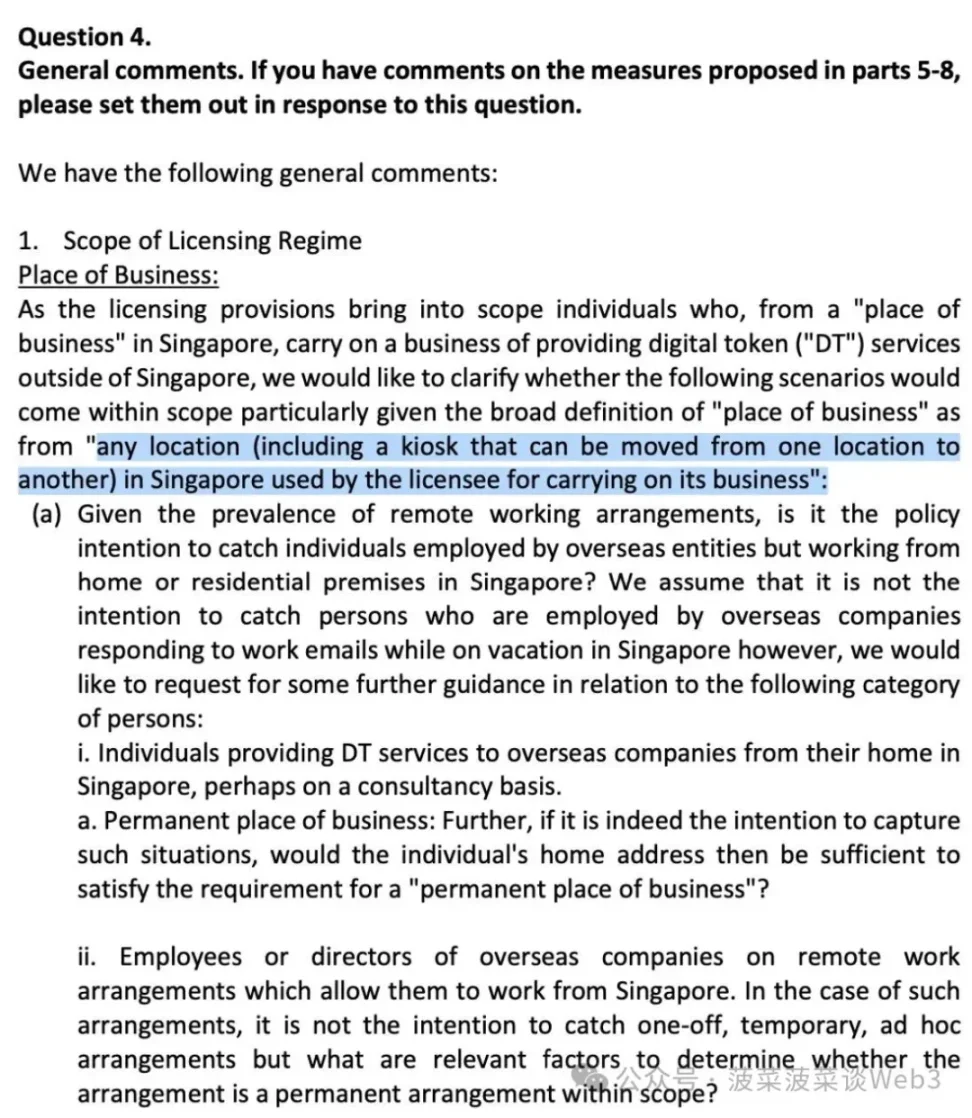
Baker McKenzie specifically sought clarification from MAS:
“Given the prevalence of remote work, does MAS intend its policy to cover individuals employed by overseas entities but working from their homes or residential premises in Singapore?”
The firm raised real concerns, listing potential red flags:
-
Individuals providing digital token (DT) services from home for overseas companies (possibly in advisory roles)
-
Employees or directors of overseas companies working remotely from Singapore
At the same time, the firm attempted to offer some protection for remote workers:
-
“Based on the current drafting of the legislation, it could be argued that a home or residential premise should not be included, as such locations are generally not understood as places where licensed entities conduct business.”
Yet MAS poured cold water on this hope:
“Under Section 137(1) of the Financial Services and Markets Act, all individuals operating from business premises in Singapore who engage in providing digital token services to persons outside Singapore must obtain a DTSP license, unless they fall under one of the categories specified in Section 137(5). In this regard, if an individual is located in Singapore and conducts business involving the provision of digital token services to persons outside Singapore (both individuals and non-individuals), they are required to apply for a license under Section 137(1). However, if the individual is an employee of a foreign-registered company providing digital token services outside Singapore, the work performed as part of their employment with that foreign-registered company does not in itself trigger the licensing requirement under Section 137(1).”
And further:
“However, if these individuals work from co-working spaces or from offices of affiliated companies of the overseas entity, they would clearly fall within the scope.”
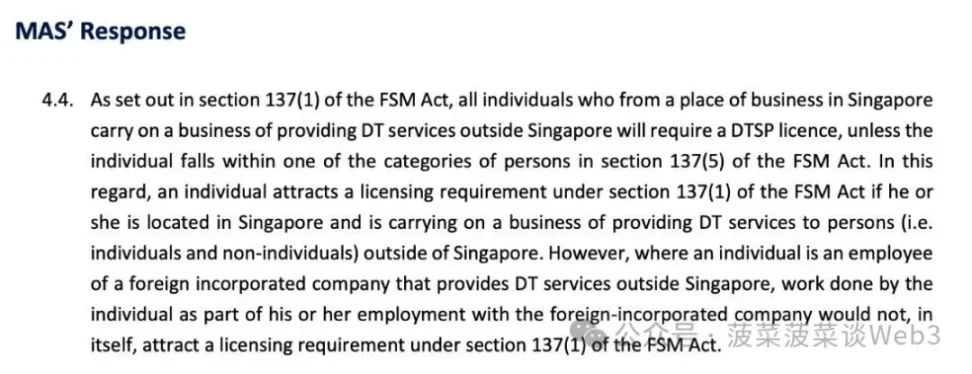
To summarize the new rules:
Without a license, neither individuals nor companies may conduct business targeting local or international clients from any business premises in Singapore.
If you are an employee of an overseas company, working from home is acceptable.
But numerous ambiguities remain:
MAS’s definition of “employee” is highly vague. Are project founders considered employees? Does holding equity disqualify someone from being an employee? It’s entirely at MAS’s discretion.
If you’re a BD or salesperson for an overseas company and you meet clients at a shared office space, does that count as operating from a business premises? Again, MAS decides.
Vague Definition of Digital Token Services—Could KOLs Be Affected Too?
The breadth of MAS’s definition of digital token services is staggering, covering nearly every token type and related service—even publishing research reports?
According to Item (j) of the First Schedule of the FSM Act, the regulated scope includes:
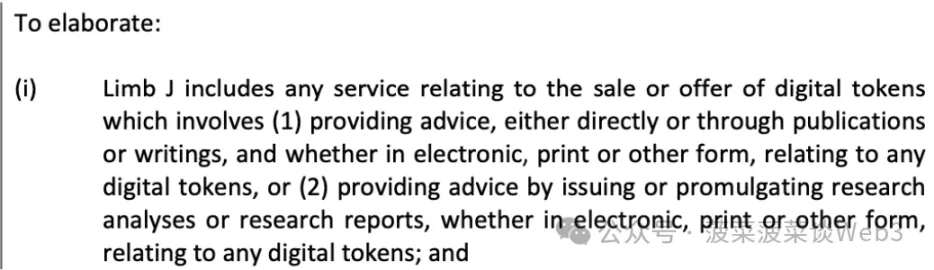
“Any service relating to the sale or offer of digital tokens, including: (1) providing advice relating to digital tokens directly or through publications, articles, or any other form (electronic, print, or otherwise), or (2) providing advice relating to digital tokens through the publication or dissemination of research analysis or research reports (in electronic, print, or other form)”
This implies that if a KOL or institution based in Singapore publishes a report analyzing the investment value of a token, they may theoretically require a DTSP license—or risk being deemed unlawful.
The Blockchain Association of Singapore posed a critical question to MAS on this matter:
“Will traditional research reports be considered as related to token sales or offers? How should participants distinguish between reports that are versus are not related to token sales or offers?”
MAS did not provide a clear answer. This ambiguity leaves all content creators walking on eggshells.
Which groups could be affected?
Individual Profiles (High Risk)
-
Independent professionals: developers, project consultants, market makers, miners, etc.
-
Content creators and KOLs: analysts, influencers, community managers, etc.
-
Core project personnel: founders, BDs, sales staff, and other key operational roles
Institution Types (High Risk)
-
Unlicensed exchanges: CEXs, DEXs
-
Project teams: DeFi protocols, wallets, NFT platforms, etc.
Conclusion: The End of Singapore’s Regulatory Arbitrage Era
A chilling reality emerges: Singapore is serious this time—aiming to expel all non-compliant actors. If you’re not compliant, virtually any activity related to digital token services could fall under regulatory scrutiny. Whether you're in a luxury high-rise or on your living room sofa, whether you're a CEO or a freelancer—if you touch digital token services, you’re at risk.
Given the vast gray areas in the definitions of “business premises” and “conducting business,” MAS is likely to adopt a “case-by-case” enforcement strategy—make examples of a few, then scare the rest.
Thinking of rushing to get compliant at the last minute? Sorry—the MAS has made it clear it will approve DTSP licenses in an “extremely cautious” manner, only in “exceptionally limited circumstances.”
The era of regulatory arbitrage in Singapore is over. The age of the big fish eating the small has begun.
Join TechFlow official community to stay tuned
Telegram:https://t.me/TechFlowDaily
X (Twitter):https://x.com/TechFlowPost
X (Twitter) EN:https://x.com/BlockFlow_News
 @wzxznl