Ethereum gas fees are cheaper, so what core problems are L2s solving?
TechFlow Selected TechFlow Selected
Ethereum gas fees are cheaper, so what core problems are L2s solving?
Different L2 solutions have their own strengths and weaknesses.
 Navigating Web3 tides with focused insights
Author: Todd
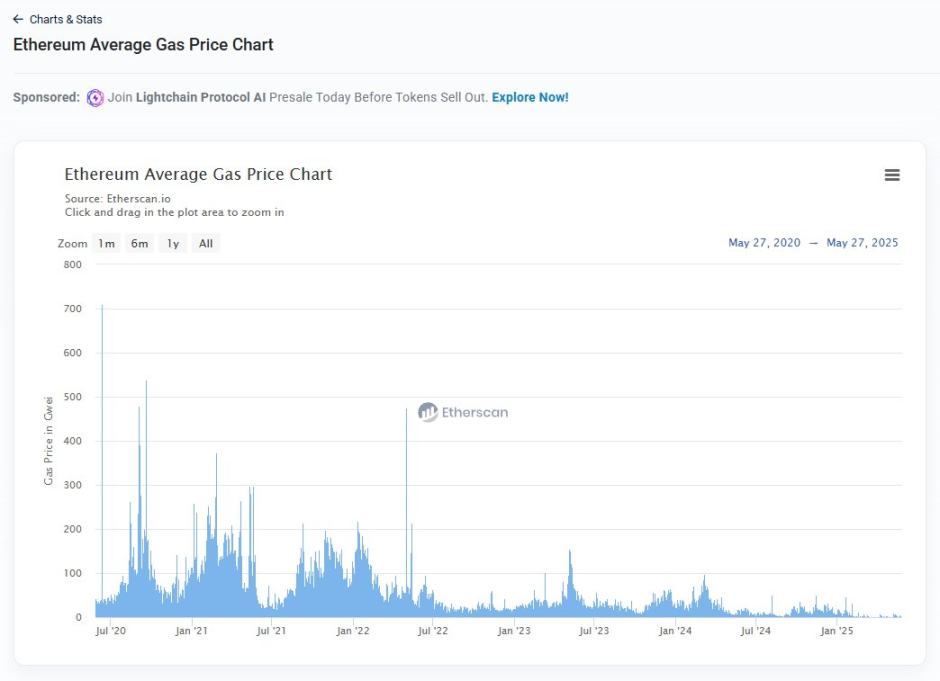
Judging from current results, after Ethereum L1 mainnet gas fees dropped to their lowest level in five years, many projects once again find deploying on L1 acceptable. So people often ask: what core problem is L2 solving now?
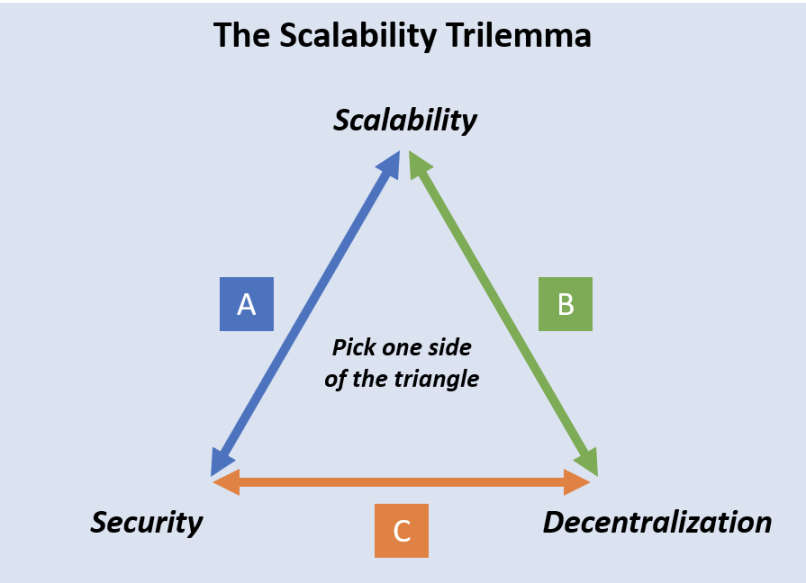
There's an old topic called the blockchain trilemma. According to Vitalik, among the three—security, decentralization, and scalability—you can only achieve two at the same time.
Back to technical fundamentals, this is exactly the problem L2 should solve:
First, place state commitments on L1, relying on the mainnet for security;
Second, work on the sequencer to maintain decentralization as much as possible;
Finally, scalability is cleverly achieved off-chain by L2.
Different L2 solutions each have their strengths. OP-style Rollups and ZK-style Rollups are already well known. Today, let’s talk about something different—Based-Rollup.
The Based L2 approach was originally proposed by Vitalik, and projects like Taiko have been actively promoting the Based Rollup concept.
PS: Note that it's Based, unrelated to Coinbase's Base, which belongs to the OP family.
As everyone knows, in a standard OP-style L2 system, the sequencer holds significant power—it decides whose transactions go first and whose go later, and can profit from MEV even without malicious behavior. This is why projects like Metis propose decentralized sequencers.
Different L2s handle MEV differently: for example, Arbitrum advocates fair treatment of MEV (strictly first-come-first-served), while OP encourages it, viewing MEV as free-market activity and thus taxing it. But regardless, the L2 sequencer remains highly influential.
Based-Rollup chooses to cut into the sequencer—it aims to let ETH L1 directly perform transaction ordering, thereby limiting the power of the L2 sequencer.
Quoting a diagram from @taikoxyz documentation:
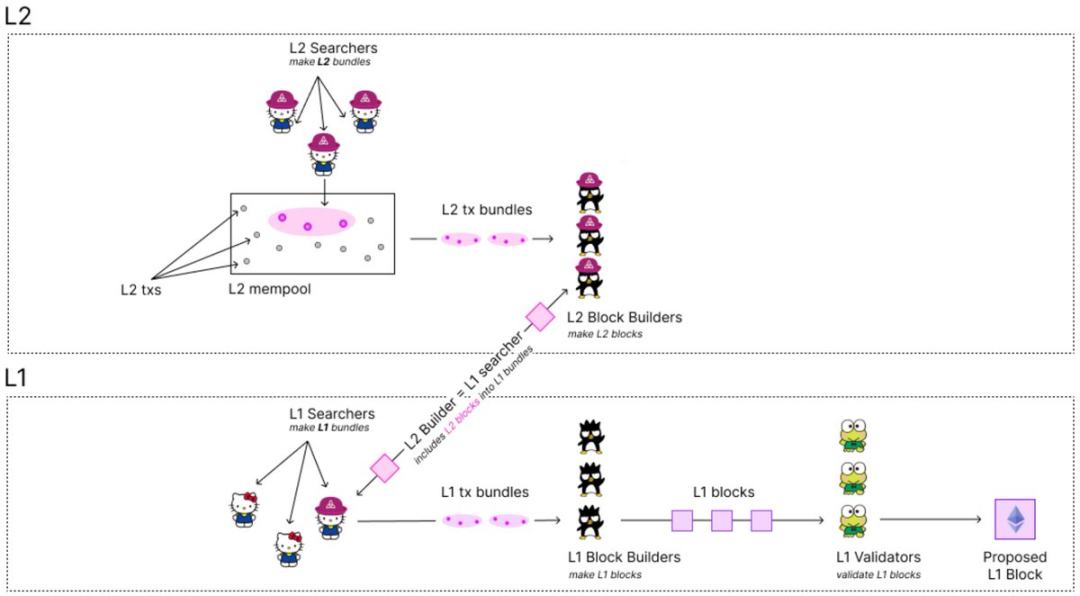
You can see it's a three-step process:
Step one: L2 searchers bundle L2 transactions and send them to the L2 block builder;
Step two: The L2 block builder constructs the block;
Step three: L1 searchers include the L2 block within the block they build on L1.
Here, the L1 searcher and L2 builder could be the same entity.
This is another clever "working two jobs" idea. In fact, L1 searchers' hardware has spare capacity, so building a Taiko L2 block adds no real burden.
To make an imperfect analogy: if we compare ETH and L2 to provincial and city governments, then the Based Rollup idea is like letting the mayor (L2 builder) also serve as deputy governor (L1 searcher), effectively leveraging L1 resources to protect L2 security.
Taiko has just completed its first full year since TGE, and token unlocking is about to begin. Over the past year, Taiko has developed a new concept called Based Booster Rollup (BBR).
Booster Rollup can also act as a mirror of L1—an interesting idea too, but due to space constraints, analysis of Booster Rollup will be covered in a follow-up article.
Join TechFlow official community to stay tuned
Telegram:https://t.me/TechFlowDaily
X (Twitter):https://x.com/TechFlowPost
X (Twitter) EN:https://x.com/BlockFlow_News
 @0x_Todd