








With airdrop expectations, is CZ's endorsed Perp DEX "Aster" worth participating in?
TechFlow Selected TechFlow Selected
With airdrop expectations, is CZ's endorsed Perp DEX "Aster" worth participating in?
What does Aster have to surpass Hyperliquid?
 Navigating Web3 tides with focused insights
Written by: momo, ChainCatcher
After Hyperliquid encountered a trust crisis, the war among Perp DEXs has reignited.
Some CEXs have also started openly supporting their own ecosystem's Perp DEX. Recently, CZ has interacted multiple times with Aster on Twitter.
BNB Chain has long lacked a representative DEX. Amid the chaos in the Perp DEX space, CZ’s move to support his “homegrown” project is clearly intentional. Aster is an exclusive investment and incubated project by YZi Labs (formerly Binance Labs) and is currently the leading Perp DEX on BNB Chain.
Aster originated from the multi-asset liquidity protocol Astherus and the established derivatives exchange APX Finance. Both projects received investments from YZi Labs, with Astherus previously being part of YZi Labs’ seventh-season incubation program. In December last year, Astherus and APX Finance announced a strategic merger and recently rebranded their platform as Aster.
Riding the Perp DEX wave and backed by Binance, Aster has made significant moves recently. Alongside the rebranding, the platform has undergone a major overhaul in product positioning and interface, relaunched its trading points program, and introduced various incentive initiatives to attract user participation.
Recently, Aster’s Perp DEX ranking surged to second place, closely trailing Hyperliquid.
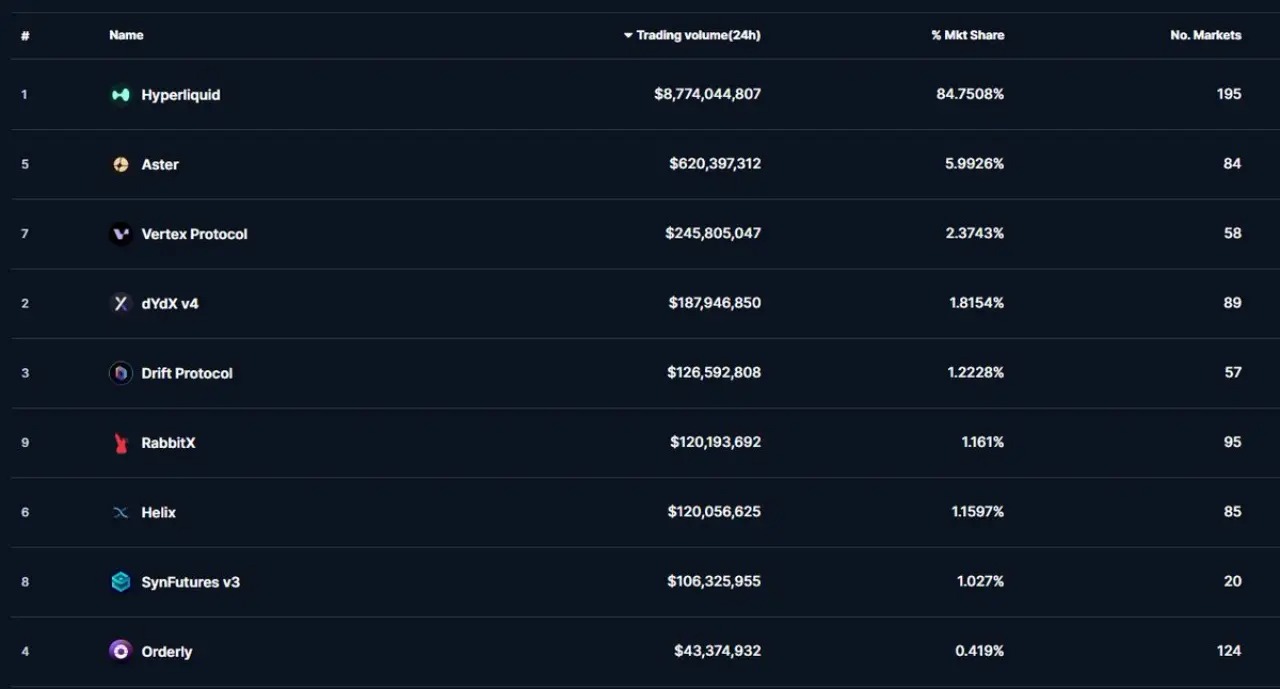
With both new and existing players entering the space, the Perp DEX sector is becoming increasingly competitive, and the landscape of on-chain derivatives markets is expected to be reshaped.
Rebranding: Aster Shifts Focus to "Perp DEX"
Astherus and APX Finance, the predecessors of Aster, were originally star projects on BNB Chain. Earlier this year, CZ frequently used and mentioned these two platforms during his exploration of on-chain DEXs.
For example, CZ tweeted about using Astherus’ DEX, and in March, on-chain analyst Ai detected that CZ had used BNB to go long on mubarak via APX Finance.

Astherus was founded only last year, making it a dark horse on BNB Chain. It joined YZi Labs’ seventh-season incubation program in July and secured exclusive funding from YZi Labs in November. Within six months of launch, its TVL surpassed $160 million and has now reached $300 million, showing rapid growth.
Positioned as a multi-asset liquidity hub, Astherus aims to maximize real yield for crypto assets. It launched several innovative products, including the diversified strategy yield product AstherusEarn and the perpetual contract DEX AstherusEX.
On AstherusEarn, users can stake mainstream assets like BTC and BNB to earn yield and further use obtained LST assets for staking or derivative trading to capture additional DeFi yields.
By partnering with CeFi institutions, Astherus leverages AI-driven active yield strategies across crypto and traditional financial markets to deliver substantial real returns to users.
AstherusEX supports not only derivative trading of mainstream assets like BTC but also staking and trading of assets such as LST (liquid staking tokens) and LRT (liquidity reward tokens).
In addition, Astherus’ yield-bearing stablecoin USDF unlocks a secondary yield curve for users in DeFi.
APX Finance, more established, was once the largest decentralized derivatives protocol on BNB Chain. Its core offering is LP-based on-chain perpetual contract trading across multiple chains including BNB Chain, Arbitrum, opBNB, and Base. Key features of APX Finance include up to 1001x leverage, zero slippage, and low fees.
Beyond YZi Labs' backing, APX Finance has also collaborated multiple times with Binance Web3 Wallet.
Driven by strong confidence in the decentralized derivatives market, the merger between Astherus and APX Finance into Aster marked a major shift in business focus toward Perp DEX.
Product Upgrade: Dual-Mode Redefines Perp DEX
Judging from the latest official website, Aster has completely revamped its UI/UX. Aster positions itself as a multi-chain, highly liquid, and secure decentralized perpetual contract platform.
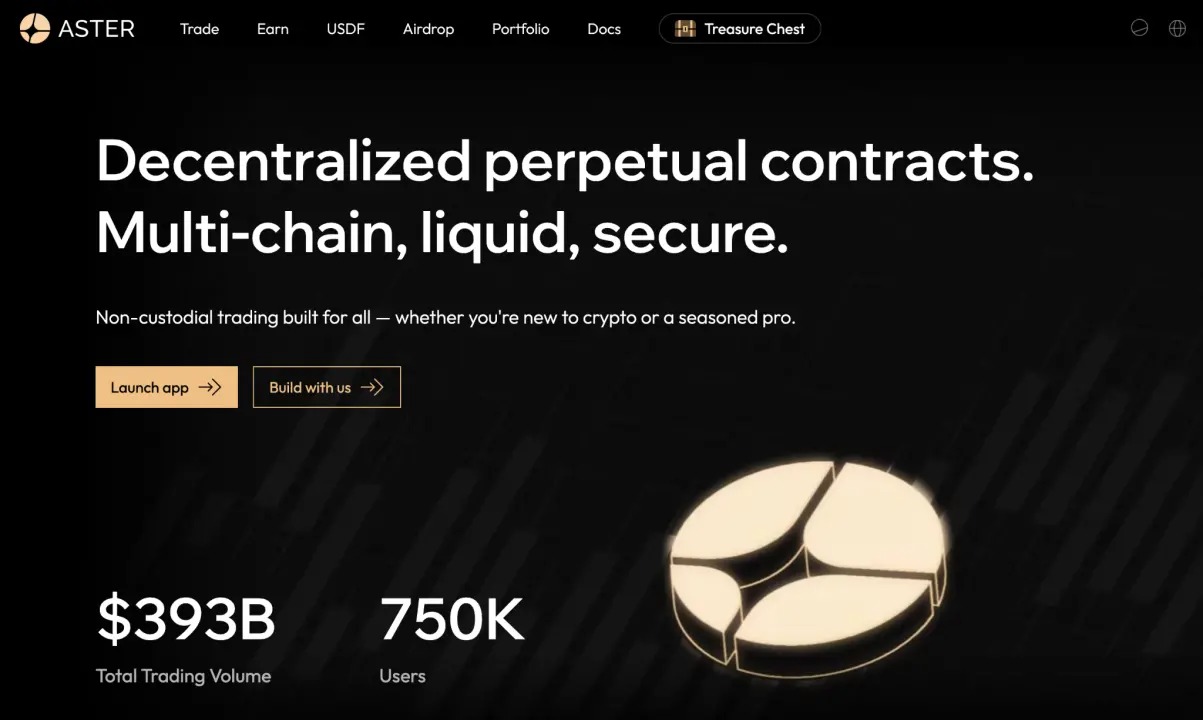
Aster is now deployed across major public chains including BNB Chain, Arbitrum, Solana, and Ethereum.
Functionally, the “Trade” feature for perpetual contracts is now front and center. Additionally, Aster retains its diversified yield staking product “Earn” and the yield-bearing stablecoin USDF.
For contracts, Aster introduces two trading modes: Simple and Pro.
The Simple mode caters to beginners—easy to use and beginner-friendly. It relies on the ALP pool for liquidity, supports over 40 trading pairs including major assets and popular Meme coins; offers up to 1001x leverage with zero-slippage entry and no opening fees. The Simple mode also features a simplified “dumb” price prediction product, further lowering the barrier to entry.
The Pro mode targets advanced traders. It uses an order book model and supports professional features like grid trading. Users enjoy deep liquidity and ultra-low fees (maker 0.01% / taker 0.035%) across multiple chains including BNB Chain and Arbitrum. This mode ensures a low-cost, fast trading experience while maintaining full user custody and no KYC requirements.
This dual-mode design preserves the autonomy advantages of decentralized trading while offering tailored experiences for different user segments through differentiated functionality.
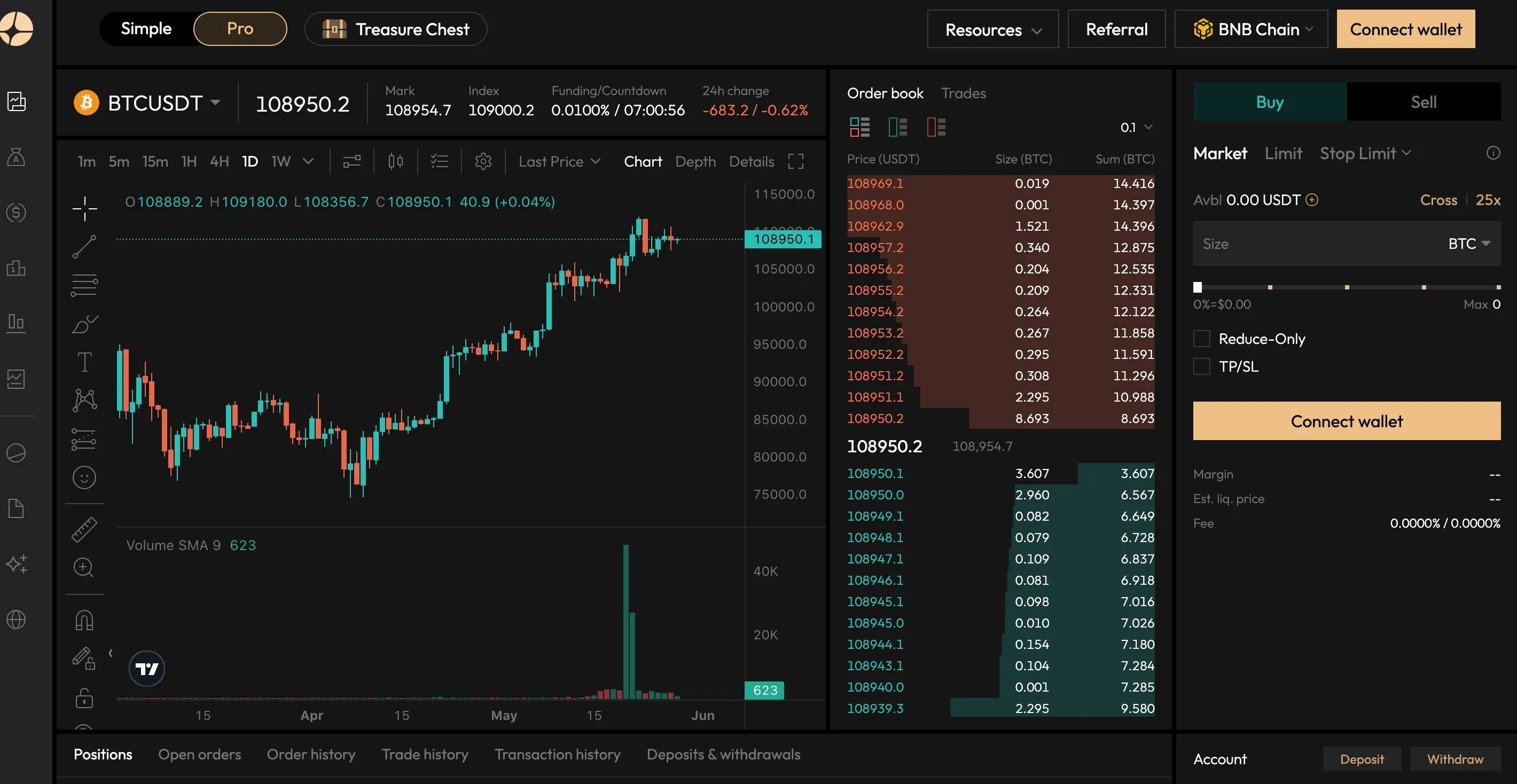
Aster states its goal is to build a professional contract platform with deep liquidity, low fees, and seamless trading experience—aiming to challenge, even surpass, Hyperliquid’s position.
Can Aster Outperform Hyperliquid?
Although Hyperliquid recently faced a trust crisis, it remains a formidable player in this cycle. Is it possible for Aster to overtake Hyperliquid?
First, considering the overall potential of the Perp DEX sector, Hyperliquid has indeed brought greater market attention to Perp DEXs in this cycle. However, the broader heating up of Perp DEXs also stems from underlying market demand.
Compared to centralized exchanges, Perp DEXs offer better token listing dynamics. Moreover, with the development of Layer2 and multi-chain ecosystems, Perp DEXs have significantly improved in transaction speed and user experience.
CoinGecko reports show that in 2024, the total trading volume of the top ten decentralized perpetual contract exchanges reached $1.5 trillion—more than double the 2023 figure.
Despite the clear rise in popularity, the decentralized perpetual contract space remains in early stages. In 2024, the total trading volume of the top ten decentralized perpetual contract exchanges accounted for only 2% of the volume seen on the top ten centralized counterparts—indicating low penetration and vast room for growth.
The landscape of decentralized derivatives remains unsettled. New and existing players must innovate and optimize across product performance, user experience, and community engagement to win user mindshare.
From a product perspective, what advantages does Aster have?
First, the lowest fees across the network. Aster’s taker fee is only 0.03%, with maker fees as low as 0.01%, undercutting Hyperliquid’s adjusted taker fee of 0.045% (effective April 30, 2025). Additionally, Aster has introduced a VIP tier system where higher trading volumes lead to lower fees, providing a clear cost advantage for high-frequency and large-volume traders. Low fees are a key competitive edge, especially evident in high-frequency trading scenarios.
Second, deep liquidity. Aster partners with top-tier market makers from centralized exchanges like Binance to build robust liquidity pools, with bid-ask spreads approaching Binance’s levels.
Third, product diversity. With both Simple and Pro modes, Aster serves both novice and professional traders, meeting varied user needs.
Moreover, Aster’s Perp DEX launched with built-in liquidity and a user base. Prior to the merger, its yield-focused products had accumulated nearly $350 million in liquidity.
Recently, Aster’s Perp DEX has shown explosive growth. According to Defillama data, Aster consistently ranks within the top five, briefly climbing to second place right behind Hyperliquid. As per Dune dashboard statistics, Aster’s total trading volume is nearing $400 billion, with approximately 750,000 total users and nearly 12,000 daily active traders—the platform’s trading activity continues to rise.
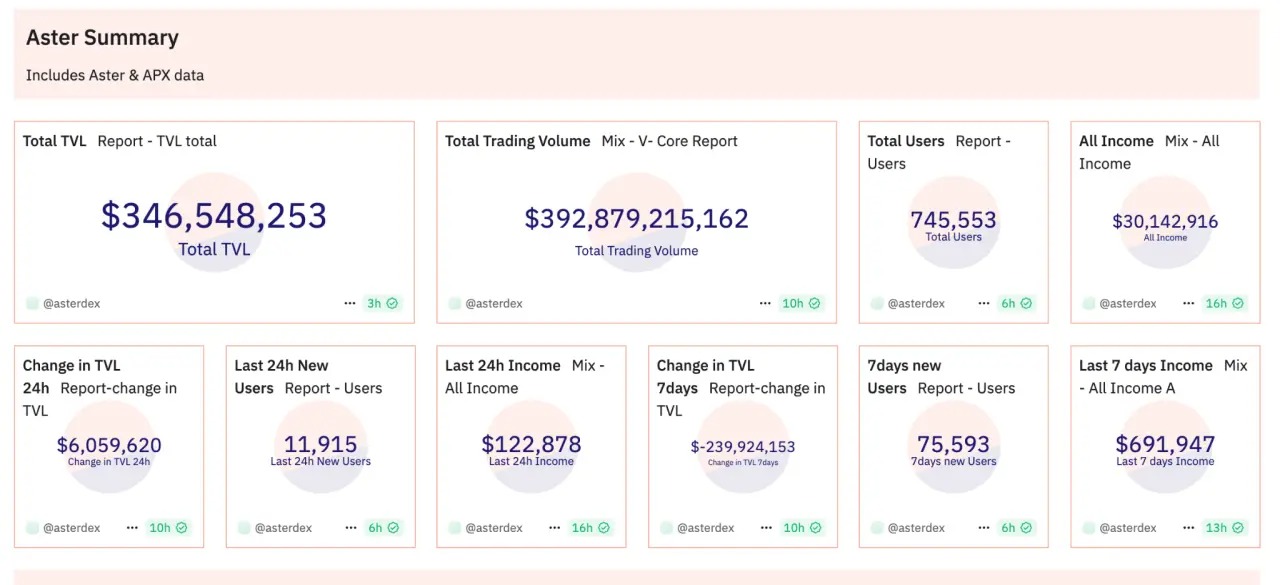
In the long run, Aster is enhancing its ecosystem and user experience to stay competitive. According to its roadmap, it plans to launch a dedicated Layer1, blockchain explorer, and mobile app to improve usability and decentralization, attracting more contract traders.
At the ecosystem level, Aster is expected to benefit from BNB Chain’s ecosystem incentives. Following Hyperliquid’s rise, major public chains—especially those backed by CEXs—are pushing their native DEXs to compete.
Solana’s ecosystem boasts multiple breakout DEXs like Raydium and Jupiter, whereas BNB Chain appears to lack a similarly sized contender. With Perp DEXs gaining traction, BNB Chain’s support for its invested project Aster is a natural move.
With Airdrop Expectations, What Participation Opportunities Exist for Users?
Amid the Perp DEX boom, Aster—as a flagship YZi Labs-backed project—has become a popular target for airdrop hunters.
The recent relaunch of Aster’s trading points program may signal an imminent TGE.
According to official documentation, the user incentive program is currently in Stage 1: Spectra phase. The points system consists of two types—Au Points and Rh Points—which will serve as eligibility credentials for future AST airdrops.
Users earn Au Points by minting and holding Aster Earn-related assets (e.g., ALP, USDF, LP Token).
Rh Points are primarily earned through perpetual contract trading on Aster’s Pro mode:
1. Rh Points earned via Pro mode trading can be redeemed for future $AST airdrop rewards, providing ongoing incentives for active supporters and traders.
2. Users who invite friends and form teams can enjoy up to a 1.2x multiplier on Rh Points.
3. The platform recently rolls out $50,000 in trading campaign rewards every two weeks, offering additional bonuses on top of points.
For early participants, Aster provides further support through adjusted trading fees and referral rebate programs. For instance, under the recently launched VIP tier program, higher trading volumes result in lower expected fees. The upcoming tiered referral rebate program will also increase the referrer’s commission percentage based on the referee’s trading volume.
Conclusion
In summary, as part of the Binance ecosystem, Aster enjoys strong ecosystem backing and ultra-low fees, positioning it well to carve out a space in the decentralized perpetual contract market. However, to replace Hyperliquid, Aster must continue strengthening its brand recognition, technical maturity, and market acceptance.
As the Perp DEX market heats up, competition will intensify, and the rivalry between Aster and Hyperliquid will likely drive innovation across the industry.
Join TechFlow official community to stay tuned
Telegram:https://t.me/TechFlowDaily
X (Twitter):https://x.com/TechFlowPost
X (Twitter) EN:https://x.com/BlockFlow_News
 ChainCatcher 链捕手






