








Must-read for Airdrop Hunters: Top 10 Red Flags of Fake Airdrops and How to Avoid Scams
TechFlow Selected TechFlow Selected
Must-read for Airdrop Hunters: Top 10 Red Flags of Fake Airdrops and How to Avoid Scams
Explore key warning signs and practical prevention techniques to effectively safeguard your assets.
 Navigating Web3 tides with focused insights
Author: Dilip Kumar Patairya
Translation: Tim, PANews
Key Takeaways
-
Fake airdrop scams targeting projects like Hamster Kombat and Wall Street Pepe in 2024 and 2025 led to millions of dollars in user losses, contributing to over $9.9 billion in global crypto fraud damages.
-
Fake airdrops impersonate legitimate projects to trick users into revealing private keys, signing malicious contracts, or paying upfront fees—resulting in irreversible fund theft.
-
Red flags include lack of official announcements, suspicious URLs, requests for private keys, grammatical errors, and unrealistic return promises.
-
Future airdrops are shifting toward activity-based, retroactive, and AI-monitored models designed to reward genuine user engagement while reducing cheating.
While crypto airdrops are a legitimate way for projects to gain exposure and users, scammers are exploiting this trend by using fake airdrop campaigns to steal user assets. Between 2024 and 2025, fraudulent airdrop schemes linked to projects such as Hamster Kombat and Wall Street Pepe have cost victims millions of dollars. According to blockchain analytics firm Chainalysis, estimated losses from global cryptocurrency scams and fraud—including fake airdrops—reached at least $9.9 billion in 2024.
Recognizing red flags is crucial for securing your participation in airdrops. This article explores key warning signs and practical prevention tips to help you safeguard your assets effectively.
What Are Fake Airdrops?
Airdrops are a common method in the crypto market for distributing free tokens, often used as part of marketing initiatives, user growth strategies, or community-building efforts. Legitimate airdrops deliver value by rewarding early participants, increasing token visibility, or incentivizing network engagement. Users typically qualify by completing simple tasks such as following social media accounts, registering, joining communities, or holding specific tokens.
However, the popularity of airdrops has attracted scammers. Exploiting users' greed and curiosity, they promise free tokens (fake airdrops) to lure victims into performing sensitive actions—such as sharing private keys, signing malicious contracts, or paying gas fees. Fraudsters may impersonate real projects using forged domains or fake social media profiles.
These scams often appear highly convincing, even fooling experienced users. For this reason, it's essential to remain vigilant when participating in any airdrop.
Did you know? In 2023, the phishing tool Inferno Drainer helped scammers steal over $80 million through fake airdrop campaigns. Operating on a "phishing-as-a-service" model, it provided pre-built phishing kits to affiliates, enabling them to create counterfeit airdrop websites that targeted digital wallets across multiple blockchains.
Key Red Flags of “Fake Airdrops”
Before participating in an airdrop, learn to identify red flags. These warnings serve as your first line of defense against stolen funds or compromised sensitive information:
1. No Official Announcement from Verified Channels
Warning: A major red flag is the absence of any official announcement from the project’s verified communication channels. Scammers often promote fake airdrops via direct messages, unofficial Telegram groups, or poorly constructed clone websites mimicking legitimate projects.
Solution: Before clicking any link, verify the airdrop’s authenticity by checking the project’s official website, verified X account, or official Discord/Telegram channels. If these sources don’t mention the airdrop, stay away.
2. Requests for Private Key or Seed Phrase “Verification”
Warning: A critical red flag is being asked to provide your private key or seed phrase to “verify” your wallet. These scams disguise themselves as eligibility checks, tricking users into surrendering full control of their crypto wallets. Once exposed, attackers can instantly drain all assets from the wallet.
Solution: Genuine airdrops will never ask for your private key or recovery phrase—these should always remain secret. Any individual or website requesting this information is clearly a scam. Exit immediately.
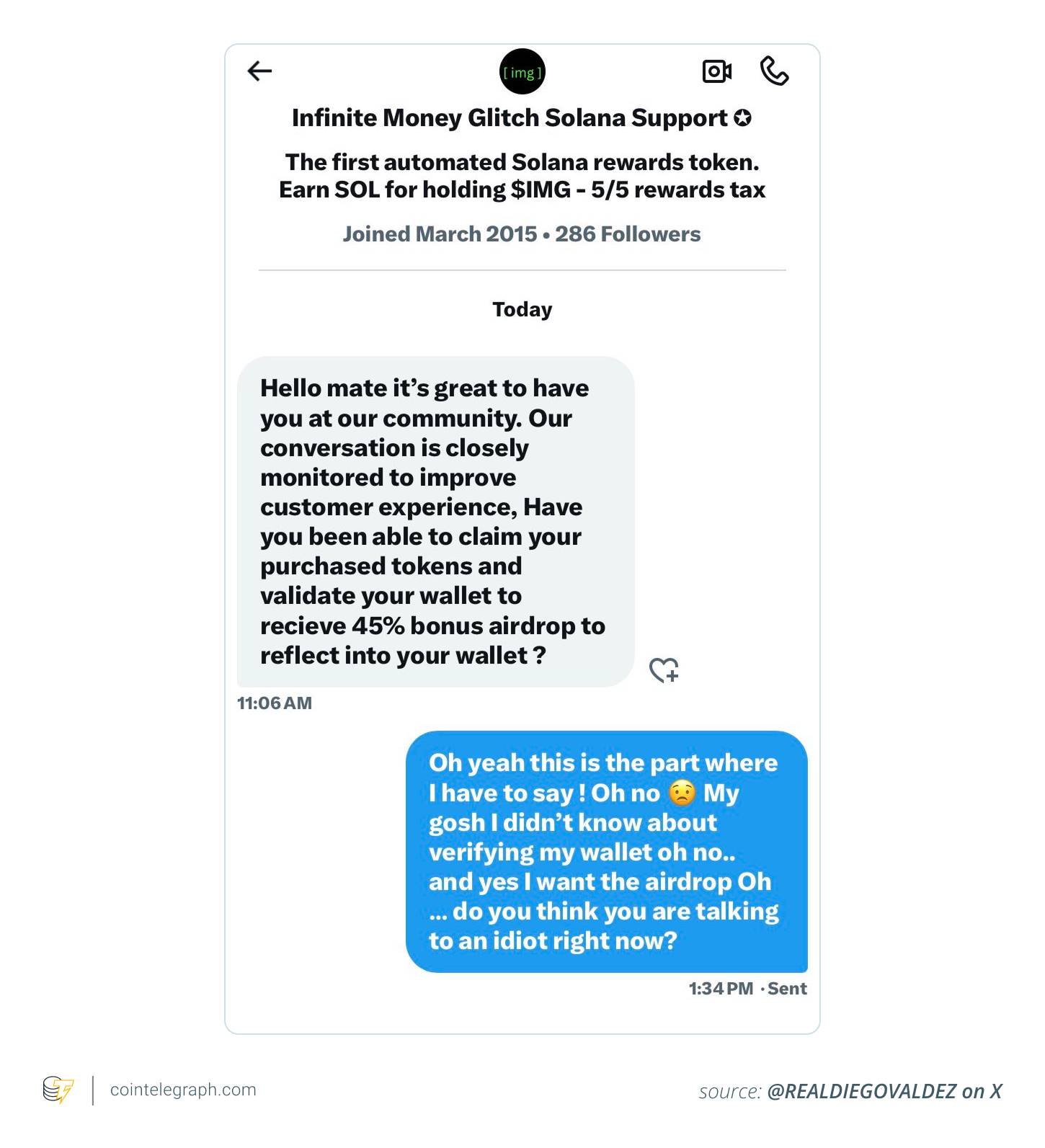
3. Prepayment of Gas Fees or Cryptocurrency
Warning: A clear red flag is being required to pay gas fees or send cryptocurrency to “unlock” tokens. Scammers insist you send ETH or other crypto to claim rewards, but after payment, promised tokens never arrive and your funds are lost.
Solution: Legitimate airdrops are free and usually only require basic tasks like connecting a wallet or completing simple steps. If an airdrop requires payment, it’s likely a scam. Never transfer funds to unknown addresses.
4. Suspicious URLs or Clone Websites
Warning: Fake airdrops often use phishing sites mimicking legitimate projects to deceive users into connecting wallets and approving fraudulent transactions.
Solution: Always double-check the URL before interacting with a project. Fake links often contain subtle differences such as spelling mistakes, extra characters, or alternative domain suffixes (e.g., .com replaced with .net).
Cool fact: Some airdrop projects use retroactive criteria, distributing rewards based on past user activity. This mechanism encourages organic ecosystem participation before the airdrop is announced, meaning natural DApp usage could qualify you for free tokens in the future.
5. Grammatical Errors and Urgent Language
Warning: Many fake airdrop campaigns contain grammar issues, spelling mistakes, or urgent phrases like “Claim now or miss out!” or “Last chance for free tokens!” These tactics create FOMO (fear of missing out), pushing users to click malicious links without thinking. Poor writing and forced urgency are key indicators of scams.
Solution: Legitimate crypto projects communicate professionally and clearly. If an airdrop post contains errors or uses time-sensitive language, avoid it.
6. Fake Social Engagement or Bot Comments
Warning: Scammers frequently fabricate engagement on airdrop posts with comments like “I just claimed 500 $XYZ!” or “Totally trustworthy!” These are typically posted by bots or fake accounts to simulate credibility and lure users in. They may also hijack celebrity accounts or create lookalike profiles to spread false endorsements. These tactics exploit herd mentality and celebrity influence to ultimately steal user funds or personal data.
Solution: Don’t rely solely on social media comments to judge an airdrop’s legitimacy. Research the token background, check if it’s listed on reputable platforms, and seek authentic user feedback via forums like Reddit or trusted project Discord servers. High-quality projects build transparent communities—not artificial hype.
7. Unknown or Nonexistent Token Projects
Warning: Some fake airdrops promote ties to obscure or entirely fictional projects lacking whitepapers, roadmaps, official websites, or verifiable team members. Scammers use these fabricated tokens to trick users into connecting wallets or authorizing transactions, leading to fund theft.
Solution: Conduct thorough research before engaging with any airdrop. Review the project’s whitepaper, official site, team credentials, and community activity. If basic information is missing or the project is newly created with no credible foundation, it’s likely fraudulent.
8. Token Approval Traps
Warning: Some fake airdrops trick users into connecting wallets and granting token transfer permissions. These seemingly harmless “approvals” allow scammers to freely transfer or steal tokens without further user action.
Solution: Be cautious when approving token transactions—especially those from unknown sources. Avoid authorizing smart contracts on untrusted sites and regularly use tools like Revoke Cash to review and revoke unnecessary token approvals.
9. Redirect Traps Leading to Wallet Drainers
Warning: Certain fake airdrop links redirect users to malicious DApps known as “wallet drainers.” Designed to mimic legitimate claim pages, these sites execute harmful smart contracts once a wallet is connected. Clicking “claim airdrop” unknowingly approves a transaction that grants attackers permission to drain all user funds.
Solution: Carefully inspect every transaction popup before signing. Consider using browser wallets with built-in anti-phishing protection (like MetaMask) and stay updated on known scam domains. Disconnect your wallet immediately if a site displays unfamiliar prompts or unexpected authorization requests.
10. Unrealistic Reward Promises
Warning: Fake airdrops often lure users with outrageous claims like “Get $2,000 worth of free tokens instantly at zero cost.” These scams exploit human greed and curiosity, tricking users into connecting wallets or signing transactions without proper verification.
Solution: Stay skeptical of exaggerated reward offers. Real airdrops typically offer modest incentives with defined eligibility requirements. If an opportunity seems too good to be true, it probably is a scam.
Cool fact: In 2021, Ethereum Name Service (ENS) airdropped governance tokens to everyone who had registered an .eth domain. Many ENS holders received thousands of dollars in tokens simply for owning a crypto domain.
Examples of Fake Airdrops
Below are some well-known fake airdrop cases illustrating how these scams defraud unsuspecting victims:
Hamster Kombat
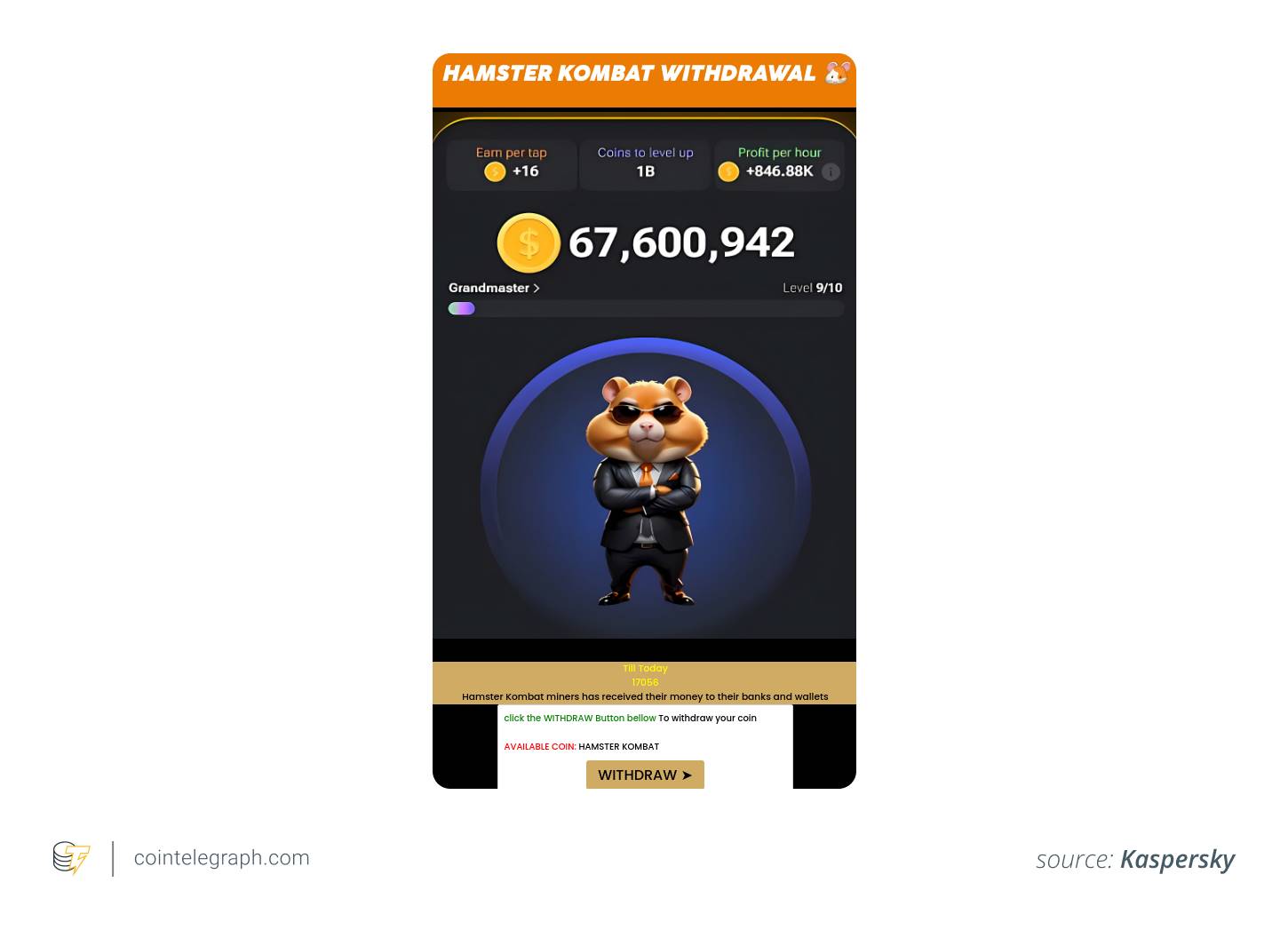
Hamster Kombat is a tap-to-earn game on Telegram where players act as hamster CEOs managing a virtual crypto exchange. By tapping, completing daily tasks, and upgrading, players earn HMSTR tokens redeemable for tradable tokens. Launched in March 2024, the game quickly attracted over 250 million users—but its viral success also drew security concerns due to widespread scams.
Scammers have targeted Hamster Kombat, aiming to profit from its rapid popularity. Kaspersky recently warned users about fake Hamster Kombat airdrops, which are phishing scams designed to steal victims’ crypto wallet credentials.
Wall Street Pepe
Wall Street Pepe ($WEPE) is an Ethereum-based meme coin that blends internet meme culture with practical trading features. Inspired by the iconic Pepe character and Wall Street finance, the token aims to empower small traders with three core benefits: unique market insights, professional strategy analysis tools, and a supportive community ecosystem.
The $WEPE airdrop scam used a counterfeit version of the official website, luring users with promises of free tokens. Victims unknowingly signed malicious contracts upon connecting their wallets, resulting in asset theft.

HEX
HEX is an Ethereum-based token designed to help users benefit from crypto market growth through a system supporting token staking and time-locked deposits.
This fraudulent webpage impersonates the official HEX site. The airdrop advertised on it is fake and has no connection to the real HEX project or any legitimate program. When users connect their crypto wallets to this counterfeit site, a malicious contract is triggered, enabling a cryptocurrency drainer to steal wallet funds.

Sui
Sui is a first-layer blockchain and smart contract platform designed for speed, privacy, and accessibility, featuring a unique object-centric data model.
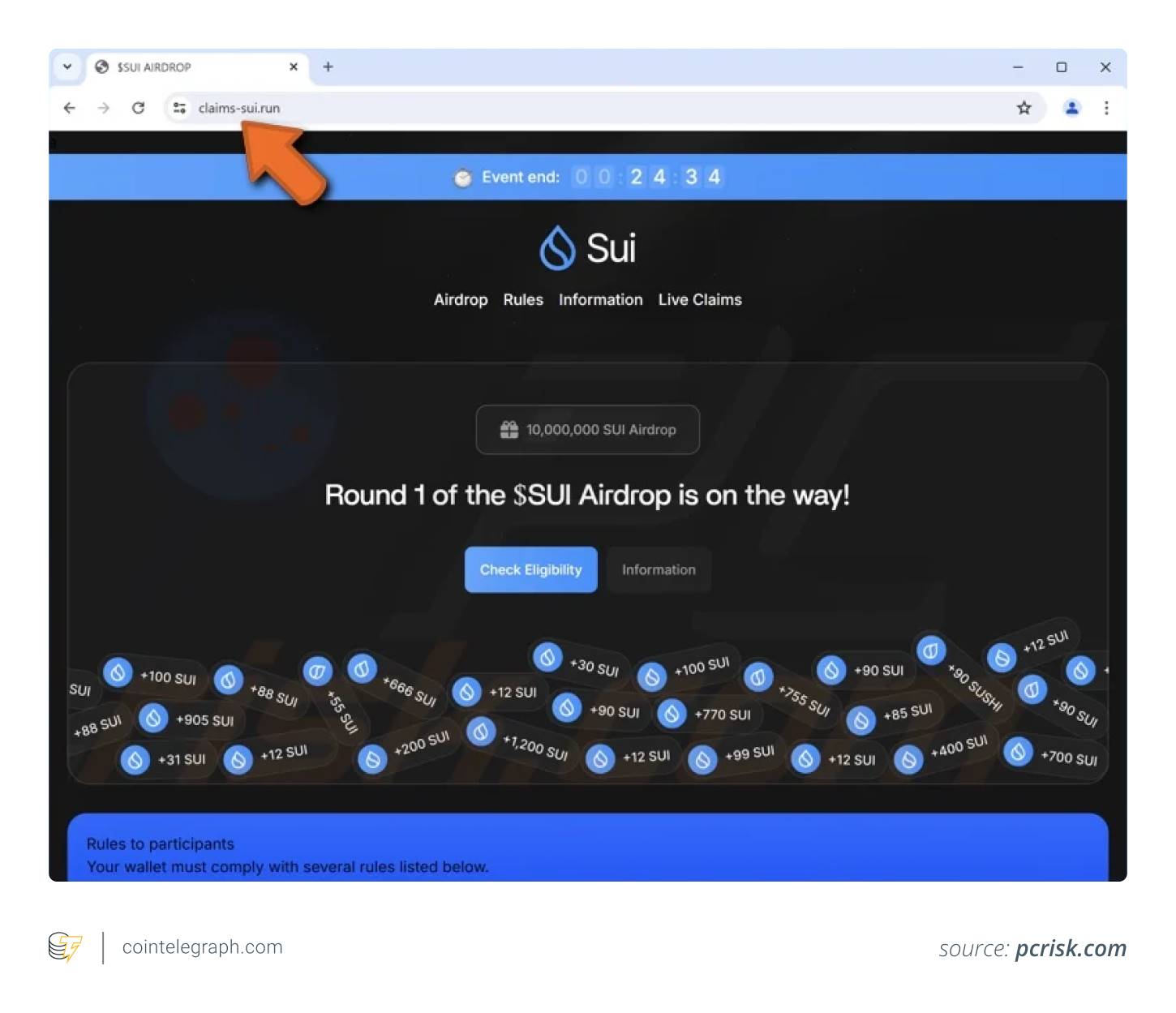
When users checked their airdrop eligibility on the scammer’s fraudulent webpage, they were prompted to connect their digital wallet. This action unknowingly approved a malicious contract, activating a cryptocurrency drainer. Victims’ funds were then automatically transferred via seamless unauthorized transactions to wallets controlled by the scammers.
LayerZero
LayerZero introduced an innovative “Proof of Donation” airdrop mechanism. Unlike typical free token distributions, LayerZero required users to donate $0.10 per ZRO token to Protocol Guild—a group supporting Ethereum core developers.
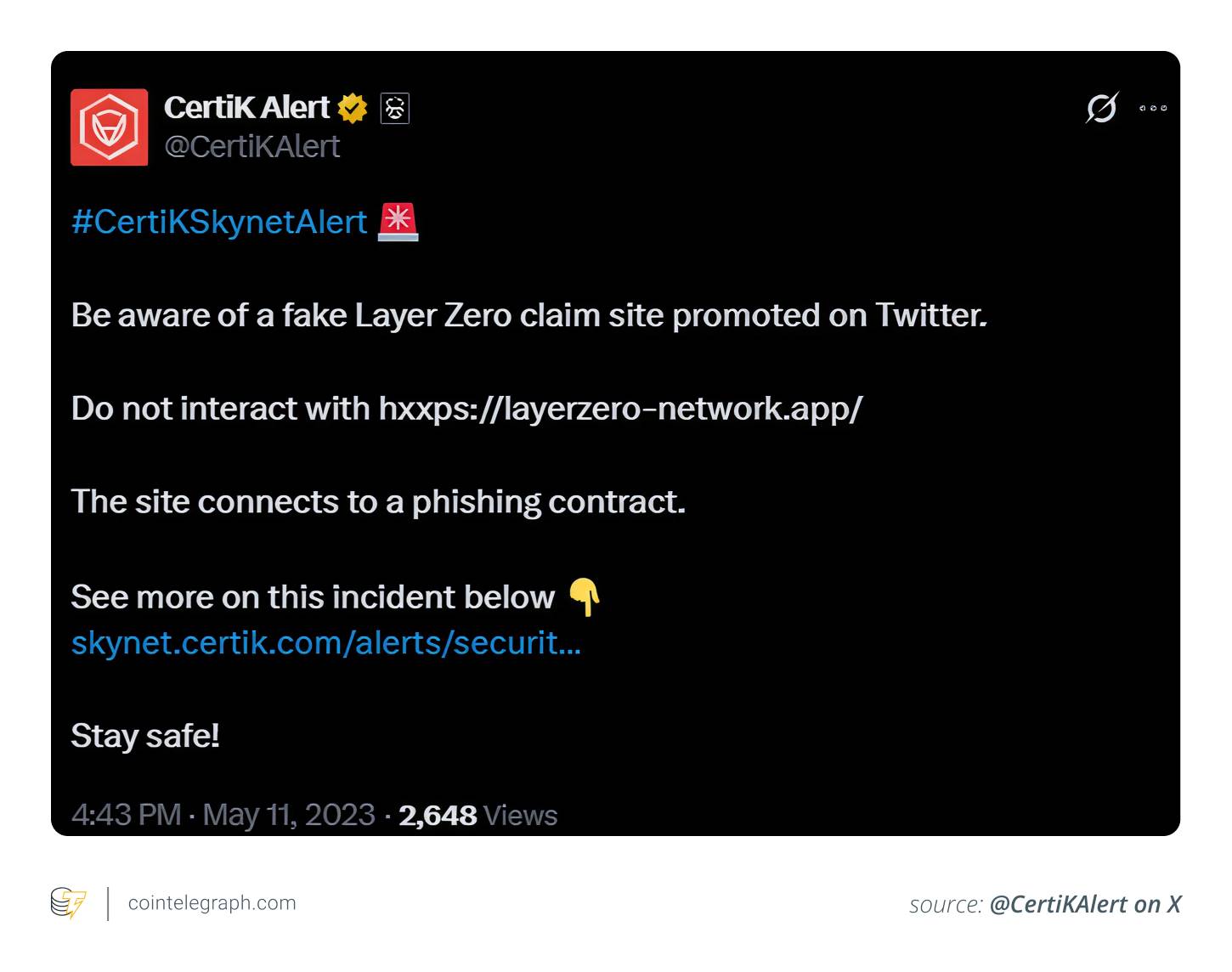
In July 2023, security firm CertiK warned users about fake airdrop campaigns promoted by impersonator accounts on X pretending to represent Layer Zero. Clicking the links redirected users to a phishing website mimicking the official LayerZero site.
How Are Crypto Airdrops Evolving from Free Giveaways to Secure Community Rewards?
Crypto airdrops are moving beyond simple token giveaways, adopting more advanced and secure strategies to drive user engagement. Projects increasingly implement behavior-based airdrop mechanisms that reward contributions such as asset staking, app testing, or governance participation. This shift aims to foster authentic community involvement while curbing speculative farming behavior.
New token distribution models are gaining attention, including snapshot-based allocations and retroactive reward systems. These innovations enhance transparency and ensure tokens reach users who actively contribute to ecosystem development. Meanwhile, deeper integration of artificial intelligence and machine learning helps detect fake accounts, bots, and fraudulent activities, significantly improving airdrop security and making token distribution more resistant to manipulation and more trustworthy.
This evolution reflects the advancement of responsible and efficient token distribution practices aligned with the goals of decentralization and community empowerment.
Join TechFlow official community to stay tuned
Telegram:https://t.me/TechFlowDaily
X (Twitter):https://x.com/TechFlowPost
X (Twitter) EN:https://x.com/BlockFlow_News
 @Cointelegraph






