








GENIUS Act clears Senate hurdle
TechFlow Selected TechFlow Selected
GENIUS Act clears Senate hurdle
The revised bill prohibits senior executive branch officials from issuing stablecoins but exempts the President and Vice President.
 Navigating Web3 tides with focused insights
Author: Token Dispatch, Shruti Lohar
Translation: Block unicorn
Introduction
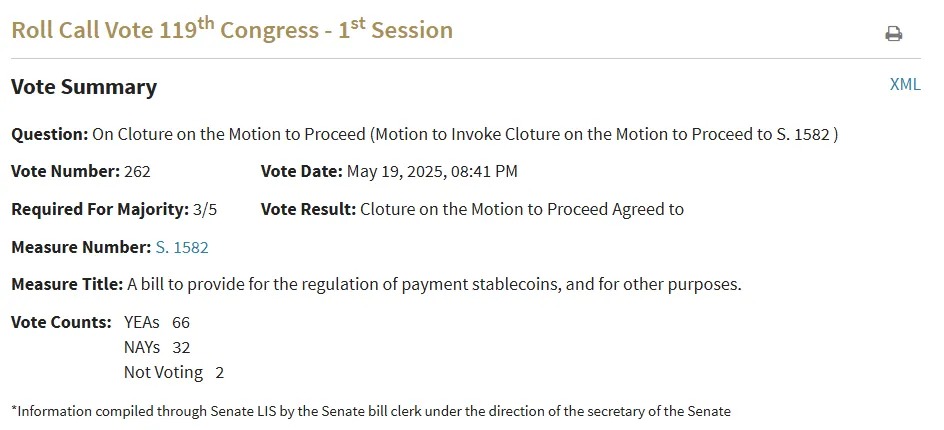
The U.S. Senate has revived its landmark stablecoin legislation, with the GENIUS Act clearing a key procedural vote late Monday—just two weeks after it appeared to have died in the Senate.
Senators advanced the bill by a 66-to-32 vote, easily surpassing the 60-vote threshold needed to end debate and move to final consideration.
This unexpected turnaround reflects shifting political dynamics.
Earlier this month, the bill failed due to key Democratic co-sponsors withdrawing support, dealing a blow to Republican leadership.
What changed?
After two weeks of intense negotiations, revised drafts incorporated new provisions addressing Democratic concerns over conflicts of interest, national security safeguards, and potential involvement of big tech companies in the sector.
Five pivotal Democratic senators—Ruben Gallego (Arizona), Mark Warner (Virginia), Lisa Blunt Rochester (Pennsylvania), Kirsten Gillibrand (New York), and Angela Alsobrooks (Maryland)—shifted their stance to back the bill after previously opposing it.
The initial failure stemmed partly from Democratic concerns about President Donald Trump's growing ties to cryptocurrency firms. The Trump family has launched multiple crypto ventures, including a stablecoin called USD1, which has quickly become the seventh-largest stablecoin by market cap.
"We can't let that corruption blind us to the broader reality: blockchain technology is here to stay. If U.S. lawmakers don't shape it, others will—and not in ways aligned with our interests or democratic values," Senator Mark Warner acknowledged before supporting the bill.
The revised bill bans senior executive branch officials from launching stablecoins but exempts the president and vice president, only partially addressing Trump-related concerns.
What's in the bill?
The GENIUS Act (Guiding and Establishing National Innovation with Stablecoins) would:
-
Require stablecoins to be fully backed by U.S. dollars or similar liquid assets
-
Mandate annual audits for issuers with over $50 billion in market cap
-
Establish a framework for legally issuing stablecoins in the U.S.
-
Restrict algorithmic stablecoins
-
Include consumer protection provisions and anti-money laundering standards
Democrats on the Senate Banking Committee released a critical staff analysis of the latest draft of the GENIUS Act.
The report labeled the draft a potential roadmap for "Trump crypto corruption" and increased control of digital currencies by big tech companies.
Staff called for further revisions, highlighting several major issues:
-
The bill does not prevent Trump from profiting off his own stablecoin.
-
It allows Elon Musk’s X platform to launch its own digital currency, “X Money.”
-
It expands existing loopholes used by Tether, potentially facilitating criminals and terrorist organizations.
-
It lacks sufficient consumer protections and financial safety measures.
Despite these warnings, the five Democrats who opposed the bill two weeks ago now support it.
Not everyone was convinced by last-minute changes.
Senator Elizabeth Warren strongly criticized the bill ahead of the vote.
"Trump and his family have already made hundreds of millions of dollars from their crypto ventures, and if this bill passes, they’ll make hundreds of millions more through their stablecoin USD1. The GENIUS Act would accelerate Trump’s corruption by expanding the stablecoin market," Warren argued.
The revival of the stablecoin bill comes amid intensified industry lobbying.
According to Decrypt, Coinbase, which had previously been hesitant about standalone stablecoin legislation, recently ramped up pressure, urging users via in-app notifications to contact their senators.
The crypto exchange’s political action organization, Stand With Crypto, said it would downgrade lawmakers who vote against the bill—an effort powered by the $300 million raised last year for a pro-crypto super PAC.
If passed by the Senate, the GENIUS Act would still need approval from the House before landing on Trump’s desk.
Join TechFlow official community to stay tuned
Telegram:https://t.me/TechFlowDaily
X (Twitter):https://x.com/TechFlowPost
X (Twitter) EN:https://x.com/BlockFlow_News






