A New Paradigm for Stablecoin Yields: From AgentFi to XenoFi
TechFlow Selected TechFlow Selected
A New Paradigm for Stablecoin Yields: From AgentFi to XenoFi
AgentFi serves as the next-stage paradigm in the convergence of "AI + DeFi," offering DeFi users intelligent agents that require no manual monitoring and automatically optimize performance.
 Navigating Web3 tides with focused insights
Author: 0xjacobzhao and ChatGPT 4o
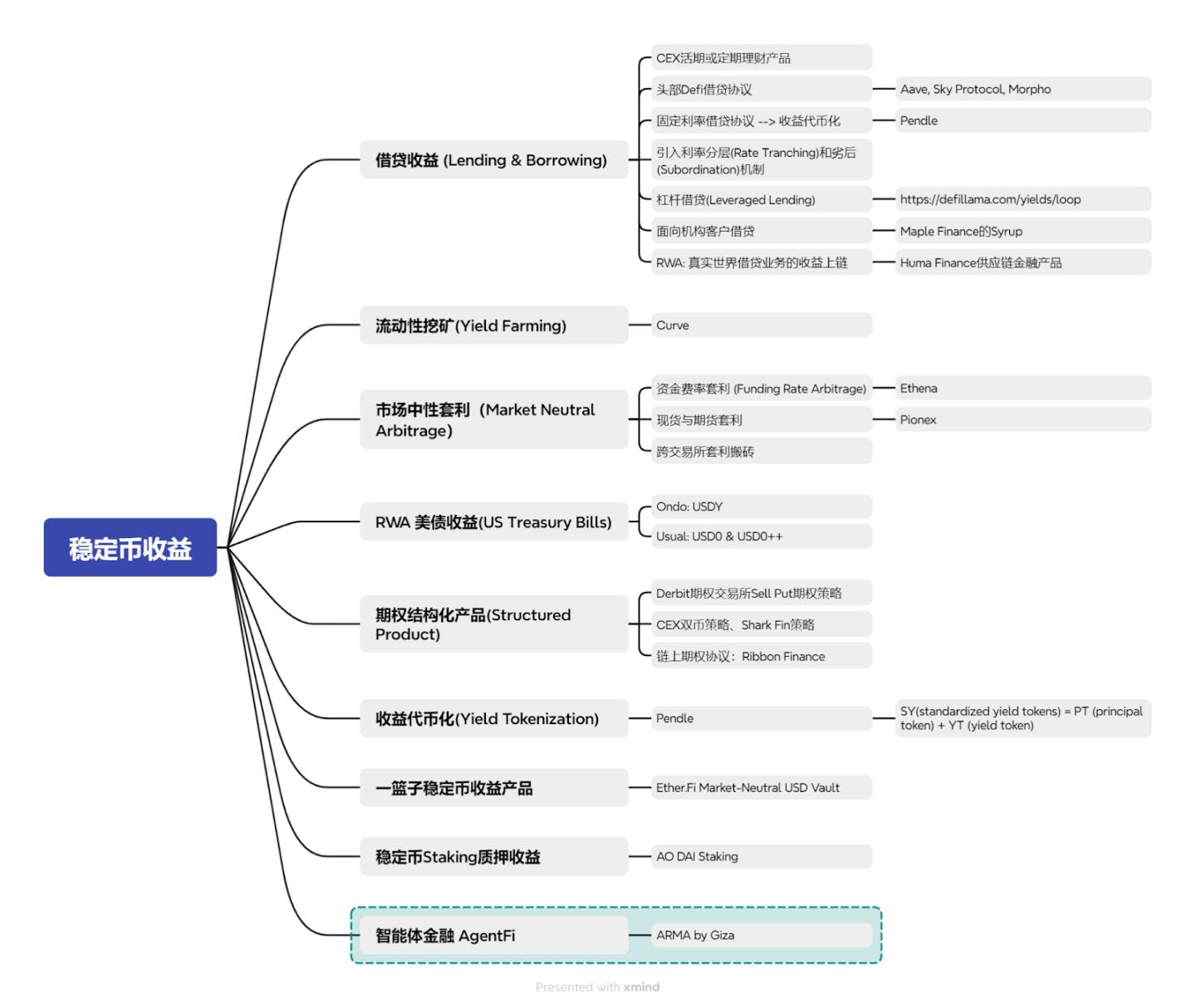
Last month's article "A Guide to Stablecoin Yields" detailed the characteristics, yield sources, and potential risks of eight stablecoin yield models: stablecoin lending & borrowing, yield farming, market-neutral arbitrage, US Treasury-backed RWA yields, structured products, yield tokenization, basket-based stablecoin yields, and stablecoin staking. It became a recommended read across multiple Chinese media outlets in April and gained notable traction within the Chinese crypto community. Several stablecoin teams subsequently reached out to me, offering new information, insights, and perspectives. Most of these projects still fall into one of the existing eight categories. Excitingly, however, I identified an emerging new paradigm in stablecoin yield generation: AgentFi.
1. Classification and Comparison of DeFAI and AgentFi
Although both DeFAI and AgentFi reside at the intersection of "AI + DeFi," their technical foundations, product forms, and paradigmatic missions are fundamentally different. Unlike traditional DeFi or generalized DeFAI projects, AgentFi’s core characteristic is that the AI agent serves as the primary executor and decision-making entity, fully automating decisions and executing them in closed loops—rather than simply using AI as an analytical tool or auxiliary for enhancing human-driven strategies.
-
DeFAI Category: Uses AI to assist or enhance DeFi-related functions such as strategy optimization, data analysis, and investment recommendations. These are tool-type applications where AI models support human decision-making. Examples include Kaito, Numerai, and Gauntlet, which focuses on DeFi yield optimization. These financial automation products rely on explicit user instructions and execute a “command-to-action” workflow.
-
AgentFi Category: Builds financial systems where on-chain AI agents act as primary executors. Agents can autonomously reason, make decisions, and perform transactions or governance actions. Users authorize agents to act on their behalf, enabling proactive decision-making and execution. This follows an “intent-to-outcome” paradigm, where users only need to express goals, and the system handles strategy formulation and execution.
The current market is flooded with agent launch platforms and trading markets. Compared to purely speculative AI meme tokens with no practical utility, genuinely Crypto-native Defi-focused AgentFi projects are extremely rare. After extensive online research and filtering—excluding overly early or clearly non-functional projects—we provide the following simplified classification and rating of current AgentFi projects:
✅ Stablecoin Yield Optimization

✅ Strategy Portfolio / Yield Farming

✅ On-chain Trade Execution
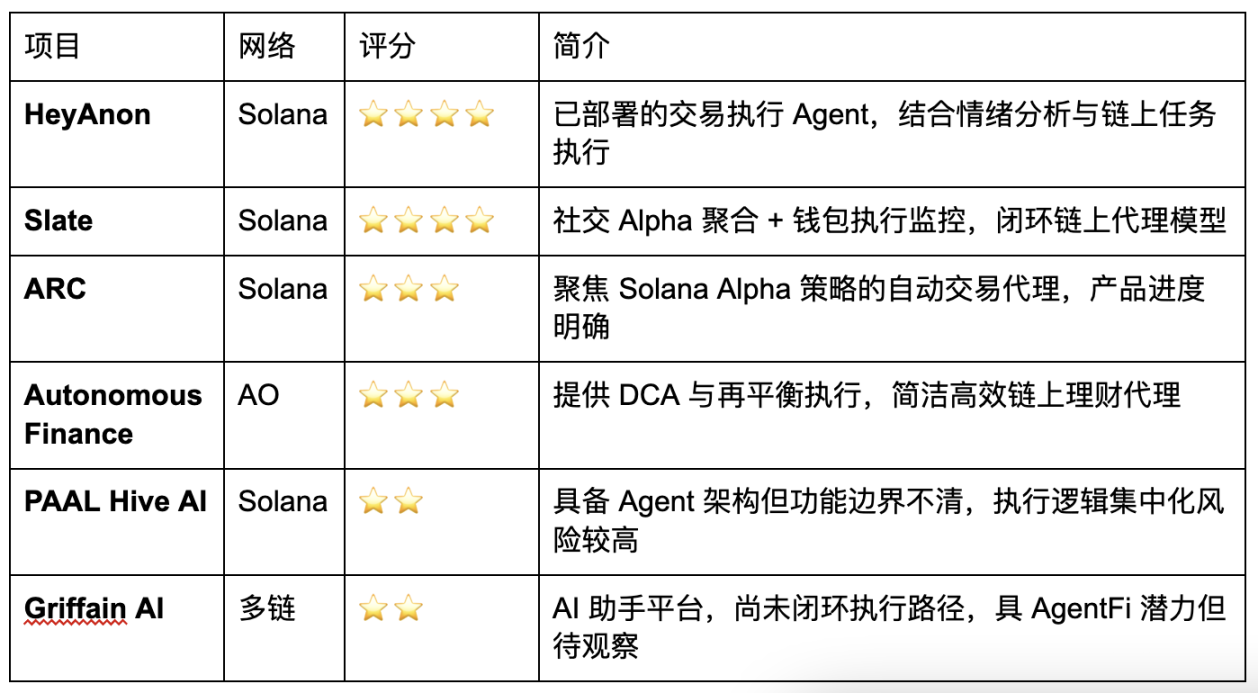
The above nine AgentFi projects all have preliminary on-chain closed-loop execution, clear use cases, and basic functional products. That said, the AgentFi sector remains highly immature—most product experiences are subpar and significantly lag behind mature DeFi protocols. We hope the AgentFi space will move beyond the meme-token speculation phase and eventually reach true product-market fit (PMF).
2. Stablecoin Yield Optimization in AgentFi
The stablecoin yield optimization space is not new to the DeFi world. From early projects like Yearn Finance (YFI), an automated yield aggregator, and Idle Finance, which offered automatic asset rebalancing and strategy portfolios, to Gauntlet—a professional DeFi risk modeling and protocol-level yield optimization platform targeting institutions—these were representative automated yield optimization projects prior to AgentFi.
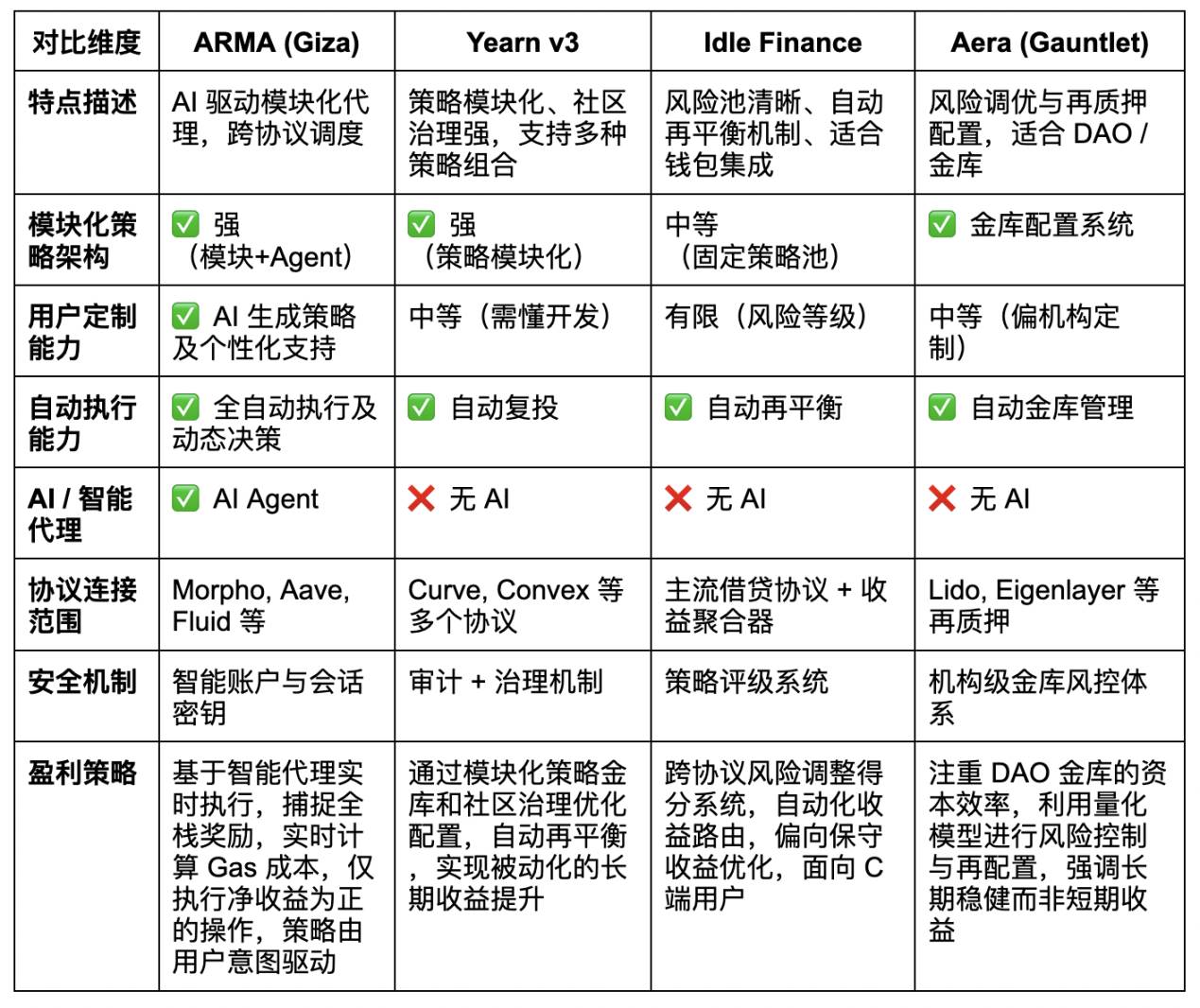
Agent Finance (AgentFi) has begun to realize the vision of symbiotic integration between crypto and AI: AI leverages on-chain data collection and decision-making capabilities to empower users in participating more effectively in native DeFi environments, while blockchain’s immutability ensures transaction details are preserved on-chain for verifiable logic and traceable behavior. As a continuation of our stablecoin yield series, we focus on ARMA—the only project in the AgentFi space so far to receive five-star usability ratings and the sole representative in the “stablecoin yield optimization” category.
3. Giza’s Project Vision and Paradigm Philosophy
Giza is a blockchain infrastructure project focused on building “Verifiable AI Agents,” aiming to advance the emerging paradigm of Agent-native Finance. Unlike other ZKML projects such as Modulus Labs or EZKL, which lean toward theoretical research or foundational development, Giza emphasizes engineering and practicality. It is among the first in the ZKML space to achieve a complete closed loop of “on-chain agents + verifiable execution + AI orchestration.”
Giza introduced a groundbreaking concept—Xenocognitive Finance—which introduces AI agents as novel interfaces in decentralized finance to overcome cognitive bottlenecks faced by human participants, thereby redefining market intelligence and structure. These agents are not passive tools but “cognitive representatives” with independent reasoning abilities and on-chain execution rights. Through a distributed network of agents, they enhance the market’s overall information-processing capacity, allowing market intelligence to scale rather than collapse with participation. Zero-knowledge proofs (ZK) ensure credible outcomes. In short, Xenocognitive Finance enables “cognitive offload” via autonomous agents—extending human cognition without sacrificing sovereignty in non-custodial setups—allowing users to participate efficiently in DeFi without constant monitoring or manual protocol switching.
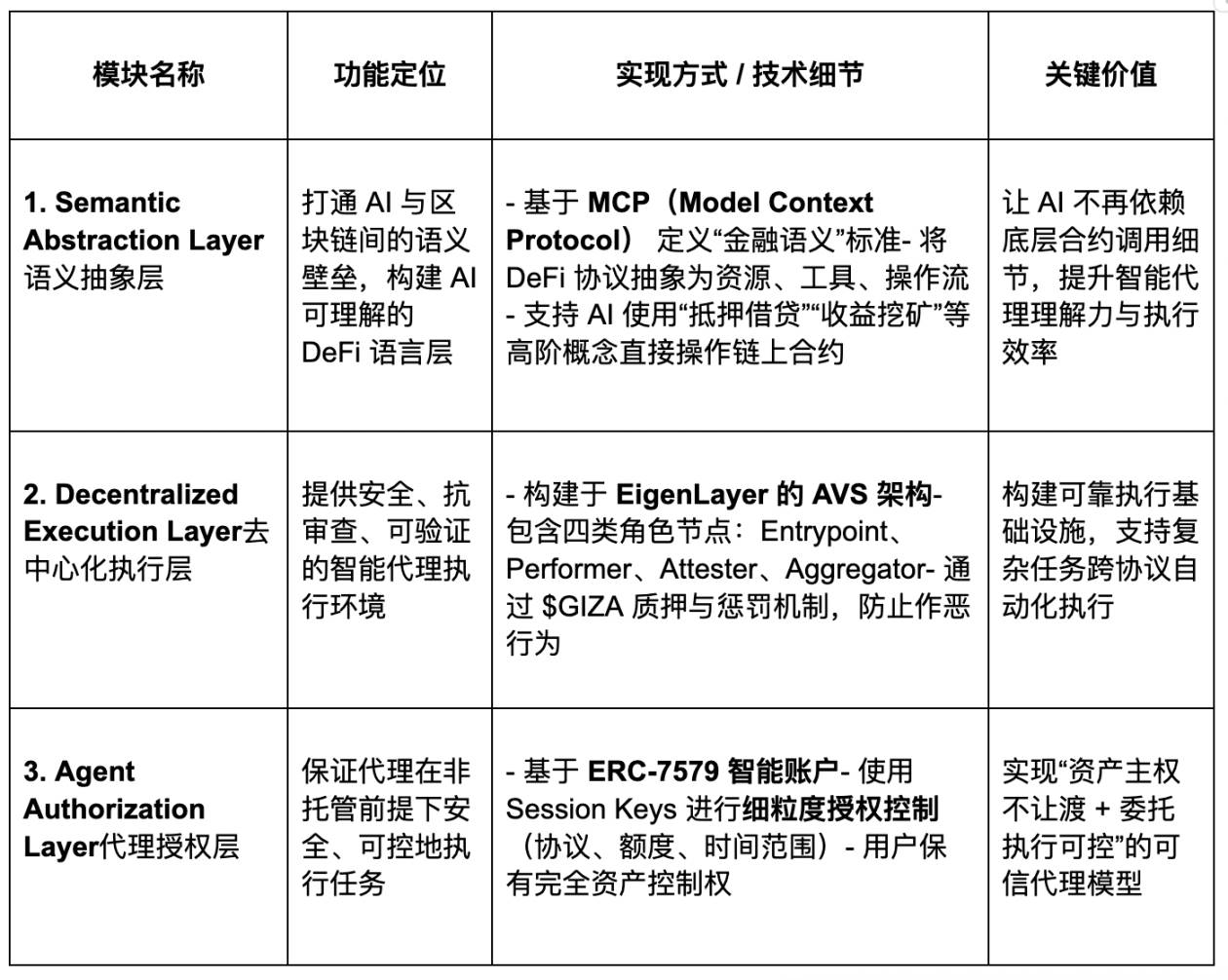
The Giza Protocol architecture consists of three layers:
-
Semantic Abstraction Layer: Bridges the semantic gap between AI and blockchain, enabling AI to understand the blockchain world.
-
Decentralized Execution Layer: Provides a scalable, secure, and censorship-resistant environment for agent execution.
-
Agent Authorization Layer: Ensures agents operate in a non-custodial, secure, and controllable manner.
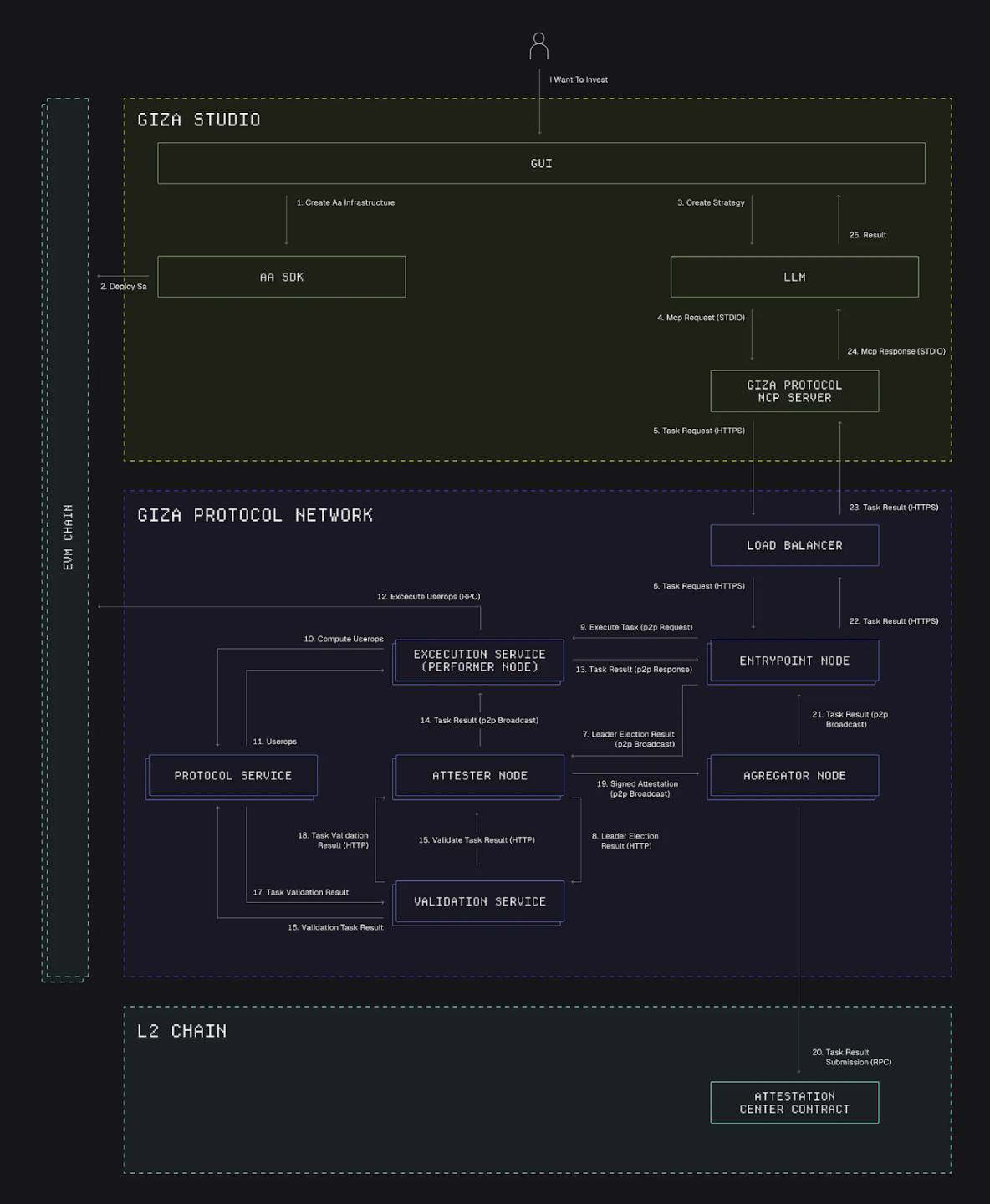
Giza’s agent execution process is coordinated by three core modules across four key steps:
-
Request Processing (Semantic Abstraction Layer): The AI agent initiates an operation request (e.g., “deposit USDC into Aave”) via the MCP protocol. The system parses natural language strategies into standardized on-chain commands, validating format, semantics, and permission boundaries to ensure legality and executability.
-
Protocol Interaction (Decentralized Execution Layer): Execution nodes invoke DeFi protocols (e.g., lending, swapping) based on instructions. The system dynamically optimizes transaction paths considering gas costs, slippage tolerance, and protocol liquidity. After task completion, results and execution proofs are generated for subsequent verification.
-
Execution Verification (Authorization Layer + Execution Layer): The system checks whether operations comply with the user-defined Session Key permissions (protocol types, limits, time windows). Multiple Attester nodes independently verify the operation, and an Aggregator node collects signatures to reach consensus, ensuring secure and trustworthy outcomes.
-
Result Feedback (Semantic Abstraction Layer): Execution results are converted into structured semantic data (e.g., yield changes, asset distribution) and returned to the AI agent system for future strategy adjustments and autonomous decision cycles.
In July 2023, Giza announced a $3 million Pre-Seed round led by CoinFund, with participation from StarkWare, TA Ventures, and Arrington Capital (founded by the TechCrunch founder). Angel investors included Rand Hindi and Julien Bouteloup. In May 2025, Giza completed a $2.2 million Seed round led by Base Ecosystem Fund, with follow-on investments from CoinFund, Arrington Capital, Re7 Capital, and Contango Digital Assets. These rounds reflect continued investor confidence in Giza’s vision at the intersection of AI and DeFi.
4. Flagship Product ARMA: Stablecoin Yield Optimization Agent
ARMA (Autonomous Revenue Management Agent) is Giza’s stablecoin yield optimization agent, designed to maximize returns across protocols automatically. It is currently deployed on Base and plans to expand to more Layer 2 ecosystems, supporting major lending protocols including Aave, Morpho, Compound, and Moonwell.
4.1 ARMA Workflow Overview
-
Intelligent Strategy Orchestration: Continuously analyzes stablecoin yields (APR), transaction costs, and rebalancing timing across protocols, automatically executing optimal reallocation.
-
APR Optimization System: Achieves net gains through comprehensive optimization of interest rate comparisons, cost assessment, and rebalancing logic. Real-world tests show annualized returns up to twice that of traditional static holdings.
-
Automatic Compounding Mechanism: Automatically claims and reinvests incentive tokens, converting rewards back into the original stablecoin. Compounding frequency is dynamically optimized based on position size and transaction costs to improve efficiency.
-
Smart Swap Logic: Supports dual-currency operations for USDC and USDT. When necessary, it uses integrated DEXs to swap efficiently, ensuring users can always withdraw in their original currency, enhancing flexibility and user experience.
4.2 ARMA Components and Security Architecture Overview
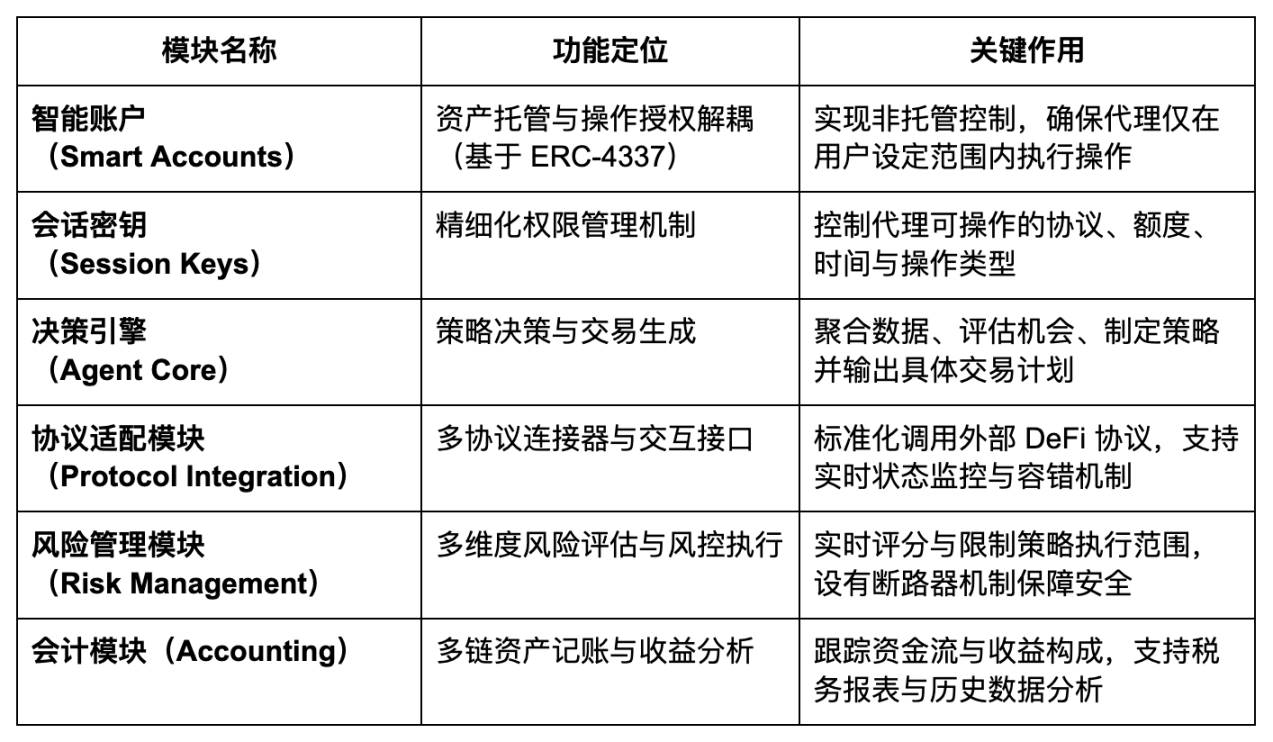
The Giza Agent architecture comprises six modules: Smart Accounts, Session Keys, Agent Core, Protocol Integration, Risk Module, and Accounting Module. Together, they form a secure, efficient, intelligent, and verifiable on-chain automation system.
Additionally, ARMA employs a three-layer security framework to protect user funds and operations:
-
Smart Account Security: Built on self-custodial smart accounts, users retain full control over assets—Giza cannot access private keys. Contracts are audited and support flexible permission management.
-
Access Control: Session Keys allow fine-grained permission settings, restricting agents to specific protocols, operation types, and validity periods, avoiding risks associated with full authorization.
-
Risk Management: Only integrates carefully vetted protocols focused on stable yield scenarios. All transactions are fully traceable, ensuring transparency and auditability, strengthening overall system security.
4.3 ARMA Fee and Revenue Model
ARMA’s fee and revenue model prioritizes user-friendliness, transparency, and efficiency across three aspects:
-
Pricing Structure: Performance-based fees—only 10% success fee charged on actual realized gains. Fees are settled in a lump sum upon withdrawal, with all calculations visible in real-time via the dashboard.
-
Reward Management: Automatic claiming and consolidation—ARMA automatically collects all rewards from integrated DeFi protocols. Rewards are returned together with principal and yield upon withdrawal, eliminating manual intervention.
-
Asset Management: No deposit or withdrawal fees. Regardless of how many protocols or tokens are involved, users always withdraw in the original deposited token, ensuring convenience.
4.4 ARMA’s Integrated DeFi Protocols and Performance Data
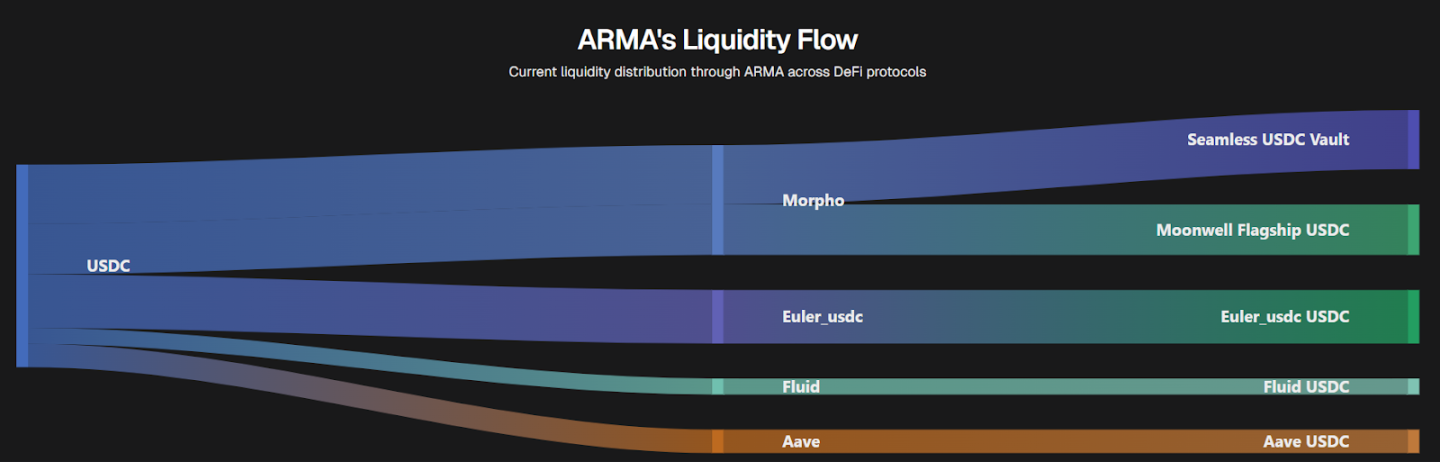
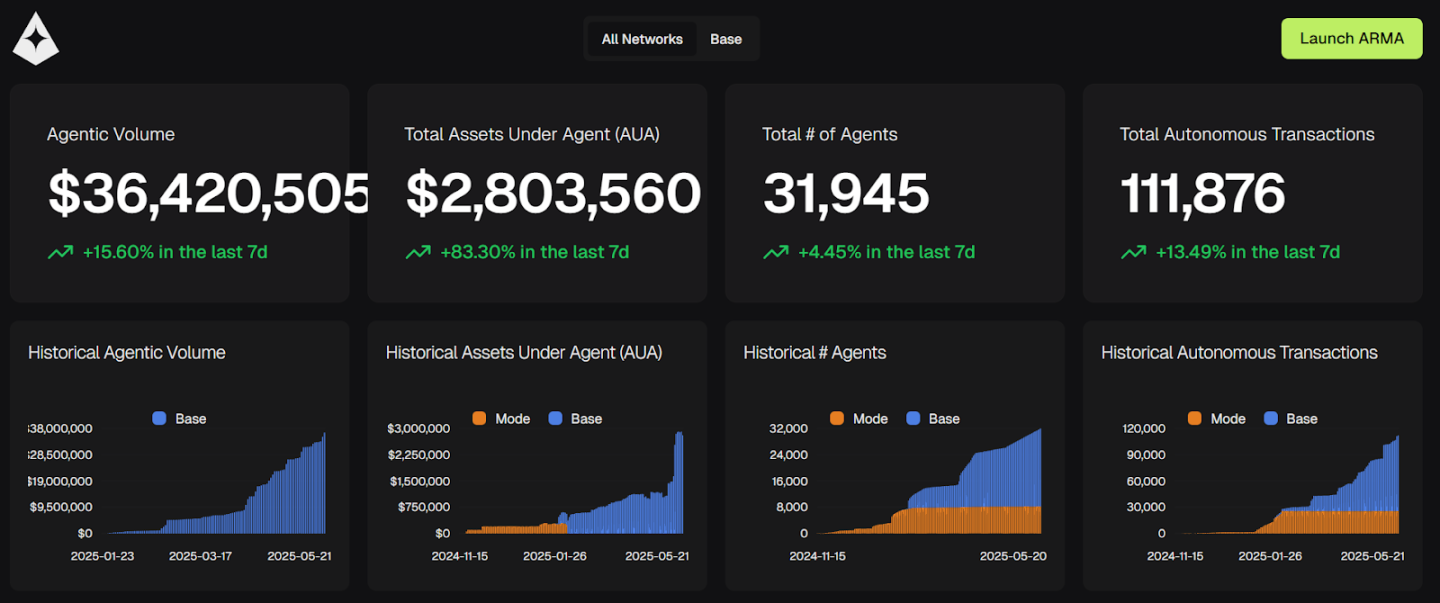
Through ARMA’s official metrics dashboard (metrics.gizatech.xyz), we can clearly observe the continuous growth in assets under management and the number of active agents since launch. The dashboard also visualizes dynamic asset flows across major lending protocols such as Morpho, Aave, and Fluid. We believe that as ARMA integrates more DeFi protocols, increases active agent count, and scales its capital base, it will further strengthen its positive flywheel effect.
5. Token Positioning and Incentive Mechanism
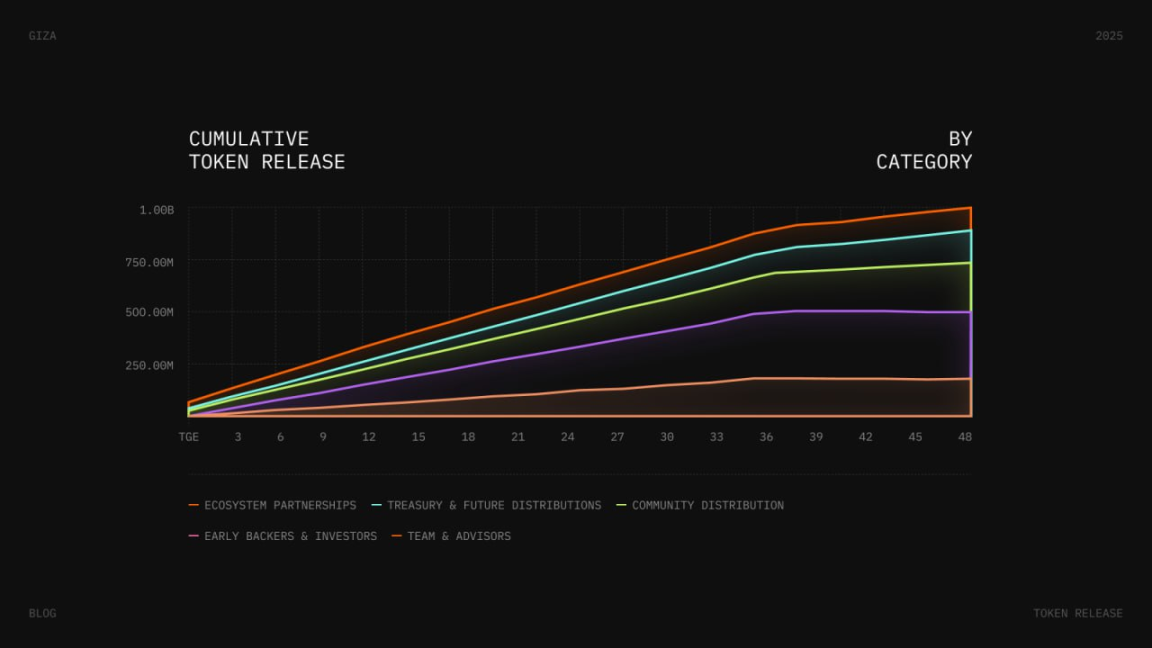
Giza has recently released full details of its tokenomics, making TGE a significant milestone. $GIZA is the native asset of the Giza agent network, featuring immediate utility, long-term value capture, and a design philosophy centered on community-first, product-driven development, and conservative mechanisms.
Key Highlights
-
Reasonable Initial Valuation: TGE initial FDV set at $70M, significantly lower than comparable AI projects, offering substantial upside potential.
-
No Initial Unlock: Team and investors receive zero token unlocks at TGE, aligning incentives with the community and avoiding early sell pressure.
-
Product Already Live: ARMA agents already manage over $30M in on-chain assets, backed by real demand and usage.
-
Clear Token Utility: $GIZA is used for staking validation, access control, protocol governance, and agent incentives—making it a core asset.
-
Incentives Tied to Security: Agent nodes must stake $GIZA; malicious behavior is penalized, ensuring reliable and secure execution.
-
Value Recirculation: A portion of agent-generated revenue flows into AMMs for $GIZA buybacks or redistribution, creating a sustainable incentive loop.
-
Community-Centric Distribution: Tokens prioritized for real users and contributors, emphasizing fair distribution and long-term co-creation of value.
-
Dual Staking Mechanism: Both node operators and regular users can stake $GIZA, earning execution rewards and governance rights respectively.
-
Time-Weighted Design: Longer staking duration yields higher reward multipliers and governance power, up to 5x, incentivizing long-term commitment.
-
Progressive Governance: Governance evolves in stages—from a security committee to representative councils and specialized committees—ultimately achieving decentralized autonomy.
Giza Points Incentive System:
To encourage users and developers to participate in building the Giza agent ecosystem, Giza launched the Giza Points System (GPS) in late 2014 as a basis for future native token distribution. This points system prioritizes “long-term contributions” over “short-term actions” and is open to the following key participants:
-
Users: Earn points continuously through on-chain activities such as using agent products, providing feedback, and stress testing.
-
Developers: Receive rewards for integrating new agents, optimizing execution logic, and submitting security improvement proposals.
-
Community Members: Gain recognition through educational outreach, governance discussions, and ecosystem-building activities.
Currently in its high-subsidy launch phase, ARMA offers users who deposit stablecoins a fixed 15% annualized yield for the first three months, composed of base interest and additional rewards. Beyond this fixed return, the first $10M in deposits will receive pro-rata allocations totaling 1% of the total $GIZA supply, linearly vested over nine months. No lockups or penalties apply—ideal for users seeking both short-term stable returns and long-term $GIZA upside.
Giza Growth Flywheel Effect
Giza has built a growth flywheel driven by agent utility, protocol usage, token value, and ecosystem participation: intelligent agents improve capital management and strategy execution efficiency, driving more DeFi activity and protocol interactions. This generates recurring revenue flowing back to stakers, boosting $GIZA’s value, attracting more nodes and developers, and expanding agent network capabilities—creating a virtuous cycle of “more usage → higher value → stronger security → broader capabilities.” This positions Giza as a scalable and trustworthy Agent-native financial infrastructure.
Giza Token Governance and Community Participation Design
Giza’s governance adopts a phased evolution model combining expert committees and community representation, ensuring decentralization progresses safely and steadily. Initially governed by a security committee, community input is gathered via voting and discussion. Mid-stage opens key decisions to on-chain governance. Ultimately, governance transitions fully to a professional council elected by the community. Token holders can delegate decision-making to representatives with technical or economic expertise and amplify their voting power through time-weighted staking, encouraging long-term engagement and shared responsibility—building a secure, efficient, professional, and democratic governance system.
6. Investment Thesis and Potential Risks
I first met the Giza team during ETHcc in Paris in 2023. Initially entering the market with a ZKML narrative, Giza gradually evolved in 2024 into a more engineering-focused, DeFi-applicable AgentFi project. After extensive research and careful evaluation of mainstream stablecoin yield projects and emerging AgentFi initiatives, we maintain that Giza’s ARMA remains one of the few AgentFi projects with real product refinement and a closed-loop on-chain execution capability. This “product-first, token-second” approach stands in stark contrast to the wave of conceptual, non-functional meme coins that emerged during the DeFAI hype. That said, we must acknowledge that compared to other stablecoin yield channels, AgentFi remains extremely early. Protocols have yet to endure full market cycles and remain in an “early mining” phase, characterized by high volatility and experimental nature. DeFi degens comfortable exploring frontier opportunities may allocate a portion of stablecoin assets to try it—but should still practice risk diversification.
Investment Thesis
-
Paradigm Innovation Narrative: Giza sits at the intersection of AgentFi, ZK, and AI, pioneering the theory of “Xenocognitive Finance”—a future financial architecture based on on-chain agents enabling “cognitive offload.” It holds a distinct first-mover advantage with philosophical depth.
-
Product Leadership: ARMA is among the very few AgentFi products currently live with a closed-loop autonomous execution system. Its user experience surpasses most projects still stuck in concept or pure token-driven “air projects.”
-
Early Miner Reward Window: Stablecoin yield inherently carries manageable risk under sound protocol security. Combined with ARMA’s current token subsidy mechanism, early adopters gain access to a “first-mover mining” opportunity.
Potential Risks
-
User Trust Still Early: The AgentFi model is still in exploration. Market trust in on-chain AI agents remains limited, especially around fund custody and transparency of strategy execution, creating psychological barriers that prevent rapid user growth.
-
Complex System Security Risks: ARMA integrates multiple high-complexity components—AI reasoning, on-chain account abstraction, and multi-protocol integration. Security depends on both correct contract design and sound reasoning logic. Failure in any component could lead to asset loss.
-
Unclear Token Value Capture Path: Current crypto markets are heavily speculation-driven, with token performance often dictated by sentiment and liquidity. Giza’s team avoids speculation; thus, the $GIZA token’s incentive structure, staking mechanics, and value recirculation model require further market validation—posing higher demands on long-term investors.
8. Conclusion
In an era of increasingly diverse stablecoin yield strategies but limited user attention and execution efficiency, AgentFi emerges as the next-phase paradigm in the “AI + DeFi” convergence—offering DeFi users intelligent agents that optimize returns automatically without constant monitoring. This article uses Giza and its flagship product ARMA as case studies to systematically review the current state, technical features, and yield potential of the AgentFi space. Grounded in the philosophy of “Xenocognitive Finance,” Giza was among the first to deliver a complete closed loop of AI-driven strategy and non-custodial execution, making it one of the few AgentFi projects today that combine deep conceptual foundation with real product utility. ARMA, focused on stablecoin yield optimization, is already live across multiple chains and integrated with major lending protocols, enhanced by a structured token incentive model that creates an early-miner effect.
That said, we must remain clear-eyed: AgentFi is still in its infancy. User trust, execution stability, and token value capture mechanisms all await further market validation. Yet precisely because of this, for users and builders who recognize the long-term potential and are willing to position themselves early in this paradigm shift, AgentFi—and particularly Giza/ARMA—may represent the leading edge of the agent-driven financial era and a unique opportunity.
Join TechFlow official community to stay tuned
Telegram:https://t.me/TechFlowDaily
X (Twitter):https://x.com/TechFlowPost
X (Twitter) EN:https://x.com/BlockFlow_News