Exclusive Interview with Hsiao-Wei Wang, Co-Executive Director of the Ethereum Foundation: Exploring Ethereum's Future
TechFlow Selected TechFlow Selected
Exclusive Interview with Hsiao-Wei Wang, Co-Executive Director of the Ethereum Foundation: Exploring Ethereum's Future
Discussed with Hsiao-Wei her personal growth journey, details on Ethereum's technical roadmap determination, and highlights and challenges in community building.
 Navigating Web3 tides with focused insights
ETHPanda Talk is a program focused on how to build a better digital future based on Ethereum. We invite outstanding Ethereum builders to share their motivations for building Ethereum, the projects they are advancing, as well as related experiences and insights—including their outlooks for the future. By uncovering these behind-the-scenes stories and ideas, we hope to offer more diverse perspectives or inspiration, encouraging everyone to participate in Ethereum's development.
This episode of ETHPanda Talk features Hsiao-Wei Wang, who joined the Ethereum Foundation in 2017 as a researcher and has remained with the organization for nearly eight years. She has participated in major Ethereum upgrades including The Merge, Shapella, and Dencun. In April 2025, she was appointed co-executive director of the Ethereum Foundation—this is her first public interview since taking on the role.
In this episode, we discuss with Hsiao-Wei her personal journey, details around Ethereum’s technical roadmap, highlights and challenges in community building, and her work at the Ethereum Foundation. We hope this brings fresh ideas and reflections for you.
Hsiao-Wei Wang’s Personal Journey
Bruce:
You started as a researcher and grew step by step, so I believe many viewers are interested in your personal growth path. You mentioned entering the industry in 2017—were there any key people or pivotal moments that brought you here? What motivated you to join Ethereum, and could you share some of your personal journey?
Hsiao-Wei:
My background is in computer science. After graduate school, I entered the telecommunications field, based in Taiwan. One day, our company held an internal training session on blockchain, mainly about Bitcoin.
In 2016, there were only a few blockchain startups in Taiwan, mostly exchanges—platforms allowing people to buy Bitcoin locally. When I was considering a career shift, a university classmate told me their company was forming a blockchain research division, so I submitted my resume. Later, I was fortunate to reconnect with a former colleague from that job—Chen Chang-wu (now at ImToken), who later also became my colleague at the Ethereum Foundation. He joined EF as a researcher first. Around 2017, the Foundation was hiring researchers in Asia, so I applied too. EF represented a unique opportunity: during my previous job, I had learned about Ethereum and experienced its community culture. I realized there was far more innovation in blockchain beyond Bitcoin. Ethereum was especially compelling, so I joined the Ethereum Foundation.
Bruce:
During your many years as a researcher, what work or learning experiences gave you a sudden sense of advancement—a breakthrough or strong achievement?
Hsiao-Wei:
As Ethereum researchers, about half of our research gets adopted, while the other half may not. The Beacon Chain underwent multiple roadmap changes. It wasn’t until the Beacon Chain launched that we finally felt we had found a clear direction—both for PoS and for integrating sharding. Previous research wasn’t wasted; parts were applied elsewhere. But at that moment, it truly felt like enduring hardship finally paid off.
Bruce:
We know Ethereum completed The Merge in 2022, transitioning from PoW to PoS—a challenge often compared to changing an airplane’s engine mid-flight. Having been fully involved, what was your biggest challenge? Any lesser-known stories?
Hsiao-Wei:
There were already many things on-chain and many participants. With numerous clients involved, coordinating human resources was the biggest challenge.
Here’s a fun fact: the Deposit Contract address starts with many zeros because it’s an address people will use for years. The person deploying it spent extra time generating this unique address to reduce phishing risks. We also took measures across platforms to prevent scammers from exploiting deposit-related scams. So we put real thought into crafting this contract address with leading zeros.
(Deposit Contract:
0x00000000219ab540356cBB839Cbe05303d7705Fa)
Bruce:
I remember there was a panda meme around The Merge—how did that come about?
Hsiao-Wei:
It’s a Dragon Ball reference. I was preparing a talk introducing The Merge and wanted to illustrate that we weren’t destroying the original chain, but merging the Beacon Chain (which includes the Consensus Layer). I came across a meme showing a black bear and a white bear merging into one panda—created by a Thai artist. We used it as a metaphor, and it went viral.
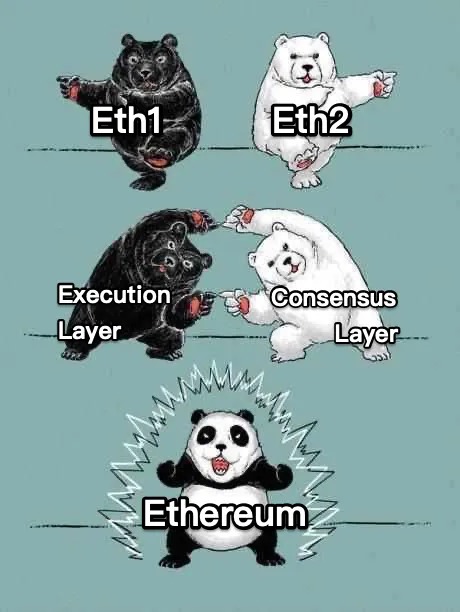
The Merge Panda meme
That’s how ethPandaOps was born—they were the powerful DevOps team behind The Merge, responsible for Ethereum network operations. They later adopted the name ethPandaOps.
Bruce:
Over recent years, the industry has seen significant volatility, along with so-called "Ethereum killers." During those times, did you ever feel down or question whether our work was valuable? How did you persevere through low moments?
Hsiao-Wei:
Sometimes blockchain technology is used for harmful purposes, giving the public a negative impression—leading many to associate crypto with speculation. For those of us in the space who care about technological progress, this is deeply saddening.
Luckily, my colleagues share similar values. Education matters too, though we can't instantly change public perception. Still, whenever positive things happen on blockchain or Ethereum, we aim to amplify them—that's where we can make a difference.
Bruce:
I’ve also noticed that being surrounded by builders makes a big difference. When feeling low, having a supportive group helps—you can collaborate, experiment, and gradually recover.
Hsiao-Wei:
Another point I’d emphasize is occasionally stepping outside the ivory tower to listen to criticism. I've been making more effort in that area recently.
Ethereum's Technical Roadmap and Future Development
Bruce:
We often see Vitalik publish an annual, complex roadmap filled with technical terms. Can you explain how the roadmap is designed, finalized, and executed? What’s the general process?
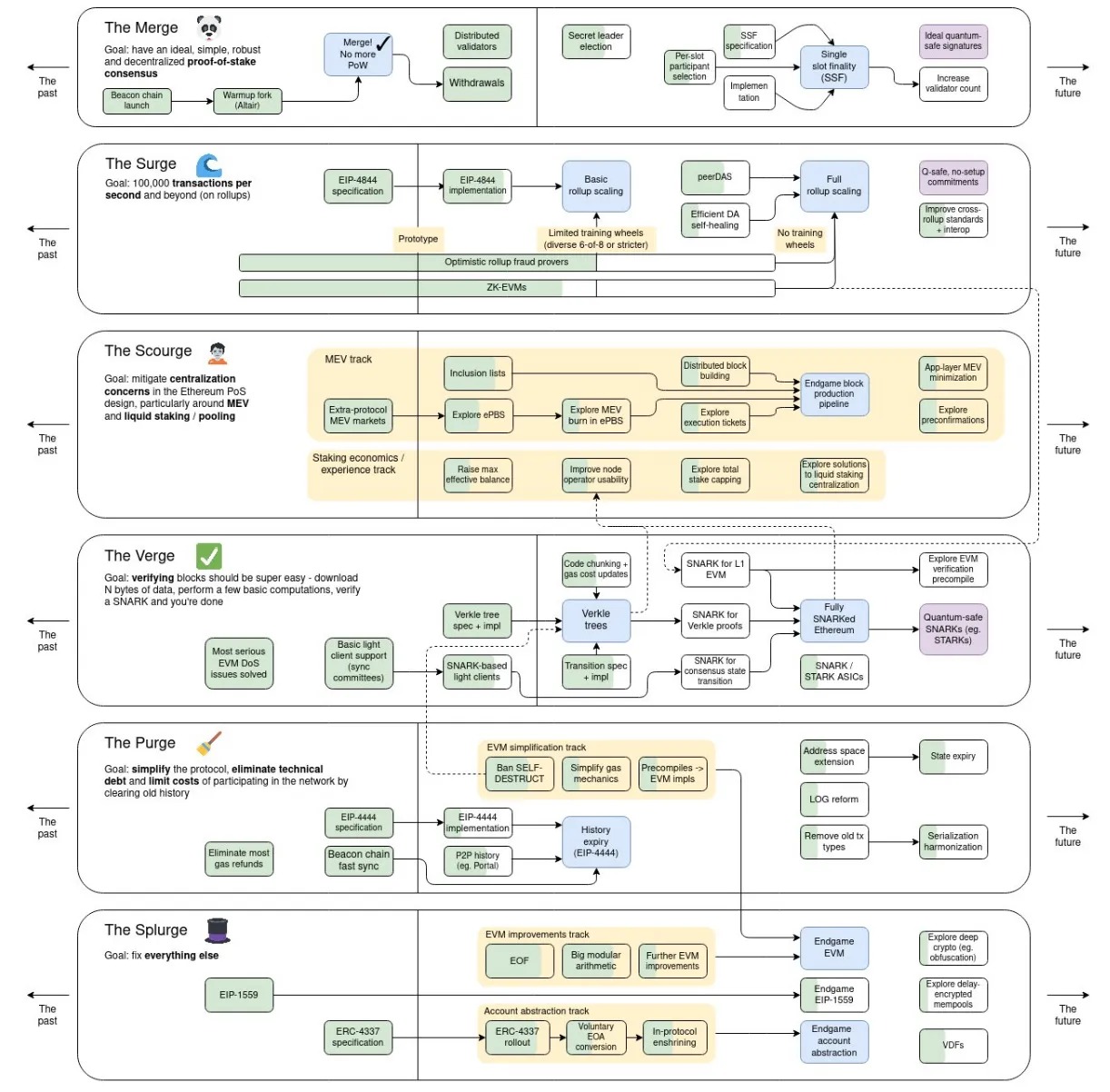
Vitalik’s Ethereum Roadmap in 2023
Hsiao-Wei:
Vitalik has published such diagrams for over three years. Last year, we nudged him to release one, but instead he wrote six articles titled Possible Futures of the Ethereum Protocol.
His technical roadmap serves as a high-level guide—he points toward a direction, then internally we might have Plans A, B, and C. Which one is most feasible becomes something developers and researchers explore each year. His input offers high-level vision and doubles as a channel for community communication. However, actual development direction is ultimately decided by Core Devs in the community. His diagrams are simple, meant to spark researcher thinking. Then different implementation options emerge.
Many EIPs exist for 3–5 years before being implemented on-chain. Proposals take time to gain traction. Some, like EIP-7702, may be adopted relatively late.
Ethereum’s GitHub hosts an EIP repository. Anyone can submit an EIP using a template, detailing specific protocol changes. Once a proposal gains attention and reviews, it may be discussed in ACD (All Core Devs weekly meetings), where client developers and researchers debate it.
Typically, someone strongly supporting the EIP presents it at the meeting, gathering feedback and signals from others. High visibility increases adoption chances. From submission to ACD discussion, then final EIP inclusion meetings—the process continues. Last month, with Pectra nearing its early May hard fork, teams have already begun planning the next upgrade.
When an EIP is likely to be adopted, we tag it “CFI” (Consider for Inclusion), signaling stronger intent and drawing industry attention.
In short: Vitalik broadly sets direction without specifying details. Researchers advance work within those directions. Anyone can propose changes via EIPs, refine them through ACD meetings and community feedback, finalize the EIP, publish it, then client teams begin development for launch at a scheduled time.
Hsiao-Wei:
Historically, EF members primarily organize ACD. EF also reflects on how much leadership is needed. Each hard fork differs. For Pectra, core devs had various user-driven proposals, resulting in a broad scope. For Fusaka, consensus centered on needing PeerDAS—clearer alignment simplified coordination. Each upgrade requires different coordination approaches.
Bruce:
This process is fascinating—it’s not like corporate operations, but driven collectively by the entire community for impactful upgrades. You expect Pectra to launch in May—what practical changes will it bring? Which EIPs are you most excited about?
Hsiao-Wei:
Each EIP serves distinct purposes, but EIP-7702 will most impact developers and applications. It allows setting code for your existing EOA address—if previously empty, you can assign new behavior. This unlocks broad design possibilities. We hope this enables new account abstraction designs, paving a wide path forward. Whether designing AA contracts on Layer 1 or Layer 2, many options open up.
The Ethereum Foundation is actively negotiating an industry-wide standard. Of course, this is interesting—we want more designs and innovation—but we also hope everyone uses secure contracts.
Bruce:
I’ve been looking into EIP-7702 recently—the design space is huge. Previously separate pop-ups could now be batched into one transaction, including gas fees and sponsorship payments. But I also worry extreme flexibility may introduce security risks. What are your thoughts, and how can we better protect security?
Hsiao-Wei:
First, AA contracts must undergo full audits. The Foundation provides implementation examples to increase trust in these contracts. Many wallet teams are working on integrating this functionality.
Bruce:
Scaling Ethereum has long been a topic. We frequently hear terms like sharding and ZK. From your perspective, could you briefly explain concepts like ZK rollups and sharding, key ongoing work, and main challenges?
Hsiao-Wei:
Sharding originates from database design. Earlier designs envisioned an open mainchain with shard chains underneath. But now we follow a rollup-centric roadmap—not downward, but upward, toward Layer 2. Thus, both sharding and ZK rollups help scale Layer 1 development. Recently, our focus is increasing blob counts. Blobs form Ethereum’s data layer—once enhanced, Layer 2 can regularly submit hash values to Layer 1 more frequently.
Scaling Layer 1 thus also benefits Layer 2—multiplying overall Ethereum throughput.
Bruce:
What are the main challenges? Any ways to accelerate development?
Hsiao-Wei:
Currently, the main goal is testing—we have many clients. Cryptographic algorithm design is mostly complete, but networking remains an engineering challenge requiring more testing and parameter tuning. An individual client may test fine internally, but interoperability issues may arise. So regular testing is critical. Occasionally spending time on testnets helps a lot.
Ethereum Ecosystem, Applications, and Community Growth
Bruce:
The Ethereum ecosystem includes more than just the protocol layer—it spans applications and communities. Which applications do you think have breakout potential? Any observations or thoughts?
Hsiao-Wei:
I find identity and SocialFi designs particularly interesting. Recently, mini-apps on Farcaster caught my eye. Seeing friends play games or use apps lets you instantly share them on social platforms. These lightweight apps easily integrate into daily life, though breakout success may still take time. Innovations here could quickly attract user bases.
For larger projects, financial design innovations over the next one to two years could be exciting—partly DeFi, partly RWA, which has recently gained momentum and fits within application scope.
Bruce:
Ethereum communities are often formed organically by local enthusiasts and volunteers. But manpower and funding aren’t always stable. From your view, are there more robust, sustainable models for communities? Have you seen good examples?
Hsiao-Wei:
I’m also a co-founder of Taipei Seminar and ETHTaipei. Many Taiwanese community members come from open-source backgrounds—some involved in Python PyCon or other open-source software communities. Many want to apply open-source principles to Ethereum.
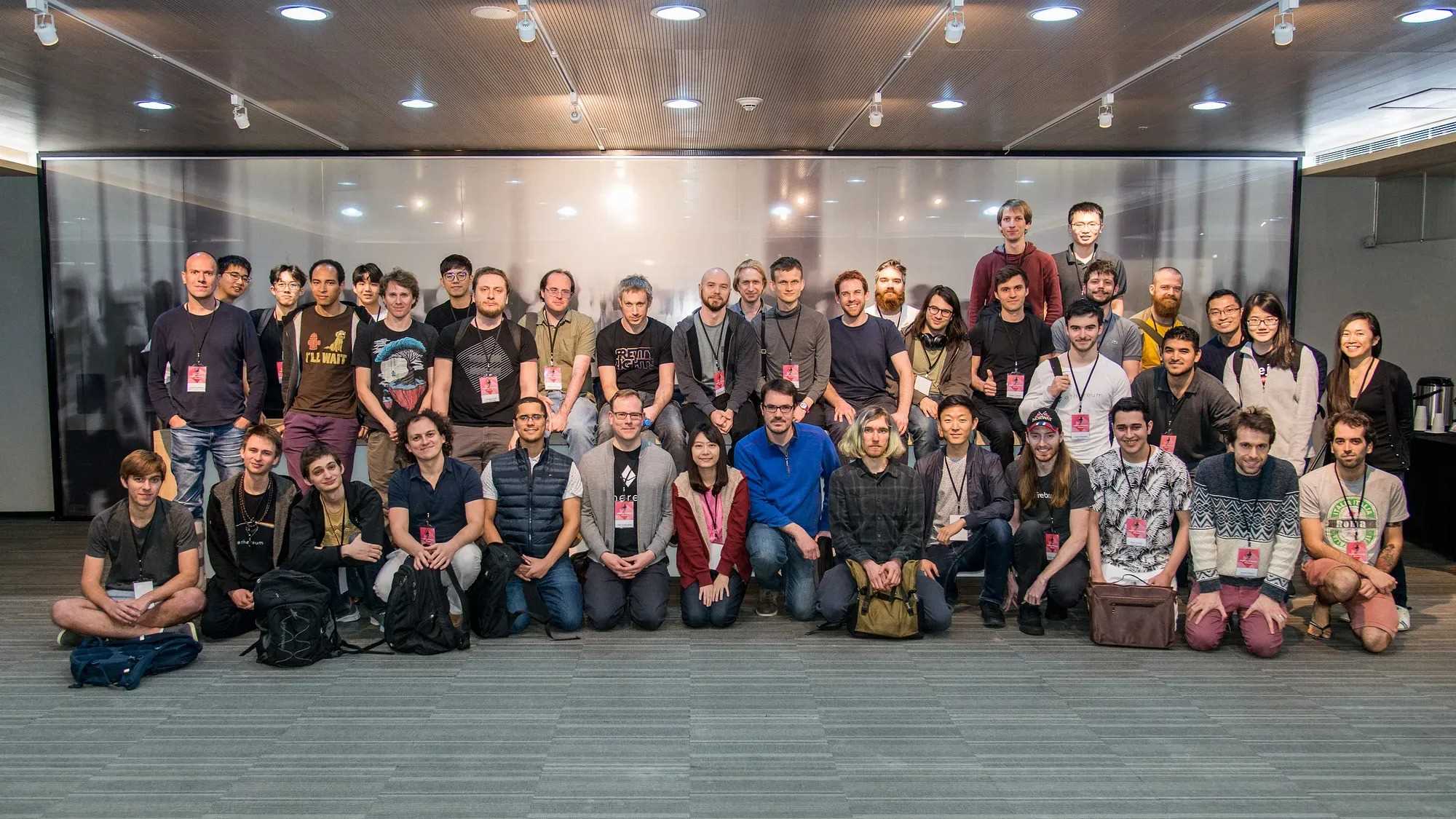
March 19–21, 2018 Ethereum Sharding Workshop in Taipei
In Taiwan, people are comfortable contributing to public goods. We work daytime jobs, then gather evenings to dig trenches, fix bugs, and build.
But sustaining this model requires onboarding newcomers. How do you pass on this spirit? Continuous onboarding is crucial.
In open-source communities, no one owns the project entirely—everyone contributes bits. If no one steps up, it becomes your responsibility. Without an open-source culture, this model may not thrive elsewhere.
Chinese-speaking regions host many creative initiatives, each with unique styles. Taiwan’s smaller size means overlapping contributors—less diversity than larger regions, where grassroots efforts sprout rapidly. That’s great too.
Bruce:
Speaking of diverse communities—you’ve helped grow Ethereum communities since 2018, including ETHTaipei. What advantages or challenges do Asian developer communities face? What role do we play in the global Ethereum system?
Hsiao-Wei:
Asian developers include many talented individuals. Our strength lies in product development and user experience. Europe and North America may have longer histories researching Ethereum. Cultural differences sometimes appear. Preserving regional characteristics is important, and better communication would help. Since Ethereum aims to be a world computer serving global users and developers, bridging cultural gaps through dialogue is essential.
Bruce:
I agree—Asia-Pacific has vast populations with cultural similarities. We naturally bring more experience in UX and applications. Looking broadly, what areas related to community work lack support or initiative? Where are underdeveloped or blank spaces we should push to improve the overall Ethereum ecosystem?
Hsiao-Wei:
Recently, AI has made accessing English content easier, reducing language barriers. Thanks to ETHPanda for immediately sharing Chinese summaries on Twitter—very responsive. Yet I suspect demand for translation may decline as more benefit from AI tools. What we really need is injecting fresh talent. After seven years, I’m practically a veteran. How do we onboard more newcomers? Student communities are key targets for outreach.
Work at the Ethereum Foundation
Bruce:
You now serve as co-executive director at the Ethereum Foundation. How has your daily work changed moving from researcher to executive director? What new challenges have emerged?
Hsiao-Wei:
Adapting to faster pace is necessary. My prior focus was mainly on Consensus Specs. I even thought I’d still review PRs casually. But within a month, priorities shifted entirely toward management. Staying closely aware of latest research developments is now vital. Challenges come from all directions.
I feel honored and grateful to co-lead with Tomasz. He actively gathers community feedback and translates it into broader EF strategy. On this challenging journey, I don’t feel alone.
Bruce:
I’ve noticed too—Tomasz often tweets inviting people to reach out. I once messaged him and the next day he organized a call with EF colleagues. It’s a positive shift.
In the past quarter—or recent months—EF has made frequent organizational and personnel adjustments, including non-EF entities like Etherealize or new external organizations forming, enriching our ecosystem. Could you explain the background and goals behind these changes?
Hsiao-Wei:
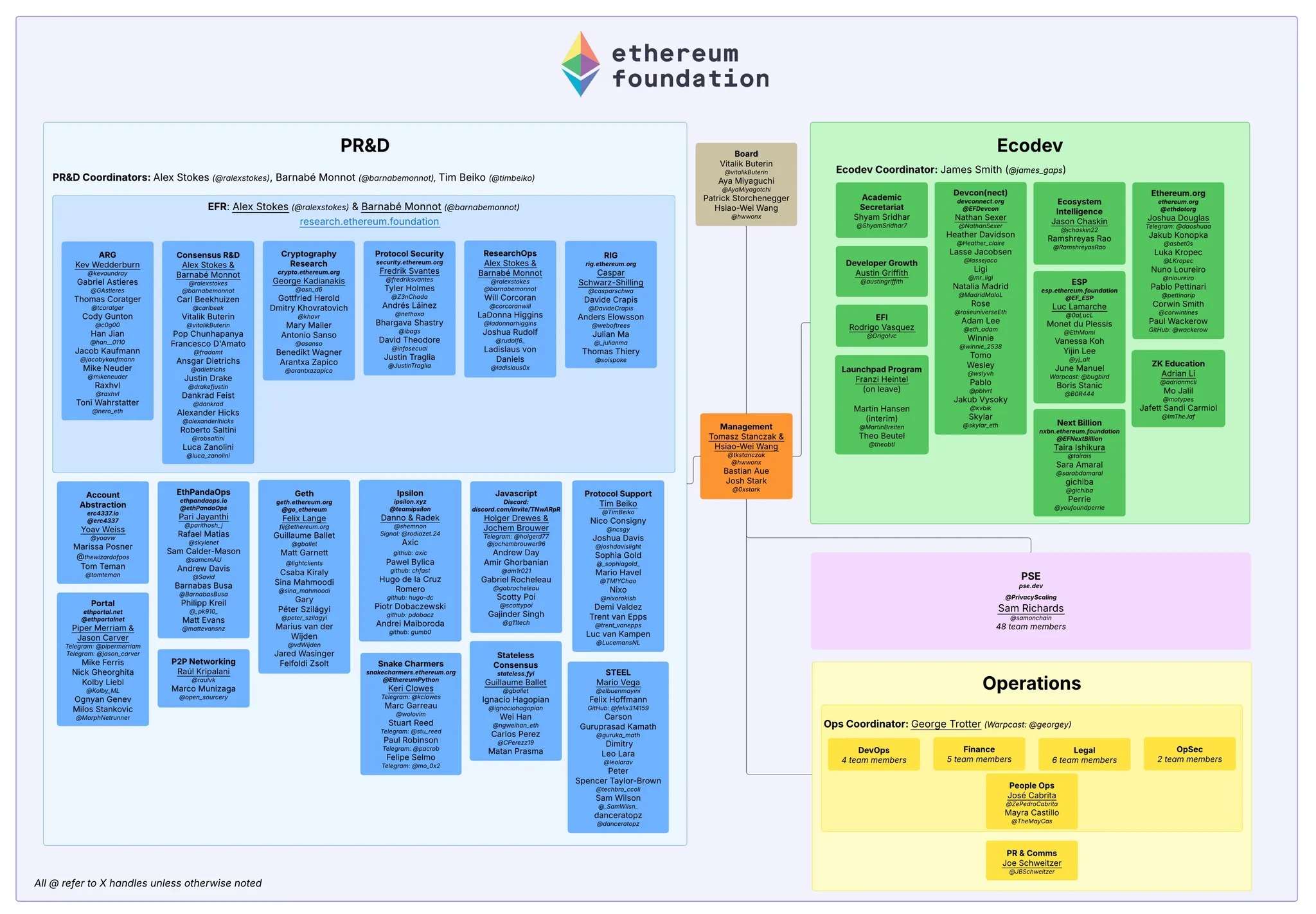
Let me outline EF’s general structure. First, there’s the Board of Directors, then the Management Team, followed by three loosely defined operational clusters. The first is Operations—Finance, HR, Legal—essential for running any foundation. The second is Development. After recent spin-offs, this cluster now focuses primarily on protocol R&D, including the Research Team. The third is Eco Dev—ecosystem development—covering grant programs like ESP and Next Billion Fellowship.
Bruce:
Could you briefly introduce EF’s external-facing organizations, such as Etherealize?
Hsiao-Wei:
If I recall correctly, Etherealize was established last year. The Foundation and Vitalik provided modest early support. Based in the U.S., they focus on Wall Street engagement. Their formation reflects shifting geopolitical attitudes toward crypto. They can operate in spaces EF might not directly enter, performing tasks highly beneficial to us. Their BD efforts better engage U.S. users and traditional finance or large enterprises. This expansion is very positive.
Bruce:
From what you said, EF doesn’t have a dedicated marketing team, right?
Hsiao-Wei:
Correct—we only handle communications. **As Josh Stark said, Ethereum doesn’t have a BD team; Ethereum has one hundred BD teams.** Application-layer teams—whether Layer 2 or Dapps—with their own BD units, effectively act as our extended BD network.
We don’t treat Ethereum as a proprietary brand. For example, on Twitter, we recently split accounts. Since年初, there’s now an Ethereum account and a separate Ethereum Foundation account.
I think the separation works well. Previously, using the Ethereum account felt overly restrictive—every post seemed to represent the Foundation’s official stance. Now, the Ethereum account handles quasi-BD activities, promoting major events and helping the community stay informed. Both accounts now serve distinct, useful roles.
Bruce:
This greatly aids our work. The official Ethereum account is a reliable source for translated content, providing timely updates and improving community outreach.
You mentioned ESP earlier—it’s played a key role in ecosystem growth. With the new structure, has EF’s budget allocation changed? Are there shifts in ESP’s focus areas?
Hsiao-Wei:
As mentioned, we have Eco Dev, Development, and other departments. Leads within dev and research teams now manage larger grants independently. ESP and other Eco Dev teams cover remaining areas. Major focus areas include AGR—not part of ESP internally, but somewhat linked—supporting academic research with annual grants. This year’s applications have closed and are under review.
Other areas: ESP essentially acts as our front-facing intake channel for inbound requests. Their selection scope is broad—no fixed budgets per event, nor rigid definitions.
EF support isn’t always monetary. Sometimes, the Foundation’s Shout Out (public endorsement) matters most.
When deciding whether to fund an event, we don’t just consider direct user acquisition. Instead, we assess broader impact: which grants create meaningful influence? Which events or projects require EF’s unique support and deliver valuable public goods?
Bruce:
To summarize: events or projects EF supports are often ones only EF would back—and the outputs are genuinely needed.
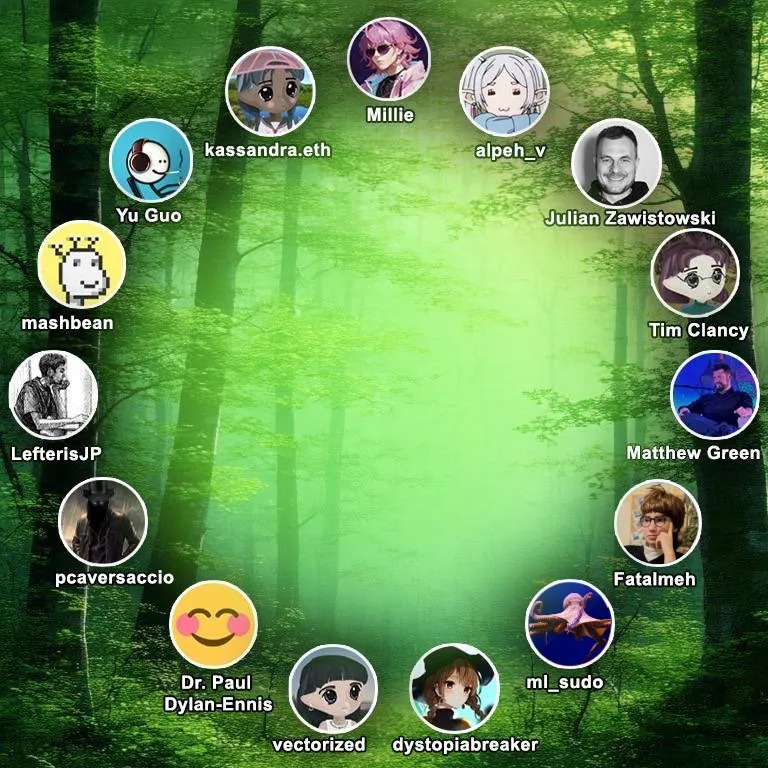
I’ve also noticed EF involving more external organizations in decision-making—like the Silviculture Society (The EF Silviculture Society) recently?
Hsiao-Wei:
They’re like an advisory council. We selected public-interest-focused advisers across fields. We’re deeply grateful. They embody cypherpunk values, emphasizing security and privacy.
If Ethereum were a business, business advisers would give us abundant input. But how do we better listen to the community? That’s precisely why this council exists.
Additionally, we’ve recently sought opinions from DeFi experts. EF has hosted many Twitter Spaces engaging Layer 2 interoperability teams and successful Dapp projects. External project leads also present seminars internally. These channels help us gather expert insights and community feedback.
Bruce:
Some suggest EF generate revenue through DeFi instead of publicly selling ETH. How do you view EF’s treasury model? What potential revenue streams ensure long-term sustainability?
Hsiao-Wei:
This year, EF began actively participating in DeFi. In early February, we deployed initial positions, experimenting with ETH lending in DeFi. Phase two is already planned. We’re evaluating whether to scale lending or explore more creative ETH asset utilization. The second major area is staking—we’re exploring various staking options and assessing whether EF participation generates positive effects. Third, we’re exploring tokenization, such as involvement in RWA. Our approach focuses on conservative funds or those beneficial to L1.
Bruce:
So there are many new experiments underway. Some community members react to occasional sales of 100 ETH—though negligible market impact, it affects sentiment. What’s EF’s internal view on this?
Hsiao-Wei:
How to say it—we have to sell. Currently EF has 200–300 staff. About 75% of expenses require fiat, 25% crypto. First, EF needs to operate, requiring asset rebalancing.
Second, the community may not fully understand this need—we’ll improve communication. Also, we don’t always sell at peaks. People assume we time the market, but often we sell at lows. These aren’t highlighted, and we don’t strategize timing.
Bruce:
Some suggest OTC or more discreet methods. What’s your take?
Hsiao-Wei:
Our main treasury is highly transparent. Short-term discretion might work, but major treasury movements remain visible to all.
Bruce:
Regarding EF’s role, some speculate EF may gradually fade or dissolve after fulfilling its mission, letting the community drive Ethereum. What’s your view? If that day comes, how would you ideally see the Ethereum community operate?
Hsiao-Wei:
First, this year is especially important for EF—we’re investing heavily in organizational transformation. Next year, if more community entities emerge capable of replacing EF roles, we could operate conservatively and shrink. Interestingly, we revise our strategy annually—each year’s focus may differ. When focusing on protocol, EF’s presence feels stronger.
Perhaps when future focus shifts to application layers or wallets, we won’t need such visibility—our footprint may naturally vary yearly. **Personally, I hope EF constantly asks: how can we enable others to do what we do today?** Tasks only we can perform, we’ll keep doing—like coordination, dependent on evolving factors and community support. If the community excels, EF can shift toward more complex or neglected areas.
Bruce:
We’re nearing the end. We’ve covered personal journeys, technical roadmaps, communities, and EF’s work. Let’s close with lighter topics. Our audience includes students and young developers. As an Ethereum “veteran,” what advice do you have for newcomers or those considering joining?
Hsiao-Wei:
**Many say choice matters more than effort—I’d add: choose places where you gain more choices.** Ethereum has a massive, vibrant community. Pioneering developers have already laid paths. Newcomers—whether developers, educators, product builders, or users—can find mentors in the community to expand your options.
Bruce :
Recommend books or resources helpful for Web3 thinking or personal growth.
Hsiao-Wei:
I often read Vitalik’s blog posts. If your thinking level is 2, try reading those at level 4—people whose depth squares yours.
Recently, I’ve also read management books. One titled Principles outlines high-level guidelines. Its key lesson: build your own principles. His may not fit me exactly, but the act of establishing principles simplifies future decisions—if you follow them, actions become clearer.
Bruce :
Outside work, do you have favorite sports or leisure activities?
Hsiao-Wei:
I’m quite homebound—mostly watching TV shows and playing chess, all sedentary activities. Lately, leisure time has shrunk significantly due to workload.
Bruce:
Thank you, Hsiao-Wei, for sharing today—your insights were thoughtful and profound. Thanks to all viewers and listeners of this ETHPanda Talk. Special thanks to Hashkey for providing a free venue. If you enjoy our content, please follow and share. See you next time!
Join TechFlow official community to stay tuned
Telegram:https://t.me/TechFlowDaily
X (Twitter):https://x.com/TechFlowPost
X (Twitter) EN:https://x.com/BlockFlow_News
 @ETHPanda_Org